In this volume, Jan Susina examines the importance of Lewis Carroll and his popular Alice books to the field of children's literature. From a study of Carroll's juvenilia to contemporary multimedia adaptations of Wonderland, Susina shows how the Alice books fit into the tradition of literary fairy tales and continue to influence children's writers. In addition to examining Carroll's books for children, these essays also explore his photographs of children, his letters to children, his ill-fated attempt to write for a dual audience of children and adults, and his lasting contributions to publishing. The book addresses the important, but overlooked facet of Carroll's career as an astute entrepreneur who carefully developed an extensive Alice industry of books and non-book items based on the success of Wonderland, while rigorously defending his reputation as the originator of his distinctive style of children's stories.
- 232 pages
- English
- ePUB (mobile friendly)
- Available on iOS & Android
eBook - ePub
The Place of Lewis Carroll in Children's Literature
About this book
Information
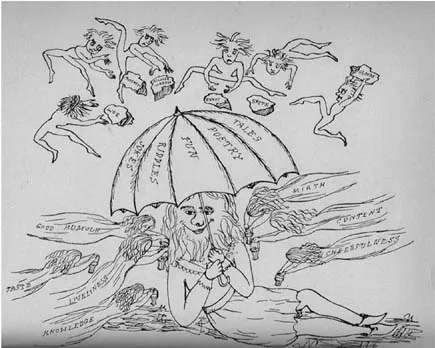
Figure 1.1 Lewis Carroll's illustration from The Rectory Umbrella (1849–1850), which was one of the many family magazines that he created.
Chapter One
“Respiciendo prudens”: Lewis Carroll's Juvenilia
Long before he adopted his famous pseudonym of Lewis Carroll, Charles Lutwidge Dodgson began his writing career entertaining his family. Readers of Alice's Adventures in Wonderland (1865) may be unaware that the book resulted from an earlier manuscript. Carroll composed the manuscript Alice's Adventures Underground (1863) for Alice Liddell and her sisters, who were children of an Oxford University don. They had requested he record the story that he had told them during the memorable boat trip in Oxford on 4 July 1862.1 But, Carroll's apprenticeship as a children's author began much earlier when he was still a child. Seventeen years before Wonderland, Carroll began a series of remarkable family magazines that he wrote and edited beginning when was thirteen years old, between 1845 and 1862. Four of Carroll's magazines—Useful and Instructive Poetry, The Rectory Magazine, The Rectory Umbrella, and Mischmasch—have been preserved and reprinted. But beyond acknowledging their existence, few critics besides Jean Gattegno have bothered to examine the family publications that were so instrumental in Carroll's development as a writer. Yet, these early works are the fertile soil from which his later, and best-known, children's books grew.
Stuart Dodgson Collingwood, Carroll's nephew and his first biographer, observed that Carroll amused himself during school breaks by editing local magazines, local in that “their circulation was confined to the inmates of the Croft Rectory.”2 Carroll's father was appointed Rector in the village of Crofts in 1843 and the Crofts Rectory continued to be the family home until the death of his father in 1868. The final entry in The Rectory Umbrella is “The Poet's Farewell,” in which Carroll presents an epic list of his previous literary projects:
First in age, but not in merit,
Stands the Rectr'y Magazine,
All its wit thou dost inherit,
Though the Comet came between.
Novelty was in its favour,
And mellifluous its lays,
All, with eager plaudits, gave a
Vote of honour in its praise.
Next in order comes the Comet,
Like some vague and feverish dream,
Gladly, gladly turn I from it,
To behold thy rising beam!
When I first began to edit,
In the Rect'ry Magazine,
Each one wrote therein who read it,
Each one read who wrote therein.
When the Comet next I started,
They grew lazy as a drone:
Gradually all departed,
Leaving me to write alone.
But in thee—let future ages
Mark the fact which I record,
No one helped in thy pages,
Even with a single word!3
In the 13 August 1855 preface to Mischmasch, which was the last of his private publications, Carroll, who was twenty-three years old at the time, provides what he terms “a brief history of our former domestic magazines in this family, their origin, aim, progress, and ultimate fate.”4 Carroll lists and evaluates the eight family publications that constitute the body of his youthful oeuvre: Useful and Instructive Poetry, The Rectory Magazine, The Comet, The Rosebud, The Star, The Will-O'-Wisp, The Rectory Umbrella, and Mischmasch.
As the final publication in Carroll's stage as an apprentice writer, Mischmasch, a collection of material dated 1855 to 1862, is altogether different in form and content from his other earlier, literary attempts. Mischmasch is not so much the work of a child as it is a transitional work composed by a talented Oxford University undergraduate in his early twenties. Carroll then reworked and recycled bits and pieces of his earlier writing to produce his first publications outside the confines of writings for his family. This early example of Carroll's constant revising is a precursor to his multiple versions of Wonderland, which will be discussed in Chapter 4. Carroll's interest in collecting and his continuing recycling bits and pieces of previous text would become the process for composing Sylvie and Bruno (1889), which will be discussed in Chapter 9. As the title of the publication suggests, Mischmasch is more of a compilation, scrapbook, or “hodge-podge,” which Carroll gives as the English equivalent for the German phrase.5 Still, the format of this college publication is highly reminiscent of those earlier childhood magazines. He was no longer satisfied with simply publishing in “local” family magazines and suggests as much in his evaluation of Mischmasch, in which he writes, “The best of its contents will be offered at intervals to a contemporary magazine of less exclusively domestic nature: we allude to the ‘Comic Times’.”6 His statement also reveals that he saw his juvenilia as a continuing process he envisioned would mature into writing that would become his proper adult work.
In reviewing Carroll's juvenilia, it becomes apparent that these publications are part of an organic unity in Carroll's literary development as a writer for children. By the period of Mischmasch, Carroll desired to reach a readership beyond that of his immediate family. The same impulse to reach a wider readership beyond the initial one would be repeated when Carroll revised Underground into Wonderland.
As early as 1845, thirteen-year-old Carroll expressed his aspiration to become a successful children's author in the second of his family publications, The Rectory Magazine. In “Reasonings on Rubbish,” the editorial that opens the magazine's first issue, he either over confidently or ironically, and not without a bit of childish exaggeration, looks forward to the day when, “the Rectory Magazine shall draw from admiring thousands their unanimous and uncalled for plaudits! when it shall become one of the staple and essential portions of the literature of England.”7 While The Rectory Magazine never realized such recognition, Carroll's youthful ambition to become an essential part of English literature has been achieved with Wonderland and Through the Looking-Glass (1871); these now classic texts owe some of their comic spirit to his earlier attempts at writing for children.
The manuscript of the earliest magazine, Useful and Instructive Poetry was composed in 1845.8 The dating of this and the other Carroll juvenilia is less than exact; Carroll records in his “Preface” that Useful and Instructive Poetry was written “about the year 1845,”9 The Comet started “about the year 1848,” and The Rectory Umbrella began “we believe, in 1849 or 1850.”10 Although The Rectory Magazine is dated 1850, the cover carries the inscription “Fifth Edition, carefully revised and improved.” Carroll's second family publication, The Rectory Magazine, was also written in 1845.11 The Rectory Umbrella, (1849–50), his seventh magazine, was produced when Carroll was seventeen and eighteen years old. Mischmasch, (1855–1862), Carroll's final family publication, was compiled when he was in his twenties.12
In his diary entry for 18 July 1885, years after the success of Wonderland and Looking-Glass, Carroll mentions the possibility of publishing The Rectory Umbrella in facsimile,13 although nothing came of this project. In his list of fifteen literary projects noted in the 29 March 1885 diary entry, number eleven is the publication of the facsimile of Under Ground, which was completed in 1886.14 These entries suggest Carroll believed there was enough merit in his early works to justify their publication. The limited sales of the facsimile of Under Ground may have been the primary reason the publication of The Rectory Umbrella was not pursued.
In his account of his family publications in Mischmasch, Carroll reports, “we shall notice, as we go on, the other magazines which have appeared, but not under own editorship.”15 This suggests that, although he was the prime instigator of such activities, other family members participated as contributors as well as editors. The listing of the “Names of the Authors and with their assumed initials” in The Rectory Magazine includes seven contributors besides Carroll.16 Carroll composed the majority of the work found in The Rectory Magazine and subsequent family magazines. It is worth noting that the work of C.L.D. (Charles Lutwidge Dodgson) in The Rectory Magazine is found under six different initials that appear in the publication's list of contributors. Even at the age of thirteen, Carroll showed a penchant for literary pseudonyms and multiple personalities.
Unlike The Rectory Magazine, Useful and Instructive Poetry was a single-author project written for the amusement of his seven-year-old brother, Wilfred Longley Dodgson, and his five-year-old sister, Louisa Fletcher Dodgson, whose initials appear on the title page. The Rectory Magazine was conceived as a household magazine; the dedication page addresses itself to “the Rectory, Croft and especially the younger members of that house.”17 Carroll actively solicited contributions for The Rectory Magazine from other members of his family, and recounts in Mischmasch that its publication “was attended by the most violent excitement through the whole house: most of the family contributed one or more articles to it.”18 Both Wilfred and Louisa, his brother and sister, contributed selections to The Rectory Magazine, as did his friends Elizabeth Lucy, Caroline Hume, Mary Charlotte, and Skeffington Hume. Yet in “Rust,” the editorial in the fourth issue, Carroll laments, “We opened our Editor's box this morning, expecting of course to finding it overflowing with contributions but found it—our pen shudders and our ink blushes as we write—empty!”19 In the introduction to the facsimile editio...
Table of contents
- Cover
- Half Title
- Full Title
- Copyright
- Dedication
- Contents
- List of Figures
- Series Editor's Foreword
- Acknowledgments
- Introduction
- 1 “Respiciendo prudens”: Lewis Carroll's Juvenilia
- 2 Lewis Carroll and the Literary Fairy Tale
- 3 The Play of Letters in Lewis Carroll's Alice Books: Ravens and Writing-Desks
- 4 Multiple Wonderlands: Lewis Carroll and the Creation of the Alice Industry
- 5 Imitations of Alice: Lewis Carroll and the Anxiety of Influence
- 6 Too Gaudy or Not Gaudy Enough: Lewis Carroll's The Nursery “Alice”
- 7 The Beggar-Maid: Alice Liddell as Street Arab
- 8 Coffee or Tea: The Two Nations of Victorian Children's Literature
- 9 “To Strike Out Yet Another New Path”: Cross-Writing and Boundary-Crossing in Lewis Carroll's Sylvie and Bruno
- 10 Alice in Consumerland: The Marketing of a Children's Classic to Contemporary Readers
- 11 Cyber Alice: Wonderland as Hypertext
- 12 Show Me, Don't (Re)Tell Me: Jon Scieszka Revises Wonderland
- Afterword
- Appendix
- Notes
- Bibliography
- Index
Trusted by 375,005 students
Access to over 1.5 million titles for a fair monthly price.
Study more efficiently using our study tools.
Frequently asked questions
Yes, you can cancel anytime from the Subscription tab in your account settings on the Perlego website. Your subscription will stay active until the end of your current billing period. Learn how to cancel your subscription
No, books cannot be downloaded as external files, such as PDFs, for use outside of Perlego. However, you can download books within the Perlego app for offline reading on mobile or tablet. Learn how to download books offline
Perlego offers two plans: Essential and Complete
- Essential is ideal for learners and professionals who enjoy exploring a wide range of subjects. Access the Essential Library with 800,000+ trusted titles and best-sellers across business, personal growth, and the humanities. Includes unlimited reading time and Standard Read Aloud voice.
- Complete: Perfect for advanced learners and researchers needing full, unrestricted access. Unlock 1.5M+ books across hundreds of subjects, including academic and specialized titles. The Complete Plan also includes advanced features like Premium Read Aloud and Research Assistant.
We are an online textbook subscription service, where you can get access to an entire online library for less than the price of a single book per month. With over 1.5 million books across 990+ topics, we’ve got you covered! Learn about our mission
Look out for the read-aloud symbol on your next book to see if you can listen to it. The read-aloud tool reads text aloud for you, highlighting the text as it is being read. You can pause it, speed it up and slow it down. Learn more about Read Aloud
Yes! You can use the Perlego app on both iOS and Android devices to read anytime, anywhere — even offline. Perfect for commutes or when you’re on the go.
Please note we cannot support devices running on iOS 13 and Android 7 or earlier. Learn more about using the app
Please note we cannot support devices running on iOS 13 and Android 7 or earlier. Learn more about using the app
Yes, you can access The Place of Lewis Carroll in Children's Literature by Jan Susina in PDF and/or ePUB format, as well as other popular books in Literature & English Literary Criticism. We have over 1.5 million books available in our catalogue for you to explore.