The Regulation of Animal Health and Welfare draws on the research of scientists, lawyers, economists and political scientists to address the current and future regulatory problems posed by the issues of animal health and disease. Recent events such as the outbreak of mad cow disease, epidemics of foot and mouth disease, concerns about bluetongue in sheep, and the entry into the food chain of the offspring of cloned cattle, have heightened awareness of the issues of regulation in animal disease and welfare. This book critically appraises the existing regulatory institutions and guiding principles of how best to maintain animal health in the context of social change and a developing global economy. Addressing considerations of sound science, the role of risk management, and the allocation of responsibilities, it also takes up the theoretical and practical challenges which here – and elsewhere – attend the co-operation of scientists, social scientists, lawyers and policy makers. Indeed, the collaboration of scientists and social scientists in determined and regulatory contexts such as that of animal disease is an issue of ever-increasing importance. This book will be of considerable value to those with interests in this issue, as well as those concerned with the law and policy relating to animal health and welfare.
eBook - ePub
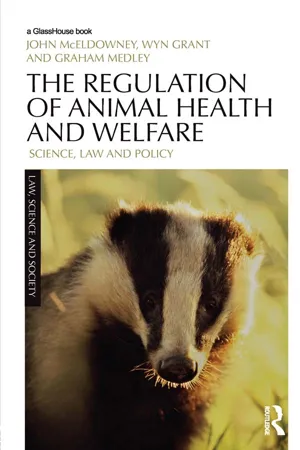
The Regulation of Animal Health and Welfare
Science, Law and Policy
- 190 pages
- English
- ePUB (mobile friendly)
- Available on iOS & Android
eBook - ePub
The Regulation of Animal Health and Welfare
Science, Law and Policy
About this book
Information
1 Introduction
Introduction
The subject of this book is the governance of disease in farmed livestock, which can be considered as anything that affects an animal's well being and welfare.1 Generally, there are considerable differences between the management of infectious and non-infectious diseases. Infectious diseases are caused by pathogens (prions, viruses, bacteria, prions, parasites) that change their behaviour over time, in terms of patterns of transmission, and can alter genetically (e.g. the emergence of resistance to drugs). The recent outbreak of the Schmallenberg virus2 previously unseen in the UK, which causes disease in sheep, cattle and goats, is a good example of the changing nature of the disease threat. Pathogens may be specific to one livestock species or may affect many species. Non-infectious diseases are caused by the management of the animal, for example poor physical resources, such as lying on hard concrete surfaces, which causes foot and limb injuries in all livestock species kept in such conditions, or poor diet, leading to deficiencies that cause metabolic disease. In this book, we concentrate on infectious endemic disease, although we believe that many of the insights are also relevant to non-infectious disease. Infectious epidemic (or exotic) diseases, such as foot and mouth disease (FMD), or emerging zoonotic diseases are used principally as comparisons, and we do not consider those directly. There is a considerable literature (both scientific and government reports) already relating to the FMD epidemics of 20013 and 2007,4 the bovine spongiform encephalopathy (BSE) epidemic5 and bluetongue.6
As we shall see, the importance placed on a particular disease largely depends on who is setting the agenda. Considerations include the need to protect public health, to promote the welfare of animals and to address wider issues, such as international trade matters and the impact on the wider economy, environment and society. Setting priorities is made more complicated by the need to balance the interests of different stakeholders as well as the protection of the public interest.
The governance of animal diseases covers different regulatory approaches, and prevention and control measures, including cost sharing and responsibility. Governance arrangements must engage with various stakeholders – animal keepers, government, citizens and supermarkets. The financial crisis and public spending cuts raise difficult questions about the best way to allocate scarce resources to achieve satisfactory standards of animal health and welfare. Currently, the government bears the main cost of compensating farmers for animals compulsorily destroyed as a result of a notifiable disease outbreak. The 2001 FMD outbreak cost £6 billion to £9 billion and expenditure on bovine tuberculosis (bTB) in 2010/11 was £91 million. Public expenditure aside, animal disease may have a wider impact on public confidence. The BSE crisis in 1996 caused considerable public alarm and challenged the trust between government, the public and industry. Today, there is heightened concern of an increased threat of diseases amongst farmed animals in the UK. Climate change, the globalisation of trade and increased animal movements all have the potential to reduce the UK's capacity to control and prevent animal diseases.
One of the most significant developments in this area has been the setting up of the Animal Health and Welfare Board for England (AHWB)7 within Defra in November 2011. The AHWB has the policy role within Defra of reducing the risk and cost of animal disease and improving animal welfare. The setting up of the AHWB makes it an opportune moment to consider the health and welfare of farmed animals. It raises questions about how law and legal regulation can ultimately help to achieve changes in public attitudes and popular culture. Sound science, the role of risk management and the allocation of responsibilities amongst those best able to undertake them are also important. How farmers and industry engage in the policy-making process and how regulatory burdens are discharged are undergoing change. This is particularly important in the context of efficient and effective market solutions for developing a new partnership approach to animal health and welfare. Lastly, it is important to consider how the AHWB is accountable and responsible for its decisions.
The main geographical focus of the book is on England, although account is taken of Wales. Defra is the central government department, but responsibility in Wales, Scotland and Northern Ireland lies with the devolved administrations within a general the framework set by Defra. The book takes into account influences from the EU, such as the current Animal Health Strategy 2007–2013.8 This provides a broad approach to future policy making, including additional prioritisation of EU intervention, a modern and appropriate animal health framework, better prevention, surveillance and crisis preparedness; and reliance on science, innovation and research. Recently, an EU policy document on the protection and welfare of animals9 takes further steps in improving animal health and welfare throughout the Member States. Article 13 of the Treaty on the Functioning of the EU and affirmed by the Treaty of Lisbon has recognised the importance of animal welfare. Animals are regarded as ‘sentient beings’, a legal term that is associated with acknowledging that full regard must be given to the welfare requirements of animals while formulating EU policies. The application of the ordinary legislative procedure known as co-decision to agriculture and fisheries has resulted in greater transparency to decision making than in the past. There is likely to be a focus on food safety policy and consumers, which will need to be addressed by the farming community. There may also be a heated contest over scarce public finances with priorities being given to considerations such as food pricing rather than animal health and welfare considerations.
The book also addresses the general context in which animal health and welfare and the governance of endemic animal diseases is best considered. Almost €70 million annually is provided by the EU to support animal welfare, of which over 70 per cent goes to farmers in the form of welfare payments available from the EU Agricultural Fund for Rural Development.10 Matters to be addressed in the strategy are enforcement, the dissemination of information amongst stakeholders and simplification of principles applicable to animal welfare.
Examining how to achieve appropriate standards of animal health and welfare is well suited to the interdisciplinary study on the governance of diseases in farmed livestock undertaken for this book. Disease threats to UK livestock drive up costs, severely impact on farming communities and undermine confidence in agriculture, as well as having an impact on the general economy. The book adopts a methodological approach that attempts to bring together the findings through an interdisciplinary perspective. The aim is to bring a fresh perspective to the way science is examined by social scientists, including lawyers, and to the way scientists think of the context of their work. This is consistent with the increasing expectation upon scientists to make their findings known in public forums outside their own disciplines.11 It is also in line with the 1999 Modernising Government White Paper that ‘policy decisions should be based on sound evidence’.12 The common methodology is to examine the problems posed by animal health and disease using materials drawn from science, social science and relevant disciplines, in order to assess the operation of the regulations and control of diseases in the context of how issues of responsibility and cost sharing should be addressed. This orientation is pluralistic in style and content – it presents an applied view of science drawing on different disciplinary approaches that critically examine how science, law and policy address issues associated with animal health and welfare. It provides a useful case study of how different disciplines can be explained and developed, as well as how regulatory and policy issues can be managed in a sustainable way,13 and this is explained further in Chapter 3.
It is also noteworthy how, during the period of research for the book, there has been an increasing awareness amongst policy makers of the impact of climate change on animal diseases.14 Haskell and others15 have shown the link between climate change and animal disease. Climate change, as a result of global warming and increasingly competitive markets, significantly affects UK agriculture. The effects of climate change have been linked to the spread of various viruses, for example bluetongue which, since 1998, has spread across Europe killing up to 1 million sheep. Bluetongue has also been found in the UK but has, to date, been successfully rebuffed. Tracking climate changes and mitigating their effects will be an important part of risk assessment and the adoption of the precautionary principle. Climate change will also affect the availability of water and may change agricultural practices. Increased storm events will also have a potential impact. Animal health and welfare will be affected by the social, economic and environmental changes likely to be caused by climate change. In the UK it has proved particularly difficult to predict the effect of climate change, but extremes of weather – drought to flooding – are likely to create serious problems. However, the Meteorological Office struggles to predict short-term and longer-term change in the climate.
Making this study particularly relevant is the integration of different disciplines. This is the most effective way to provide analysis across distinct areas of expertise, ultimately encouraging the dissemination of information and more effective policy making. Relying on a small subset of specialists and a limited role for stakeholders' interests is unlikely to be effective in disease management. Decision making must be transparent and consider the range of interests if it is to be acceptable.
The role of science and scientists in collaboration with lawyers, economists and political scientists in reaching agreement on the criteria that should be considered by policy makers16 is a recurrent theme throughout the book. The conclusions draw together the strands of analysis across the various disciplines and are intended to set the agenda for future research in this area. For example, this study may inform the approach adopted by the government and the AHWB in England. As an influential regulatory body, the AHWB should address how different disciplines17 can best combine to promote effective control of animal diseases, protect animal health and improve regulation, as independent scientific information and its evaluation is crucial to its success. This sets a more general challenge18 to facilitate the collaboration necessary for an understanding of the evidence-led policy making based around sound science. Interdisciplinary work fostering collaboration provides mutual understanding of complex multi-faceted problems that policy makers and decision makers need to examine to ensure effective management of animal health and welfare.
First, we define what we mean by disease and discuss some biological and epidemiological characteristics that determine control. We go on to outline the management and regulation of animal diseases and what characterises appropriate regulation.19
Defining animal health and welfare in a multidisciplinary study: a biological and epidemiological approach to animal diseases
In a multidisciplinary study of this kind, the management and regulation of animal health and welfare must take account of the biological and epidemiological characteristics that determine disease control. How science informs the analysis that contributes to the management and governance of animal diseases is considered.
As already outlined, disease in farmed livestock can be thought of as anything that affects an animal's well being and welfare. Considerable differences exist between the management of different infectious agents, therefore a short explanation of the terms and concepts is required for an understanding of the book.
Infectious and non-infectious diseases
A fundamental difference between infectious and non-infectious diseases is that infectious diseases are transmitted between hosts and spread through populations via direct a...
Table of contents
- Cover
- Half Title
- Law, science and society
- Title Page
- Copyright Page
- Table of Contents
- List of contributors
- Preface
- Acknowledgements
- 1 Introduction
- 2 Historical and contemporary aspects of animal health and welfare
- 3 Combining disciplines
- 4 Understanding and assessing the risk management of animal health and welfare
- 5 Endemic diseases
- 6 Regulating animal health and welfare: law and economics in an era of fiscal uncertainty
- 7 Policy making and future regulatory strategy
- 8 Conclusions: animal health and welfare for the twenty-first century
- Bibliography
- Index
Trusted by 375,005 students
Access to over 1.5 million titles for a fair monthly price.
Study more efficiently using our study tools.
Frequently asked questions
Yes, you can cancel anytime from the Subscription tab in your account settings on the Perlego website. Your subscription will stay active until the end of your current billing period. Learn how to cancel your subscription
No, books cannot be downloaded as external files, such as PDFs, for use outside of Perlego. However, you can download books within the Perlego app for offline reading on mobile or tablet. Learn how to download books offline
Perlego offers two plans: Essential and Complete
- Essential is ideal for learners and professionals who enjoy exploring a wide range of subjects. Access the Essential Library with 800,000+ trusted titles and best-sellers across business, personal growth, and the humanities. Includes unlimited reading time and Standard Read Aloud voice.
- Complete: Perfect for advanced learners and researchers needing full, unrestricted access. Unlock 1.5M+ books across hundreds of subjects, including academic and specialized titles. The Complete Plan also includes advanced features like Premium Read Aloud and Research Assistant.
We are an online textbook subscription service, where you can get access to an entire online library for less than the price of a single book per month. With over 1.5 million books across 990+ topics, we’ve got you covered! Learn about our mission
Look out for the read-aloud symbol on your next book to see if you can listen to it. The read-aloud tool reads text aloud for you, highlighting the text as it is being read. You can pause it, speed it up and slow it down. Learn more about Read Aloud
Yes! You can use the Perlego app on both iOS and Android devices to read anytime, anywhere — even offline. Perfect for commutes or when you’re on the go.
Please note we cannot support devices running on iOS 13 and Android 7 or earlier. Learn more about using the app
Please note we cannot support devices running on iOS 13 and Android 7 or earlier. Learn more about using the app
Yes, you can access The Regulation of Animal Health and Welfare by John McEldowney,Wyn Grant,Graham Medley in PDF and/or ePUB format, as well as other popular books in Droit & Droit de l'environnement. We have over 1.5 million books available in our catalogue for you to explore.