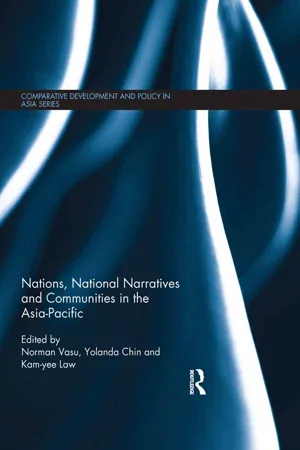
Many states in the Asia Pacific region are not built around a single homogenous people, but rather include many large, varied, different national groups. This book explores how states in the region attempt to develop commonality and a nation and the difficulties that arise. It discusses the consequences which ensue when competing narratives clash, and examines the nature of resistance to dominant narratives which arise. It considers the problems in a wide range of countries in the region including Indonesia, Malaysia, Singapore, Hong Kong, Korea, Australia and New Zealand.
eBook - ePub
Nations, National Narratives and Communities in the Asia-Pacific
- 218 pages
- English
- ePUB (mobile friendly)
- Available on iOS & Android
eBook - ePub
Nations, National Narratives and Communities in the Asia-Pacific
About this book
Information
Part I
Constructing commonality and the nation
1 Rethinking the who, what and when
Why not Singaporean military heroes?1
Singapore's national narrative, in its present form generally referred to as the Singapore Story, serves the nation building project by providing ‘the backdrop which makes sense of [Singapore's] present … showing what external dangers to watch out for, and where our domestic fault lines lie’.2
Although ‘not history for its own sake’,3 this national narrative is still written by utilizing the historian's basic questions of who, what and when to explain Singapore's success against vast odds.4 The answers are typically derived from a small pool of historically significant ‘great men’ (and women) who acted with distinction and agency during earlier events of political flux or dramatic crisis. The bulk of ‘The Singapore Story – Overcoming the Odds’, a multi-million dollar exhibition put up in 1998 as part of Singapore's then newly launched National Education (NE) effort, represented such an approach. Although narrated by a granddaughter-grandfather pair, ostensibly common Singaporeans, the history presented in the exhibition focused on the agency of leading historical figures in Singapore as it faced one challenge after another from its birth to the present.5 Such an overarching narrative, however, has a tendency to assume a finite, timeless constitution, particularly in intellectual interpretation. This is problematic as the mind of the national narrative's target audience, Singaporeans, does not remain static; it develops intellectually, like a maturing individual. With increasing levels of education and global exposure, Singaporeans' understanding of themselves has become more sophisticated and critical over time. The rising interest in counter-narratives in Singaporean history is a clear example.6
This chapter does not seek to add to the discussion that there are opposing sides, or perspectives, to the Singapore Story, but accepts that the intellectual essence of the incumbent Singapore Story is currently hegemonic, and will be so for some time to come. Rather, through an examination of the commemoration of military heroes (or lack of) in the Singaporean national narrative, this chapter identifies two practical problems the Singapore Story, as it is currently scripted, faces when used in nation building. It first argues that narrowly scoping the basic historical terms of person (who), event (what) and period (when) to include only the great, dramatic and the distant, limits the scripting of the national narrative to merely a narrow band of the past, at the expense of the rest of the colourful spectrum. Such an approach, homage to Thomas Carlyle's ‘Great Man’ view of history, provides recognizable anchors to the Singapore Story for the easy consumption of the masses. Yet, this constrained approach also occasionally twists historical facts to fit the process, a glaring abuse of history that can undermine the legitimacy of the national narrative.
Furthermore, the lack of diversity in approaching the Singapore Story can inadvertently disengage Singaporeans, especially as new chapters are written. This chapter also posits that in order to avoid this disinterest, the stories of those who are not immediately associated with the nation as a concept, what Albert Lau refers to as the ‘underside’ of history,7 also have to be included. By injecting the comparatively insignificant stories of heroic Singapore Armed Forces (SAF) soldiers into the Singapore Story, a pool of citizens who have interestingly been overlooked despite the profession's association with the production of great personalities, it is hoped the field of history of Singapore will no longer be ‘disappointingly barren and non trodden by Singapore's home scholars’.8 Doing so will help shift the framing of the national narrative away from the overstated ‘whiggish telos of economic development, progress, modernity and modernisation’9 by incorporating the subaltern into the Singapore Story as well.
This is important. As younger generations become increasingly wary of the existing Singapore Story as merely a propaganda tool of the People's Action Party (PAP) government, and as new chapters of the national narrative have to be written about a comparatively less tumultuous present, this fixation with the larger-than-life personality and the historically grand event may be detrimental to NE in the long term. Almost four decades ago, the National Pioneer, the monthly newsletter of the SAF already noted that responses to NE would correspond to how well it reflected the ‘nature and character’ of the present.10 How the national narrative is constructed has to address younger Singaporeans who are more interested in a relatable past of the average citizen than one that focuses almost exclusively on the grand person or event. The epistemes of the Singapore Story have to be broadened to include the perspective of the subaltern, as well as explore lower-level personalities and historical events from a recent past. For the Singapore Story to remain usable, the who, what and when questions have to be cast in broader directions, not just upwards but downwards too.
Dismantling the existing mould of the great, the dramatic and the distant
That history is a powerful tool in nation building cannot be ignored. Hong Lysa puts this task in more precise terms: ‘The history that a state tells of itself, and the degree of its success in getting its citizens to embrace that history as their own, are … central to the process of its nation-building.’11 This dynamic nexus between the past, present and future through the historical text has been engaged variously by Singaporeans of different stripes and agendas, especially by academic historians whose bread and butter lies precisely in this realm of historical interpretation, contestation and presentation. Summarizing this burden, Wang Gungwu notes that Asian historians can no longer afford to pursue history for its own sake, but find themselves compelled to write national histories for their country's nation-building efforts, an expected professional contribution.12 And so, responsible historians have.
In Singapore, however, the lead author of the dominant component of the national narrative was not a historian, but its first Prime Minister, Lee Kuan Yew. Lee's two-volume memoirs, generally referred to by the first volume's abridged title, The Singapore Story, has become just that, despite Lee's claim otherwise.13 His memoirs, Lee wrote, were penned to inform younger Singaporeans just how difficult it was for Singapore to survive in the tumultuous post-war years with few resources, and how despite these odds, Singapore, through good governance, still managed to steer itself to success.14 This heroic narrative of achievement against tremendous odds has now become the preamble to any part of the Singapore Story.15 The unbroken dominance of the PAP in Singaporean politics, of whom Lee was a founder, makes this unsurprising.16
Singaporean historians are thus confronted with how to further the national narrative within Lee's hegemonic heroic-survivalist rubric. Expectedly, there exists a tension between the historian's ethos of objectivity and completeness, and the need of a state to be selective in what it recalls in its national narrative. This debate on the politics of inclusion and exclusion, appropriation or rejection, has been ably explored in the recent edited volume, The Scripting of a National History: Singapore and Its Pasts, by Hong and Huang Jianli.
How the basic historical components of this debated past – person, event and period – are defined, however, has received far less critical attention. The methodology and structure in the engineering of the national narrative is fundamentally important as the shape of a national narrative depends as much on what the historical framework allows in, as what the authors of the story decide to include. In the current Singapore Story, the historical actor must have been a great man (or woman) of history whose contributions were far-reaching.17 An event worthy of a place in the national narrative must be dramatic, and have equally dramatic consequences. Historical periods worth considering must be from an earlier past that is notably removed from the present. The result is a national narrative that has a very narrow range of characters from precise events and periods. For example, Loh Kah Seng observes that the tumultuous period of the 1950s and 1960s, the ‘most compelling chapter of the “Singapore Story”’, has been ‘authorised primarily by the personal experiences of the PAP Old Guard’.18 In sum, the Singapore Story is a dramatic one of the endeavours of the elite from a period that has already passed; a conclusive narrative of victory by the victors.19
Singaporean author Gopal Baratham notes how the way the Singapore Story is written reminds him of how he was taught British imperial history. That history, taught through the victorious ‘heroism of brigands like Drake, Clive and Warren Hastings’, was unbalanced as it was exclusionary. Yet his main critique of this approach lies in the omission of the counter-narratives of the defeated, but only those so considered within the existing Gramscian framework of the great, the dramatic and the distant. Ret...
Table of contents
- Cover Page
- Half Title page
- Series
- Title Page
- Copyright Page
- Contents
- Figures
- Tables
- List of Contributors
- Introduction Un/settled narrations — Nationalism in the Asia-Pacific
- I Constructing commonality and the nation
- II Competing narratives clash
- III Resisting dominant narratives
- Index
Trusted by 375,005 students
Access to over 1.5 million titles for a fair monthly price.
Study more efficiently using our study tools.
Frequently asked questions
Yes, you can cancel anytime from the Subscription tab in your account settings on the Perlego website. Your subscription will stay active until the end of your current billing period. Learn how to cancel your subscription
No, books cannot be downloaded as external files, such as PDFs, for use outside of Perlego. However, you can download books within the Perlego app for offline reading on mobile or tablet. Learn how to download books offline
Perlego offers two plans: Essential and Complete
- Essential is ideal for learners and professionals who enjoy exploring a wide range of subjects. Access the Essential Library with 800,000+ trusted titles and best-sellers across business, personal growth, and the humanities. Includes unlimited reading time and Standard Read Aloud voice.
- Complete: Perfect for advanced learners and researchers needing full, unrestricted access. Unlock 1.5M+ books across hundreds of subjects, including academic and specialized titles. The Complete Plan also includes advanced features like Premium Read Aloud and Research Assistant.
We are an online textbook subscription service, where you can get access to an entire online library for less than the price of a single book per month. With over 1.5 million books across 990+ topics, we’ve got you covered! Learn about our mission
Look out for the read-aloud symbol on your next book to see if you can listen to it. The read-aloud tool reads text aloud for you, highlighting the text as it is being read. You can pause it, speed it up and slow it down. Learn more about Read Aloud
Yes! You can use the Perlego app on both iOS and Android devices to read anytime, anywhere — even offline. Perfect for commutes or when you’re on the go.
Please note we cannot support devices running on iOS 13 and Android 7 or earlier. Learn more about using the app
Please note we cannot support devices running on iOS 13 and Android 7 or earlier. Learn more about using the app
Yes, you can access Nations, National Narratives and Communities in the Asia-Pacific by Norman Vasu, Yolanda Chin, Kam-yee Law, Norman Vasu,Yolanda Chin,Kam-yee Law in PDF and/or ePUB format, as well as other popular books in Social Sciences & Ethnic Studies. We have over 1.5 million books available in our catalogue for you to explore.