eBook - ePub
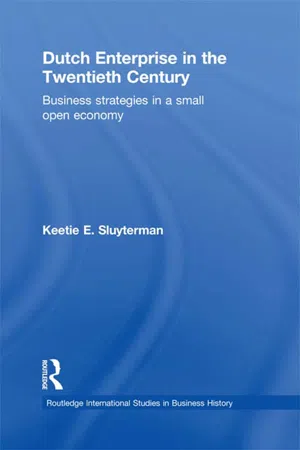
Dutch Enterprise in the 20th Century
Business Strategies in Small Open Country
- 336 pages
- English
- ePUB (mobile friendly)
- Available on iOS & Android
eBook - ePub
About this book
This is the first book to summarise the twentieth century economic history of the Netherlands from a business history perspective. It has a broad historical coverage of Dutch business development including in particular the major multinationals such as Philips, Shell, and Unilever. Although focused on Dutch business it has a strong international flavour.
Information
1 Family-based management in an international context, 1895–1914
Introduction
During the last decade of the nineteenth century and the first of the twentieth century the world economy greatly expanded. National income growth accelerated in many regions and most countries. Improved communications stimulated international trade, large-scale international migration and massive flows of foreign capital. Colonialism reached its highest point with Western countries scrambling for the last regions in Africa and Asia. Though there was some increase in tariff levels, the flow of trade benefited from fixed exchanged rates as most of the world adopted the gold standard.1 International business was not a new phenomenon in the nineteenth century, but it's fair to say that its size and significance greatly expanded after 1880. Multinational trading companies and multinational banking increased their activities, international oil companies arose and multinational manufacturing developed in a wide range of products.2
These were years when people believed in progress, especially in technological progress. The whole world would be revolutionised through technical inventions. Some of those inventions, such as electricity with its new possibilities for light, power, telephone and film, greatly appealed to the general public. Others, such as those in the chemical industry with its chemical fertilisers and dyes, were hidden within industry. The same goes for the opportunities created by the availability of cheap steel in the production of ships and later on in armaments, bicycles and cars. While inventors, producers and users shaped the new technologies, their own lives were in turn changed by them in an intricate process of reciprocity. All these technological innovations, coming together at the end of the nineteenth century, have been understood as the Second Industrial Revolution. Other economic historians see this period as the upswing period of the Third Kondratieff wave, boosted by electrical and heavy engineering with cheap steel as the key-factor. Kondratieff waves are considered to last about fifty years. The first wave might have appeared from 1785 till 1845, the second from 1845 till 1895, though views differ on the exact timing.3 In fact, the remarkable upswing of the 1895–1914 period formed the inspiration for formulating the first tentative long wave theory.4 Contemporaries related the upswing in the economy to the invention of electricity with its many ramifications and the globalisation of the economy.
The last decades of the nineteenth century saw the rise of big business in manufacturing in the US, and to a lesser extent in Britain, Germany and France. As mentioned in the Introduction, the fascinating phenomenon of the rise of big business has been extensively analysed by the American business historian Alfred Chandler.5 In his view, the modern industrial enterprise played the most fundamental role in the transformation of Western economies. They had been rural, agrarian and commercial and subsequently became industrial and urban. That transformation brought the most rapid economic growth in the history of mankind. The revolution in transport and communications made possible larger, faster and more regular movements of goods and raw materials. A new group of entrepreneurs moved quickly to exploit these market opportunities, using the new technologies of the Second Industrial Revolution to achieve economies of scale and scope. The first country where this transformation took place was the US. To benefit fully from the cost advantages of high-volume technologies they also had to invest in marketing and distribution networks and to ensure the regular supply of raw materials. This led to a process of horizontal and vertical integration, either by internal growth or mergers. The real challenge for these companies came when faced with the problem of their internal organisation. Here the experiences in administrating national railway systems helped entrepreneurs to develop their own model. They set up layered managerial hierarchies to process and control flows of information crucial to profitable production and marketing. At the same time, ownership and control became more and more separated. Essential in creating the large manufacturing company in the new sectors of the Second Industrial Revolution were therefore, according to Chandler, the three-pronged investments in production, distribution and management. The result was the rise of mass production and mass consumption. The entrepreneurs who first moved forward in this direction, the so-called first movers, acquired powerful competitive advantages, which made it hard for followers to challenge them successfully. Therefore, many of the big companies that arose after the 1880s were still at the core of their national economies at the end of the twentieth century.6
Chandler's generalisations have found much acclaim but have also met with reservation and criticism. This was particularly true for his suggestion that the continuation of other forms of doing business, such as the family firms and small businesses working together in an intricate web of relationships in preference to vertical integration, were a sign of failure to meet the modern requirements. The discussion on failure concentrated on the performance of Britain compared with the US and Germany. In particular, developments in the UK were compared negatively with those with the US. In his study of European big business, Youssef Cassis therefore broadened the analysis of Chandler by including big business outside the manufacturing industry in banking, insurance, transport and trading, in which sectors British companies did relatively well.7 Sabel, Zeitlin and Scranton have stressed the equal value of alternatives to mass production, such as speciality products for niche markets. Even in the US itself, a large sector of the economy was based on speciality manufacturing. By using multi-purpose machinery these firms kept a great deal of flexibility in their production process, which enabled them to adjust successfully to changing demands. This sector, they argue, deployed a dynamic that paralleled, complemented and at times conflicted with the achievements of the mass-production sector.8 Small businesses, serving local markets or working as flexible specialist producers for niche markets, remained an important part of business life. This was particularly true for Europe, but even in the US itself a third of the workforce was still employed by firms with 100 or fewer workers by 1914.9
In this chapter I will explore the strategies of Dutch business people during the upswing period till 1914 with its profusion of new technologies and its growing international interconnectedness. In these favourable surroundings, the Dutch economy experienced a period of sustained growth. All sectors in the Dutch economy, agriculture, services and manufacturing, contributed equally. The Dutch felt as though they were at long last reconnecting with the major economic developments in Europe, taking their rightful place amongst their peers. Within Europe, the Netherlands belonged to the group of smaller countries, but because of its colonial empire it still considered itself one of the middle-ranking political powers. Around 1900 the Dutch were very much aware of their status as colonial power and their tradition in trading, dating back to their Golden Age of the seventeenth century. Their art and architecture demonstrated clear references to this period of glory.10 Also, there was a distinct feeling especially amongst businessmen that a new Golden Age was now dawning.
Interlude 1: The Philips family and the incandescent lamp
International orientation, collaboration and family capital, three themes central in our first chapter, lay at the basis of the formation of one of the most well-known Dutch companies in the twentieth century, the Koninklijke Philips Electronics NV. A short history of the firm therefore forms an ideal introduction to the main arguments of this chapter. Gerard Philips and his father Frederik founded the Philips company as a family partnership in 1891. Gerard had studied mechanical engineering at Delft University before taking up a job at a shipyard in Glasgow. There he developed an interest in electrical engineering and studied at Glasgow University. Subsequently he worked for the Anglo-American Brush Electric Light Corporation in London and Berlin and for the Allgemeine Electrizitäts Gesellschaft (AEG) in Amsterdam, thus learning the trade and getting acquainted with many of the players in this new field. He came to the conclusion that there was room for specialist lamp-bulb producers alongside the big electrical-equipment manufacturers and started to experiment with the production of incandescent lamps, in particular the carbon filament. His father, a banker, tobacco trader and landowner in the Dutch town Zaltbommel, agreed to provide the financial means. Together they chose a convenient production site in the south of the Netherlands, in the small town of Eindhoven, with good communications and cheap labour. Gerard was a relatively late starter as he was the fifth to take up the production of incandescent lamps in the Netherlands. In order to fully master the intricate production process, he started on a small scale before introducing the mass production which was essential to manufacture the lamps cheaply enough to leave sufficient profit margin. In a small country like the Netherlands, with a modest home market, mass production also implied producing for foreign markets.11
The family character of the firm was reinforced when Gerard's younger brother Anton Philips joined the firm in 1894. Anton was learning the business at a stockbroker in London. His father called him back from the financial centre of the world to the backwaters of Eindhoven to deal with the commercial aspects of the family firm. Anton delighted in international travel, including a successful trip to Russia. Soon the exports surpassed the home sales. In 1900 the firm boasted 28 foreign agencies, ranging from London to Berlin, St. Petersburg, Yokohama, Surabaya and Buenos Aires, and employed about 600 people, of which two-thirds were young women.12 The employees worked sixty hours per week, though the working days could be shorter if demand for lamps was sluggish. In 1911 Philips introduced the 57.5 hours working week. The Philips brothers were in contact with a group of forward-looking employers in the Netherlands, who studied best practices in organising social funds such as sick funds and pension funds. The rising number of workers in the small town of Eindhoven demanded from the employers an active policy in housing and recreation.13
Dutch producers profited from the fact that patents were not protected in the Netherlands between 1869 and 1912. Philips and others could start up their business and experiment without having to pay huge licence fees or be involved with patent litigation. But, as mentioned, for a mass product such as light bulbs the Dutch home market was not large enough. It was fortunate for the company that by this time the claims of the Edison patents had been sufficiently challenged in Germany and France to make them ineffective. In England and the US the patents would soon expire. Philips could therefore enter the foreign markets without the threat of litigation. Expansion, however, became hampered by fierce international competition resulting in pressure on prices. In particular, the German company AEG tried to squeeze competitors out of the market through low prices. The Dutch producers, therefore, started negotiations with the German light bulb manufacturers in 1901 to reach a European-wide cartel agreement. It took two years to work out an agreement between the major European bulb manufacturers. In fact, it became predominantly a German cartel because the French and English producers backed off, afraid as they were of German domination. The Dutch producers, including Philips, however, joined the cartel agreement that covered a joint sales organisation in Berlin and fixed production quotas against stable prices. The benefits for Philips were considerable. The participation in the cartel made the name of Philips known to customers and colleagues far outside its home market. The secure level of production enabled Philips to rationalise its production units and thus lower production costs.14
In the meantime the real competition between the bulb manufacturers took place elsewhere. Many new types of bulbs were being developed of which the metal filament lamp turned out to give the best performance. While the family firm Philips & Co participated in the carbon filament cartel, a new limited liability company, NV Philips’ Metaalgloeilampenfabriek, was founded to develop the new metal filament bulb. The cartel arrangement became increasingly irrelevant as outsiders acquired market share and the new metal filament lamp conquered the market.15 As a specialist bulb producer, Philips was able to move fast. When Gerard learned that General Electric had developed better production techniques, Anton took the first steamer to the US to study the process and buy the necessary machinery to take them back home. Because of the lack of patent protection in the Netherlands, Philips could once again experiment freely at home, but by exporting its products the company ran the risk of infringing existing patents and indeed became deeply involved in patent wrangles in Germany, England and the US. As is often the case, the legal position was far from clear as many different patents covered the field. Though Philips disputed the various claims, in most cases it preferred to reach agreements in order to avoid long-lasting legal battles. The three important Berlin producers combined in a Patentgemeinschaft which forced Philips into a licence agreement, curtailing its expansion in the metal filament bulb. Philips had to withdraw from the British market, but could continue to sell in the British colonies. In the US, General Electric and Philips agreed to wait for the outcome of the legal process, while in the meantime imports of Philips lamps into the US could go ahead. Here Philips’ joint venture, Laco Philips, created a large though not very profitable outlet. While these negotiations were going on, the development of yet another improved variety, the ‘half-watt’ bulb, upset the earlier arrangements.16 In the development of the ‘half-watt bulb’ Philips once again moved quickly to introduce its own half-watt bulbs before the market opportunity would be lost. It also realised the importance of basic scientific research to move from follower to initiator of new developments. The company already had a chemical laboratory, but in 1914 a physics laboratory was added with the double task of doing practical as well as fundamental research.17
In 1912 the family firm was turned into a limited company, the NV Philips’ Gloeilampenfabrieken, which also encompassed the Philips’ Metaalgloeilampenfabriek established in 1907. Philips considered following the example of the margarine producer Henry van den Bergh, who had turned to the London capital market, but in the end decided to remain a Dutch company. The family kept a considerable influence in the new company through its large shareholding, while the two Philips brothers acted as managing directors and two of their brothers became members of the board of supervisory directors. With a nominal share capital of six million guilders and about 2,500 employees Philips was small compared with its main foreign competitors, such as General Electric, Siemens and AEG. In the Dutch context it belonged to the top twenty largest manufacturing companies. It also represented the successful entrance of a Dutch company into one of the industries of the Second Industrial Revolution as a second mover.18
1.1 Small scale and family run
The Netherlands had been late in catching up with the opportunities shaped by the First Industrial Revolution: the use of steam power and mechanisation in the textile and machinery industry. According to Van Zanden and Van Riel, the rise of the modern manufacturing industry took place from the mid-1860s onwards with a short interruption around 1890. Investment in machinery showed a marked growth after 1895. The manufacturers were stimulated to mechanise their production, because of the relatively high wages in comparison to the costs of coal and machinery. High real wages at the same time provided a growing market for consumer goods and stimulated the manufacturers to further increase production.19 While the Netherlands had been slow to adapt to the First Industrial Revolution, they were quick to take up the benefits of the Second Industrial Revolution. One of these benefits was that electricity fitted well in the tradition of small-scale production. The spread of the electric motor was remarkably fast in the Netherlands.20 Important elements in the dynamics of the 1895–1914 period were the growth of the agricultural sector with its agribusiness, the expanding transit-trade which benefited from the economic growth in two neighbouring countries, Germany and Britain, and the economic exploitation of the Dutch East Indies creating rising opportunities for investment and supply of goods. In this dynamic context the manufacturing industry began to thrive.
Between 1889 and 1909 the number of people employed in manufacturing rose 44 per cent. How balanced the economic growth in the Netherlands was during that period becomes clear when we compare the structure of employment. The division of the labour force over the three main sectors, agriculture, industry and services, remained by and large the same with roughly a third for each sector, though the general trend was already visible: the share of agriculture went down from 36.6 per cent in 1889 to 30.4 per cent in 1909, while that of industry increased from 31.6 to 34.3 per cent and services from 31.9 per cent to 35.4 per cent.21 The size of industry as measured in workforce was growing as well, though not spectacularly. Factories with a few hundred employees were no longer an exception. The number of people working in firms with more than 50 employees increased from 15 per cent of the total workforce in the manufacturing sector in 1889 to 29 per cent, nearly a third, in 1909. Unfortunately, this source gives no information on the number of firms with 1,000, let alone 10,000 employees.22 Mass production of textiles, shoes, furniture and ready-made clothes had made its entrance, though it certainly had not yet ousted all craft production. Dutch entrepreneurs took on new products such as bicycles and light bulbs. The joint stock company became more frequently used, even by manufacturing companies. Between 1895 and 1914 Dutch manufacturing clearly displayed growth and modernisation. Y...
Table of contents
- Front Cover
- Half Title
- Routledge international studies in business history
- Title Page
- Copyright
- Contents
- List of illustrations
- Acknowledgements
- Introduction
- CHAPTER 1: FAMILY-BASED MANAGEMENT IN AN INTERNATIONAL CONTEXT, 1895–1914
- CHAPTER 2: A SMALL COUNTRY IN AN ERA OF WAR AND PROTECTIONISM, 1914–1945 68
- CHAPTER 3: FOLLOWING THE AMERICAN LEAD, 1945–1975 126
- CHAPTER 4: COMPETING IN THE GLOBAL ECONOMY, 1975–2000 183
- Conclusion
- Notes
- Bibliography
- Index
Trusted by 375,005 students
Access to over 1.5 million titles for a fair monthly price.
Study more efficiently using our study tools.
Frequently asked questions
Yes, you can cancel anytime from the Subscription tab in your account settings on the Perlego website. Your subscription will stay active until the end of your current billing period. Learn how to cancel your subscription
No, books cannot be downloaded as external files, such as PDFs, for use outside of Perlego. However, you can download books within the Perlego app for offline reading on mobile or tablet. Learn how to download books offline
Perlego offers two plans: Essential and Complete
- Essential is ideal for learners and professionals who enjoy exploring a wide range of subjects. Access the Essential Library with 800,000+ trusted titles and best-sellers across business, personal growth, and the humanities. Includes unlimited reading time and Standard Read Aloud voice.
- Complete: Perfect for advanced learners and researchers needing full, unrestricted access. Unlock 1.5M+ books across hundreds of subjects, including academic and specialized titles. The Complete Plan also includes advanced features like Premium Read Aloud and Research Assistant.
We are an online textbook subscription service, where you can get access to an entire online library for less than the price of a single book per month. With over 1.5 million books across 990+ topics, we’ve got you covered! Learn about our mission
Look out for the read-aloud symbol on your next book to see if you can listen to it. The read-aloud tool reads text aloud for you, highlighting the text as it is being read. You can pause it, speed it up and slow it down. Learn more about Read Aloud
Yes! You can use the Perlego app on both iOS and Android devices to read anytime, anywhere — even offline. Perfect for commutes or when you’re on the go.
Please note we cannot support devices running on iOS 13 and Android 7 or earlier. Learn more about using the app
Please note we cannot support devices running on iOS 13 and Android 7 or earlier. Learn more about using the app
Yes, you can access Dutch Enterprise in the 20th Century by Keetie E. Sluyterman in PDF and/or ePUB format, as well as other popular books in Negocios y empresa & Negocios en general. We have over 1.5 million books available in our catalogue for you to explore.