This volume addresses the growing obsolescence of traditional constructions of masculine identity in popular romantic comedies by proposing an approach that combines gender and genre theory to examine the ongoing radical reconstruction of gender roles in these films. Alberti creates a unified theory of gender role change in the movies that combines the insights of both poststructuralist gender and narrative genre theory, avoiding binary approaches to the study of gender representation. He establishes the current "crises" in both gender representation and genre development within romantic comedies as examples of experimentation and change towards narratives that feature more egalitarian and less essentialist constructions of gender.
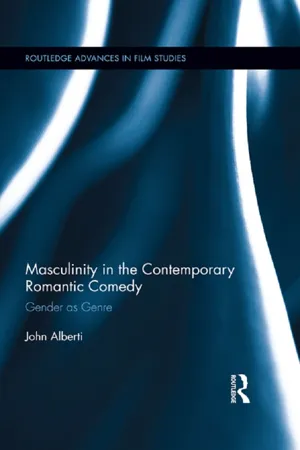
- 124 pages
- English
- ePUB (mobile friendly)
- Available on iOS & Android
eBook - ePub
About this book
Information
1
Masculinity in the Contemporary Romantic Comedy
Gender and/as Genre
In 2009, New York Times critic Manohla Dargis began her review of the critically panned but commercially successful romantic comedy The Ugly Truth (Robert Luketic, 2009) by observing, “That tap-tap-tapping sound you hear is another nail being driven into the coffin of the romantic comedy.”1 The review testifies how her critical disappointment with this specific romcom—one she sees as typical of other contemporary versions of the genre—tied in with a larger aesthetic and cultural crisis: the credulity of the genre itself. For if the romantic comedy is indeed dying, it is not just being killed by inept filmmaking; it would have to be because traditional genre expectations find themselves in increasing dissonance with larger cultural narratives about romance, love, sexuality, and gender, a dissonance that disrupts enough of our individual experiences of the genre to cause us to question the cultural efficacy and pleasure of the genre as a genre.
Consider, for example, the following plot summary of another romantic comedy that appeared just two years before The Ugly Truth:
A smart, attractive, ambitious, talented, and successful television entertainment reporter becomes pregnant after a drunken one night stand with an ill-kempt, unemployed, emotionally immature stoner and aspiring Internet pornographer. Not only does the reporter decide to carry the child to term, she embarks on a relationship with the sperm provider, finally inspiring him to find legal employment and attempt the responsibilities of parenting.
Most movie goers will recognize that I am describing one of the new century’s most commercially successful and iconic Hollywood releases: Judd Apatow’s Knocked Up (2007). My effort to defamiliarize this synopsis away from the style of the press release or the IMDb (Internet Movie Database) plot summary highlights the issue of gender in this movie in order to suggest a possible source for Dargis’s crisis over genre credulity, a logical paradox that strains the genre expectation of this movie, a paradox obvious to most viewers, critics, and even filmmakers and one that even adds to the aesthetic pleasure and power of Knocked Up. Put simply, would the character of Alison (played by Katherine Heigl, who also stars in The Ugly Truth) ever consent to even a brief sexual liaison with the character of Ben (Seth Rogen), no matter how drunk or depressed? And would she really not terminate the pregnancy? Most incredible of all, would she then embark on a romance with a self-absorbed, emotionally stunted, and unhygienic character whose only redeeming “virtues” seem to be a relaxed attitude toward personal responsibility and a misogynist sense of humor?
Credulity, of course, is more than just a simple matter of verisimilitude. When we say that a movie strains credulity, we refer less to whether the story does or does not fit empirical reality, but instead the various complex and evolving social codes and narratives that constitute our sense of social reality. Movie narratives do not exist outside and apart from these social codes and narratives; they are themselves constituent parts and cultural expressions of them. One particular set of social codes and discourses that we have created to organize, understand, discuss, debate, and manage cultural narratives themselves comprises the codes of genre, metacodes we most often apply to artistic narratives but that can extend beyond the realm of particular media into the larger social imagination.
Genre and genre expectations play a crucial role in our sense of artistic credulity, beginning with our assessment, whether consciously or intuitively, of how well or effectively a given cinematic text meets those expectations. The more problematic we find the fit between our generic expectations and our reception experience of a cinematic narrative, the more we are led to what we might call metageneric awareness, an assessment of those generic expectations themselves that stems from how self-aware a text makes us of those expectations. It is just this metageneric awareness that Dargis wrestles with in her review, one she connects to her experience of The Ugly Truth, a movie she describes as “a cynical, clumsy, aptly titled attempt to cross the female-oriented romantic comedy with the male-oriented gross-out comedy” in the fashion of Knocked Up and the subgenre of “movies about funny, smutty but sincere man-boys puzzling their way through adult heterosexual relations,” movies where “the women aren’t romantic foils, much less equals: they’re either (nice) sluts or (nicer) wives, and essentially as mysterious and unknowable as the dark side of the moon.”
As we will look at in more detail later, The Ugly Truth shares with Knocked Up an opposites-attract approach, pairing another attractive, successful, young woman in the media industry with, in Dargis’s vivid words from her review, “professional ape … who delivers loutish maxims on camera about the sexes that basically all boil down to this: Men have penises, and women should accommodate them any which way they can, preferably in push-up bras and remote-controlled vibrating panties.” That finally she “succumbs to his coarse ways, even adopting his crude language” derives for Dargis not from any internal narrative logic but from a kind of tired generic inertia, a rote follow-through of the rules of genre, or as Dargis puts it, “because, well, that’s what the public wants.” The genre (and the public, or at least the filmmakers’ understanding of the public) demands that she succumbs, but Dargis isn’t buying it, and we return to the same questions I posed for Knocked Up: why, other than as the result of strict cultural mandates, would these women involve themselves with these men?
The problem of the contemporary romantic comedy as a genre, I argue, is the problem of men as a genre; specifically, what use are men in the contemporary romantic comedy? In approaching this question, I draw on the parallels between gender theory and genre theory to understand the relationship between the crisis of genre in relation to the romantic comedy that Dargis describes and the cultural crisis surrounding the perceived obsolescence of traditional conceptions of masculinity. Drawing on performance-based versions of both gender and genre theory, I hope to demonstrate the interpretive usefulness of looking at gender through the lens of genre, of analyzing the crisis of masculinity in the movies as part of the evolution and eventual obsolescence of various genres of gender. My thesis suggests that the evolution of the genres of masculinity in the contemporary romantic comedy can be read as a form of growing pains, of the ongoing pressure to develop both narrative and gender genre conventions that connect with the larger cultural struggle involved in the development of a more egalitarian understanding of gender identity and relationships in the United States.
In the rest of this chapter, I will briefly explore the larger cultural meme of the obsolescence of masculinity in terms of the difference between an essentialist understanding of gender—one that conflates the obsolescence of certain expressions of masculinity with the obsolescence of people identified as men—and a more performative approach to gender, one that views these various expressions of masculinity in terms of how well they serve cultural and social structures based on a strictly binary gender hierarchy. These performative expressions of gender I identify as genres of masculinity, and the next section of the chapter defines the theory of gender as genre in more detail by drawing on performance-based theories of gender and genre—in particular, those by the gender theorists Judith Butler and Judith Halberstam and the cinema genre theorist Rick Altman—to emphasize the radically dynamic, evolving, and playful status of all systems of social and cultural categorization.
In terms of romantic comedy, this study identifies the growing pains that define the current crisis in romantic comedy as an uneasy but productive tension between the poles of neorealism and parody, between cinematic expressions of gender genre and narrative genre that stake a claim for the congruence between artistic representation and cultural reality and movies that aim for the comic exaggeration of gender and narrative stereotypes. In general terms, these two approaches are associated in the current cinematic environment with indie film on the one hand (neorealism) and the mainstream Hollywood film (parody) on the other.
What both approaches depend on, however, is the idea and ideal of culturally stable expressions of gender performance, stable enough to allow audiences to experience these two approaches as either realistic or parodic. Contemporary romcoms of all kinds oscillate between generic unconsciousness and self-consciousness, between wish-fulfillment narratives that try to disguise their generic machinery and self-conscious metanarratives that foreground that machinery, just as their genres of gender—especially masculine gender—swing between the reactionary and the progressive. These ambiguous and even contradictory genres of gender and narrative performance reveal the strains of constructing new genres of masculine identity that escape the ideology of male centrality and revising the conventions of the romantic comedy that have long depended on these obsolete performances of masculinity. It is just this sense of cultural strain that leads an astute critic like Dargis to experience a movie such as The Ugly Truth not only as a successful or unsuccessful expression of the romcom as genre but also as a kind of cultural harbinger, one signaling the end of the genre as a whole.
The final section of the chapter compares The Ugly Truth with the equally contemporary but much more critically successful teen romcom Easy A (Will Gluck, 2010) to show how this cultural destabilization of traditional genres of cinematic masculinity can lead either to generic crisis or generic revision and renewal. The ambiguous persona of the actor Gerard Butler, the male lead of The Ugly Truth, serves as a useful model of the unsettled and even contradictory genres of masculine identity that define the contemporary romcom. A movie star whose celebrity is paradoxically defined by a lack of definition, Butler has become both a mainstay of the contemporary romantic comedy as well as a central target for critics who despair of the genre. Using the concept of gender minstrelsy, a version of the historic instability between realism and parody, I argue that the conflicting star persona(s) of Butler illustrate the increasing obsolescence of those genres of masculine performance that insist on the cultural centrality of masculinity. The reluctance of The Ugly Truth to either fully embrace or abandon these obsolete genres creates the generic incoherence to which Dargis responds. Easy A, on the other hand, exploits the instability of gender and narrative genres to feature adolescent characters who play with the genres of gender in ways that suggest new models for the development of both the romcom as narrative genre and for the genres of gender on which it depends.
The remaining chapters trace how the instability of the genres of cinematic masculinity manifest themselves in terms of a radically ambiguous relationship between neorealism and parody in the contemporary romantic comedy, resulting in the emergence of an improvisatory form I call the anxious romance. Chapter 2, “I Love You, Man: Gender Genre Instability in the Bromance,” focuses on the ongoing reconstruction of gender identities within the narrative framework of the ostensibly parodic male-centered romantic comedy known as the bromance. Focusing in particular on Judd Apatow’s The 40-Year-Old Virgin (2005) and Knocked Up (2007), as well as related films in the bromance movie cycle such as I Love You, Man (John Hamburg, 2009) and Superbad (Greg Mottola, 2007), the chapter argues that while these movies respond to the same cultural anxieties over the confused, even contradictory genres of masculinity that (fail to) define the masculine persona of Gerard Butler in The Ugly Truth, they make this anxiety more directly the focal point of their narrative conflicts. Functioning as outrageous parodies and comic exaggerations of the genres of contemporary cinematic masculinity, bromances at the same time make claims for truthfulness and honesty, a potential contradiction that accounts for the marked critical ambivalence over these movies. Alternating between endorsing and ridiculing the misogynist and homophobic gender representations that define gender minstrelsy, the bromance reads as both a reactionary and a progressive response to the obsolescence of genders of masculine centrality as well as the heteronormative structure of the narrative genre of the romantic comedy.
Chapter 3, “The Emergence of the Anxious Romance: Mumblecore, Neorealism, and Gender Play,” traces a parallel line of gender and narrative genre evolution within the neorealist indie movies of the early 2000s loosely and sometimes pejoratively described as mumblecore. While the contemporary indie movie has become something of a genre all its own, the ultralow budgets and semiguerilla filmmaking style of mumblecore created greater freedom to experiment not only with constructions of gender but also with highly conventionalized narrative genres such as the romantic comedy. In this way, mumblecore movies participate both in the tradition of the independent auteur John Cassavetes as well as the revisionist romcoms of the 1970s—most famously, Woody Allen’s Annie Hall (1977)—that Frank Krutnik famously labeled “nervous romances,” resulting in the emergence of what I call the anxious romance, a version of the romantic comedy that explores not only whether the genre is able to adapt to changing social ideas about gender roles but also the radical inescapability of genre, both in terms of narrative and gender.
The chapter focuses on how two representative mumblecore movies— Aaron Katz’s Dance Party, USA (2006) and Lynn Shelton’s Humpday (2009)—deploy the signifiers of indie neorealism (handheld camera, improvisational acting, and the use of the emotionally subdued and digressive dialogue that gave the movement its name) while simultaneously foregrounding the gender performativity and minstrelsy inherent in all cinematic narratives. Katz’s Dance Party, USA, a take on the teen coming-of-age romantic comedy, dramatizes how the main character of Gus begins to chafe against the constraints of the dominant misogynist genres of masculine performance he and his friends inhabit. In his take on the teen comedy, however, Katz’s goal is neither easy parody nor the neorealist expression of “authentic” adolescent psychology. Neither the characters within the movie nor the filmmakers themselves can ever transcend genre. Instead, the more relevant point is the ongoing negotiation and revisioning of genres, both of narrative and gender.
Shelton’s Humpday similarly takes a high-concept plot structure more commonly associated with the mainstream bromance—two longtime but recently estranged “straight” male friends who challenge themselves to win a local adult movie competition by making and starring in a gay porn movie— to create a subtle exploration of performativity in relation to genres of gender and sexual identity. Again, the point of this anxious romance is not to parody the high-concept approach to genre in the name of a greater realism, but the understanding that genres of gender expression are all equally high concept and equally inescapable. There is no “outside” of genre, because the structures of genre are precisely what allow for meaning and coherence.
The final chapter, “Greenberg: The Anxious Romance and the Future(s) of the Romantic Comedy,” uses Noah Baumbach’s 2010 movie as a case study of a contemporary anxious romance that takes on the gender genre instability and anxiety over masculine obsolescence that mark the mainstream contemporary romcom and both its bromance and mumblecore variations. Easy A, a movie clearly marketed as a mainstream teen romcom, uses its generic status to provide a happy ending that forestalls questions of marriage and the long-term functionality of heteronormativity in relation to its adolescent characters. The at once indie and mainstream Greenberg more clearly engages thes...
Table of contents
- Cover
- Title
- Copyright
- Dedication
- Contents
- Acknowledgments
- 1 Masculinity in the Contemporary Romantic Comedy: Gender and/as Genre
- 2 I Love You, Man: Gender Genre Instability in the Bromance
- 3 The Emergence of the Anxious Romance: Mumblecore, Neorealism, and Gender Play
- 4 Greenberg: The Anxious Romance and the Future(s) of the Romantic Comedy
- Notes
- Bibliography
- Index
Trusted by 375,005 students
Access to over 1.5 million titles for a fair monthly price.
Study more efficiently using our study tools.
Frequently asked questions
Yes, you can cancel anytime from the Subscription tab in your account settings on the Perlego website. Your subscription will stay active until the end of your current billing period. Learn how to cancel your subscription
No, books cannot be downloaded as external files, such as PDFs, for use outside of Perlego. However, you can download books within the Perlego app for offline reading on mobile or tablet. Learn how to download books offline
Perlego offers two plans: Essential and Complete
- Essential is ideal for learners and professionals who enjoy exploring a wide range of subjects. Access the Essential Library with 800,000+ trusted titles and best-sellers across business, personal growth, and the humanities. Includes unlimited reading time and Standard Read Aloud voice.
- Complete: Perfect for advanced learners and researchers needing full, unrestricted access. Unlock 1.5M+ books across hundreds of subjects, including academic and specialized titles. The Complete Plan also includes advanced features like Premium Read Aloud and Research Assistant.
We are an online textbook subscription service, where you can get access to an entire online library for less than the price of a single book per month. With over 1.5 million books across 990+ topics, we’ve got you covered! Learn about our mission
Look out for the read-aloud symbol on your next book to see if you can listen to it. The read-aloud tool reads text aloud for you, highlighting the text as it is being read. You can pause it, speed it up and slow it down. Learn more about Read Aloud
Yes! You can use the Perlego app on both iOS and Android devices to read anytime, anywhere — even offline. Perfect for commutes or when you’re on the go.
Please note we cannot support devices running on iOS 13 and Android 7 or earlier. Learn more about using the app
Please note we cannot support devices running on iOS 13 and Android 7 or earlier. Learn more about using the app
Yes, you can access Masculinity in the Contemporary Romantic Comedy by John Alberti in PDF and/or ePUB format, as well as other popular books in Media & Performing Arts & Film & Video. We have over 1.5 million books available in our catalogue for you to explore.