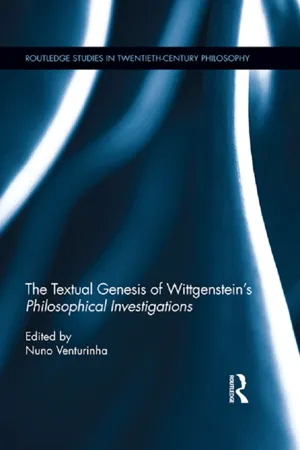
Sixty years after its first edition, there is an increasing consensus among scholars that the work posthumously published as Philosophical Investigations represents something that is far from a complete picture of Wittgenstein's second book project. G.H. von Wright's seminal research on the Nachlass was an important contribution in this direction, showing that the Wittgenstein papers can reveal much more than the source of specific remarks. This book specifically explores Wittgenstein's Philosophical Investigations from the different angles of its originary conceptions, including the mathematical texts, shedding new light on fundamental issues in twentieth century and contemporary philosophy. Leading authorities in the field focus on newly published or hitherto unpublished sources for the interpretation of Wittgenstein's later work and a Wittgenstein typescript, translated for the first time into English, is included as an appendix.
- 226 pages
- English
- ePUB (mobile friendly)
- Available on iOS & Android
eBook - ePub
The Textual Genesis of Wittgenstein’s Philosophical Investigations
About this book
Information
Argumentative Uses
1
Religious Language as Paradigmatic of Language in General
Wittgenstein’s 1933 Lectures
1. Introduction
Sometime between 1929 and 1932, Maurice O’Conner Drury began attending G. E. Moore’s lectures at Cambridge. Drury later recalled that “[a]t the commencement of his first lecture Moore read out from the University Calendar the subjects that his professorship required him to lecture on; the last of these was ‘the philosophy of religion’. Moore went on to say that he would be talking about all the previous subjects except this last, concerning which he had nothing to say”.1 Drury was unhappy with this, and when he saw Wittgenstein he expressed his dissatisfaction: “I told Wittgenstein that I thought a professor of philosophy had no right to keep silent concerning such an important subject”.2 Wittgenstein agreed and reassured Drury, saying: “I won’t refuse to talk to you about God or religion”.3
In fact, more than simply not refusing to talk about God or religion to his students, in the May Term of 1933 Wittgenstein announced in one of his lectures: “I have always wanted to say something about [the] grammar of ethical expressions, or e.g. of ‘God’” (MWL, 8, 74). And he spent the rest of the lecture discussing God, the soul, belief in idols, the afterlife, and prayer. Ironically, the best notes that we have of this lecture were taken by G. E. Moore.
2. G. E. Moore’s Notes of Wittgenstein’s Lectures, 1930–334
Wittgenstein gave his first lecture in Cambridge in January 1930,5 about a year after his return to the university; and he continued to lecture, with a few interruptions, until the end of the academic year in 1947. Moore— who had been elected Professor of Philosophy five years earlier—attended most of Wittgenstein’s lectures from that January 1930 until the end of the academic year in 1933. And he took copious notes, as he later recalled: “At the lectures … I took what I think were very full notes, scribbled in note-books of which I have six volumes nearly full” (PO, 49–50). These six notebooks—which now reside in the G. E. Moore Collection of Cambridge University Library—provide us with both the most comprehensive and the most accurate record that we have of those first three seminal years of Wittgenstein’s lecturing.
I will briefly say a word about each of these qualities—comprehensiveness and accuracy—in turn. The relative comprehensiveness of Moore’s notes can be seen by a simple word count. Covering the period of Moore’s notes we also have the published notes of John King and Desmond Lee for 1930– 32,6 and the published notes of Alice Ambrose for 1932–33.7 Together these amount to approximately 50,000 words. At 80,000 words, however, Moore’s notes are longer than King’s, Lee’s and Ambrose’s by more than half again.8 This ratio is even more exaggerated when it comes to Wittgenstein’s remarks on religion from 1933. It is not just that Moore’s notes are more detailed, but rather, they contain entire discussions which are missing from King, Lee and Ambrose.
The greater comprehensiveness of Moore’s notes itself makes them more accurate records of Wittgenstein’s lectures than the other existing notes. But there are further reasons for taking them to be more accurate. The first major difference between Moore’s notebooks and the published notes by King, Lee and Ambrose is that all the latter have undergone later editorial neatening-up and even sometimes extensive rearrangement, whereas with Moore’s notes we have an unedited and unaltered record of what Wittgenstein said, in exactly the order in which, and in much the way that, Wittgenstein actually said it. As Moore himself says, “I tried to get down in my notes the actual words he used” (PO, 50).
However, there are reasons to believe that Moore’s notes are more accurate than even the original, unedited versions of King’s, Lee’s and Ambrose’s notes9—for Moore probably had a better understanding of what Wittgenstein was doing in his lectures and was therefore in a better position to record it accurately. First of all, Moore was a professor of philosophy at the time, whereas King, Lee and Ambrose were all at one stage or another of their student careers. Moreover, it seems that the lectures were, in a sense, directed at Moore. Karl Britton, one of the students who attended the lectures, said: “We felt that Wittgenstein addressed himself chiefly to Moore, although Moore seldom intervened and often seemed to be very disapproving … we had the impression that a kind of dialogue was going on between Moore and Wittgenstein, even when Moore was least obviously being ‘brought in’”.10 Wittgenstein himself wrote to one of his correspondents in 1932 that he was glad that Moore was attending his discussion classes, given the poor quality of his other students: “My audience is rather poor—not in quantity but in quality. I’m sure they don’t get anything from it and this rather worries me. Moore is still coming to my classes which is a comfort”.11 And most significantly, Moore later reported Wittgenstein to have told him that “he was glad I was taking notes, since, if anything were to happen to him, they would contain some record of the results of his thinking” (PO, 50). Thus, Moore was the attendee of the lectures who was best placed to understand what Wittgenstein was saying; Wittgenstein recognized this fact, directed his lectures at Moore, and considered Moore’s notes to be a “record of the results of his thinking”.
In general, Wittgenstein’s attitude towards the status of his lectures seems to have been somewhat conflicted. On the one hand, as we have just seen, Wittgenstein viewed Moore’s notes of his early lectures as an authoritative record of his thought. In keeping with this positive attitude towards his lectures, Norman Malcolm and others report Wittgenstein to have said, on a number of occasions, “that he had always regarded his lectures as a form of publication”.12 Casimir Lewy recalled that “Wittgenstein once said to me that ‘to publish’ means ‘to make public’, and … therefore lecturing is a form of publication”.13 On the other hand, however, in his letter to Mind—apropos R. B. Braithwaite’s 1933 article purporting to summarize Wittgenstein’s recent thought14—Wittgenstein wrote: “I … have not published any of my work … had I published … in print I should not trouble you with this letter” (PO, 156–7). Wittgenstein thus identified “publishing” with “publishing in print”, thereby discounting his lectures as true publications. Furthermore, Wittgenstein once stopped a student from taking notes in his lectures, saying:
If you write these spontaneous remarks down, some day someone may publish them as my considered opinions. I don’t want that done. For I am talking now as freely as my ideas come but all this will need a lot more thought and better expression.15
It is therefore unclear to what extent Wittgenstein considered notes of his lectures to officially represent his thought—perhaps it depended on the particular lectures, or lecture series. However, even if Wittgenstein did not consider his lectures to be quite on a par with print publications, and even if he thought that they did not fully represent his considered opinions, they are nonetheless often extremely important progenitors of that text which was considered to the highest degree, and which was intended by him for publication—namely, the Philosophical Investigations.
In this essay I look at Wittgenstein’s remarks on religion from his 1933 lectures as progenitors of some of the key ideas of the Philosophical Investigations. For there are indications that Wittgenstein’s 1933 grammatical investigations into religious language may have acted as a seedbed for the development of ideas which he later came to see as applying with much more general scope to both religious and nonreligious uses of language. Religious language was able to play this seminal role because it is, in many ways, paradigmatic of language more generally—by which I mean that religious language has certain characteristics which are shared by many other realms of language, but which are more pronounced or more clearly seen in the religious context than in others. I illustrate the way in which religious language is paradigmatic of language in general by means of two examples—both of which emerge from Wittgenstein’s 1933 remarks on religion, and both of which touch on core Wittgensteinian insights. In section 3 I discuss Wittgenstein’s idea that grammar expresses essence, and in sections 4 and 5 I discuss Wittgenstein’s notion of the “messiness” of grammar. In both instances I argue that the case of religious language highlights these Wittgensteinian insights particularly clearly—thus possibly explaining why Wittgenstein paid so much attention to religious language in the lectures he was giving while he was developing these themes in his later thought.
3. Essence, Grammar, Theology and PI §373
Near the middle of the Philosophical Investigations is a short remark which, according to Peter Hacker, “crystallises a leitmotif of W[ittgenstein]’s later philosophy”.16 Wittgenstein writes: “Essence is expressed in grammar” (PI, §371). Two remarks later, Wittgenstein expands on this terse pronouncement by repeating the point in slightly different words: “Grammar tells what kind of object anything is” (PI, §373). The point is that a thing’s essential properties are not the kind of properties which it could have failed to instantiate—rather, they are properties which it would not make sense to deny of the thing in question. Since the grammar of a given word is the collection of rules governing its meaningful use, it follows that an overview of the grammar of a given word informs us what it would and would not make sense to say of the referent of that word. The grammar of a given word thereby expresses the essence of its referent. Thus: essence is expressed in grammar. Wittgenstein summarized the point in a 1936 lecture by saying that the essential “nature of … objects … is not determined by properties which we can attribute to them truly as opposed to those which we can’t. It is determined by the grammar of the word which denotes it” (PO, 307). This is a fundamental insight of Wittgenstein’s later philosophizing.
What is interesting about this, for our purposes, is that Wittgenstein appended to the claim that “Grammar tells what kind of object anything is” (PI, §373), a cryptic bracketed note: “(Theology as grammar.)” Without help from elsewhere in Wittgenstein’s corpus, this bracketed remark would almost certainly have remained impossibly obscure. Fortunately, however, Wittgenstein’s remarks on religion from his 1933 lectures come to our aid. Moore’s notes read as follows:17
Luther said: “Theology is Grammar of word of God”. / This might mean: An investigation of idea of God is a grammatical one. / Now (a) suppose “god” means something like a human being; then “he has two arms” & “he has four arms” are not grammatical propositions. but (b) suppose someone says: You can’t talk of god having arms, this is grammatical. / Austrian general: “I will remember you after death, if this is possible”. / That so & so is ridiculous (as this is), or blasphemous, shows grammar. (MWL, 8, 74–8)
The claim that Wittgenstein attributes to Luther provides the key to understanding his bracketed remark—“(Theology as grammar)”—in PI §373. Reports differ, however, as to precisely what claim Wittgenstein actually attributed to Luther. Moore’s original notes, just quoted, record Wittgenstein to have claimed that “Luther said: ‘Theology is Grammar of word of God’”; whereas Alice Ambrose’s published notes have Wittgenstein claiming that “Luther said that theology is the grammar of the word ‘God’” (AWL, 32). There are good reasons—over and above the general ones mentioned in the previous section—for thinking that Moore’s notes are the more accurate in this case.18 Nonetheless, even Moore seems to have been in two minds as to whether his original notes recorded what Wittgenstein actually meant— for though Moore originally wrote “Luther said: ‘Theology is Grammar of word of God’”, he later put a circle around the second “of” in the sentence and marked it with a question mark.19
What may explain the conflicting evidence is the possibility that Wittgenstein himself vacillated between the two claims, which are not actually as different as they may seem at first glance. For—given the role that God plays in scripture—a grammar of the word of God would, in the end, necessarily also be a grammar of the word “God”. This is borne out by looking further into the very example that Wittgenstein gives of a theological-grammatical statement, namely: “You can’t talk of god having arms”. At the close of the fourth century, a controversy erupted in the Christian world over just this matter: whether or not God had a corporeal form. Cassian reports that the archbishop of Alexandria, in his festal letter of 399 CE, wrote, “a long refutation of the absurd heresy of the Anthropomorphites”.20 The archbishop’s claim—as a deacon called Photinus elaborated at one public reading of the letter—was that God’s “immeasurable, incomprehensible, invisible majesty cannot be limited by a human frame or likeness. His nature is incorporeal, uncompounded, simple, and cannot be seen by human eyes nor conceived adequately by a human mind”.21 The anti-anthropomorphic letter proved explosive: “Nearly all the monks in Egypt … received this with bitterness and hostility: and … decreed that the bishop was guilty of a grave and hateful heresy, because (by denying that Almighty God was formed in the fashion of a man, when Scripture bears clear witness that Adam was created i...
Table of contents
- Cover
- Title
- Copyright
- Contents
- List of Illustrations
- Acknowledgments
- Introduction: A Composite Work of Art
- PART I Argumentative Uses
- PART II The Significance of Logic and Mathematics
- Addendum: A Wittgenstein Typescript
- Notes
- Contributors
- Index
Trusted by 375,005 students
Access to over 1.5 million titles for a fair monthly price.
Study more efficiently using our study tools.
Frequently asked questions
Yes, you can cancel anytime from the Subscription tab in your account settings on the Perlego website. Your subscription will stay active until the end of your current billing period. Learn how to cancel your subscription
No, books cannot be downloaded as external files, such as PDFs, for use outside of Perlego. However, you can download books within the Perlego app for offline reading on mobile or tablet. Learn how to download books offline
Perlego offers two plans: Essential and Complete
- Essential is ideal for learners and professionals who enjoy exploring a wide range of subjects. Access the Essential Library with 800,000+ trusted titles and best-sellers across business, personal growth, and the humanities. Includes unlimited reading time and Standard Read Aloud voice.
- Complete: Perfect for advanced learners and researchers needing full, unrestricted access. Unlock 1.5M+ books across hundreds of subjects, including academic and specialized titles. The Complete Plan also includes advanced features like Premium Read Aloud and Research Assistant.
We are an online textbook subscription service, where you can get access to an entire online library for less than the price of a single book per month. With over 1.5 million books across 990+ topics, we’ve got you covered! Learn about our mission
Look out for the read-aloud symbol on your next book to see if you can listen to it. The read-aloud tool reads text aloud for you, highlighting the text as it is being read. You can pause it, speed it up and slow it down. Learn more about Read Aloud
Yes! You can use the Perlego app on both iOS and Android devices to read anytime, anywhere — even offline. Perfect for commutes or when you’re on the go.
Please note we cannot support devices running on iOS 13 and Android 7 or earlier. Learn more about using the app
Please note we cannot support devices running on iOS 13 and Android 7 or earlier. Learn more about using the app
Yes, you can access The Textual Genesis of Wittgenstein’s Philosophical Investigations by Nuno Venturinha in PDF and/or ePUB format, as well as other popular books in Philosophy & Logic in Philosophy. We have over 1.5 million books available in our catalogue for you to explore.