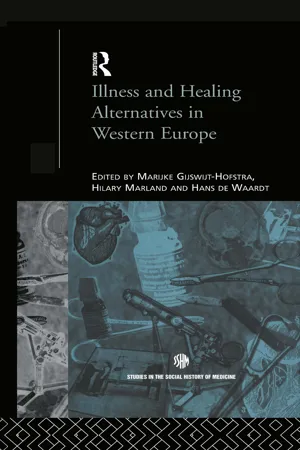
Despite the recent upsurge in interest in alternative medicine and unorthodox healers, Illness and Healing Alternatives in Western Europe is the first book to focus closely on the relationship between belief, culture, and healing in the past. In essays on France, the Netherlands, Germany, Spain, and England, from the sixteenth century to the present day, the authors draw on a broad range of material, from studies of demonologists and reports of asylum doctors, to church archives and oral evidence.
eBook - ePub
Illness and Healing Alternatives in Western Europe
- 288 pages
- English
- ePUB (mobile friendly)
- Available on iOS & Android
eBook - ePub
Illness and Healing Alternatives in Western Europe
Chapter 1
Magical healing, witchcraft and elite discourse in eighteenth- and nineteenth-century France
In his classic study of magistrates and witches in seventeenth-century France, Robert Mandrou describes how a growing reluctance to accept the demonic origin of witchcraft practices led in 1682 to a royal edict that virtually ended prosecutions for witchcraft in secular courts. Previously, following a tradition that remained entrenched in some provincial jurisdictions, persons suspected of causing harm through witchcraft could be brought before a royal magistrate and charged with sortilèges and maléfices (acts of witchcraft and the casting of evil spells). Even those who had performed seemingly more innocent actions, such as reciting incantations to lift spells or treat illness, might also be charged with using diabolical arts. What these practices had in common was that they were believed to depend on the intervention of the devil or his agents. To indulge in them was to defy God, and no less so than the acts described in the demonological literature which more explicitly involved commerce with the devil, such as an overt pact, sexual intercourse with demons or participation in a witches’ sabbath – behaviours that the prosecutors in any case readily attributed to the defendants. Hence the charge, sometimes levelled in French courts, of divine lèse majesté.
Although the edict of 1682 was presented as a measure for punishing cunning folk, magicians, witches and poisoners, the body of the text never explicitly treated ‘witchcraft’ as an offence, nor did it even use the word. What had once been the crime of witchcraft was now only ‘so-called magic’. Under the provisions of the edict and earlier French law, those who used spells and conjurations could still be prosecuted, as could those who purported to lift the spells cast by others. But they would be charged with offences such as fraud, sacrilege and blasphemy, poisoning, or possibly even unauthorized medical practice. Persons who brought accusations of witchcraft against their enemies might be charged with defamation. The edict reflected a world view in which the active presence of the devil had become vanishingly small and ‘witches’ were to be treated as the victims of delusions or as tricksters seeking to exploit the credulity of others.1 The celebrated affair of the Jesuit priest Jean-Baptiste Girard, accused in 1730 of using sorcery to harm Marie-Catherine Cadière, who had been under his spiritual direction, was the last major witchcraft case in France and definitively confirmed that French jurisprudence no longer recognized witchcraft as a criminal offence.2 Although the church continued to admit the real (though rare) possibility of commerce with the devil, the educated laity increasingly denied it together with divination, magical healing and other practices that putatively depended on the intervention of supernatural or preternatural forces.
The end of official prosecutions forms a major topic in the history of witchcraft in early modern Europe. With some variations, the standard narratives generally point to the process of ‘disenchantment’ associated with the scientific revolution and later with the Enlightenment in conjunction with other factors specific to the witch hunts, such as the judiciary’s dissatisfaction with the methods of criminal procedure followed in the trials.3 In addition to witchcraft, this large cultural transformation affected a wide range of other practices and beliefs, particularly the arts of astrology and what we would now call magical medicine – that is, the manipulation of preternatural forces by a human agent to prevent, diagnose, prognosticate or, above all, cure disease.4 Because it shaped the thinking of the educated classes but left the greater mass of the population largely untouched, this shift in outlook contributed to the growing divorce between popular and elite culture in the seventeenth and eighteenth centuries.5
The conclusion of one story is the beginning of another: the evolution of elite discourse on witchcraft and magical healing in the period following what Mandrou calls the ‘retreat of Satan’6 and the withdrawal of the state from witchcraft prosecutions. The end of prosecutions did not mean that the population as a whole had ceased to believe in witchcraft and magic or to engage in magical practices intended to lift spells or cure disease. Nor did educated observers cease to reflect on these phenomena, even after the urgency of the trials had passed. They continued to debate the reasons for their persistence and the stance that non-believers should adopt towards them. The basic outlines of this story are familiar. We know the Enlightenment scepticism of Voltaire and the Benedictine monk Benito Feijóo, the romantic fascination with witchcraft and magic shared by Sir Walter Scott and Prosper Mérimée (to cite just four totemic examples), and the development in the middle decades of the nineteenth century of folklore studies which purported to present these practices and beliefs as objects of neither scorn nor exaltation but of scientific description and analysis. But the question of elite discourse in the period after the last trials has received less attention than the ‘decline of witchcraft’ and it is worth revisiting, not least because it may help us reflect on how we ourselves talk about both the believers and the sceptics.
In this essay, I will use the French example to highlight some of the remarkably static features of elite discourse on witchcraft and magical healing. These predated the seventeenth-century turn from witchcraft prosecutions and survived both the nineteenth-century rediscovery of the folk and the development of positivist ethnography. I will also briefly explore where we may stand in relation to this tradition. In so doing, I do not mean to challenge the basic framework (just summarized) for interpreting the decline of witchcraft and its aftermath. Let us instead take this as a point of departure, while recognizing that the last generation of scholarship on seventeenth-century science has developed a more nuanced and complex account of the relationship between the new mechanical philosophy and older traditions concerning the occult, the spirit world, witchcraft and magic.7
I also ask the reader, for the purposes of this exercise, to accept several other premises. First, the broad distinction between elite and popular culture, which has been widely and often convincingly criticized,8 but which for present purposes works well enough as a convenient shorthand. The critics of witchcraft and magical healing associated them with ‘the people’, by which they meant the uneducated masses, though some noted that they had their adherents among the cultivated elites and that the term ‘people’ should be construed broadly enough to include the deluded of all ranks and stations. Second, the distinction between magical and natural forms of healing. The labels that we now often apply to various forms of folk medicine – ‘religious’, ‘magical’, ‘empirical’ – would have been almost meaningless to those who practised them. Prayers might accompany the application of an ointment; herbs might have to be gathered on an appointed day, following certain hallowed rituals. All remedies were, in a sense, empirical; they happened to have curative properties known from experience. For the educated commentators who wrote about these practices, however, the distinction was often crucial. Third and last, the notion of a widely shared ‘discourse’ constructed from a shared fund of terms, concepts, arguments and rhetorical devices. The expression is not used here in a technical sense; as will be quickly apparent, this essay is an empirical account of a tradition rather than an exercise in Foucauldian discourse analysis.
The discussion will focus on magical healing and related practices, including counter-witchcraft, rather than diabolism or the putative causing of harm through maleficium. This choice perhaps requires a few words of explanation. It has been shown that ‘black’ and ‘white’ witchcraft were closely linked in the prosecutions carried out in the sixteenth and seventeenth centuries in such regions as Lorraine and the Jura mountains;9 theologians and jurists commonly lumped together as witches and Satan’s henchmen all those who used occult arts, including practitioners of magical healing and devins-guérisseurs (cunning folk) who claimed to counteract the spells that witches had cast on their patients. Sceptics, too, tended to conflate all such practices, not as evidence of diabolical agency but as delusions. In French usage, the same term – sorcier or sorcière – was applied indiscriminately to those who cast spells, those who lifted them and even magician–healers in general, also known in some regions as maiges or mèges. Even so the distinction pervaded popular culture, and if one takes the long view, a secular shift in emphasis becomes apparent.
The sixteenth- and seventeenth-century trials could not have sustained their momentum without a succession of witches who had publicly admitted to making a pact with the devil and casting spells, however one may judge the sincerity of confessions extracted under torture or the place of diabolism in popular culture as opposed to learned demonology.10 In subsequent periods, however, though witchcraft accusations continued at the village level – despite the efforts of the authorities to discourage them – there were virtually no self-professed practitioners of ‘black’ witchcraft. Harm caused by witchcraft – for those who believed in it – was either secret or involuntary and unconscious.11 There were still, however, acknowledged counter-witches and magical healers, many of whom claimed a gift not from the devil but from God, and whom the elites had to confront as a real social presence. They attracted particularly close attention from medical practitioners, who saw them as rivals, especially for rural patients, and an obstacle to their larger project of professionalizing health care. Physicians arguably replaced the clergy as the closest observers of magical healing, which they described and denounced in texts intended for colleagues, administrators and often a broader public among the educated laity.
THE SCEPTICAL DISCOURSE ON WITCHCRAFT AND MAGICAL HEALING IN THE SIXTEENTH AND SEVENTEENTH CENTURIES
In the early modern texts that figure as the loci classici for discussions of the decline of witchcraft beliefs in elite culture, from Wier in the mid-sixteenth century to Spee, Cyrano de Bergerac, Malebranche, Bekker and Bayle, a central theme is the search for alternative explanations for the experience of feeling bewitched or possessed by demons, or the memory of having participated in commerce with the devil. Some writers, such as Spee, were equally preoccupied with the procedural defects of witchcraft prosecutions. Many continued (or professed) to believe in the influence of the devil – if only on the imagination – and even in the occasional existence of witchcraft. Here the devil appears essentially as deceiver and impostor.12 However, it is the sceptical elements, which seem to adumbrate the later positivist account of the witchcraft phenomenon, that have given these texts their canonical status.
The application of Occam’s razor led to several naturalistic explanations which we might now label psychological, physiological and sociological. The first included mental illness (the physician Wier stressed the role of melancholia) and an overactive imagination, whose powers Montaigne analyzed in a celebrated essay,13 and which the Cartesian Oratorian Malebranche saw, together with an irrational human need to be frightened, as the driving force behind the whole witchcraft phenomenon. The second type of explanation pointed to physical disease, debility and the use of mind-altering drugs (mentioned by both Malebranche and Cyrano). The third adduced the ignorance and folly of the unlettered peasantry; Malebranche and Cyrano singled out silly shepherds as fomenters of witchcraft beliefs. Witchcraft, in short, was a delusion and its victims fitter objects for medical attention than legal prosecution – a first, and critical, step in the medicalization of elite discourse on witchcraft and magic as a whole. Physicians also contributed in another way to the demystification of witchcraft phenomena by offering medical explanations of conditions, such as sexual impotence, commonly attributed to spells.14
So, witchcraft delusions in themselves were an involuntary affliction to which those considered weak of mind were most susceptible. Most commentators reflexively cited peasants, children and women, though even educated men, it was believed, could be led astray – Monsieur Oufle, the protagonist of Bordelon’s long novel of 1710 detailing the effects of a disor...
Table of contents
- Front Cover
- Illness and Healing Alternatives in Western Europe
- Studies in the Social History of Medicine
- Title Page
- Copyright
- Contents
- Notes on contributors
- Acknowledgements
- Introduction: demons, diagnosis and disenchantment
- 1 Magical healing, witchcraft and elite discourse in eighteenth- and nineteenth-century France
- 2 Demons and disease: the disenchantment of the sick (1500–1700)
- 3 Demonic affliction or divine chastisement? Conceptions of illness and healing among spiritualists and Mennonites in Holland, c. 1530–c. 1630
- 4 A false living saint in Cologne in the 1620s: the case of Sophia Agnes von Langenberg
- 5 Popular Pietism and the language of sickness: Evert Willemsz’s conversion, 1622–23
- 6 Charcot’s demons: retrospective medicine and historical diagnosis in the writings of the Salpêtrière school
- 7 Breaking the boundaries: irregular healers in eighteenth-century Holland
- 8 Conversions to homoeopathy in the nineteenth century: the rationality of medical deviance
- 9 Abortion for sale! The competition between quacks and doctors in Weimar Germany
- 10 Healing alternatives in Alicante, Spain, in the late nineteenth and late twentieth centuries
- 11 Bosom serpents and alimentary amphibians: a language for sickness
- 12 Women as Winti healers: rationality and contradiction in the preservation of a Suriname healing tradition
- Index
Trusted by 375,005 students
Access to over 1.5 million titles for a fair monthly price.
Study more efficiently using our study tools.
Frequently asked questions
Yes, you can cancel anytime from the Subscription tab in your account settings on the Perlego website. Your subscription will stay active until the end of your current billing period. Learn how to cancel your subscription
No, books cannot be downloaded as external files, such as PDFs, for use outside of Perlego. However, you can download books within the Perlego app for offline reading on mobile or tablet. Learn how to download books offline
Perlego offers two plans: Essential and Complete
- Essential is ideal for learners and professionals who enjoy exploring a wide range of subjects. Access the Essential Library with 800,000+ trusted titles and best-sellers across business, personal growth, and the humanities. Includes unlimited reading time and Standard Read Aloud voice.
- Complete: Perfect for advanced learners and researchers needing full, unrestricted access. Unlock 1.5M+ books across hundreds of subjects, including academic and specialized titles. The Complete Plan also includes advanced features like Premium Read Aloud and Research Assistant.
We are an online textbook subscription service, where you can get access to an entire online library for less than the price of a single book per month. With over 1.5 million books across 990+ topics, we’ve got you covered! Learn about our mission
Look out for the read-aloud symbol on your next book to see if you can listen to it. The read-aloud tool reads text aloud for you, highlighting the text as it is being read. You can pause it, speed it up and slow it down. Learn more about Read Aloud
Yes! You can use the Perlego app on both iOS and Android devices to read anytime, anywhere — even offline. Perfect for commutes or when you’re on the go.
Please note we cannot support devices running on iOS 13 and Android 7 or earlier. Learn more about using the app
Please note we cannot support devices running on iOS 13 and Android 7 or earlier. Learn more about using the app
Yes, you can access Illness and Healing Alternatives in Western Europe by Marijke Gijswit-Hofstra,Hilary Marland,Hans de Waardt in PDF and/or ePUB format, as well as other popular books in History & World History. We have over 1.5 million books available in our catalogue for you to explore.