eBook - ePub
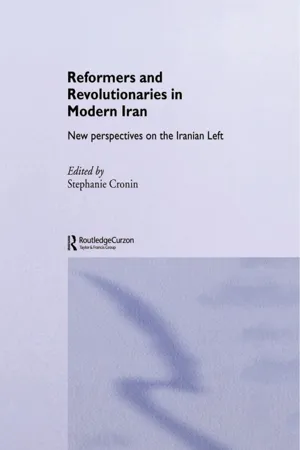
Reformers and Revolutionaries in Modern Iran
New Perspectives on the Iranian Left
- 328 pages
- English
- ePUB (mobile friendly)
- Available on iOS & Android
eBook - ePub
Reformers and Revolutionaries in Modern Iran
New Perspectives on the Iranian Left
About this book
Even though the left has never held power in Iran, its impact on the political, intellectual and cultural development of modern Iran has been profound. This book's authors undertake a fundamental re-examination and re-appraisal of the phenomenon of leftist activism in Iran, interpreted in the broadest sense, throughout the period of its existence up to and including the present.
Part I
THE IRANIAN LEFT
Overviews and balance sheets
1
THE IRANIAN LEFT IN INTERNATIONAL PERSPECTIVE
Fred Halliday
Contexts: national, regional, international
From its origins in the 1900s, the Iranian Left was prominent in opposition to the authoritarian Iranian state, of shah as much as of imam, and to the various forms of external intervention to which Iran has been subjected. This sustained record was marked by many a division and twist of policy and, in all but one case, that of 1908–09, ended in defeat. The cost in human life and suffering, and the commitment demonstrated across these decades, were immense. Despite continued repression, the Left did much to shape the course of Iranian politics and intellectual life. No history of twentieth-century Iran can, indeed, be written without a discussion of the role within it of the Left, be it of the current that dominated for much of this period, pro-Soviet communism, or of the many other more autonomous groups, from the constitutionalist social democrats of the Constitutional Revolution through to the Third Force of the 1940s and on to the components of the independent Marxist Left in the 1970s and 1980s. Despite the attempts of their enemies, monarchical and clerical, to do this, no measured history of Iran in the twentieth century can, therefore, suppress this record.1
The first context for any such discussion of the Left is Iranian history and society itself: this permits discussion of the impact, in political and intellectual terms, of this Left on Iranian society as a whole but also of the causes of this sustained opposition record. As recent historiography has made clear, radicalism, in ideas and in practical protest, long predates the advent of the socialist movement to Iran.2 At four periods in the twentieth century, in the defence of the constitution of 1908–09, the years after the First World War, the period 1941–53, and the years immediately preceding and following the revolution of 1979, the Left had a significant role, as much on its opponents as on its own followers: while in 1908–09 the Left helped successfully to defend the constitutional political order, each of the later three periods is associated with an opportunity for taking power that ended in defeat.
No history of the Left, in any country, can, however, be written within a purely national context. The assessment of the Iranian Left needs to be seen in a broader context, of proximity to Russia, and that of the Middle East and Asia, of which it was a part. The history of the Iranian Left is bound up, as few others are, with that of the socialist movement to its north, in Russia. This, rather than any strong connections to the Arab world, Turkey, Afghanistan or South Asia, was the formative context. Its most successful moment, the 1908–09 defence of the constitution, involved active support from Russia – but not the Russian state. Yet, from 1917, that guiding, when not controlling, influence from the Soviet state was to distort the Left in Iran until the USSR foundered in 1991. As much as the Left parties of eastern Europe, those of Iran were influenced, and deformed, by their relation to Russia, not just because of the ideological influence felt by communists around the world, but because of the way in which it split the Left from nationalism.
At the same time, the fate of the parties in the two states on either side of Iran can underline the importance of any regional comparison. To the west, in Iraq, the communist movement played a significant role in the opposition to the Hashemite monarchy in the 1940s and 1950s, and was a participant in the radical government that emerged after the revolution of 1958; it was, however, despite formal alliances with the Ba‘th, to succumb to the latter’s repression from 1963 onwards.3 To the east, in Afghanistan, communism had an even more dramatic record – a marginal current until the late 1960s, the People’s Democratic Party of Afghanistan seized power through a military coup in April 1978, was rescued from collapse by Soviet forces in December 1979, and remained in power until 1992, when a coalition of counter-revolutionary Islamist forces overthrew it. All three parties, therefore, Iraqi, Iranian and Afghan, ended the 1990s in defeat and disarray.
The broader, continental, context of Iranian communism is equally striking. The Iranian Communist Party was founded in June 1920 before any other in Asia, months earlier than China, India, Vietnam or Japan. In the 1940s and 1950s, it was as influential as any in the Middle East. During the revolution of 1978–79, the Iranian Left, in its various forms, was to play a distinctive role, and was, in considerable measure, to influence the discourse of the Islamist forces themselves. After its defeat in Iran, in the early 1980s, the Tudeh was to acquire a substitute role, as ideological mentor to the ruling Communist Party in neighbouring Afghanistan. Yet within Iran itself it was, unlike the other major parties of Asia, never to come to power and to spend much of its history on the defensive.
The history of the Iranian Left poses, therefore, as much as that of any other country, the challenge of combining analysis of internal and external dimensions. The history of any Left movement is at once national and international – national in the sources of its emergence, development and impact, but, equally, international in terms of the global political and strategic context in which it developed, and in terms of the ideological forces acting up it. Any analysis of the dogmatism and sectarianism of the Iranian Left has to take internal, Iranian, political culture and Soviet influence into account. This is not peculiar to Iran: the whole history of the socialist movement, from the French Revolution through to the collapse of Soviet communism in 1991, is one inscribed within a context of global conflict and social change on the one hand, and of internationally stimulated ideological militancy, and division, within specific countries on the other.
However, while all left-wing movements partake of the influence, the ‘world-historical’ context, in which they grow, that of Iran was particularly affected by external ideological context, that of the international socialist and communist movements. The importance of this global context is often recognised, but too often in a polemical way: the Left is cast as being an agent or client of the USSR, those opposed to it as agents of the West, Britain or the US. A similar simplification applies to the Right, seen as ‘clients’, ‘tools’, ‘lackeys’ of imperialism. The issue of external context, and the forms of influence it produced, goes much further than questions of direct control, be it of the USSR over the Tudeh in the 1940s or of the CIA over the shah in 1953. If this external influence was self-evidently true of the pro-Soviet forces, who followed Moscow in every turn, it was also to a large extent true of the other components of the Left, for whom the external context, and the ideas derived from it, was to play such an important role. The independent Left of the 1970s, of writers such as Pouyan, Jazan, Farahani and Ahmadzadeh, was shaped by the Third World enthusiasm for guerrilla struggle. To deny this external context, and the forms of influence, some very direct, which this occasioned, would be unfounded. But this has to be accompanied by analysis of the internal social and political forces on which the Left drew.4
International context also provides much of the explanation for the ultimate fate of the Iranian Left, in that it was the combination of geostrategic position, on the borders of the USSR, and ideological subservience to external models, that was to do much to ensure the defeat of the Left within Iran itself. Iranian writers make much of the internal failings of the Left, be this its mistaken evaluation of the political and social balance within the country, sectarian divisions or its unduly trusting attitude to the Islamist revolution. These choices were, however, compounded by the very real and difficult international context in which Iran found itself, one which led to a particularly strong external counterrevolutionary support for the state on the one hand, and to a constriction of the Left’s ideological and political choices on the other, above all the fact that the USSR was also a target of Iranian nationalism. It was not only what these movements aspired to, and the patrons they chose, but also the enemies they opposed, that were defined in terms of a global conflict. The political context, of conflict between colonial and colonised peoples, of world war, and of Cold War, of relations between Third World states and Western patrons, of the whole seventy years of conflict surrounding the Bolshevik revolution, was an international one, as much in the forces that were thrown up to fight the Left as in the forces that developed in support of it.
All three contexts – international, regional, national – are, therefore, essential to an understanding of the Iranian Left. Any retrospective on the history of the Left is, however, made all the more challenging by another aspect of international perspective, that of the end of the Cold War, and with it the collapse of the USSR. For the Left in every country, the events of the late 1980s and early 1990s have occasioned a major rethinking of their history, both because of the availability of new materials and because of the light which these events cast on the very goal of the Left itself. Recent research has indeed thrown up new material pertinent to the history of the Iranian Left and of relevant episodes in Iranian history, be this material on the early history of the Tudeh, the text of Stalin’s 1946 letter to Ja’far Pishevari or the text of the CIA internal report on the coup of 1953.5 At the same time there has been a marked shift in the very historical perspective within which the Left is viewed. Those opposed to the Left have tended to stress the degree of Soviet control: yet research since 1991 has shown to what degree the Iranian Left, like so many others, evaded or sought to evade such direction. On the other hand, if, up to 1991, the Left critique had revolved around a supposed failure to achieve a realistic goal, of building a socialist Iran, the very general discrediting of this goal, for Iran or any other country, casts the history of the Left in a different light. No retrospective on the Iranian Left, and on what might have occurred, can avoid the question of what such a Left, with its authoritarian and sectarian culture, would have done if it had come to power.
One of the tasks facing the historian of the Left in any region of the world has been to match these two changes, of greater historical detail and insight, with a shift in perspective, to write of the history of these movements without recourse to the myths, of justification or denigration, associated with the communist period and with the Cold War. Beyond conspiracy theory or counter-factual piety, there is the challenge of a political sociology of these movements. In what follows, four aspects of the Left in Iran, pertinent to its overall history, will be examined, bringing to bear both the international and the retrospective perspectives suggested here. These will not resolve all, or indeed any, of the controversies associated with the Iranian Left: they may contribute, however, to reorienting a discussion that is too often beset with polemic.6
Three great opportunities: myths and realities
The retrospective history of the Iranian Left revolves, above all, around the three major periods, after 1908, in which it played a role within Iranian political life. The first was in the period 1917–21, when a revolutionary republic was established in the northern province of Gilan, formed by an alliance of nationalists and communists. The second was in the period between the Anglo-Russian invasion of 1941, which opened up the political situation within Iran to nationalist and communist forces, and the coup of August 1953. The third was the period preceding and following the revolution of 1979. In each case the Left appeared to have established itself as an important component of the Iranian political scene, only to find itself defeated by a more powerful Iranian state, in the first two cases with the support of external, imperial, powers. Out of each period has also come a counter-factual narrative, according to which the defeat of the Left was the result of political choices, by the Iranian Left and by their international ally, the USSR, which could have facilitated a different conclusion.
The rise and fall of the Gilan republic has to be seen in international context. If the first Iranian socialists had emerged during the twin crises of the tsarist and Qajar states in the 1900s, the Gilan movement was the product of the dissolution of empires brought on by the First World War: Gilan formed part of the broader crisis of established regimes after 1918 that was evident across Europe, in Hungary, Bavaria, northern Italy, and which stretched through Turkey to northern Iran and on to Afghanistan, Mongolia and China. While the nationalist guerrillas of Kuchik Khan had been active in the region since 1911, it was the intervention of Bolshevik naval forces operating in the Caspian, who took the port of Enzeli in May 1920, which led to the establishment of the Gilan republic on 5 June. Yet if international conflict had facilitated the establishment of the republic, it also played a part in its downfall: by early 1921, the Bolsheviks were so weakened that they were forced to sign a commercial agreement with Britain, and to come to terms with the nationalist regimes along their southern frontiers, in Turkey and Iran. Bolshevik support was, therefore, withdrawn and the Gilan region occupied by the central army. We need not accept literally the story told by the Comintern envoy Yakov Blumkin, to grasp how far Soviet policy changed: ‘My “Persian tale”? There were a few hundred of us ragged Russians down there. One day we had a telegram from the Central Committee: “Cut your losses, revolution in Iran now off.” But for that we would have got to Tehran.’7
To ascribe the f...
Table of contents
- Front Cover
- Reformers and Revolutionaries in Modern Iran
- Routledgecurzon/Bips Persian Studies Series
- Title
- Copyright
- Contents
- List of illustrations
- Notes on contributors
- Acknowlegments
- Note on transliteration
- Introduction
- Part I The Iranian Left: overviews and balance sheets
- Part II The Iranian Left: historical dimensions
- Part III The Iranian Left and the Islamic Republic: contemporary critiques
- Index
Trusted by 375,005 students
Access to over 1.5 million titles for a fair monthly price.
Study more efficiently using our study tools.
Frequently asked questions
Yes, you can cancel anytime from the Subscription tab in your account settings on the Perlego website. Your subscription will stay active until the end of your current billing period. Learn how to cancel your subscription
No, books cannot be downloaded as external files, such as PDFs, for use outside of Perlego. However, you can download books within the Perlego app for offline reading on mobile or tablet. Learn how to download books offline
Perlego offers two plans: Essential and Complete
- Essential is ideal for learners and professionals who enjoy exploring a wide range of subjects. Access the Essential Library with 800,000+ trusted titles and best-sellers across business, personal growth, and the humanities. Includes unlimited reading time and Standard Read Aloud voice.
- Complete: Perfect for advanced learners and researchers needing full, unrestricted access. Unlock 1.5M+ books across hundreds of subjects, including academic and specialized titles. The Complete Plan also includes advanced features like Premium Read Aloud and Research Assistant.
We are an online textbook subscription service, where you can get access to an entire online library for less than the price of a single book per month. With over 1.5 million books across 990+ topics, we’ve got you covered! Learn about our mission
Look out for the read-aloud symbol on your next book to see if you can listen to it. The read-aloud tool reads text aloud for you, highlighting the text as it is being read. You can pause it, speed it up and slow it down. Learn more about Read Aloud
Yes! You can use the Perlego app on both iOS and Android devices to read anytime, anywhere — even offline. Perfect for commutes or when you’re on the go.
Please note we cannot support devices running on iOS 13 and Android 7 or earlier. Learn more about using the app
Please note we cannot support devices running on iOS 13 and Android 7 or earlier. Learn more about using the app
Yes, you can access Reformers and Revolutionaries in Modern Iran by Dr Stephanie Cronin, Dr Stephanie Cronin,Stephanie Cronin in PDF and/or ePUB format, as well as other popular books in History & Middle Eastern History. We have over 1.5 million books available in our catalogue for you to explore.