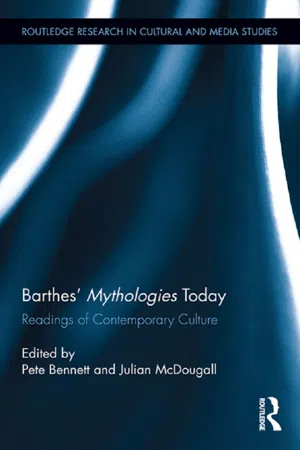
This is Barthes' seminal text reimagined in a contemporary context by contemporary academics. Through a revisiting of Mythologies, a key text in cultural and media studies, this volume explores the value these disciplines can add to an understanding of contemporary society and culture. Leading academics in media, English, education, and cultural studies here are tasked with identifying the "new mythologies" some fifty or so years on from Barthes' original interventions. The contributions in this volume, then, are readings of contemporary culture, each engaging with a cultural event, practice, or text as mythological. These readings are then contextualized by an introduction which reflects on the 'how' of these engaging responses and an "essay at the back of the book" which replaces Myth Today with a reflection on the contemporary provenance of both Barthes and his most famous book. Thus the book is at least two things at once whichever way you look: a 'new' Mythologies and a book about Barthes' legacy, an exploration of the place of theory in critical writing, and a book about contemporary culture.
eBook - ePub
Barthes' Mythologies Today
Readings of Contemporary Culture
- 174 pages
- English
- ePUB (mobile friendly)
- Available on iOS & Android
eBook - ePub
Barthes' Mythologies Today
Readings of Contemporary Culture
About this book
Information
Part I Fables of Reconstruction
1 Fables of Reconstruction
DOI: 10.4324/9780203568422-1
The ghost of Roland Barthes is suitably perplexed (Penman, 1981).
This book presents the outcome of a research enquiry, for which an international, interdisciplinary community of authors reimagined Barthes’s collections of Mythologies (1973, 1979), producing new readings of, from, and for the cultural landscape. It has the same aims as we (re)imagine Barthes set out with—to bring to the fore ‘the categories and distinctions through which culture gives meaning to behaviour’ (Culler, 1983: 36). And we hope this book will be put to the same variety of work—as scholarly intervention, academic research, student textbook, and ‘popular’ writing as a ‘stand-alone’ set of readings of and (with) contemporary culture and in comparison to Barthes’s original collections.
The ‘data’ assessed here, through discourse analysis (Fairclough, 1995; Gee, 2011), is textual. Responding to an open call for abstracts, a range of published ‘experts’ in the fields of Media and Cultural Studies and related ‘disciplines’, problematic though such insulations are (Bernstein, 1996), produced essays for this new version of Mythologies.
In the process of inviting and editing this range of work, we were asking a number of questions. What is a myth today? What constitutes theory? And who has the authority to impose a theory on myth? What will the various new mythologies tell us about the phenomenology of myth in culture today? What will these processes for ‘doing theory’ on culture tell us about academic ‘power’ and textual authority? We want, then, to present not only the ‘new’ Mythologies, but to explore what this process means, working with and within mythology, trying perhaps to ‘have it both ways’ (Sontag, 1993: xxxi).
The function of myth is to empty reality: it is, literally, a ceaseless flowing out, a haemorrhage, or perhaps evaporation, in short a perceptible absence (Barthes, 1973: 155).
While reimagining the work of the mythologist as intellectual and pedagogical practice, this collection faithfully reproduces Barthes’s structural presentation. To this end, we leave our exploration of the Barthes myth to the end, in keeping with his presentation of ‘Myth Today’ as a concluding essay, rather than as a framework for the outset. So, like Barthes, we present our collection of mythologies before we overarch and underpin them.
So, we ‘bookend’ the edited collection with two interventions of our own. In these opening pages, we interrogate the essays published here as ‘data’ to elicit findings in relation to myth, theory, and expertise—with specific attention to the significance of these in contemporary Cultural Studies. To this end, we explore the implications of what we publish in relation to recent perspectives on the ‘discipline’ from Grossberg (2010), Turner (2011), Rancière (2012), and Bowman (2011, 2012). And, to conclude, we turn our gaze to ‘Myth Today’, getting inside Barthes so we can speak to myth—to reimagine from the vantage point of looking away from and at its ‘perceptible absence’—just as one must climb the Eiffel Tower to ‘pause’ the excess of its meaning.
In this introduction, we offer two ‘framing’ editorial keynotes. First, we describe and deconstruct four emerging discourses that serve to (partly) categorise the analyses of contemporary myth that follow in the collection. And, second, we assess the significance of this project and its outcomes for the ‘discipline’ of Cultural Studies and its pedagogy.
BARTHES | MYTH
Barthes is not chosen as our ‘vehicle’ coincidentally, or even largely because of his profile within our related disciplines. Mythologies offers a critical approach that is both a pragmatic and a spontaneous engagement with the myths that surround us all in our daily lives. It is, very much as our project must be, a compilation of responses to contemporary concerns and, in particular, issues surrounding mass culture. It includes a significant theoretical essay, ‘Myth Today’ (le Mythe aujourd’hui), but one that emerges from the pragmatic (and, in style, journalistic) ‘readings’ rather than underpinning them.
There are fifty-four ‘readings’ in the original French version, with an additional, and important, theoretical essay, ‘Myth Today’, written out of and after the active readings and thus serving them rather than being served by them. This priority of engagement over theoretical speculation is key to Barthes’s model and our response to it. The 1973 English translation has twenty-eight of the readings, and we offer the same number of ‘reimaginings’ here.
We asked our twenty-eight contributors to reacquaint themselves with ‘the “message” of the author-god’ but then to consciously build ‘a multidimensional space in which a variety of writings, none of them original, blend and clash’ (1977: 146). In other words, we have asked them ‘through’ Barthes to participate: not to reflect but to engage. This is exposing for ‘myth hides nothing’; it renders the world ‘open to appropriation by society’. (1973: 109) This puts it at odds with most conventional forms of academic writing. These negotiations appear explicitly or implicitly. This is our ‘data’. Unlike Barthes, we seek an international and intercultural diversity in our collection. While we resist the notion that his essays are (French) culture-bound or that they are ‘correctly’ read as developing the lineage of Saussurian thinking in the context of French cultural politics, it can be fairly said that there is scope for historical comparison. If Mythologies speaks to an early foray into the political ‘unveiling’ of myth as political action in 1950s Paris, then Mythologies Today wrestles with arguably more complex third orders of meaning—returning with a cynical, even jaded gaze to the arch-mythologist as a signifier—the ‘wildcard’ as mistaken for an orthodoxy. That is all, and that is enough.
METHOD
We derive our methods of discourse analysis from the work of Fairclough (1995) and Gee (2004). The formal academic reading of culture, contemporary or otherwise, can be understood as a ‘figured world’. ‘Figured worlds’ are identified by Gee but attributed to Holland (1998), as ‘socially and culturally constructed realms of interpretation’ (1998: 52). Our concluding essay muses for longer on the mythological status of Barthes himself, but, for certain, our authors here are speaking the interpretive discourse of the culture-scholar within the idioms of such an imposed (and profoundly constructed) realm.
Fairclough (1995) views discourse as triangular—combining the spoken or written language text (here, the essays), interaction between people to interpret the text (here, our editorial ‘mark’), and social practices (the combined effect of our intervention and the existing social relations of expert/peer-academic/apprentice-student reader identities). The layers of epistemology that render myth as being what ‘counts’ must always already reinforce the symbolic power structures at work in textual/cultural pedagogy. Unless, as Barthes understood, our knowledge can depend on the ‘unmasking’ of our own idea—of doing this—a ‘kenosis’, toward this, our concession here is only a gesture.
In reading our mythologies as exercising discourses, we might be accused of confusing or at least conflating the politically systematic, even quasi-scientific/ontological tendencies of semiotics—to reveal the ideological nature of the seemingly ‘natural’ with the poststructuralist epistemological deconstruction of the production of the subject in representation. This is a crude attempt at drawing fault lines, and any such ‘having it both ways’ will be, of course, an inevitable part of our ‘reimagining’. Furthermore, it is our avowed intent to liberate the work of the mythologist from the ‘delimiting’ effects of such insulations—either Barthesian or Foucaultian. If one must ‘get inside’ the Eiffel Tower, the same applies to Barthes himself and to our project. We interrogate mythology as discourse here, but profoundly from within. In Bourdieu’s words, in this way, we contribute to ‘the blurring of the differences between the field of restricted production’ (1984: 157).
FINDINGS: THEORY AND THE EXPERT
From the essays produced by our ‘expert academics’, we identify four emerging discourses of contemporary mythology. The discourses overlap and are not contained and insulated by such categorization, but they demonstrate our ways of understanding this reimagining of theory, as editors and researchers. This is not, of course, simply demonstrative of contemporary culture, or even readings of such. What we deconstruct here is a textual field largely of our making. While the invitation was open, the editorial process of commission, redrafting, and acceptance has been configured along shifting axes, seeking to present sufficient international range to avoid thematic duplication and ensure that the gaze of the reader is upon the ‘now’. As a result, some ‘readings of culture’ were written but do not appear in these pages. They may be published elsewhere, or not at all. Other essays that can be read here have been ‘refocused’, cut down or extended, to comply with our editorial preferences, to be ‘more Barthesian’, to be less ‘academic’. To this end, we asked authors to bracket their academic instincts (to reference, paraphrase, or show how they have mined a ‘field’) and instead to ‘do Barthes’ on contemporary myth. We allowed minimal footnotes, because Barthes used these, but we reserve the luxury of academic references to ourselves in this introduction, imposing a scholarly authority with this apparently more scientific register. What we present is, then, a ‘figured world’ partly of our own construction, and thus, we can no more claim to ‘know’ myth today than Barthes did or could. Our only recourse is to get inside it.
TEMPORAL: REMAINING A TYPE OF SPEECH
The systematic configuration of language as everything along polar, binary lines is and must be, of course, timeless (The ‘classic props of the music hall’ have been replaced by slick routines and lighting which serve to frame a vista of surgical body enhancement and augmentation). And yet, the focus can so we can look at replacement, extension, and response (This essay starts from Barthes’s discussion of myth as semiological system and extends it to consider the history of similar characters and also the impact of their appearance across media forms and across cultural boundaries in a globalised media ecology). Myth remains the ‘master category’, the mythologist the ‘watcher at the crossroads’ (Sontag, 1993: xxi, xxiii):
This essay defines the myth of zombie walks as underpinned by a series of binary oppositions, such as the individual/hive; the political/recreational; and the technological/homemade.
SECONDARY ENCODING: THE REAPPRAISAL AND AFFIRMATION OF SIGNIFICATION
This discourse speaks an impulse to ‘update’ or extend:
Needless to say, Joker’s bullet marked a point, a punch (coup de poing), what we might call a punctuation in the sentence of Batgirl’s narrative; it severed the ‘Bat’ from the ‘Girl’.
It most prominently and profoundly speaks the very stock-in-trade of media and cultural studies, that of the textual expert-scholar, the teacher (The very notion of a ‘Sherlock for our times’ reifies an historical moment as calling for its own distinctive myths, even while Sherlock’s present-day narratives can be read as highly reactionary). The endurance of Barthes is here, the enthusiasm with which our authors speak this discourse of Brechtian ‘einverstandnis’ (Barthes, 1973: 171)—an ‘advanced’ complicity in the form of a metalanguage, which is that of the aesthete but nonetheless compromised by acceptance of this game of ‘hide and seek’ (‘Pippa Middleton’s bottom “too bony”, claim French.’…. The excitement, speculation, and fetishisation reveal something about the order of things … the signification of the body.). Whereas the overlapping, at first glance largely indistinguishable, temporal discourse speaks to the endurance of mythology as an interpretive regime, secondary encoding goes further to endorse the permeability of the regime, beyond the self-referential, toward a grand narrative of myth—even a sense of something prophetic in Mythologies, a playing out in the zeitgeist (If the face of Garbo was an idea, and...
Table of contents
- Cover Page
- Half-Title Page
- Title Page
- Copyright Page
- Dedication
- Table of Contents
- PART I Fables of Reconstruction
- PART II Mythologies
- PART III Barthes’ Myth Today
- List of Contributors
Trusted by 375,005 students
Access to over 1.5 million titles for a fair monthly price.
Study more efficiently using our study tools.
Frequently asked questions
Yes, you can cancel anytime from the Subscription tab in your account settings on the Perlego website. Your subscription will stay active until the end of your current billing period. Learn how to cancel your subscription
No, books cannot be downloaded as external files, such as PDFs, for use outside of Perlego. However, you can download books within the Perlego app for offline reading on mobile or tablet. Learn how to download books offline
Perlego offers two plans: Essential and Complete
- Essential is ideal for learners and professionals who enjoy exploring a wide range of subjects. Access the Essential Library with 800,000+ trusted titles and best-sellers across business, personal growth, and the humanities. Includes unlimited reading time and Standard Read Aloud voice.
- Complete: Perfect for advanced learners and researchers needing full, unrestricted access. Unlock 1.5M+ books across hundreds of subjects, including academic and specialized titles. The Complete Plan also includes advanced features like Premium Read Aloud and Research Assistant.
We are an online textbook subscription service, where you can get access to an entire online library for less than the price of a single book per month. With over 1.5 million books across 990+ topics, we’ve got you covered! Learn about our mission
Look out for the read-aloud symbol on your next book to see if you can listen to it. The read-aloud tool reads text aloud for you, highlighting the text as it is being read. You can pause it, speed it up and slow it down. Learn more about Read Aloud
Yes! You can use the Perlego app on both iOS and Android devices to read anytime, anywhere — even offline. Perfect for commutes or when you’re on the go.
Please note we cannot support devices running on iOS 13 and Android 7 or earlier. Learn more about using the app
Please note we cannot support devices running on iOS 13 and Android 7 or earlier. Learn more about using the app
Yes, you can access Barthes' Mythologies Today by Pete Bennett, Julian McDougall, Pete Bennett,Julian McDougall in PDF and/or ePUB format, as well as other popular books in Social Sciences & Media Studies. We have over 1.5 million books available in our catalogue for you to explore.