This important new contribution to the history of the body analyzes the role of filth as the material counterpart of sin in medieval thought. Using a wide range of texts, including theology, historical documents, and literature from Augustine to Chaucer, the book shows how filth was regarded as fundamental to an understanding of human history. This theological significance explains the prominence of filth and dung in all genres of medieval writing: there is more dung in theology than there is in Chaucer. The author also demonstrates the ways in which the religious understanding of filth and sin influenced the secular world, from town planning to the execution of traitors. As part of this investigation the book looks at the symbolic order of the body and the ways in which the different aspects of the body were assigned moral meanings. The book also lays out the realities of medieval sanitation, providing the first comprehensive view of real-life attempts to cope with filth. This book will be essential reading for those interested in medieval religious thought, literature, amd social history. Filled with a wealth of entertaining examples, it will also appeal to those who simply want to glimpse the medieval world as it really was.

- 244 pages
- English
- ePUB (mobile friendly)
- Available on iOS & Android
eBook - ePub
About this book
Information
1 The Devil in the Latrine
DOI: 10.4324/9780203138076-1
A godly father sitting on a draught,
To do as neede, and nature hath us taught;
Mumbled (as was his manner) certen pray'rs,
And unto him the Devil straight repayr's:
And boldly to revile him he begins,
Alledging that such pray'rs are deadly sins;
And that it shewd, he was devoyd of grace,
To speake to God, from so unmeete a place.
The reverent man, though at the first dismaid;
Yet strong in faith, to Satan thus he said.
Thou damned spirit, wicked, false & lying,
Dispairing thine own good, & ours envying:
Ech take his due, and me thou canst not hurt,
To God my pray'r I meant, to thee the durt.
Pure prayr ascends to him that high doth sit.
Down fals the filth, for fiends of hel more fit.
—Sir John Harington, The Metamorphosis of Ajax1
Among the concerns of medieval theology, one debate was particularly down-to-earth: whether the latrine was a proper place for the praise of God. The thirteenth-century Italian chronicler Salimbene de Adam tells a story in which the devil weighs in on this question:
Quidam religiosus, dum in loco privato ad requisita nature sederet et Deum laudaret, fuit reprehensus a demone quod locus ille non erat ydoneus, sed inhonestus ad Deum laudandum. Cui respondit frater et dixit: “Ita sum divinis laudibus assuetus, quod a laude Dei cessare non possum. Nam, Scriptura teste, didici quod Deus est ubique, ergo ubique est laudandus a suis…. Igitur qui omnem locum dicit nullum excludit. Quapropter et ventrem meum purgabo et Deum meum laudabo.”2
A certain man in religious orders was praising God while sitting on the privy “for the necessities of nature” [Deuteronomy 23.12]. And a demon came and rebuked him, saying that such a place was not suitable and honorable for giving praise to God. But the Brother answered, “I am so accustomed to singing divine praises that I cannot cease praising God. For I learned in the Scripture that God is everywhere; therefore, everywhere is suitable for praising him… . Therefore, I shall praise God while emptying my bowels.”3
The brother castigates the demon for some time, and finally expounds on the similarities between the demon and latrines:
“similia similibus gaudent. Nam omne animal ad sibi simile convertetur. Tu porcus es, immundus es, immundus diceris, immunda diligis et immunda requiris. Factus enim eras ut habitares in celo, et nunc vadis per sterquilinia visitando latrinas.” Cum igitur frater talia perorasset, demon erubuit et recessit ab eo confusus.4
“like rejoices in like. For every animal seeks its own kind. You are a pig: you are impure, you speak impurities; you love impurities; you seek impurities. For you were created to live in heaven, and now you seek out toilets and go visiting latrines.” After the Brother had said these things, the demon blushed and departed in confusion.5
In replying, the brother articulated an important theme of medieval thought: that moral impurity and material impurity are closely allied. Thus cleanliness was indeed next to godliness, and filth and material corruption, no less than sin, were the realm of the devil. So it should come as no surprise that the latrine was regarded as the haunt of demons and that this religious man was not alone in meeting the devil when he went to satisfy the necessities of nature. Similar tales were abundant in the Middle Ages. The story is found, for instance, attached to Gregory the Great.6 As in Salimbene's account, the devil reproaches the religious man for reciting psalms in the privy, whereupon Gregory defends himself, echoing the memorable line, “Ventrem meum purgo, et deum meum laudo,” “I empty my bowels and I praise my God.” Peter the Venerable, abbot of Cluny in the twelfth century, tells the story of monk who was able to expel a demon into a privy: “immundum spiritum per condignum ejus immunditiae locum a domo sua expulit,” “he expelled the foul spirit from his dwelling via the place befitting his foulness.”7 The biographer of Peter told another story in which a monk who had not confessed all his sins was oppressed by a demon; when he completed his confession, casting out his sins, the demon fled to the privy.8 Another story, retailed by Thietmar of Merseburg in the thirteenth century, tells of seven demons who emerged from a privy.9 The Prose Rule of the Céli Dé, an Irish rule preserved in a twelfth- or thirteenth-century manuscript, confirms that “the privy-houses and the urine-houses they are the abode of demons,” and prescribes the blessings to be performed before entering, as well as the prayers permitted in the privy.10 The Cent nouvelles nouvelles, a fifteenth-century French collection of stories, tells of a knight who met the devil in the latrine and struggled physically with him for an hour, and was only able to vanquish him by maintaining a steadfast faith in baptism.11 The Icelandic tale Þáttr Þorsteins skelks describes the ordeal of Þorsteinn, who defies the king's orders that no one should visit the privy alone at night, and finds himself confronted in the privy by a demon. After describing hell, the demon advances on Þorsteinn until vanquished by the ringing of church bells.12 In the early twelfth century, Guibert of Nogent tells the story of a man who witnessed the Devil creeping amongst the sleeping associates of a bishop and finally retiring into the latrine.13 Elsewhere he describes a monk accosted by the Devil in the latrine.14 The Passion of St. Juliana recounts Juliana's encounter with the Devil. Though he appeared to her disguised as an angel, she was able to discern his true identity and cast him into a latrine or dungheap.15 The Life of the fifteenth-century holy woman Francisca or Francesca of Rome tells of the time she was accosted by two demons, who attempted to abduct her to the latrine; she resisted only by keeping a strong faith and by angelic intervention.16 The fifteenth-century theologian Johannes Nider tells the story of a brother who cast out a demon and mockingly told it to repair to the latrine; when the brother later went to use the latrine at night, the devil tormented him so much there that he barely survived.17 The very popular thirteenth-century Dialogue on Miracles of Caesarius of Heisterbach recounts the story of a lay-brother named Albero, who suffered eight days of illness after spotting a devil lurking by the latrine.18 He also tells the story of a priest who encountered the devil in the privy and nearly succumbed to the devil's urgings to hang himself there; finally he purified himself through confession and hence was able to cast the devil out.19
A latent theme runs through all of these stories, most clearly articulated in the version of Caesarius of Heisterbach. The latrine is the realm of filth and danger both material and spiritual. When the man purifies himself—through confession, as in Caesarius, or through faith in baptism, as in the Cent nouvelles nouvelles—the devil is cast out of the privy. Both the latrine and the man undergo purification: it is as if the man himself is a latrine, full of corruption and vulnerable to the devil.
The motif extended past the close of the Middle Ages, appearing in the works of some of the most notable figures of the sixteenth century. The Protestant reformer Philipp Melanchthon is witness to a tradition that assigned the encounter to St. Bernard:
Dicitur de sancto Bernhardo, qui cum aliquando in latrina oraret Psalmos, venit ad eum Diabolus et obiurgavit eum dicens: Quare tu in latrina oras sanctos Psalmos? Respondit ei S. Bernhardus: Illud, quod ex ore exit, Deo offero; sed id, quod infra ex ventre eiicio, tu comedas.20
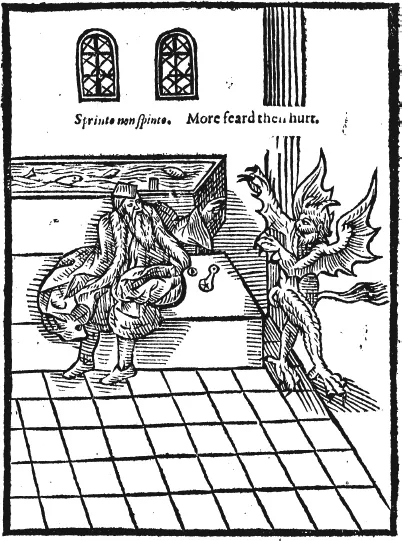
Figure 1 The Devil appears to the hapless man in the latrine. As the latrine is the domain of the rear, and the Devil is its champion, the Devil is backing in and presents himself rear foremost. Illustration of the poem “A godly father sitting on a draught,” from A New Discourse of a Stale Subject, called The Metamorphosis of Ajax (London, 1596), p. 18. “Ajax” is a pun on the contemporary word for a privy, “a jakes.”
It is told of St. Bernard that once when he was praying the psalms in the latrine, the Devil came to him and reproached him, saying, “Why do you pray the holy psalms in the latrine?” St. Bernard answered him saying, “That which comes out of my mouth, I offer to God; but that which I cast down below from my belly, eat it!”
Even more prominently, the Tischreden or Table-Talk of Martin Luther offers another example, most likely an echo of a Latin jingle on the subject. Curiously, Luther proffers the verse shortly after mentioning Melanchthon, though his formulation differs from the version Melanchthon attributes to St. Bernard. The multiple recensions of Luther's version show how widespread the story had become. The rhyme is clear in the first version, in which Luther is said to have cited the following:
Monachus super latrinam non debet orare primam. Deo, quod supra; tibi, quod cadit infra. Ita quidam respondit Diabolo.21
[The Devil]: A monk on the latrine should not pray the hour of prime.
[The Monk:] To God what is above, to you what drops below.
Thus a certain man responded to the Devil.
The motif of God/high, Devil/low is equally clear in the alternate version:
Monachus quidam sedens super latrinam legebat horas canonicas; ad hunc accessit Diabolus dicens: Monachus non debet legere primam super latrinam! Respondit monachus: Purgo meum ventrem et colo Deum omnipotentem. Tibi, quod infra; Deo omnipotenti, quod supra.
A certain monk sitting on the latrine was reading the canonical hours. The Devil came to him saying, “A monk should not read prime on the latrine!” The monk responded: “I purge my belly and I worship omnipotent God. To you, what is below; to omnipotent God what is above.”22
An elaborated version is found in Sir John Harington's Metamorphosis of Ajax, published in 1596 and quoted above as the epigraph to this chapter.23 As we shall see, from the medieval period there are dozens, perhaps hundreds, more serious theological stories centered on this least dignified of human necessities, stories in which the latrine is the focus of evil, a breeding-ground for sin or a locus of damnation.
St. Augustine himself wrote about the issue of whether the latrine was too filthy a place for God's presence. The question arose while he was staying in the country with his mother and friends. His mother had heard his friend Licentius singing a psalm in the latrine and expressed the familiar sentiment that the latrine was too sordid to be associated with God. As Augustine tells the story:
audio Licentium succinentem illud propheticum laete atque garrule: Deus uirtutum, conuerte nos et ostende faciem tuam, et salui erimus. Quod pridie post cenam cum ad requisita naturae foras exisset, paulo clarius cecinit, quam ut mater nostra ferre posset, quod illo loco talia continuo repetita canerentur. Nihil enim aliud dicebat, quoniam ipsum cantilenae modum nuper hauserat et amabat, ut fit, melos inusitatum. Obiurgauit eum religiossima, ut scis, femina ob hoc ipsum, quod inconueniens locus cantico esset. Tunc ille dixerat iocans: Quasi uero, si quis hic me inimicus includeret, non erat deus exauditurus uocem meam.24
I heard Licentius singing, joyfully and loudly, the verse of the prophet: God of virtues, turn to us and show us your face, and we will be saved [Ps 79:8]. The day before, when he had gone outdoors after dinner to satisfy the necessities of nature, he had sung this verse a bit more loudly than my mother was able to bear such things to be sung time and again in such a place. For he gave voice to nothing else, since he had recently learned the way the song went and, as usual, he loved a new melody. That woman, who is most pious, as you know, chastised him for this reason: that it was an inappropriate place for singing. Then he said, jokingly, “As if, truly, were any enemy to shut me in there, God would not hear my voice!”
Augustine goes on to interpret the episode symbolically: the latrine represents the bodily vices, which those who love God must rise above. He explains to Licentius:
Nam illi cantico et locum ipsum, quo illa offensa est, et noctem congruere uideo. A quibus enim rebus putas nos orare ut conuertamur ad deum eiusque faciem uideamus, nisi a quodam ceno corporis atque sordibus et item tenebris, quibus nos error inuoluit? Aut quid est aliud conuerti nisi ab immoderatione uitiorum uirtute ac temperantia in sese attolli? Quidue aliud est dei facies quam ipsa, cui suspiramus et cui nos amatae mundos pulchrosque reddimus, ueritas?25
“For I see that place at which she was offended, and the night as well, as relevant to the song. For what things do you think we pray that we may be converted to God and see his face, if not from a certain filth of the body and its ordures, and also from the darkness in which error has enveloped us? And what else is conversion but to raise oneself up from the excess of vice by means of virtue and restraint? And what else is the face of God but that truth for which we yearn, and that beloved thing which we repay with our own selves made clean and beautiful?”
Here Augustine lays out the essential dichotomies that make up the medieval system of thought about purity and pollution, and that will inform this book. God is associated with cleanliness, rising and the face; sin with excrement, the backside and the latrine. Like many another medieval author, Augustine is quick to use an essential aversion to the latrine as an occasion to think about these matters.
Although Licentius asserted that God would hear him from the latrine, it is significant that he did not claim the latrine as part of the realm of God. The unsuitability of this claim is the subject of a passage in Abelard's Theologia “Summi Boni,” in which Abelard discusses appropriateness in language, and particularly in discussing the divine. His lengthiest example concerns the essential incompatibility of filth and the divi...
Table of contents
- Cover
- Half Title
- Series Page
- Title Page
- Copyright Page
- Contents
- List of Illustrations
- Abbreviations
- A Note About the Translations
- Acknowledgements
- Preface
- 1 The Devil in the Latrine
- 2 Pollution and Filth in the Middle Ages: Material Realities
- 3 The Symbolic Order of the Body
- 4 The Realm of Corruption
- 5 In Conclusion
- Notes
- Bibliography
- Subject Index
- Index of Biblical Passages
Trusted by 375,005 students
Access to over 1.5 million titles for a fair monthly price.
Study more efficiently using our study tools.
Frequently asked questions
Yes, you can cancel anytime from the Subscription tab in your account settings on the Perlego website. Your subscription will stay active until the end of your current billing period. Learn how to cancel your subscription
No, books cannot be downloaded as external files, such as PDFs, for use outside of Perlego. However, you can download books within the Perlego app for offline reading on mobile or tablet. Learn how to download books offline
Perlego offers two plans: Essential and Complete
- Essential is ideal for learners and professionals who enjoy exploring a wide range of subjects. Access the Essential Library with 800,000+ trusted titles and best-sellers across business, personal growth, and the humanities. Includes unlimited reading time and Standard Read Aloud voice.
- Complete: Perfect for advanced learners and researchers needing full, unrestricted access. Unlock 1.5M+ books across hundreds of subjects, including academic and specialized titles. The Complete Plan also includes advanced features like Premium Read Aloud and Research Assistant.
We are an online textbook subscription service, where you can get access to an entire online library for less than the price of a single book per month. With over 1.5 million books across 990+ topics, we’ve got you covered! Learn about our mission
Look out for the read-aloud symbol on your next book to see if you can listen to it. The read-aloud tool reads text aloud for you, highlighting the text as it is being read. You can pause it, speed it up and slow it down. Learn more about Read Aloud
Yes! You can use the Perlego app on both iOS and Android devices to read anytime, anywhere — even offline. Perfect for commutes or when you’re on the go.
Please note we cannot support devices running on iOS 13 and Android 7 or earlier. Learn more about using the app
Please note we cannot support devices running on iOS 13 and Android 7 or earlier. Learn more about using the app
Yes, you can access Sin and Filth in Medieval Culture by Martha Bayless in PDF and/or ePUB format, as well as other popular books in Literature & European Medieval History. We have over 1.5 million books available in our catalogue for you to explore.