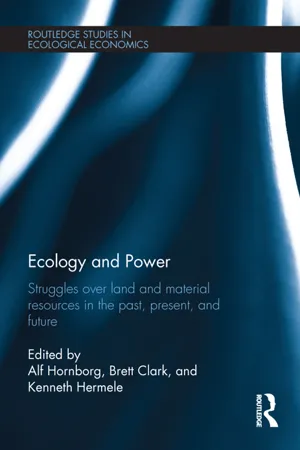
Power and social inequality shape patterns of land use and resource management. This book explores this relationship from different perspectives, illuminating the complexity of interactions between human societies and nature. Most of the contributors use the perspective of "political ecology" as a point of departure, recognizing that human relations to the environment and human social relations are not separate phenomena but inextricably intertwined. What makes this volume unique is that it sets this approach in a trans-disciplinary, global, and historical framework.
eBook - ePub
Ecology and Power
Struggles over Land and Material Resources in the Past, Present and Future
- 304 pages
- English
- ePUB (mobile friendly)
- Available on iOS & Android
eBook - ePub
Ecology and Power
Struggles over Land and Material Resources in the Past, Present and Future
Part I
Theoretical perspectives on historical political ecology
1 Accumulation
Land as a medium of domination
In conventional Western thought, ‘nature’ and ‘society’ have been perceived as separate categories, justifying distinct analytical approaches. Studies of ecosystems, land use, and human–environment relations have gravitated towards natural science, while studies of social structures have remained couched in social science. In several ways, and for many reasons, this dichotomy is currently being challenged. It has become increasingly obvious not only that the biophysical constitution of landscapes to a large extent is a product of social processes, but also that the organization of social systems to a large extent relies on the distribution of biophysical resources. This recursivity between natural and societal systems has taken many forms over the course of human history, yet appears to have been increasingly ignored in the context of globalized, capitalist extractivism. This chapter reviews some of the main ways in which the management of land and land-based resources can serve as strategies for social domination, from more obvious cases of local land tenure through the political demarcation of national and colonial boundaries to unequal global flows of natural resources. In examining such strategies, it is important to identify not only measurable net transfers of energy, materials, hectare yields, or labour time, but also the specific symbolic and ideological images by which unequal exchanges are represented as reciprocal and fair.
Central to a world-system perspective is the concern with accumulation, i.e. the strategies of different groups to enrich themselves through various kinds of exchange. The concept of accumulation (as opposed to the notion of ‘growth’) is generally taken to presuppose some kind of unequal exchange, and unequal exchange in turn tends to be defined in terms of asymmetric transfers of some kind of ‘value’. For Karl Marx and his most orthodox followers, the notion of ‘surplus value’ accumulated by capitalists is thus founded on a theory of labour value, while for the earliest proponents of a theory of ecologically unequal exchange (Bunker 1985, 2007; Odum 1988; Odum and Arding 1991), accumulation is tantamount to a net transfer of energy or ‘natural values’.
As opposed to such conceptual dependencies of theories of ‘accumulation’ and ‘unequal exchange’ on the notion of ‘value’, I believe that it is imperative to maintain an analytical distinction between the material/biophysical and the cultural/semiotic dimensions of exchange. It is obvious that the ‘value’ or attractiveness of a commodity for a given consumer hinges on the cultural preferences of that consumer (Baudrillard 1972; Sahlins 1976; Bourdieu 1984), rather than on the investments of labour or energy made in its production, and that the former cannot be reduced to the latter. Any history of consumption will make it abundantly clear that the first condition for accumulation is that there is a cultural demand for the commodity in question (Wolf 1982; Pomeranz and Topik 1999). In this respect, economists of all persuasions should be in agreement. But, contrary to mainstream economists, we must recognize that a second condition for accumulation is the material organization of production. It is this biophysical dimension of economic processes that the mainstream economists’ preoccupation with ‘utility’ neglects, and that has been the common denominator of the many materialist challenges to this preoccupation from Karl Marx to ecological economics. A crucial task is to offer such a challenge, which acknowledges the biophysical dimension but without equating it with ‘value’.
Rather than posit an ‘unequal exchange of value’, accounts of accumulation need to combine, on one hand, (1) an understanding of the requisite cultural constructions of consumption and market demand, and on the other, (2) an analysis of the specific organization of material resources employed to cater to those demands. This combination of qualitative/semiotic and quantitative/biophysical knowledge is rarely fostered in the current division of labour between disciplines, yet it is essential for understanding the relations between culture, economy, and ecology. Accumulation, and by extension global environmental history, hinges precisely on these relations.
For several millennia, trade has been driven by the aspirations of various groups to enrich themselves, i.e. to accumulate. Long-distance traders saw opportunities to profit from geographical discrepancies between different cultural valuations of commodities. Local elites were enthusiastic consumers of exotic imports that helped to communicate their privileged social positions. In the regions of the world-system where these imports originated, local producers were encouraged to invest labour and transform landscapes to increase their income in response to such distant demand. This general understanding of world economic history is applicable to a very long list of traded commodities over the past few millennia, including a wide variety of exotic foodstuffs, spices, drugs, animal parts, textiles, dyes, metals, and manufactures such as porcelain (cf. Pomeranz and Topik 1999). The social and environmental impacts of such export production, particularly over the last five centuries, have no doubt affected most of the land surface of the Earth. We need only think of the vast impacts of the trade in cotton, silk, sugar, coffee, tea, tobacco, silver, and furs. However, although equally systemic, the environmental impacts of global, long-distance exchange are not as immediately obvious as those of local or regional exchange.
In order to analytically clarify the changing environmental dimensions of the history of world trade, it is useful to distinguish between two main strategies for enhancing accumulation through investments in capital. ‘Capital’ is here defined as investments of labour time and natural resources for the purpose of increasing the productivity of land or labour. The universal incentive for capital accumulation is to increase output, but the extent to which such increases are relative to inputs of labour time or of landscape space depends on circumstances. The rationality of different strategies for capital accumulation, in other words, is socially constructed. With the integration of increasingly wider global markets, the ambition to increase productivity has generally been connected to the imperative to increase competitiveness, which usually means producing commodities at a relatively low cost per unit produced. Measures to lower costs may include increasing efficiency of production (e.g. through mechanization) as well as minimizing costs for labour, land, energy, and raw materials. To increase efficiency generally means to increase the volume of production in order to benefit from so-called economies of scale.
Capital accumulation for the purpose of increasing the productivity of land has been referred to by Harold Brookfield as ‘landesque’ capital (cf. Widgren 2007). This category includes inalienable modifications of land such as irrigation or drainage canals, terraces, raised fields, forest clearance, stone clearance, and soil improvement. In non-industrial societies throughout history, all such changes of the land have required considerable inputs of human labour. Their rationale has universally been to increase output per unit of land, even if it should imply increasing inputs of labour. The accumulation of landesque capital has often been recursively connected to the concentration of human populations in larger communities with more complex divisions of labour, including processes of urbanization. The increased agricultural output per unit of land has made such demographic concentration and socio-economic complexity possible. Conversely, in representing a valuable resource coveted by militant neighbours, the investment in landesque capital has required access to larger populations for purposes of defence. Larger populations have in turn demanded more socio-political complexity and agricultural output, and so on. Even if, as Widgren (ibid.) points out, landesque capital has often permanently improved the conditions for sustainable human land use, there are also examples of adverse effects. Among the diverse environmental impacts of various forms of landesque capital are salinization, deforestation, drainage of wetlands, depletion of groundwater, eutrophication, carbon dioxide emissions, and erosion following abandonment.
If landesque capital is defined as non-detachable investments in land for the purpose of increasing its productivity, what we usually think of as ‘capital’ (pertinently referred to by Amartya Sen as ‘labouresque’ capital) should be defined as investments for the purpose of increasing the productivity of labour. This category of investments can be subdivided into two analytically distinct but interrelated types: (1) education and training resulting in specific types of competence and skill; and (2) technology, widely defined. Beyond the sophisticated local efficiencies of pre-industrial technologies and ‘traditional ecological knowledge’, the accumulation of labouresque capital has generally been recursively connected to a successful engagement in trade, measured as a net appropriation of biophysical resources such as energy, embodied land, or embodied labour. A continuous net gain in access to such resources can be converted into technological growth, as illustrated by the contemporary imports of fossil fuels to the United States, or by nineteenth-century imports of cotton fibre to England (Hornborg 2006). If the accumulation of landesque capital has been recursively connected to population growth, then the accumulation of labouresque capital is recursively connected to unequal exchange. It would be superfluous to exemplify the environmental impacts of technological intensification, whether in the vicinity of industrial factories, the distant sources of their raw materials, the disposal of garbage, or the atmosphere.
This is not the place to rewrite the global history of human–environment relations in terms of capital accumulation and unequal exchange. Suffice it to say that such a project would be both feasible and essential. Once we rid ourselves of the ambition to ground our understanding of unequal exchange in some putatively objective notion of ‘value’, we can focus on the objectively quantifiable net transfers of energy, embodied land, and embodied labour in world trade. Such material transfers have historically been geared to production processes catering to the most diverse cultural desires, whether porcelain from China, cotton textiles from Gujarat (or British imitations thereof), hats from Canadian beaver, ornaments from African ivory, or the taste of Moluccan nutmeg, Mexican cacao, or Virginia tobacco. Global histories of cultural desire are continuously being written, but so far there is no systematic global history of the environmental impacts of these desires, and of the production processes organized to cater to them. The cultural attribution of ‘value’ to commodities such as sable, silver, cinnamon, coffee, or Coca-Cola should not be analytically confused with the biophysical changes in ecosystems subjected to their production. This, of course, applies no less to modern industrial exports such as cars, mobile phones, and computer software. A truly global environmental history would need to systematically examine: (1) how particular constellations of cultural demand have encouraged specific strategies of accumulation and export production; (2) how such interconnected strategies of accumulation have entailed net transfers of energy, embodied land, and/or embodied labour; and (3) how these processes of extraction, production, and transport have affected societies and environments in different parts of the world-system. It would also need to distinguish between environmental problems deriving, respectively, from biophysical impoverishment versus biophysical overload. While extractive zones will tend to experience loss of biodiversity, topsoil, fish stocks, and other vital assets, world-system centres have historically suffered from smog, acidification, eutrophication, accumulation of heavy metals, and problems with the disposal of solid waste. Whereas the former problems result from removal of resources, the latter are associated with a concentration of the use of matter and energy. The emission of carbon dioxide from combustion of fossil fuels is a tangible illustration of the global displacement of entropy associated with capital accumulation. The issue of ‘climate justice’ (Roberts and Parks 2007, 2009) is founded on the fact that such emissions are largely the result of technological accumulation and energy use in the North, whereas their deleterious consequences disproportion-ally afflict the South. Using the atmosphere as a sink for carbon entropy, in other words, is yet another example of environmental load displacement. Such environmental inequalities, of course, recur at various levels of scale within the North as well as the South, but a truly global environmental history must acknowledge that the metabolic rift (Foster 1999; Foster et al. 2010) ultimately polarizes populations and landscapes at the planetary level.
Over the long term, diverse combinations of ‘landesque’ and ‘labouresque’ capital have been accumulated to cater to the demands of markets at varying distances. At our current point in historical time, of course, it ...
Table of contents
- Cover
- Halftitle
- Title
- Copyright
- Contents
- Introduction: Ecology and power
- PART I. Theoretical perspectives on historical political ecology
- PART II. Struggles over material resources in the modern world
- Index
Trusted by 375,005 students
Access to over 1.5 million titles for a fair monthly price.
Study more efficiently using our study tools.
Frequently asked questions
Yes, you can cancel anytime from the Subscription tab in your account settings on the Perlego website. Your subscription will stay active until the end of your current billing period. Learn how to cancel your subscription
No, books cannot be downloaded as external files, such as PDFs, for use outside of Perlego. However, you can download books within the Perlego app for offline reading on mobile or tablet. Learn how to download books offline
Perlego offers two plans: Essential and Complete
- Essential is ideal for learners and professionals who enjoy exploring a wide range of subjects. Access the Essential Library with 800,000+ trusted titles and best-sellers across business, personal growth, and the humanities. Includes unlimited reading time and Standard Read Aloud voice.
- Complete: Perfect for advanced learners and researchers needing full, unrestricted access. Unlock 1.5M+ books across hundreds of subjects, including academic and specialized titles. The Complete Plan also includes advanced features like Premium Read Aloud and Research Assistant.
We are an online textbook subscription service, where you can get access to an entire online library for less than the price of a single book per month. With over 1.5 million books across 990+ topics, we’ve got you covered! Learn about our mission
Look out for the read-aloud symbol on your next book to see if you can listen to it. The read-aloud tool reads text aloud for you, highlighting the text as it is being read. You can pause it, speed it up and slow it down. Learn more about Read Aloud
Yes! You can use the Perlego app on both iOS and Android devices to read anytime, anywhere — even offline. Perfect for commutes or when you’re on the go.
Please note we cannot support devices running on iOS 13 and Android 7 or earlier. Learn more about using the app
Please note we cannot support devices running on iOS 13 and Android 7 or earlier. Learn more about using the app
Yes, you can access Ecology and Power by Alf Hornborg, Brett Clark, Kenneth Hermele, Alf Hornborg,Brett Clark,Kenneth Hermele in PDF and/or ePUB format, as well as other popular books in Economics & Business General. We have over 1.5 million books available in our catalogue for you to explore.