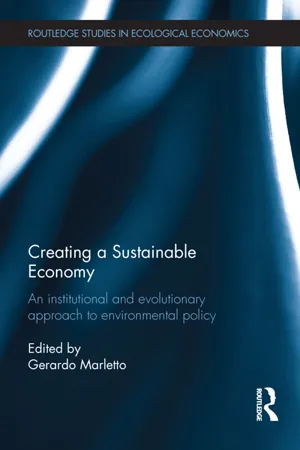
This book is designed for those scholars, students, policy-makers – or just curious readers– who are looking for heterodox thinking on the issue of environmental economics and policy. Contributions to this book draw on multiple streams of institutional and evolutionary economics and help build an approach to environmental policy that radically diverges from mainstream prescriptions. No 'silver bullet' solutions emerge from the analyses. Even market-based tools – such as green taxes or tradable pollution permits – are bound to fail if they are not incorporated into an integrated, multi-dimensional and multi-actor policy for structural change.
eBook - ePub
Creating a Sustainable Economy
An Institutional and Evolutionary Approach to Environmental Policy
- 256 pages
- English
- ePUB (mobile friendly)
- Available on iOS & Android
eBook - ePub
Creating a Sustainable Economy
An Institutional and Evolutionary Approach to Environmental Policy
Part I
A dynamic and systemic analysis of economic change
1 Agency and economic change
Introduction
Neoclassical economics provides too narrow a perspective to deal with behavioral and structural changes in the economy (Henrich et al. 2001b; Fehr and Gachter 2002; Gowdy 2004; Ayres and Bergh 2005; van den Bergh 2007). It focuses on equilibrium outcomes and rationality of market participants, which ignores dynamics occurring out of the equilibrium, bounded rationality, and path-dependent processes. Socio-technical systems and eco-systems coevolve over time, not always in desirable directions. This relates to the fact that increasing returns associated with material infrastructure, production routines, consumer habits, collective frames and institutions determine directions in which changes in the system are unfolding. Over time, they may render lock-in to a single technology or interrelated technologies, which is often illustrated with an example of lock-in to fossil fuel technologies. In this context, structural change may involve, or even require, overcoming behavioral, institutional and technological inertias.
Evolutionary economics provides theoretical concepts and methodological tools to frame dynamics underlying structural change (van den Bergh and Gowdy 2000; Potts 2001; Hodgson 2004). Changes in evolutionary systems are analyzed as a result of variety-reducing selection and variety-generating innovations operating on a diversity of behaviors, institutions and technologies. Populations of heterogeneous elements constitute a prerequisite for selection to act upon. Selection limits diversity of available options, and so the scope for experimenting with variations and combinations of existing options. It can act on the level of individuals and groups leading to multi-level, complex dynamics. In socio-economic systems, two or more evolutionary populations or subsystems can be linked together through mutual adaption processes, leading to coevolutionary dynamics (Winder et al. 2005). Coevolution has been evoked to describe interactions between different populations: industry–technology, gene–culture, ecological–economic systems, demand–supply, behaviors–institutions (van den Bergh and Stagl 2004). For instance, in evolutionary models of demand and supply coevolution, preferences of consumers evolve over time as a result of consumer interactions and technological progress, which in turn affects the direction of innovative activities by firms (Windrum and Birchenhall 1998 and 2005).
Evolutionary economics is one of the pillars of neo-Schumpeterian studies of innovations and technological change. They have inspired a number of policy suggestions regarding how to fuel the process of technological change (Nelson and Winter 1982; Silverberg et al. 1998; Malerba et al. 2008). This includes insights regarding the optimal allocation of investments in different technological options (van den Bergh 2008), polices for creation of market niches (Unruh 2000), un-locking the market (Malerba et al. 2008), or the optimal timing of policy interventions (Zundel et al. 2005). Still, lacking is a coherent evolutionary perspective on policies for behavioral, technological and institutional change. This partially relates to the fact that the notion of the individual in evolutionary economics in not well established and builds loosely on stylized facts from various disciplines (Dosi et al. 2006). As a result, evolutionary economics provides less clear cut policy recommendations regarding individual behavior than neoclassical economics. The aim of this chapter is to explore the contributions of evolutionary economics to policies aimed at inducing structural change and the role of agency therein. The remainder of this chapter is as follows: next we discuss core mechanisms of evolutionary change; following this, the building blocks of agency in evolutionary economics are discussed; then we discuss different types of evolutionary models for environmental policy; the last section concludes.
Mechanisms of evolutionary change
In this section, we discuss the general mechanisms of change in evolutionary systems. In particular, mechanisms of general Darwinism are discussed, which provide a general framework for framing processes in complex evolving systems. Evolutionary changes in one population can occur in response to changes in another population. Different types of coevolutionary dynamics are also briefly presented. The mechanisms of general Darwinism can be applied to explain changes within as well as between groups, leading to multi-level selection. Path dependence and lock-in demand attention too; these notions explain why it may be increasingly difficult to alter pathways of system development over time.1
General Darwinism
Evolutionary economics builds upon insights from general Darwinism, which provides a general framework for dealing with complex evolving systems, consisting of populations of varied and replicating entities (Hodgson and Kundsen 2007, 2008). Accordingly, the interplay of diversity, innovation and selection determines the direction in which changes in the system are unfolding. However, there are concerns that studying economic processes in analogy to natural selection comes at the price of abstraction from details relevant for understanding social systems, such as creativity, intentionality and knowledge accumulation (Levit et al. 2011). Witt (2004) argues that general Darwinism should be treated as a meta-theory about evolution in nature rather than general principles applicable to explain changes in social systems.2 Still, the fact that Generalized Darwinism may need to be augmented by detailed explanations of the specific mechanisms in society and nature, does not imply that the framework is inapplicable to the study of social processes (Hodgson and Knudsen 2006).
A heterogeneous population, consisting of diverse elements or members, is essential for evolutionary dynamics. The greater the heterogeneity or variability of elements upon which selection for fitness can act the greater the expected improvement in fitness. This is captured by Fisher’s principle (Fisher 1930). In innovation studies inspired by evolutionary theorizing, maintaining a diversity of technologies is often recommend for increasing the resilience of the system to unforeseen contingencies so as to ‘keep the options open’. However, at the high levels of policy making, the pursuit of a balanced portfolio of diverse options is not always clearly defined or understood (Stirling 2010). This relates to the fact that diversity is a multi-layered concept. Stirling (2004 and 2007) proposes to analyze diversity as having three properties: variety, balance and disparity. Variety is defined as the number of categories into which a population can be partitioned. As a result, the larger these numbers the larger the diversity is. Balance relates to the distribution of the shares of each category in the population, implying that the more equal the shares, the more even the distribution and the larger the diversity. Finally, disparity refers to the degree to which options differ; it captures the distance between categories. Disparity is a qualitative property, which represents a rather subjective and context-dependent aspect of diversity. Economists often emphasize that diversity may come at other costs, for instance, of foregoing advantages of economies of scale and specialization, conducting a multidisciplinary research or co-ordinating various projects. There is a trade-off between the benefits of diversity and the benefits of specialization, which needs to be addressed by decision-makers (van den Bergh 2008).
Selection encompasses different mechanisms by which certain elements, technologies or policies are chosen from the variety of available options. In the simplest form, selection can be understood in terms of picking a subset from a certain set of elements according to a criterion of preference, referred to as subset selection (Price 1995). Alternatively, selection can be seen by analogy with natural selection as the outcome of two independent processes, namely: replication of an encoded instruction set and differential replication of entities during their interactions (Knudsen 2002). In the economic context, selection can operate on behaviors, technologies and institutions. Selection environments determine which options are more likely to develop and diffuse. For instance, liberalization of the electricity market in the United Kingdom has favored the entrance of new combined cycle gas turbines (CCGT). Although, the technology has been relatively cheap to install due to low capital costs and a short time of setting up CCGT plants, its rapid diffusion cannot be explained solely in this way. A number of policy decisions have been taken that created a selection environment advantageous for the adoption of gas in electricity production. This left behind other promising technologies, such as the fluidized bed boiler (Watson 2004).
Selection acts so as to limit diversity in the system. Ultimately, the system may become dominated by, or locked-in to, a single technology or a constellation of interrelated technologies. The process is counterbalanced by innovation mechanisms, which introduce new options to the population. In neoclassical models, innovation processes are typically deterministic or captured by stochastic improvements in input productivity. On the contrary, in evolutionary theories, heterogeneous firms actively search the landscapes of technical or service characteristics for better solutions or imitate existing (profitable) technologies on the market, following the seminal work by Nelson and Winter (1982). This implies that the opportunities for innovation depend on the existing options in the population. In particular, the existing variety of technologies determines the scope for experimentation with variations or combinations of existing designs. The latter can be a source of modular or recombinant innovations, where components of different technologies are recombined into a new technological option. Recombinant innovation has been shown to be an important source of novelty in the past. For instance, the medieval European printers combined six independent existing technologies: paper, movable type, metallurgy, presses, inks and scripts (Diamond 2005); early mill technology incorporated water mill and sailing solutions (Mokyr 1990). A recent study compares short- and long-term costs and benefits of investing in recombinant innovation using a formal model (Safarzyńska and van den Bergh 2011a).
Coevolution
Structural change can be conceptualized as a non-linear process, where economic, social and technological subsystems interact with each other leading to irreversible patterns of change. During the process, different sub-systems (markets, technologies, institutions, scientific knowledge, etc.), and within them different groups of entities with conflicting interests (producers, consumers, investors, policy makers, universities, NGOs, labor unions, etc.), coevolve affecting the evolution of socio-technological trajectories (van den Bergh and Stagl 2004; Geels 2005; Loorbach and Rotmans 2006). By starting from the notion of representative agents, neoclassical economic models do not allow modeling coevolutionary responses, feedback mechanisms and increasing returns between heterogeneous populations. Formally, coevolution requires that heterogeneous populations are linked together through mutual adaptation and pressure mechanisms (van den Bergh and Stagl 2004; Winder et al. 2005). Evolutionary modeling techniques build explicitly upon the population approach. They allow the conceptualizing of different types of coevolutionary processes, such as between environments and human strategies (e.g., Noailly 2008), technological coevolution (see Safarzyńska et al. 2011), different types of industries (e.g., Malerba et al. 2005), demand-supply coevolution (e.g., Windrum and Birchenhall 2005), behavior and institutions (e.g., Bowles et al. 2003; Hodgson and Knudsen 2004) so as to explore their properties.
In particular, studying three types of interrelated coevolutionary dynamics can offer insights to mechanisms underlying the process of structural change: technological, industry and supply–demand coevolution. Technological coevolution implies that technologies coevolve together shaping each other’s trajectories. For instance, changes in products qualities, the system of their production and use can occur as a result of mutual adjustments and adaptations between two or more technological systems. This can be studied using the NK-model (Frenken and Nuvolari 2004; Caminati 2006; Alkemade et al. 2009). The model has been proposed by Kauffman (1993) as a stochastic method for constructing an adaptive fitness landscape. In the framework, each element of the system is assigned a fitness value, which changes depending on the fitness of other elements. In NK models of technological coevolution, technologies are represented by binary bit-strings; each b...
Table of contents
- Cover Page
- Half Title page
- Routledge studies in ecological economics
- Title Page
- Copyright Page
- Dedication
- Contents
- Notes on contributors
- Preface
- Acknowledgments
- Abbreviations
- Part I A dynamic and systemic analysis of economic change
- Part II Institutional/evolutionary views on environmental policy
- Part III Regime change Three case studies
- Part IV Creating a sustainable economy
- Index
Trusted by 375,005 students
Access to over 1.5 million titles for a fair monthly price.
Study more efficiently using our study tools.
Frequently asked questions
Yes, you can cancel anytime from the Subscription tab in your account settings on the Perlego website. Your subscription will stay active until the end of your current billing period. Learn how to cancel your subscription
No, books cannot be downloaded as external files, such as PDFs, for use outside of Perlego. However, you can download books within the Perlego app for offline reading on mobile or tablet. Learn how to download books offline
Perlego offers two plans: Essential and Complete
- Essential is ideal for learners and professionals who enjoy exploring a wide range of subjects. Access the Essential Library with 800,000+ trusted titles and best-sellers across business, personal growth, and the humanities. Includes unlimited reading time and Standard Read Aloud voice.
- Complete: Perfect for advanced learners and researchers needing full, unrestricted access. Unlock 1.5M+ books across hundreds of subjects, including academic and specialized titles. The Complete Plan also includes advanced features like Premium Read Aloud and Research Assistant.
We are an online textbook subscription service, where you can get access to an entire online library for less than the price of a single book per month. With over 1.5 million books across 990+ topics, we’ve got you covered! Learn about our mission
Look out for the read-aloud symbol on your next book to see if you can listen to it. The read-aloud tool reads text aloud for you, highlighting the text as it is being read. You can pause it, speed it up and slow it down. Learn more about Read Aloud
Yes! You can use the Perlego app on both iOS and Android devices to read anytime, anywhere — even offline. Perfect for commutes or when you’re on the go.
Please note we cannot support devices running on iOS 13 and Android 7 or earlier. Learn more about using the app
Please note we cannot support devices running on iOS 13 and Android 7 or earlier. Learn more about using the app
Yes, you can access Creating a Sustainable Economy by Gerardo Marletto in PDF and/or ePUB format, as well as other popular books in Business & Business General. We have over 1.5 million books available in our catalogue for you to explore.