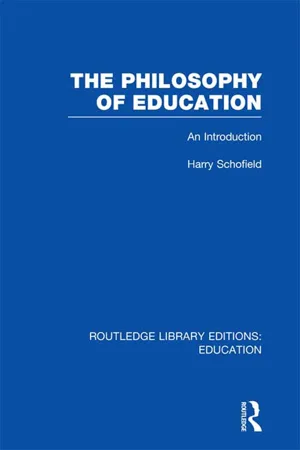
There are many students who find philosophy of education difficult, because they have never received teaching in the basic essentials of general philosophy. This book begins by asking the basic question 'what is philosophy?' and examines a number of possible answers. Step by step the reader is introduced to the modern techniques of linguistic and concept analysis. Whenever a technical term is used it is explained and illustrated by reference to familiar situations in everyday life.
The Meaning and Function of Philosophy and Educational Philosophy
The word ‘philosophy’ frequently causes a feeling of apprehension in the average man and even in the average student. Both believe that it deals with mysterious matters far removed from everyday life and that it traffics in ideas which only the brilliant few are capable of understanding. Such apprehension causes the average man (and the average student) to close his mind firmly against philosophy.
THE ORIGIN OF THE WORD ‘PHILOSOPHY’ AND A DEFINITION
The word ‘philosophy’ comes from the Ancient Greek noun
(philosophia) which literally means ‘love of wisdom’. The word ‘wisdom’ is somewhat old-fashioned nowadays and the expression ‘love of wisdom’ causes little less apprehension than the word ‘philosophy’ itself. It suggests abstract and even other-worldly ideas and that strange area of philosophical investigation – metaphysics. The word ‘metaphysics’ comes from the Greek expression ‘ta meta physica’ – ‘things beyond the physical realm’ – and again we feel mysterious associations which suggest that philosophy is beyond us.
Moreover, if we turn to the writings of Bertrand Russell, one of the most lucid exponents of philosophy, and read his definition of the word ‘philosophy’, we are more certain than ever that our fears about its difficulty were well founded. Russell (1) writes:
‘“Philosophy”, as I shall try to understand the word, is something intermediate between theology and science. Like theology, it consists of speculations on matters as to which definite knowledge has, so far, been unascertainable; but like science, it appeals to human reason rather than to authority, whether that of tradition or that of revelation. All DEFINITE knowledge, so I should contend, belongs to science; all DOGMA as to what surpasses definite knowledge belongs to theology. But between theology and science there is at no-man’s-land exposed to attack by both sides; this no-man’s-land is philosophy.’
We shall have need to refer on many occasions throughout this book to the terms ‘speculation’, ‘reason’ and ‘types of knowledge’, but our overall impression of the quotation is that it offers little comfort and merely tells us that philosophy deals with vague matters, which is what we suspected before turning to Russell for help and comfort.
Furthermore, Scheffler (2) suggests that it is not only the average man who shies away from philosophy and believes that it offers little help to him. Scheffler says that in the past and still to some extent in the present professional philosophers and professional educators come together as ‘relative strangers in an academic landscape’. The professional educator cannot see how the general philosopher, who can give no definite answers even to general problems in the same way that science can give definite answers, can throw light on educational problems. The sole purpose of this book is to show that philosophy can help not only professional educators, but also practising teachers, however experienced or inexperienced they may be in their chosen profession. It is never too early or too late to enlist the help of philosophy.
In the first place, nothing is ever achieved in life by running away from problems and situations which overawe us. The child who states emphatically that he hates cabbage without ever having tasted it, denies himself the opportunity of ever coming to like it. In addition, every time cabbage forms part of the family meal, there is a tense atmosphere caused by the parents insisting that he must eat cabbage because it is good for him, and the child, with mounting frustration, flatly denying that he will eat cabbage. Consequently, for the child cabbage comes to be associated with his parents’ anger, just as Pavlov’s dog associated the ringing of a bell with the appearance of food (3), and a perfectly harmless vegetable becomes highly emotionally-toned for that particular child.
Similarly, those who visit psychiatrists are often there for no other reason than that they regularly fail to face up to problems and consequently become afraid of all problems. They try to push the fear out of their conscious mind, but they do not prevent the fear from continuing to work destruction. When they can endure the mental agony no longer, they resort to the psychiatrist. He brings them face to face with their fears and prevents their running away. Only in this way can the fears be destroyed.
Like the child, we shied away from the word ‘philosophy’ and like the psychiatrist’s patient we ran away from Russell’s definition of philosophy. It is now time that we faced the situation, to decide whether in fact it is as bad as we feared. If we read what Russell writes directly after the passage quoted, he says that the term ‘philosophy’ can be used and indeed has been used ‘in a number of ways’. Immediately we realize that the terrifying ‘no-man’s-land’ idea may not be the only one available. Furthermore, he writes that the term may be used in a wider or a narrower sense. These two ideas tempt us to think that possibly the term may be used in a simpler way. Assuming that it can, and because we have already seen that philosophy concerns itself with speculation, we will define philosophy as ‘the process of asking questions’ and see where this definition leads us.
THE PROCESS OF ASKING QUESTIONS
We have now come from a very complex definition to a very simple one, and it is possible that we have oversimplified matters in the transition. We can think of some questions that merely arouse the original fear in our minds, such as the one asked elsewhere by Russell. He says that a philosophical question may be ‘Is there a china tea-pot between earth and Mars revolving in elliptical orbit?’
Again, the thought occurs to us that many people besides philosophers ask questions, and we wonder if all philosophical questions must be like the example which Russell gives to us. It will help at this point if we return to our original definition (by translation) of ‘philosophy’ as ‘love of wisdom’. Since we are attempting to simplify matters, let us substitute the more everyday word ‘knowledge’ for ‘wisdom’. A moment’s thought tells us that, young as we are, we have acquired a tremendous store of knowledge (or wisdom), that the process began in infancy and largely consisted of asking questions. We did not approach philosophers for the answers, but, by asking questions of our parents, teachers, friends, we obtained knowledge. Nor was the knowledge which we acquired in this way, i.e. by asking questions, ‘metaphysical’ or unrelated to daily life. But there were times when we asked difficult questions, such as ‘Where was I before I was born?’ or ‘How was I born?’, which caused the people we asked no small difficulty. Without being taught to ask questions, we formed of our own accord a connection between wanting to know and asking questions. It is a simple matter now to suggest that the philosopher, wanting to know the answers to certain problems, asks a certain type of question.
Our apparently naïve and over-simplified definition of philosophy as ‘the process of asking questions’ has a famous precedent. No less a person than Plato’s teacher Socrates used the question and answer technique, which came to be known as the Socratic method, in his search for true knowledge. The questions which he asked and the answers he received, and the conclusions which he came to, are recorded in the philosophical dialogues of Plato.
Moreover, Socrates asked questions in order to clarify people’s ideas, to ‘rid their minds of error’, as he called it. He believed that too many people accepted ideas at secondhand without ever questioning them. Once they had acquired them, they applied them automatically, without any real understanding of them, and in some cases gained an unjustified reputation for wisdom. Socrates, on the other hand, said that he himself was the wisest man in the world because he did not pretend to know what he did not know. His wisdom consisted of recognizing his own limitations. By asking questions, he attempted to rid his own mind and the minds of other people of preconceived ideas, which were often a barrier to understanding. We shall find, throughout this book, that once we begin to ask questions we are frequently forced to abandon many preconceptions, often those which we hold most dear. It is not comfort to either intending or practising teachers to know that we are just as prone to these preconceived ideas as anyone else. In view of what we have said already it is clear that philosophy, at least in the form of asking questions, can be practically useful to us.
Some of Socrates’ questions are of the metaphysical kind. When he asks ‘What is justice?’, he is being just as metaphysical as Pontius Pilate when he asked Christ ‘What is truth?’ At other times, the questions he asks are everyday ones, such as that directed at Cephalus (4): ‘But has your property, Cephalus, been chiefly inherited or acquired?’ There is certainly nothing mysterious or other-worldly here.
However, we must notice now one of the greatest weaknesses of the Socratic method, namely that it is easy to ask ‘loaded’ questions. ‘Loaded’ questions are those which compel the person whom we are questioning to give the answer which we require to suit our purposes. In a court of law such questions are called leading questions, and no judge will allow counsel to use them when interrogating a witness, because they make the witness, who can answer only ‘Yes’ or ‘No’, condemn himself out of his own mouth. The questions of the prosecutor ‘lead’ him to the answer which the prosecutor needs to clinch his case.
It is easy to see, then, that philosophical questions asked in the quest for true knowledge must not be loaded but impartial. They must not reflect the preconceived ideas and bias of the person asking them. The questioner must keep an open mind throughout his investigation and be scrupulously fair in the questions he asks.
One of Socrates’ victims becomes very indignant when he realizes that the questions asked of him are loaded (5): ‘This is scandalous, Socrates. You understand my doctrine in the sense in which you can damage it most easily.’ In the present century, Ryle (6) warns against the same thing when he says that he becomes most angry in his writings when he sees in other people the assumptions, prejudices, and bias which he realizes he himself has.
Emmet (7) says that questions which make ‘illegitimate assumptions’, which ‘beg the question’, are the most frequent sources of error in the history of philosophy. This is a further indication that even great minds can become victims of this fault. It also warns us, who are not great minds, that we must be extra careful when we ask questions. Teachers are particularly prone to ask loaded questions when tackling philosophical problems, because in their daily routine they frequently use a loaded question to make a pupil give them the correct answer, as an alternative to providing him with the information. When the matter is of fact, the method is legitimate, because facts are certain. But, philosophy often asks questions in the realm of beliefs, and loaded questions here are illegitimate. We may find when we begin to ask questions about educational problems that we expose false doctrines and destroy them. If this is done, it must be as the result of asking fair questions.
In order to chart the no man’s land which Russell said was philosophy, we must determine not only what sort of questions the philosopher is entitled to ask, but also the areas in which he can legitimately ask them. We hinted at this when we said that not only philosophers ask questions. In other words, not all questions are philosophical questions.
THEORETICAL AND EMPIRICAL QUESTIONS
Some questions can be answered in the laboratory, while others cannot. The former are empirical questions, and Russell, in his definition, suggested that this sort of question belongs to science, the area of definite knowledge. The other type of question was described by Russell as speculative. We also refer to these as theoretical questions and again we use a Greek word which was used in a philosophical context by Aristotle (8). The Greek noun
(theoria), as used by Aristotle, referred to a state of contemplation or speculation. This theoretical state was the supreme state of happiness, and one cannot measure happiness in the laboratory. Similarly, Plato’s Guardians (9) ‘contemplated the good’ (rather similar to studying philosophy). Again, one cannot measure the good in the laboratory.
Speculative or theoretical or contemplative questions, then, are not scientific, since they cannot produce in the laboratory answers on which certain knowledge or definite knowledge is based. These questions may belong to the realm of theology, as Russell indicates, but they may equally belong to philosophy. This point will become clearer in a moment. Speculative or theoretical or contemplative questions require us to ‘sit down and think’, in order to obtain an answer.
The word ‘empirical’ is derived from the Greek noun empeiria, meaning ‘experience’. Thus, empirical questions can be answered by our own direct experience. We can test the rightness or the wrongness of the answer. To answer empirical questions, we must ‘get up and do’. We can illustrate these two types of questions by very simple examples.
Let us assume that I am sitting on the beach and somebody asks me, ‘Is the sea warm today?’ If I have already been in for a swim, I can give him a certain answer based directly on my own first-hand experience. If he sees that I am wearing swimming trunks and that my skin is still wet, he can assume that the experience on which I base my answer is recent experience and therefore reliable. If the same person asks me the same question when I have not been in for a swim, it is probable that my answer would be, ‘I’m sorry. I cannot tell you, because I have not been in.’
However, let us assume that I am undecided whether to go in the water or not, because I am not certain that it will be warm enough for my liking. I then pose the question ‘Is the sea warm today?’ to myself. It is possible to arrive at a theoretical answer. I can summon all the evidence which I know is relevant, such as what time of year it is, what time of day it is, whether the sun is out or not, and how long it has been out. All these pieces of evidence help me to come to a conclusion about the temperature of the sea. But there is still an ‘element of doubt’. Perhaps I have got my facts wrong about the temperature of the sea at certain times of the year or of the day. I can be ‘pretty sure’ of my facts but not ‘absolutely’ sure. The only sure way to remove the lingering doubt is ‘to get up and do’, to go and put my hand in the water. In these circumstances, it is probably quicker, and certainly more effective, to go and test the water in the first instance, than it is to sit and theorize about its warmth.
But as I sit on the beach, instead of asking myself ‘Is the sea warm today?’, I might well ask myself ‘Where did the sea come from originally?’ A certain theoretical line of reasoning may lead me to ask further questions: ‘Is there a God?’, ‘Did God create the sea?’ I have now asked myself four questions as I sit on the beach. I can answer the first one, which is a very ordinary, everyday sort of question, either by speculation (sitting and thinking), or empirically (getting up and doing). In the case of the remaining three questions, I cannot go and do; I can only sit and think, contemplate, speculate, theorize. I can avail myself of experience in my theoretical answers, but not of direct experience. To have learned the theories of philosophers and theologians is a sort of experience, but not the same sort as that experience where I went and put my hand in the water. In answering the last three questions I must avail myself of ideas. After considering my own theories and those of other people that I recall, I may arrive at an answer which satisfies me, or I may not. In neither instance is there any final arbiter, any conclusive evidence equivalent to testing the warmth of the sea with my hand.
From the above examples it becomes clear why Russell assigns all DEFINITE knowledge to science. Science...
Table of contents
Cover Page
Half Title page
Title Page
Copyright Page
Original Title Page
Original Copyright Page
Dedication
Acknowledgements
Contents
Author's Preface
1 The Meaning and Function of Philosophy and Educational Philosophy
The First Trilogy: Education Training Child-Centredness
Link Chapter: Aims
The Second Trilogy: Culture Curriculum Liberal Education
The Third Trilogy: Value Judgments Values Morals
Bibliography
Index
Trusted by 375,005 students
Access to over 1.5 million titles for a fair monthly price.
Study more efficiently using our study tools.
Frequently asked questions
Yes, you can cancel anytime from the Subscription tab in your account settings on the Perlego website. Your subscription will stay active until the end of your current billing period. Learn how to cancel your subscription
No, books cannot be downloaded as external files, such as PDFs, for use outside of Perlego. However, you can download books within the Perlego app for offline reading on mobile or tablet. Learn how to download books offline
Perlego offers two plans: Essential and Complete
Essential is ideal for learners and professionals who enjoy exploring a wide range of subjects. Access the Essential Library with 800,000+ trusted titles and best-sellers across business, personal growth, and the humanities. Includes unlimited reading time and Standard Read Aloud voice.
Complete: Perfect for advanced learners and researchers needing full, unrestricted access. Unlock 1.5M+ books across hundreds of subjects, including academic and specialized titles. The Complete Plan also includes advanced features like Premium Read Aloud and Research Assistant.
Both plans are available with monthly, semester, or annual billing cycles.
We are an online textbook subscription service, where you can get access to an entire online library for less than the price of a single book per month. With over 1.5 million books across 990+ topics, we’ve got you covered! Learn about our mission
Look out for the read-aloud symbol on your next book to see if you can listen to it. The read-aloud tool reads text aloud for you, highlighting the text as it is being read. You can pause it, speed it up and slow it down. Learn more about Read Aloud
Yes! You can use the Perlego app on both iOS and Android devices to read anytime, anywhere — even offline. Perfect for commutes or when you’re on the go. Please note we cannot support devices running on iOS 13 and Android 7 or earlier. Learn more about using the app
Yes, you can access The Philosophy of Education (RLE Edu K) by Harry Schofield in PDF and/or ePUB format, as well as other popular books in Education & Education General. We have over 1.5 million books available in our catalogue for you to explore.