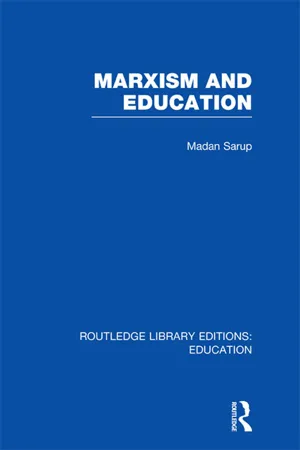
This book introduces the student to the various phenomenological and humanistic Marxist perspectives as they are being applied to education and provides an account of the strengths and weaknesses of these perspectives, drawing on a variety of disciplines in order to explain the controversies described. The opening chapters deal with the phenomenological perspective in the sociology of education, discussing its adoption of a phenomenological model of man, its use of anthropological studies, the importance of classroom studies, and its rejection of the 'liberal' philosophy of education. The aim is to show the significance of these ideas for education, with a discussion of the concept of alienation and schooling, developments in Marxism such as the focus on the mode of production and the labour process, and the political economy of education.
eBook - ePub
Marxism and Education (RLE Edu L)
A Study of Phenomenological and Marxist Approaches to Education
- 4 pages
- English
- ePUB (mobile friendly)
- Available on iOS & Android
eBook - ePub
Marxism and Education (RLE Edu L)
A Study of Phenomenological and Marxist Approaches to Education
About this book
Information
Part One
Some Features of the
New Sociology of
Education
Chapter 1
The Injunctions of the
New Approach
A new approach has revolutionized the sociology of education. Its main expression and source of inspiration has been the book edited and introduced by Michael F.D. Young, Knowledge and Control. Its contributors have differing perspectives and concerns, but the collection of papers, particularly those by Young, Esland and Keddie, expresses criticism of the traditional sociology of education. This ‘new sociology of education’ has been described as a fundamental change within the sociology of education.1 What then were its main criticisms of the traditional sociology of education, and what did the alternative approach suggest we do?
Michael Young begins the ‘Introduction’ by making two criticisms of the prevailing conception of sociology of education: the absence of theoretical discussion, and the failure to question the assumptions on which much of the ‘conventional’ work is based. Serious debate had been limited to the ‘problem of order’ in areas such as stratification, deviance and politics, and discussions of the work of Durkheim, Weber and Marx are rarely included in the traditional textbooks on the sociology of education. By the ‘problem of order’ I mean the problem of how society manages to cohere. Durkheim, Weber and Marx held differing views about this. The traditional, Durkheimian, view is that individuals cannot create and maintain order, and that constraint, through internalization, is therefore necessary for society to exist. Society must define social meanings for individual actors who are merely a reflex of the social system.
The second criticism is that in the past sociologists accepted educational problems, and their own implicit assumptions are ‘taken for granted’. They raised important issues, but they did not examine or question their basic presuppositions such as, for example, what it was to be educated. By treating ‘what it is to be educated’ as unproblematic, or consensually agreed, their work could be utilized for the purpose of legitimation of the existing political order.2 In other words, we should not take for granted existing definitions of education reality but should inquire what implicit assumptions lead to some questions but not others, or some ‘answers’ but not others, to be accepted as correct or valid. In the eighteenth century feudal and clerical dogmas were taken for granted, and in the nineteenth century it was the assumed absolutism of the market and its laws that were unquestioningly accepted. Today it is the ‘scientific’ and the ‘rational’ that are dominant in our lives. Certain social, political and educational beliefs are assumed to follow from the unquestioned acceptance of these legitimizing categories. There should, therefore, be critical questioning of whatever is taken for granted, ‘as a matter of course’.
As I cannot hope to provide a comprehensive exposition of Michael Young’s writings, what follows is a selective account. His basis thesis of 1971 could perhaps be put in this way: The ‘liberal philosophers’ like Richard Peters and Paul Hirst start from a priori assumptions about the forms of knowledge. They have an absolute conception which justifies what are no more than the socio-historical constructs of a particular time. Their view ignores the point that knowledge is a selection and organization from the available knowledge at a particular time, which involves conscious or unconscious choices. As curricula often come to be defined in terms of the dominant group’s ideas of the educated man, we can ask: What model of man is implicit in the views of the ‘liberal philosophers’?
Michael Young argues that it is not only people but knowledge that is processed, and, if this is so, we can ask questions about the selection and organization of knowledge. There have been various contributions, of course, to our study of knowledge; the Marxist, Weberian, the Durkheimian traditions, for example, have been valuable, but, till now, the curriculum has not been studied.
The most challenging aspect of Young’s thesis is the suggestion that we treat knowledge, or what counts as knowledge, as socially constructed. Discussing this, he notes:3
That knowledge is socially constructed means that the knowledge transmitted in education is neither absolute nor arbitrary but are available ‘sets of meanings’ which do not ‘emerge’ but are collectively given. What is regarded as ‘logical’ or ‘valid’, is based on various standardized models which are necessarily sets of shared meanings which come to be taken for granted. The ‘rules’ of the standardized model are negotiated and selected in accordance with the purpose of the discourse, or the intentions of the enquirers. One of the outcomes of this view is that teachers may take these ‘rules’, these shared, meaningful conventions of what is considered logical, sensible, good reasoning, for granted and then see the failure to comply with the social conventions of teachers as forms of deviance. This does not imply anything about the absolute ‘rightness’ or ‘wrongness’ of the teachers’ or pupils’ statements but does suggest that the interaction involved is in part a product of the dominant defining categories which are taken for granted by the teacher.
And so it follows that we should explore how and why certain dominant categories persist and their possible links with sets of interests and occupational groups. We should also consider the influence of the traditions of a centralized elite which has close links with those holding economic and political power. It should be noted however that neither a mechanistic-deterministic nor a crude conspiracy theory is being referred to here. It is possible that certain educational theories come to be accepted by teachers who begin to act on the basis of these assumptions. Some theories become institutionalized and then are used to legitimate our practices, which, in circular fashion, justify the theories. One of our tasks therefore is to enquire into our institutionalized educational theories and practices and to ask: How has it come about that western academic standards are treated as if they were absolutes?
What Michael Young calls for is a focusing on the relation between social stratification and the stratification of knowledge, that is to say, the social value accorded to different areas and kinds of knowledge. By this means we can raise questions about:
| 1 | The relations between the power structure and curricula. |
| 2 | The access to knowledge, and how certain forms of it come to be legitimated as superior to other forms. |
| 3 | The relations between knowledge and its functions in different kinds of society. |
Then, as if to give us an example, he raises some questions concerning the organization and transmission of knowledge that is accorded ‘high status’ in our society. He notes that it is taught to the ‘ablest’ children, usually in homogeneous ability groups, and is then formally assessed. He suggests that academic curricula, high-status knowledge, tends to have ‘abstractness’, a high level of literacy, minimum relatedness to non-school activities, and a stress on individual performance. These dimensions are social definitions of educational value and they persist because they are the choices which accord with the values and beliefs of dominant groups at a particular time. But these values legitimate the existing organization of knowledge in such a way that even the discussion of alternatives in our society is, for many reasons, difficult. He however does pose the question: Could we not change the criteria of high-class knowledge so that it is concrete rather than abstract, oral rather than literate, related rather than unrelated, and communal rather than individual?
In a later section, where I suggest that one of the important features of the ‘new sociology of education’ is its use of anthropological studies, I attempt to show by a consideration of Gladwin and other ethnographers that it is possible to conceive of the possibility of the granting of equal status to other sets of cultural choices. That this is possible is because ‘education’ is – and this is often ‘forgotten’ – a social construct. There would of course be changes in such labels as ‘success’ and ‘failure’, but if many were successful rather than a few, this would entail a parallel redistribution of rewards in terms of wealth, prestige and power.
In brief, this is Michael Young’s thesis. Till now, there has been no sociological study of the curriculum, of school knowledge. He proposes that we accept the notion of curricula and forms of assessment as social constructs, that ‘knowledge’ and education are inventions just like man’s other inventions. He then outlines the beginnings of the project and argues that we should adopt a new approach and consider alternatives for a radical, political purpose.
The above is a very schematic outline of just the first six pages of the Introduction to Knowledge and Control, but from even such a short section some important features of the reorientation in the sociology of education can be stated in the form of several interlinked propositions. Let us now turn to these ‘injunctions’, many of which have become the assumptions of most of those who support the ‘new’ sociology of education.
Some Propositions of ‘the New Approach’
1 There should not be an absence of theoretical debate in the sociology of education
It can be convincingly argued that traditional sociology of education was an elaboration of readers’ common sense (which is why it is, in some ways, so appealing); till recently, at any rate, it was considered a parasitic discipline. But since the distinction between sociology and sociology of education is breaking down, it is not now possible to say that sociology of education draws on a ‘parent’ discipline. It is my opinion that the importance of sociology of education, in terms of its general contribution and insights, is increasing. The boundaries between sociological theory, sociology of knowledge and sociology of education are becoming increasingly indistinct. There is a growing awareness that the split between the ‘pure’ (sociological theory) and the ‘applied’ (sociology of education) is unproductive.
2 There should be continuous critical questioning of the ‘taken for granted’
This proposition, or process rather, is not the exclusive feature or property of any one perspective, but in this context can perhaps be seen as an integral part of a phenomenological approach. This self-awareness, critical self-consciousness, is now one of the meanings of ‘reflexivity’.
Phenomenology is a philosophical tradition and a movement with a close connexion with many areas of discourse, and is slowly influencing sociology. Husserl and Schutz, for example, believed that philosophizing must begin by not taking anything for granted. In our everyday experience we do not normally raise fundamental questions; we leave them unexamined. Our consciousness is buried in our concern for the natural, everyday world, and we live in the ‘natural attitude’. Phenomenologists say that we must first suspend, or ‘put into brackets’, the natural attitude. This is the phenomenological ‘reduction’ or epoché which has been likened to successive peelings off of layers of thought previously taken for granted in order to see what is left, what is presented or construed as essential by thought.
We are urged, then, to make problematic notions such as ‘scientific’, ‘rational’, ‘childhood’, ‘the pupil’ – and ‘education’.4 Most of the work undertaken in these areas has started from prior assumptions which have been of a limiting and restricting nature. It is for this reason that in the ‘new approach’ the work of anthropologists is utilized; by looking at other cultures, and then at our own, certain aspects of our own culture which we have always regarded as ‘natural’, appear in a new light, as anthropologically strange. Anthropology contributes to the examination of our taken for granted suppositions and shows us that there are alternative conceptions of ordering the world.
3 There should be a move towards treating knowledge, or what counts as knowledge, as socially constructed, and a study of the implications that follow from this
This injunction may be seen to contain within it the following overlapping assumptions which are implicit: a rejection of positivism and of objectivist epistemology, and the adoption of the notion that reality is socially constructed. The thesis that knowledge is socially constructed is part of a wider thesis that reality is a social construction. This view is based on the notion that it is not the ontological structure of objects but the meaning of our experiences which constitute reality.5 This means that there is no inherent, intrinsic meaning within objects as if they were ‘facts’ obvious for all to see. Even so-called ‘facts’ have to be interpreted, and in this process we give meaning to objects, situations and experiences. The abortion of a child can be a happy occasion for some mothers and a sad loss for others, according to how they choose to see it and how they explain, or make sense, of it to themselves. That is to say, the reality of the social world is constructed by its members in terms of their accounting procedures for explaining it.
If social reality is conceived in this way as socially constituted and not ‘out there’, existing unproblematically, as is assumed in some versions of the correspondence theory of truth, then a criticism of traditional sociology, with its emphasis on scientific method and measurement, was inevitable. One of phenomenology’s strongest contributions to our understanding of the social world is its critique of positivism, and this has influenced some writers to reject any theories of knowledge based on an ‘objectivist’ epistemology, and treat knowledge as if it was fixed and not relative. Many teachers have taken Paul Hirst, for example, to be saying (and acting in the classroom on the supposition) that knowledge is not relative but fixed, and that some types of knowledge, ‘the forms’, are intrinsically superior to others, ‘the fields’. It has already been argued that such a view of knowledge, entailing a passive learner, is fundamentally conservative and elitist. It institutionalizes present practices, legitimizes them; most important, such views of knowledge can be seen as an ideology serving the interests of those who wish to resist radical educational and, therefore, political change. What is being urged by writers sympathetic to the new approach in the sociology of education is that we should not necessarily regard academic curricula as superior; that if we move towards treating knowledge, or what counts as knowledge, as socially constructed, we can recognize such academic curricula as human constructs limiting access to a privileged few – and that this need not be the case.
The rejection of positivism and objectivism, implied by the adoption of a phenomenological perspective, meant that there was a new stress on what can be called, for present purposes, a phenomenological ‘model of man’. One of the most important features of such a model is the notion of intentionality, which is used to distinguish human ‘action’ from ‘behaviour’. Phenomenologists hold that all mental activities are always directed towards some object. In brief, intentions determine relevance, and order thought. What is stressed is the individual’s own mental ordering processes – that man is a meaning maker. Some sociologists have been excited, ‘turned-on’ by this way of seeing the world and have emphasized phenomenological sociology as a method of transcending the experienced realities of life day after day. If reality is constructed by our consciousness, our minds, then we are free despite material conditions that may oppress us; by choosing to see them differently we have a way of attaining freedom. These views, usually implicit, are based on a phenomenological model of man and I think can be most clearly explicated by a rendering of Sartre’s work which emphasized the notion that man is free, to choose, to transcend oppression.6 This exposition will be done in a following section, but it is relevant for my present purpose to point out here that the presuppositions of a phenomenological ‘model of man’ are linked with a view of knowledge, through such notions as intentionality and meaning. Thus it comes about that the new approach suggests that knowledge is shared; that truth and objectivity are human products, and that knowledge is extricably linked to methods of coming to know. Man is the author of knowledge and reality.
4 There should be a move to accepting members’ categories and explanations as valid ways of making sense and giving meaning
This methodological injunction is in marked contrast to the traditional approach which relied almost entirely on the observer’s categories and the meanings he inferred; moreover, the observer was presented as having the so-called objective, value-free characteristics of a natural scientist. It is partly for this reason that there are so few accounts in the literature of how patients see medical and psychiatric staff, of how ‘deviants’ view the police, or of how pupils and teachers feel, think and act. Accepting members’ accounts is, of course, not only a feature of the phenomenological method but is adopted, as we shall see, by many anthropologists and ethnographers as well. Charles Frake is an example of an ethnographer who uses natives’ accounts, and calls this ‘the explicit method’.
These concerns have led to an interest in different types of research. Interactional studies of pupils and teachers have gained impetus from this approach; much of the research focuses on their experience of the classroom, and the learning and teaching of a school subject, the meaning of the curriculum for the participants, or the significance of school-knowledge. Besides this type of research there has also been a development of historical studies dealing with the origins, growth and institutionalization of different subjects such as mathematics, science, history or music. The struggle for different definitions of school-knowledge has made this type of research pertinent to our understanding of competing conceptions of knowledge.
5 There should be a study of how and why certain defining categories persist, of how and why western academic standards are treated as absolutes
Because some sociologists of education used relativistic arguments drawn from different sources such as phenomenology and anthropology to criticize narrow and fixed notions of knowledge and education and to suggest other possibilities, alternative versions of the world, they were taken to be implicitly saying that all rationalities, or ways, of looking at the world are equally acceptable; that all propositions are of equal value. This was, I believe, a misunderstanding of the position of the writers who, though they used a phenomenological approach, were also politically committed to changing the prevailing hierarchical conceptions of ‘knowledge’, ‘ability’ ...
Table of contents
- Front Cover
- Half Title
- Title Page
- Copyright
- Title Page
- Copyright
- Contents
- Acknowledgments
- Introduction
- Part One Some Features of the New Sociology of Education
- Part Two Marxism and Education
- Notes
- Index
Trusted by 375,005 students
Access to over 1.5 million titles for a fair monthly price.
Study more efficiently using our study tools.
Frequently asked questions
Yes, you can cancel anytime from the Subscription tab in your account settings on the Perlego website. Your subscription will stay active until the end of your current billing period. Learn how to cancel your subscription
No, books cannot be downloaded as external files, such as PDFs, for use outside of Perlego. However, you can download books within the Perlego app for offline reading on mobile or tablet. Learn how to download books offline
Perlego offers two plans: Essential and Complete
- Essential is ideal for learners and professionals who enjoy exploring a wide range of subjects. Access the Essential Library with 800,000+ trusted titles and best-sellers across business, personal growth, and the humanities. Includes unlimited reading time and Standard Read Aloud voice.
- Complete: Perfect for advanced learners and researchers needing full, unrestricted access. Unlock 1.5M+ books across hundreds of subjects, including academic and specialized titles. The Complete Plan also includes advanced features like Premium Read Aloud and Research Assistant.
We are an online textbook subscription service, where you can get access to an entire online library for less than the price of a single book per month. With over 1.5 million books across 990+ topics, we’ve got you covered! Learn about our mission
Look out for the read-aloud symbol on your next book to see if you can listen to it. The read-aloud tool reads text aloud for you, highlighting the text as it is being read. You can pause it, speed it up and slow it down. Learn more about Read Aloud
Yes! You can use the Perlego app on both iOS and Android devices to read anytime, anywhere — even offline. Perfect for commutes or when you’re on the go.
Please note we cannot support devices running on iOS 13 and Android 7 or earlier. Learn more about using the app
Please note we cannot support devices running on iOS 13 and Android 7 or earlier. Learn more about using the app
Yes, you can access Marxism and Education (RLE Edu L) by Madan Sarup in PDF and/or ePUB format, as well as other popular books in Education & Education General. We have over 1.5 million books available in our catalogue for you to explore.