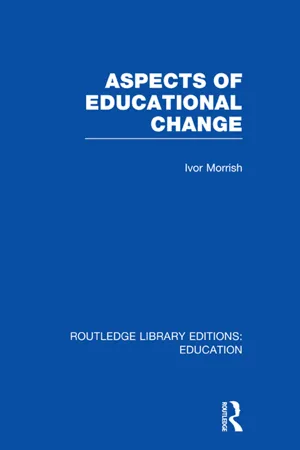
In recent years teachers have realized that change has become a permanent factor on the educational scene and therefore its operation or mechanism must not just be accepted, or even rejected, but above all understood. This book presents an approach towards some real understanding of educational changes and innovations. A number of mechanisms and processes are discussed and analysed in an attempt to present some sort of overview of the agents involved in change, an analysis of the major characteristics of resisters and innovators, an account of the traits and functions of innovative institutions and a description of three particular models which delineate the way in which change occurs. In the final section of the text attention is given to some contemporary educational innovations, and some suggestions provided for dealing with problems involved in their evaluation.
- 4 pages
- English
- ePUB (mobile friendly)
- Available on iOS & Android
eBook - ePub
Aspects of Educational Change
About this book
Information
Chapter 1
Introduction
The view that has generally been adopted in the past is that there is something almost virtuous about changelessness, as distinct from stability. Indeed, by some sort of theological analogy, it all but has the divine sanction – ‘I, the Lord God, change not.’ There is an assumption that we humans ought to imitate this divine, changeless quality. But the fact is that, in contemporary society, the ‘unchanging’ has lost much of its currency. A society, or even an individual, that is the ‘same yesterday, today and for ever’, does not necessarily command our respect, admiration or allegiance. We are not any longer foolish enough to think (even if we ever did) that whatever we do represents progress; but we still believe in movement, in the dynamic process of life, in change. Things never just stay as they are, they change whether they improve or decay.
Change, however, does not necessarily involve instability, and provided change is gradual and innovations are steadily tested and absorbed, the stability of society and of its institutions is not seriously affected. If, on the other hand, the institutions themselves are attacked and are the subject of sudden innovational change, then instability can quickly result. If, for example, we really did, with a wave of the hand, change all schools into street schools, or if we were to ‘deschool’ the whole of society, or to make heurism the basis of all learning, or to run all existing comprehensive schools on the model of Summerhill, we might reasonably expect instability and even chaos in our society. The success of many such ideas and ventures depends very much on the fact that they are limited experiments, applying to specific areas or particular groups or cultures, or to selected children who have peculiar problems. Such experiments do, however, provide elements for change even in the larger conventional pattern so long as they are adequately tested, assessed and evaluated.
There is, thus, something very positive about change. A study of man's development and history reveals that change is essential to his expansion and greater adaptation to life and his environment. But however novel the innovations offered to man may be, he finds it essential to assimilate them, and to accommodate older forms and structures to them, in a gradual and steady manner. Man rarely starts completely afresh; revolution is too expensive of life, happiness and stability in the short run, whatever it may afford in the long run. Most of us are Fabians at heart; we cannot bear very much stark change – we like it in small, accumulative doses. And the social, as well as psychological, processes of assimilation and accommodation afford a slow and natural means of absorbing educational change.
It was the view of Herbert Spencer that the steady progress towards improved schooling was inevitable whether there was conscious planning towards that end or not. This ‘linear theory’, however, is not really something that can be demonstrated in practice since there always has been some educator or other who consciously applied his thinking to educational problems, and to schooling in particular; and his ideas were almost inevitably adopted somewhere and they influenced the development of schooling generally. Without, however, attempting to prejudge issues at this stage it is clear that, in an investigation and analysis of change in relation to education, we must look at and understand social change itself, discuss why certain types of modification prove to be more effective than others, why some changes and innovations have rapid dissemination and application whilst others spread slowly, why certain strategies for changing institutions succeed or fail, and what is the nature of resistance to change in human affairs.
Chapters 2 to 11 will be concerned with the nature of change, where it originates, how it develops, who are involved and in what precise context, where it occurs and why it has appeared to occur so infrequently in the past. Chapters 12 to 19 will examine the factors which determine whether, and in what form, changes can be introduced; the main characteristics in the nature of the innovators, in innovative systems, and in the personalities of resisters to innovation; the various ways in which change is and may be planned; and finally some current innovations and some of the problems involved in their evaluation. These problems will be investigated in terms of the target public, that is, the adopters in an institutional context such as the school, and of the change agents, that is, those who are mainly responsible for doing the changing.
This is clearly a vast subject and the present book is little more than a brief introduction to it. But it is virtually impossible to devise blue-prints for laws for the description of how changes in education come about, or how they might be controlled, delayed or accelerated. We need, however, to look far more closely at the nature of change and the way it occurs in different cultural and political systems if we are to improve our understanding of the process. This implies a fuller study of other societies and their development as well as an intelligent concern for the discipline of comparative education.
There are, however, some general principles that need to be looked at and pursued in order to elicit such understanding (67, pp. 2–3). We need, firstly, to identify and to describe innovativeness as it is elicited in individuals, in institutions, in systems of education, and in total societies. There is no infallible rule here, for in some schools change appears to encourage and reinforce what is already operating, whereas in others it encounters resistance of a very strong kind. And whilst, like all open systems, the school systems have a drive to maintain order and stability, they also have a counterbalancing drive to improve and to innovate. These mechanisms determine the response to innovation.
Secondly, whether or in what circumstances any particular innovation may be accepted or resisted and rejected is highly predictable. Among the main variables are, for example, the cost of the innovation, the nature of its complexity, the possibility of its divisibility into parts, the relationship between the source of change and the target public who are being helped to change, and the general congruence between the innovation and the environment.
Thirdly, the school system normally is not responsible for the evaluation of its practices in order to discover whether changes are necessary, and so most educational innovations develop from outside. It is natural, therefore, that they will receive adoption usually in a somewhat superficial manner. As Huberman comments: ‘The most durable and effective innovations are those which the user has internalized; that is, which he has embraced because they satisfy his own specific needs. This implies that we should begin to use radically different methods of institutionalizing changes and using outside expertise’ (67, p. 3).
Fourthly, the critical factor appears to be the adopter's concept of the changes he himself will be required to make, rather than the nature of the innovation or its potential for improving learning. It seems that innovations are rarely, if ever, installed for their intrinsic value; indeed, the immediate emphasis is upon changing attitudes rather than changing practices and procedures, and both teachers and administrators are asked to interact with one another and with students in a different way when an important innovation is introduced.
One thing becomes evident as we pursue our study of the process of change and that is that we need to utilise a large number of separate disciplines which have some contribution to make to the total problem. Just as education itself leans heavily upon a number of disciplines (103) (147) (164), such as philosophy, psychology, sociology and history, so any analysis of the process of change demands some understanding of the way in which change is viewed in a great variety of disciplines concerned with social change. For example: anthropology (particularly social anthropology) makes a study of change arising from contact between cultures; sociology looks at innovations, such as co-operative activities; rural sociology is concerned with the effect of the spread of new farming practices and materials; social psychology examines the problems involved in the acceptance of change, in assimilation, accommodation and socialisation.
It should soon become obvious that no single, elaborated theory of social change has been, or can be, devised to link the multiplicity of different elements suggested by this interdisciplinary approach. As Huberman (67, p. 3) has pointed out, in education interdisciplinary groups of specialists have not so far found a ‘common language, common methods of research and common perceptions’ which would permit them to converge on any particular educational problem. R. G. Havelock (61, p. 1.19), in his work on the dissemination and utilisation of knowledge, discovered less than 50 items prior to 1955, but some 500 annually by 1964, a mere decade later. Items in this very extensive literature covered changes in curricula, changes in organisation, the development and expansion of new educational ideas and practices, roles, materials and a variety of new organisational groups. Havelock's 4,000 entries include a large number of quantitative studies, but there are far fewer theoretical studies and a few case histories. Nearly all Havelock's references are American, but it would be quite wrong to imagine that there is little or no non-American literature on change in education (67, p. 4), as I hope we shall see in some of our later chapters.
One of the drawbacks of American literature on innovation in education is that the language used is frequently highly technical and jargonistic, and its other drawbacks include the fact that it has a tendency to look at change as an industrial process, and as a logical and rational development from theory to practice; there is less emphasis given to types of resistance to change which are patently illogical; it tends to concentrate upon the behavioural aspects of change in roles and interpersonal relationships. In addition, there is an overemphasis upon the importance of rewards and reinforcement of new habits in effecting change, and a neglect of the importance of historical, political and social contexts in which all innovations operate.
It is also necessary to note that the socio-cultural milieu in which changes arise is of vital importance. If we look at change and at the models or strategies of change, within a limited cultural range, we shall obviously obtain only a one-sided view of change; but we shall also get a view or model of change which, whilst appropriate in America, may be quite inappropriate for the majority of countries. One of the lessons of the study of comparative education is the reinforcement of the inescapable fact that the transfer of content and methods of education from one cultural system to another must be tackled with critical care and judgement. The successful innovation and novelty of one society may well prove disastrous in another.
SECTION ONE: SOURCES, TYPES AND
PROCESSES OF INNOVATION
Chapter 2
A Working Definition
of Innovation
There is something very misleading about the term ‘innovation’, particularly as used by the uninitiated public. To many the word appears to connote an unqualified improvement on method, matter or materials used in the past. But an innovation per se, whether in education or in any other sphere, is merely something introduced which is new and different. In itself, however, it may be good or bad, or neither. When we take the definition a little further and make the attempt to distinguish between innovations which are mere novelties and nothing more, and innovations which are improvements, we find ourselves involved in value-judgements based upon certain criteria. What, in fact, does constitute an improvement in education, in the teaching or learning process? And can we always be certain whether the cause of the improvement observed was really the innovation under analysis? Or was it merely one of the many contingent factors in the total improvement? Or, indeed, was the whole process merely coincidental and in no way causative?
There are certain general points which may be made at the outset in regard to innovations and their evaluation. Firstly, they can be assessed only in relation to the aims and objectives of any particular educational system. There can be no judgement about any innovation in vacuo, for a successful innovation in one system may prove to be unsuccessful if introduced into another. Certain innovations, for example, in A. S. Neill's school Summerhill (62) (111), may be proved to be highly successful there because they fit in with the general pattern of the school's aims, objectives and social milieu; but they might have no relevance or transferability to Eton or Harrow or Highbury Comprehensive, because their educational aims are very different. At first blush this might appear to be the statement of the obvious – and perhaps it is, but the many failures in the history of education resulting from the introduction and transfer of successful innovations from one country to another, one society to another, or even one school to another, should make us aware that even ‘successful’ innovations are not intrinsically good but depend upon a multiplicity and variety of contextual factors and relations.
Secondly, innovations are usually concerned with increased learning, or at least with more individualised learning, with broad attempts to improve the quality of teaching and its professionalisation, and with more developed, relevant and refined curricula. In the classroom the attempt to make learning a more individual thing, and teaching less of a mass operation, has resulted, for example, in both different seating arrangements, whereby individualised learning or teaching can be facilitated, and in heuristic methods which exploit individual learning and discovery to the full. In the increased professionalisation of teachers, innovations have included the extension of the training period in this country from two years to three years or even four years (40) (96) (109); the introduction and further development of a number of disciplines in education in any consideration of its general theory (103) (164); the establishment of the Bachelor of Education degree as a first degree (101, pp. 363–71) (40, chapter 3), in the first instance for a select few but eventually, no doubt, for all members of the teaching profession other than those with a university degree in a teaching subject; and inservice courses at regular intervals for all members of the profession (40, chapter 2). Curricular changes have been so regular in recent years that it has become exceedingly difficult to allow time for full and detailed evaluation of projects. They may be good, bad, indifferent or just different and, therefore, to some teachers a welcome change and to others a perpetual nuisance.
A case study in the process of curriculum change has recently been made by M. D. Shipman et alii (138) which is basically an attempt to indicate the way in which a particular project was established and implemented, and to analyse the influence exerted on curriculum change by the many agents employed in education. It also very conveniently, however, takes up our third point concerning innovations, namely, that they involve a corresponding change in the activities and attitudes of school personnel; it investigates the impact of the particular project in integrated studies on the trial schools and, in turn, of the schools on the project. Changes and innovations affect people and their attitudes, not simply institutions and their methods, and in any attempt to understand innovation in education we shall inevitably find ourselves analysing human personality and interpersonal relationships. It is clear, for example, that a conventionally-orientated teacher who likes to ‘do his own thing’ – unoriginal though it may be – within the carefully closed doors of his own classroom, is not going to welcome immediately with open arms the prospect of an integrated studies project organised on the basis of team teaching. He needs educating as much as his pupils; he also needs convincing that such a change or innovation really is worth while in terms of his own concepts of the aims and objectives of education; or in the terms of M. Richland (123): ‘Innovation is … the creative selection, organization and utilization of human and material resources in new and unique ways which will result in the attainment of a higher level of achievement for the defined goals and objectives.’
But innovation in our present context does not necessarily mean something wh...
Table of contents
- Front Cover
- Title Page
- Copyright
- Dedication
- Preface
- Contents
- 1 Introduction
- Section One: Sources, Types and Processes of Innovation
- Section Two: Overview of Agents Involved in Change
- Section Three: System and Process
- Section Four: Characteristics of Resisters and Innovators
- Section Five: Innovative Institutions
- Section Six: Planning and Executing Change
- Section Seven: Educational Change and Its Evaluation
- Bibliography and References
- Name Index
- Subject Index
Trusted by 375,005 students
Access to over 1.5 million titles for a fair monthly price.
Study more efficiently using our study tools.
Frequently asked questions
Yes, you can cancel anytime from the Subscription tab in your account settings on the Perlego website. Your subscription will stay active until the end of your current billing period. Learn how to cancel your subscription
No, books cannot be downloaded as external files, such as PDFs, for use outside of Perlego. However, you can download books within the Perlego app for offline reading on mobile or tablet. Learn how to download books offline
Perlego offers two plans: Essential and Complete
- Essential is ideal for learners and professionals who enjoy exploring a wide range of subjects. Access the Essential Library with 800,000+ trusted titles and best-sellers across business, personal growth, and the humanities. Includes unlimited reading time and Standard Read Aloud voice.
- Complete: Perfect for advanced learners and researchers needing full, unrestricted access. Unlock 1.5M+ books across hundreds of subjects, including academic and specialized titles. The Complete Plan also includes advanced features like Premium Read Aloud and Research Assistant.
We are an online textbook subscription service, where you can get access to an entire online library for less than the price of a single book per month. With over 1.5 million books across 990+ topics, we’ve got you covered! Learn about our mission
Look out for the read-aloud symbol on your next book to see if you can listen to it. The read-aloud tool reads text aloud for you, highlighting the text as it is being read. You can pause it, speed it up and slow it down. Learn more about Read Aloud
Yes! You can use the Perlego app on both iOS and Android devices to read anytime, anywhere — even offline. Perfect for commutes or when you’re on the go.
Please note we cannot support devices running on iOS 13 and Android 7 or earlier. Learn more about using the app
Please note we cannot support devices running on iOS 13 and Android 7 or earlier. Learn more about using the app
Yes, you can access Aspects of Educational Change by Ivor Morrish in PDF and/or ePUB format, as well as other popular books in Pedagogía & Educación general. We have over 1.5 million books available in our catalogue for you to explore.