![]()
1. The Long Road toward Truth and Reconciliation
Unwavering Attempts to Achieve Justice in South Korea
Kim Dong-Choon
EFFORTS BY KOREANS TO FACE THEIR DARK PAST began on 15 August 1945 when the nation broke free from Japanese occupation. Attempts to bring honor to the victims of the dark past continued for decades as South Koreans suffered under and then revolted against a series of dictatorships before they finally succeeded in establishing a civilian government. Many a governmental and civil organization dedicated to historical justice appeared and dissolved throughout this period of struggles. A milestone was reached in 2005 when the South Korean government enacted a special law, the Framework Act, which established the Truth and Reconciliation Commission, Republic of Korea (hereinafter, the TRCK).
The Special Investigation Committee (SIC), which had been established in September 1948 by the Special Act on Punishing Anti-National Conduct, was South Korea’s first attempt to bring former Japanese collaborators to justice. After 1948, other attempts to pursue historical justice were made on several occasions,1 only to suffer the same fate as the SIC’s, which the Rhee Syngman regime annulled in 1951. For instance, Korea put on trial police officials who were suspected of ordering the shooting of demonstrators in April 19602 and of those responsible for the Gwangju massacre of 18 May 1980. Unlike Taiwan and Vietnam, which had experienced similar historical tragedies in the twentieth century,3 South Korea made several attempts to rectify its history before so-called past-dealing commissions were established after the end of the military regimes. Thus, the TRCK can be considered a crystallization of Korea’s unwavering efforts to confront the injustices in its past. In all of Asia, only South Korea has established past-dealing commissions without foreign assistance.4
The Truth and Reconciliation Commission, Republic of Korea, takes its name from South Africa’s Truth and Reconciliation Commission (TRC), which served as the TRCK’s model. The South African TRC showed the TRCK how to investigate and settle historical incidents, but the two commissions also had distinct differences in their context and historical backgrounds.5 For South Africa, consolidating democracy and promoting social reconciliation by investigating human rights violations under the apartheid regime were the aims of its TRC, but South Korea had a larger task, namely, dealing with a history burdened with colonial legacies, mass killings, mysterious political incidents, and human rights abuses that had occurred since 1945.
South Korea resembled many Latin American, African, and Asian nations that had endured U.S.–supported dictators during the cold war, but its politics were unique in three specific respects. First, Korea had a history of suffering under occupation that began with Imperial Japan’s colonial totalitarianism (1910–1945). The cold war–influenced politics of the postcolonial period (1945–1950) followed next, with the Korean Peninsula becoming the site of a proxy confrontation between the United States and the Soviet Union. Due to its strategic location, one analyst has noted, “South Korea was the first place where America set up a dictatorial government.”6
Second, the three-year-long war—the Korean War—and the subsequent armistice resulted in a division of the peninsula that led to a tense military and ideological confrontation between the newly formed North and South Korean states. Third, tensions continue to exist today between the two Koreas, which are technically still at war, even after the disintegration of the Soviet Union and the end of the cold war.
The existence of Communist North Korea and the chronic state of confrontation have profoundly affected South Korean politics. The nation’s policy was to indoctrinate its people with an anticommunist ideology and violently enforced through legal means, such as the National Security Law, and government institutions, such as the Korean Central Intelligence Agency (KCIA). As the rule of law and the ideals of liberal democracy yielded to fears about communism, the state exploited the threat of communism as justification for violating human rights.7 Given this history, it is therefore all the more remarkable that the TRCK was established in an environment so permeated by cold war politics.8
In the early years of the cold war, the United States was so preoccupied with fighting communism at all costs that it turned a blind eye to the reinstatement of Japanese collaborators and colonial state apparatuses in postliberation Korea.9 Amidst the anticommunist fervor, Koreans who had formerly served the fascist colonial authorities prospered in their careers, for despite their past collaboration in Japan’s efforts to colonize Korea, they could now point fingers at socialists and even liberals, accusing them of being dangerous enemies of the state. The failure to disrupt the legacy of colonial bureaucracy at this critical juncture of Korea’s liberation led to the development of state terrorism, human rights abuses, and other types of injustices. Since 1948 Koreans have struggled for democratization and justice, but with little to show for their efforts. Yet, their failed attempts suggested new approaches to historical rectification and eventually led to the establishment of the TRCK.
Civil society’s effort to enact the Framework Act and establish the TRCK on the accumulated experiences of building justice after the fall of the military government in 1987 demonstrates Korea’s unique approach to the past-settlement process in the context of East Asian cold war politics. It also reveals the extent of the government’s neglect during the cold war as the public’s demands for justice were disregarded for the alleged sake of national security and state order. South Korea’s path toward historical rectification and settlement may hold useful lessons for other East Asian nations that have suffered similar difficulties on their road to historical justice.
The Cold War and Two Failed Attempts to Achieve Justice
The Two Critical Moments of Political Transition
In the twentieth century, Korea had two critical periods in which to build transitional justice and democracy: the post–World War II period and the post–cold war period. The political vacuum created by the defeat of the totalitarian powers of Germany, Italy, and Japan was filled with postwar democracy through measures such as the Nuremberg and Tokyo trials. The countries in Asia, Africa, and Europe that had suffered from colonial suppression longed to create their own independent democratic state through due process of decolonization. But severe political unrest, social conflict, revolutionary violence, and mass killings followed and filled the political vacuum of the post–World War II era. The task of overcoming the colonial legacies and building a new democratic system was, as a result, left unfulfilled, to be tackled by the formerly colonized states at a later time.
The second period came with the collapse of authoritarianism, military dictatorships, and the cold war, mostly in the 1980s. The countries that had just escaped from military dictatorship or communist totalitarianism were confronted with serious political turmoil and conflict in the transitional period toward democracy. Just as those postcolonial nations sought to deal with past wrongdoings by their colonial rulers and collaborators, so too were these countries that during the cold war had suffered from a dictatorship or a totalitarian rule left with the urgent task of dealing with past wrongdoings by authoritarian rulers and their collaborators. As a result, governmental and intergovernmental organizations were founded to deal with the earlier atrocities by seeking truth and reconciliation or by prosecuting the perpetrators.
The First Moment: The Postcolonial Period (1945–1950)
Since Korea had been colonized by Japan before World War II, its political task in the postcolonial era was to establish an independent democratic nation-state. Both in Japan and Korea, the U.S. occupying forces declared special orders that nullified Imperial Japan’s laws. The U.S. military government presided over the task of prosecuting Japanese war criminals in the Tokyo Trials,10 but it did not adopt a similar policy in South Korea because Korea was not an enemy of the United States but had been a victim of Japanese annexation for almost forty years. In order to build a new nation where justice and democracy flourished, dissolving Japan’s colonial governing system and prosecuting the collaborators were the priorities.11 While U.S. occupational forces arrested and later tried and convicted some Koreans who had served in the Japanese Army in South Asian battlefields, those serving in Japan’s colonial regime on the Korean Peninsula were regarded as petty criminals and were never punished. This is despite their being called “betrayers of the nation” among Koreans. The public’s moral indignation, rather than a legal assessment, played a greater role in judging pro-Japanese collaborators under Japanese colonial rule.12
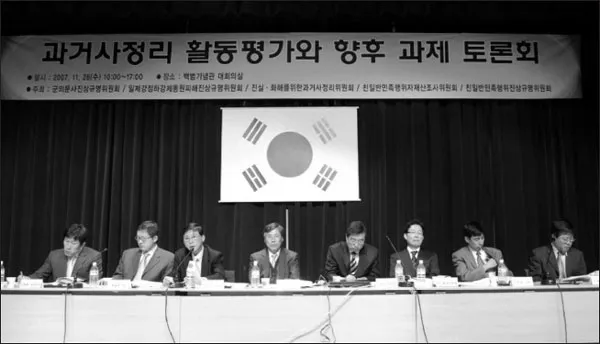
The Truth and Reconciliation Committee, Republis of Korea, “can be considered a crystallization of Korea’s unwavering efforts to confront the injustices in its past.” Pictured here is an open forum conducted by the TRCK on 28 November 2007. Author Kim Dong-Choon is pictured on the left. (Credit: Truth and Reconciliation Committee, Republic of Korea)
Since it was more convenient for the occupational government to recruit experienced Korean administrators from the Japanese colonial government, these individuals were not punished after the nation’s independence even though many of them had willingly cooperated with Japanese colonial rule. The U.S. military government employed them in spite of their past and they later secured high-ranking positions in Rhee Syngman’s government, the first republic of South Korea.13 The U.S. policy of exonerating war criminals from the Tokyo Tribunal was in line with the occupation policy of the U.S. military government in Korea. This policy judged Japanese-trained soldiers, intelligence agents, and police officers to be useful in the suppression of communist operations in South Korea.14 The U.S. policy of resurrecting Imperial Japan’s governing architecture in South Korea reflected the ideological confrontation seen in the cold war era. This political expediency contradicted Koreans’ desire for historical justice. The United States did not officially abandon its goal of building one unified state until 1947, and thus it faced strong opposition from both dissidents within the United States who demanded “graceful” disengagement and the Korean rightists, including Rhee Syngman, who accused the United States of tolerating suspected communists.15 Confronting this political opposition, the United States eventually opted to support the extreme rightist Rhee as South Korea’s first president.
Calls for the prosecution of Japanese collaborators in order to obtain historical justice were not easily dismissed, however. Reflecting public sentiment, the Korean National Assembly passed the Special Act on Punishing Anti-National Conducts in September 1948. Even President Rhee, who aligned himself with many of the former collaborators, felt compelled to accept the Act and create a body to investigate and prosecute Japanese collaborators in accordance with the law: the Special Investigation Committee (SIC).
The first attempt at historical justice and truth did not last long. No sooner had the SIC been founded than it began to be assaulted by conservatives who were former collaborators or had aligned themselves with collaborators for personal gain. From the beginning, the Rhee government hindered the Act’s implementation by accusing the SIC of communist-influenced leadership and protesting that the Act might be misused to arrest “patriots” who had fought against the communists. The SIC ceased to function within a year, having produced few results.16
In South Korea, just as in South Vietnam, old colonial elites continued to enjoy their social status thanks to strong U.S. support, and their power was entrenched under the cover of anticommunism.17 Although elections and a modern judicial system introduced a modicum of procedural democracy, the Rhee government failed to represent the people inasmuch as the government was filled and run by individuals who had collaborated with the Japanese in the colonial era. In time, the old elites restored many of the oppressive features of the colonial government in an effort to protect themselves from their own past and from future challenges. For example, in December 1948, the government enacted the National Security Law, a continuation of the former Security Maintenance Law of Imperial Japan, and revived the Japanese-style police apparatus that had been notorious for torturing and assaulting those who struggled for Korea’s independence. The old colonial machines of oppression were restored to serve the new regimes as a bulwark.18
The Second Moment: Interim Period of Political Freedom and Another Failed Attempt to Achieve Justice (19 April 1960–15 May 1961)
The bulwark, however, proved inadequate to stop the wave of student-led protests from toppling the U.S.–sponsored Rhee government in April 1960. The National Police killed approximately two hundred students and demonstrators in its futile attempt to protect the regime. The fall of President Rhee meant more than the end of a dictatorship. Just after Rhee’s resignation, new waves of student-led demonstrations and social unrest emerged that pressed demands for historical justice.19 After divisions between supporters and opponents of the Rhee regime erupted on 19 April, the deeper historical cleavage between those whose power was rooted in colonial rule and those who had suffered during the colonial and postcolonial regimes emerged. The cleavage was most graphically revealed in the struggles over the white terror and the mass civilian killings committed under, if not by, Rhee’s government before and during the Korean War.20
The collapse of the Rhee regime created an opening for the struggle. Its collapse made it possible for the families of the victims killed during the Korean War to press their demands for justice and for newspapers to publish their stories on a daily basis. The bereaved families organized demonstrations to demand a full investigation into the mass killings committed by the South Korean authorities. They established the National Association of the Bereaved Families of the Korean War Victims, an organization that has exhumed and properly buried the victims’ remains in a cemetery built to honor all the dead. They thus posed a serious challenge to South Korea’s official discourse that the “6.25” (Korean War) was an anticommunist “crusade” against a communist invasion. Revealing the existence of mass killings of civilians by South Korean forces threatened this “myth.” The families’ actions also raised difficult questions about the legitimacy of South Korea’s military and police force whom they charged with killing civilians, communists or not, under the excuse of anticommunism. These actions worried the conservative bloc, which was composed of Rhee’s Liberal Party, police officers, government personnel, and military leaders. Especially frightened were the high-ranking police and military officials, most of whom had been Japanese collaborators. And some government officials had been responsible, directly or indirectly, for atrocities committed during the Korean War.
In response to an escalating number of petitions from angry, bereaved families, the ruling Liberal Party–led National Assembly organized the Special Committee on the Fact-finding of Massacres in May 1960. But the Liberal Party, which had faithfully supported the Rhee government, only mollified the bereaved families because the Committee’s investigation into the huge numbers of mass killings nationwide lasted no more than eleven days.
Thus, the committee’s investigations failed to yield any results regarding the suspicious deaths of opposition leaders or to locate and indict those responsible for the mass killings during the Korean War. Rhee Syngman himself fled to Hawai’i just after his resignation on 26 April 1960, and thereby escaped prosecution. Upset over the lack of progress, some victims’ families turned to mob justice and lynched local agents who had worked for the police and military. In an extreme instance of pent-up anger, one group of victims’ families burned a government agent to death. The vengeance taken by the bereaved families illustrates the failure of legal and political justice in those times.
The pro-Rhee, anticommunist bloc regarded the families’ activities as a recurrence of communist riots or a constitutional crisis and called for a stronger response. The response took the form of a military coup on 16 May 1961. The coup that brought the nine-month-old political opening to a close was an anticommunist reaction to what coup leaders considered to be a security crisis caused by pro-communist agitation. Citing anticommunism as their primary justification they claimed that military intervention was necessary to save...