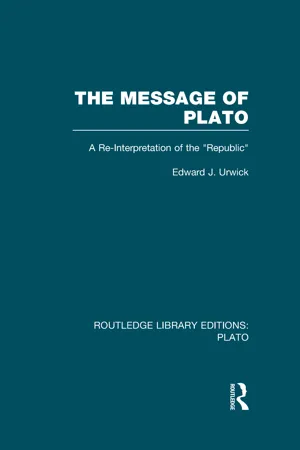
Edward Urwick's original work draws upon Plato's best known work, the Republic, to provide a new interpretation of Plato's teaching based upon Indian religious thought. Most scholars have sought to interpret the Republic from the standpoint of politics, ethics, and metaphysics and indeed the accepted title of the dialogue – Concerning a Polity or Republic – would seem to legitimate this. Even the alternative title for the work – Concerning Justice – seems to justify such an approach. Yet the original Greek work, Dikaiosune, had a fuller meaning: righteousness. The author believes this gives a truer clue to the meaning of the dialogue. It is a discussion of righteousness in all its forms, from the just dealing of the law-abiding citizen to the spirit of holiness in the saint.
eBook - ePub
The Message of Plato (RLE: Plato)
A Re-Interpretation of the Republic
- 4 pages
- English
- ePUB (mobile friendly)
- Available on iOS & Android
eBook - ePub
About this book
Information
THE MESSAGE OF PLATO
PART I
THE ANCESTRY OF PLATO'S FAITH
CHAPTER I
THE QUEST OF SOCRATES. THE WESTERN ANCESTRY OF PLATO'S DOCTRINE.
PLATO was the disciple of Socrates. He was not the pupil of a great teacher : he was the disciple of a great master. This relationship is quite unfamiliar to us, at any rate in the region of philosophical study. We recognise some great exponents—thinkers, discoverers, system-builders—and each of these has his followers, acknowledging their debt, gladly paying tribute to their teacher. But the full relationship of disciple to master is hardly known nowadays, except in the East. In India we find it still: there, every seeker for truth seeks first for a Guru or master to be his guide in the quest; and the Guru becomes his enlightener, his inspiration, and the life-long object of his fullest devotion and reverence. The Guru alone can “dispel his darkness ” (this is the literal meaning of the word) ; the Guru alone can turn the rusty lock of the closed chamber of the soul and open the door to light. For the Guru is one who has himself seen the truth and lives it; who can therefore teach the wisdom which is also life. And, in return, the disciple hugs close the unpayable debt, glorying in it as a possession beyond price. To the Guru he owes the knowledge of his own soul, the certainty of his immortality, the vision of heaven which he may see whenever he closes his eyes to the moving world. In this sense Socrates and Plato were Guru and disciple. Socrates was a true Guru in every essential but one. Like every true Guru, he sought for souls capable of the search for truth, souls not yet tarnished, not yet bewitched by the great sorcerer—the world. Like every true Guru, he tested them, each and all, rejecting those who failed in the spirit of constancy and earnestness. Like every true Guru, he taught those who could be taught, not by thrusting conviction bodily into their minds, but first and most by the negative process of convincing them of the futility of their accepted beliefs and dogmas, and so preparing them for the task of striking the sparks of truth out of the clean flint of their own deeper consciousness. But, unlike most Gurus, Socrates never claimed that he had himself seen the truth. He delighted in confessing his ignorance : that was his great “ irony.” He loved to put his work and his power on a lowly level. “ My mother was a midwife,’’ he would say, “ and I must have inherited a little of her art. For this is all I can do : I can bring truth to the birth in the labouring souls of others,’’ Yet he did not pretend to be nothing more than a seeker among other seekers. He had some convictions of truth so sure and so strong that he never hesitated to call them inspirations. He knew that the Reality which truth would reveal is good and nothing but good, and the cause and creator of all good everywhere. He knew that this Reality could be found, if the search were only earnest enough. And, most of all, he knew what was not the road to it: he knew that the way of the world was the wrong road, that most of its estimates were false estimates, its knowledge unreal knowledge, its wisdom little better than foolishness. He followed his faith unfalteringly : it caused him to tell his world, and most of its wise men, that they were wholly deluded. He followed his “ inherited art,” his great natural gift, unfalteringly : this caused him to expose and prove false every convention and dogma and belief behind which comfortable worldliness entrenches itself. His life-work earned for him his death, at the hands of his world, “ for corrupting the young and perverting religion.” It was the inevitable wage of such a work in such a world. But it earned for him something more : the reverence of a little band of disciples, and the passion-ate devotion of the greatest of these disciples—a devotion so strong in a disciple so great as to immortalise not the name only but the character and life and mind of the master.
Plato was a disciple in the completest Indian sense. Just as an Indian disciple prefaces everything he says or writes about wisdom and truth with the invocation “ Glory to Guru,’’ and writes, not in his own name, but in the name of some spiritual quality which his master has taught him to love; so Plato, throughout the greater part of his long life, put all his thoughts into the mouth of Socrates, as if to show that the teaching was his master's, not his own. The most beautiful of all the dialogues, such as the Phaedo, are like hymns in his master's honour; in all the dialogues, with few exceptions, Socrates is the chief speaker—critic, questioner, unveiler of error, or expounder of truth. In the few exceptions, written late in Plato's life, Socrates usually appears as a listener only—probably because his disciple felt that, so long after his master's death, his own thoughts ought no longer to appear as the direct utterances of his teacher. In the latest of all the dialogues, the Laws, Socrates does not enter at all; and for this there is perhaps the additional reason that here Plato sets himself to work out a conception peculiarly his own, relating, not to the kingdom of reality and truth, but to a second-best state on earth.
Now in the very voluminous writings which Plato lays at the feet of his master, we find not only a picture of a character and a mind of singular interest, charm and power, but also a picture of that mind absorbed in a ceaseless quest, animated throughout by a double passion—for truth and for goodness. We need not ask here how far the picture is true to the historical Socrates: the character revealed is certainly his ; the nature of the quest equally certainly belongs to Socrates as he was; but the mind and thought are the mind and thought of Plato, who, taking his master's quest for his own, and his character for his own ideal, interpreted and elaborated in his own way the suggestions of his teacher. But this does not matter in the least; let us call the picture that of Socrates as Plato liked to think of him. What is important is that we should get a fair and true view of the picture, in order to understand the mind and the quest of Plato himself.
Let me try, first, to give an account of the quest. If we read the different dialogues in the order in which they appear to have been written, we are first of all interested and fascinated, and then (let it be confessed) a little irritated and wearied, by the elaborate discussion of all those metaphysical and ethical conundrums with which philosophers and moralists have made us so familiar. What is knowledge ? How is it possible to know anything ? What is it that is known ? Is there such a thing as absolute truth, or permanent fact in and behind the ever-changing universe ? Is there a knowable reality ? And if so, is it one or many ? What are the faculties of cognition ? What are the correct processes and methods of learning, of separating truth from error ? What is the relation of action to knowledge ? What is happiness or pleasure ? Is good conduct based upon knowledge ?—and of what ? Can society get that knowledge, and so manage itself satisfactorily and scientifically ? Are there any real teachers of political or ethical knowledge ? If so, upon what is their teaching based ?
These are the subjects which appear to indicate the great quest of Socrates—subjects discussed and re-discussed through hundreds of pages, with frequent excursions into less or greater matters, ranging from the derivation of words to the origin of the soul and of the universe. What are we to make of it all ? We know that for more than a century before the time of Socrates most of these subjects had occupied the minds of Greek thinkers, and that various schools of thought had arisen, giving different answers—the beginnings in Europe of metaphysical and ethical philosophy. Reality is multiform and ever changing, and we know it only through the organs of sense perception ; reality is one and unchangeable, and we cannot know it at all. The good is pleasure, and everyone knows it; the good is intelligent judgment, and very few can possess it. These were the types of leading theory, already fully expounded, each with its bands of supporters. Are we to conclude, then, that Socrates, entering the philosophical arena, devoted his life to carrying analysis farther, criticising, re-defining, re-combining, what his predecessors had left him, sometimes failing altogether to reach a new conclusion, sometimes abandoning the search as hopeless, sometimes merely quibbling—at very great length—sometimes really managing to reconcile conflicting ideas into a new synthesis, always carrying farther the logical method of enquiry, insisting upon a dialectical process which shall separate valid concepts from confusions ? That was his quest and his work, then ? That was his contribution to his world's good ?
This is a very natural view to take, especially for those who have some knowledge of the history of philosophy. The Platonic Socrates (or the Socratic Plato) thus falls into his place among the builders of metaphysical, ethical, political and logical systems —a very high place, for, despite his many contradictions and failures, he undoubtedly advanced far beyond any and all of his predecessors. True, he confused matters which we think are better kept distinct : ethics with politics, and metaphysics with both. He failed to distinguish the theoretical from the practical reason, as Aristotle and Kant did. He mixed up argument with metaphor, reasoned statement with mythical story. Even his greatest contribution to metaphysical theory—the doctrine of Eternal Ideas as the great knowable reality—was presented in a confused and contradictory way. Nevertheless, he carries us a long way beyond the theories of reality and knowledge upon which he built, the theories of Heraclitus and Cratylus and Protagoras, of Anaxagoras and Parmenides and Zeno. And all through his pages there shine flashes of intuition which point far beyond his own theories, hints of fuller truth which, if only he had followed them up, might have led him even nearer to our more mature and more consistent explanation of the problems of cognition with which he struggled.
This, I say, is a very natural view. It is, on the whole, the view of most commentators. It is the academic, and therefore the sane and safe view. It is, for that reason, an utterly lifeless view, an insult to the realities by which life lives. For, candidly, is it not the case that, when we talk and read and write and puzzle our brains about the fundamental subjects of metaphysics— reality, essence, appearance, cognition ; or of ethics—the sum-mum bonum, the criterion of right, the moral sense ; is it not the case that we treat the whole business as something, important doubtless, but by no means supremely important ? It is not a matter of life and death to us : it is a matter of speculative interest. If we cannot get the matter clear—well, life will go on, and happiness will not be destroyed any more than will efficiency. It is not the supreme thing in life ; its teachers have followers indeed, but not followers such as Pythagoras had. There are ardent followers of Green and Bradley, as once there were of Bentham and Mill ; of Hegel, as once of Hume. But would they die for the theories which they hold or follow ?
Now this is just the difference between philosophy as we think of it or look for it in the writings of Plato or anyone else, and “ philosophy “ as both Socrates and Plato thought of it. Put aside, if you can, the academic interest, and read the Platonic dialogues through, looking for consistency, not inconsistencies, for the One and not the Many. Then you will hardly fail to realise that, when Socrates is searching for the explanation of cognition, of reality, or of the standard of right and wrong, his quest and his interest are totally different from ours, in quality and in kind. He is out to find life, and the whole secret of life. It is all in all to him: not a theoretical interest, not a metaphysical or philosophic interest, but just everything that matters, the whole key to the soul's wellbeing. For this “ reality “ or “ ens “ or “essence “ (a dead thing with a lifeless name in all our philosophies) is, for him, the living Good and the living God. He must find it, he must know it—in order to become good, in order to find salvation. It was not knowledge or truth which he sought, as we seek knowledge and truth. His life-search was for the knowledge which saves the soul, for the truth which reveals God, for the reality which makes goodness real, makes virtue unshakable, realises the perfection of the soul's relations to all existing things. His eternal questions—What do we mean by knowing ? How is knowledge possible ? are not our questions. We want to explain the possibility of cognition, the functions of sense and intellect in relation to a knowable universe, and the metaphysical implications of all this. But his question always meant—How are we to know Goodness in order that we may be good and a source of good in the world ? It was his faith—he never attempted to prove it—that Reality, Goodness, and God are all one. To be good, we must know this One, not as the world knows or thinks it knows facts and truths, but with a directness, a certainty, altogether different. Goodness is knowledge, therefore ; but we of the world have not got this knowledge, and therefore we are neither good nor happy, do not even know what goodness and happiness are. The world talks about virtue, about justice and right. But it is like a man talking about a weaver's shuttle when he has never seen a loom, or about steersmanship when he has never been on board a ship.
His search is not a search for perfectly unified knowledge, but for the knowledge which shall itself unify all things in heaven and earth. He goes from teacher to teacher, searching for this but never finding it in them. The search is usually negative, critical. He examines the philosophical teachers of Greece : they have not found the True. He examines the moral teachers of Greece : they have not found the Good. He is far more concerned to criticise the latter than the former ; of course : for it is not truth as a theory of knowledge which he seeks, but truth as an existent fact, the creator and source of all good everywhere. For this reason the Platonic Socrates in the dialogues of Plato returns again and again to the attack upon both the unconscious teachers and the professed teachers of morality or good conduct : upon the poets and politicians, and upon the Sophists and Rhetoricians. These latter he came as near hating as was possible for so gentle a nature ; for knowing nothing, they professed to teach the greatest thing in the world. They were the new and fashionable Professors of Right Action and Right Speech. They were not bad men : far from it. Protagoras, the Sophist, was a very fine man with a very exalted aim ; even Thrasymachus, the Rhetorician, was only unpleasant by reason of the violence of his dogmatism. But they were false teachers, because they were ignorant ; dangerous teachers, because their ignorance was of the one thing that mattered. They were purveyors of food for the soul, hawkers of goods for the mind, selling for money wares blindly labelled Virtue and Knowledge. They were concocters of persuasion for the multitude ; clever cooks who served up attractive dishes of Belief without Understanding. Their arts were the counterfeits of the true arts of teaching and of healing. For all they knew, they were selling poison for food, falsehood for truth, ignorance for knowledge and wrong for right. They had not got the wisdom which is also the secret of goodness.
He confused metaphysics and ethics and politics, you say ? Of course he did—a noble confusion, which vitalised the truth instead of dissecting it. For how can there be separation in such a quest ? Here again his faith kept the road clear for him. He could not think of a real cause which was not good, nor a Good which was not Nous (wisdom), nor a universe which was not both Nous and Good at bottom—and nothing else real, nor a true society which was not the incarnation of Good Nous. All his questions therefore were but modes of a single question. It appeared in many forms : What is cognition ? Can virtue be taught ? What are knowledge and ignorance ? What is false opinion ? What is the One ? What are the Many ? What is right ? What is the Ideal State ? But each and all of these forms are but aspects of the single search for the secret of life and immortality, for God and Righteousness, for that flame of knowledge which purifies the soul even as it illumines it and reveals all things to it. Each and all of the questions are but variants of the supreme quest in which and for which Socrates lived and died : “ How shall we find God and be like Him ? “
Now this vital difference, which, for both the master and the disciple, turned philosophy into religion, and so fused meta-physics, ethics, politics and everything else into an indissoluble unity, is exactly the difference which distinguishes the speculations of ancient India from ours. Like us, the Indian thinkers set out to answer the question—What are knowledge and reality and truth ? Like us, they worked out their answers into elaborate philosophical systems. But, unlike us, they never dreamed of searching for a knowledge which was anything but spiritual, for a reality which was anything short of the source of eternal life, for a truth which was any less thing than the inspiration of eternal goodness. They called their philosophy Vidya, or knowledge; but they meant by it knowledge of the spiritual by the spirit, not knowledge of the intelligible by the intellect. If, like most modern philosophers, they seemed in their speculations to “ leave the Lord God out of the business,” this was only because they related all their thought to an even greater Reality, transcending personality—just as Socrates did. And the text upon which their whole philosophy hung might serve equally well as the text of the whole Socratic philosophy :—
“ Mankind errs here
By folly darkening knowledge. But, for whom
That darkness of the soul is chased by light,
Splendid and clear shines manifest the Truth,
As if a Sun of Wisdom sprang to shed
Its beams of dawn.”1
By folly darkening knowledge. But, for whom
That darkness of the soul is chased by light,
Splendid and clear shines manifest the Truth,
As if a Sun of Wisdom sprang to shed
Its beams of dawn.”1
But I do not, at this point, wish to dwell upon the general resemblance of the Indian and the Platonic philosophies. No doubt a modern critic could explain it all away very satisfactorily by saying that both represent the beginnings of the “ meta-physical stage “ of thought, in which the confusions of the “ theological stage “ have not yet been completely shaken off. My reason for noting the similarity is just this : in the Indian conception, the fusion of metaphysics with ethics and politics was as necessary and complete as was the interdependence of good living with the knowledge of the living source of good ; and from this a double result followed. On the one hand, only the purified soul could ever know reality ; on the other hand, only knowledge of Reality could make purity of soul unchangeable and personal or social goodness real. On the one hand, the equanimity of resolute self-control was a condition of the discovery of spiritual truth ; on the other hand, the full vision of truth alone could make the soul for ever “ lord of senses and of self.” Their philosophy, therefore, was always a rule of life as well as a philosophy ; it was Yoga as well as Vidya, a path of preparation for knowledge as well as an account of the knowledge to be reached. And in this the Platonic Socrates undoubtedly resembled them, not in his theory only, but in his life. His quest, as revealed in the Platonic writings, may seem obscure and confused ; but the character of the seeker, like his faith, stands out with absolute clearness and consistency ; stands out, also, as at once the condition and the result of his quest.
There are two dialogues in which Plato has given a picture of the character of Socrates ; and these two dialogues—the Symposium and the Phaedo—are diametrically opposed to one another in the setting, the scene, and all the circumstances. The one depicts Socrates in the midst of life ; the other depicts him in the presence of death. The one reveals him as a reveller among revellers, holding a feast to celebrate a great achievement on the part of one of the company ; the other reveals him as a prisoner in a criminal's cell, waiting, with a few of his friends, for the sunset which marks the hour of his execution. In the one, the subject of the discussion is love ; in the other, death and immortality. In the one, every member of the company becomes shamelessly drunk—except Socrates; in the other, every memb...
Table of contents
- Front Cover
- Half Title
- Title Page
- Copyright
- Preface
- Contents
- PART I THE ANCESTRY OF PLATO'S FAITH
- PART II THE PREPARATION OF THE SOUL, AND AN ACCOUNT OF THE RIGHTEOUSNESS OF THE LOWER PATH
- PART III SPIRITUAL REALISATION, OR THE PATH OF RELIGION
- PART IV THE DANGERS OF THE LOWER PATH
- PART V SUMMARY AND DISCUSSION
- INDEX AND GLOSSARY
Trusted by 375,005 students
Access to over 1.5 million titles for a fair monthly price.
Study more efficiently using our study tools.
Frequently asked questions
Yes, you can cancel anytime from the Subscription tab in your account settings on the Perlego website. Your subscription will stay active until the end of your current billing period. Learn how to cancel your subscription
No, books cannot be downloaded as external files, such as PDFs, for use outside of Perlego. However, you can download books within the Perlego app for offline reading on mobile or tablet. Learn how to download books offline
Perlego offers two plans: Essential and Complete
- Essential is ideal for learners and professionals who enjoy exploring a wide range of subjects. Access the Essential Library with 800,000+ trusted titles and best-sellers across business, personal growth, and the humanities. Includes unlimited reading time and Standard Read Aloud voice.
- Complete: Perfect for advanced learners and researchers needing full, unrestricted access. Unlock 1.5M+ books across hundreds of subjects, including academic and specialized titles. The Complete Plan also includes advanced features like Premium Read Aloud and Research Assistant.
We are an online textbook subscription service, where you can get access to an entire online library for less than the price of a single book per month. With over 1.5 million books across 990+ topics, we’ve got you covered! Learn about our mission
Look out for the read-aloud symbol on your next book to see if you can listen to it. The read-aloud tool reads text aloud for you, highlighting the text as it is being read. You can pause it, speed it up and slow it down. Learn more about Read Aloud
Yes! You can use the Perlego app on both iOS and Android devices to read anytime, anywhere — even offline. Perfect for commutes or when you’re on the go.
Please note we cannot support devices running on iOS 13 and Android 7 or earlier. Learn more about using the app
Please note we cannot support devices running on iOS 13 and Android 7 or earlier. Learn more about using the app
Yes, you can access The Message of Plato (RLE: Plato) by Edward Urwick,Edward J Urwick in PDF and/or ePUB format, as well as other popular books in Philosophy & Philosophy History & Theory. We have over 1.5 million books available in our catalogue for you to explore.