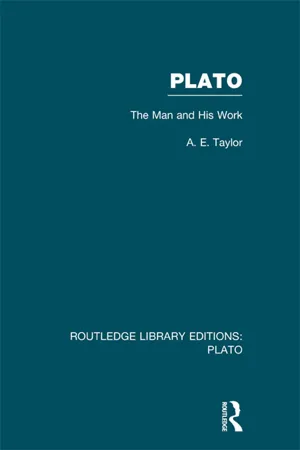
This book provides an introduction to Plato's work that gives a clear statement of what Plato has to say about the problems of thought and life. In particular, it tells the reader just what Plato says, and makes no attempt to force a system on the Platonic text or to trim Plato's works to suit contemporary philosophical tastes. The author also gives an account that has historical fidelity - we cannot really understand the Republic or the Gorgias if we forget that the Athens of the conversations is meant to be the Athens of Nicias or Cleon, not the very different Athens of Plato's own manhood. To understand Plato's thought we must see it in the right historical perspective.
- 562 pages
- English
- ePUB (mobile friendly)
- Available on iOS & Android
eBook - ePub
Plato: The Man and His Work (RLE: Plato)
About this book
Information
APPENDIX
THE PLATONIC APOCRYPHA
In using the name Apocrypha as a convenient collective designation for those items contained in our Plato MSS. of which it is reasonably certain that they have no real claim to Platonic authorship, I make no gratuitous assumption of fraudulence in their writers or worthlessness in their contents. Apart from the collection of Definitions, which has its own special character, the Apocrypha seem to be undiguised imitations of Platonic “discourses of Socrates,” and most of them to be the work of the early Academy; the attribution to Plato has arisen naturally and by accident. The works in question fall into three classes: (A) items actually included in the canon of Thrasylus; (B) the collection of δϱοι or definitions, which falls outside the division into “tetralogies”; (C) νοθευόμενοι, dialogues recognized in antiquity as spurious.
A. Dialogues included in the “tetralogies,” but certainly, or all but certainly, spurious.
Of these there are seven: Alcibiades I, Alcibiades II, Hipparchus, Amatores (the whole of the fourth “tetralogy”), Theages (“tetralogy” V), Clitophon (“tetralogy” VIII), Minos (“tetralogy” IX). All were clearly regarded as genuine by Dercylides and Thrasylus. The only fact known about their earlier history is that Aristophanes of Byzantium had included the Minos in one of his “trilogies” along with the Laws and Epinomis (D.L. iii. 62). Since we never hear of Dercylides or Thrasylus as introducing any items into the Platonic canon, it seems reasonable to infer that the whole group were already accepted by the Alexandrian scholars of the third century B.C. and that the composition of all must therefore be dated earlier still. None of the group is certainly quoted by Aristotle, or even Cicero,1 but this proves nothing since none contains anything which makes any difference to the interpretation of Plato's thought. As I shall try to show, the linguistic evidence is also decidedly against a late date in almost every case; the Greek with which these dialogues present us is recognizably that of the fourth century.2 It follows that we should assign their composition, speaking roughly, to the half-century between Plato's death and the opening of the third century, while one or two may quite possibly have been written even within Plato's lifetime. I shall also try to show that the thought is quite Platonic, though the way in which it is presented is not altogether that of the Master. My own conclusion is that the whole group is the work of Platonists of the first two or three generations, intending to expound Academic ideas by “discourses of Socrates.” This thesis cannot be formally demonstrated, but seems more probable than either the extreme view of Grote, who accepted the whole group as Platonic, or the rival extreme view which would bring some of the items well within the Alexandrian period.
Alcibiades I. This is in compass and worth the most important member of the group, as it contains an excellent general summary of the Socratic-Platonic doctrines of the scale of goods and the “tendance” of the soul. The Platonic authorship has been defended by Grote, Stallbaum, C. F. Hermann, J. Adam and recently M. Croiset and P. Friedländer; Jowett included a version in his English translation of Plato. For my own part I feel reluctantly forced to decide for rejection on the following grounds. (1) Close verbal study seems to show that in language the manner is that of the later Plato,1 whereas the thought is that of Plato's earliest ethical dialogues, and the exposition, at points, so unskilled that a resolute defender is almost bound to regard the dialogue as one of the earliest of all. (2) It seems incredible that Plato, who has given us such vivid portraits of Alcibiades in the Protagoras and Symposium, should ever have treated his personality in the colourless fashion of this dialogue. (3) It should be still more incredible that Plato, with his known views on the worth of “text-books,” should have composed what is, to all intents, a kind of hand-book to ethics. The work has the qualities of an excellent manual, and this is the strongest reason for denying its authenticity. I agree, then, with those who hold that Alcibiades I is a careful exposition of ethics by an early Academic, written well before 300 B.C., and possibly, though perhaps not very probably, even before the death of Plato. I should say with Stallbaum that it contains nothing actually unworthy of Plato, but I am equally satisfied that it contains echoes of Plato which are not in the manner of a writer who is echoing himself. In particular, the closing words (135e)1 can hardly be anything but an allusion to Plato's description (Rep. 491 ff.) of the corruption of the young man of genius by the blandishments of that supreme sophist, the “public,” a passage itself perhaps inspired by the tragic career of Alcibiades. There are other similar disguised quotations, as we shall see.
The writer's purpose is to expound the thoughts that the one thing needful for true success in life is self-knowledge, that this means knowledge of what is good and bad for our souls, and that such knowledge is different in kind from all specialism. Alcibiades is drawn as a young man of boundless ambition just about to enter on public life. (The date assumed is the end of his “ephebate,” before the outbreak of the Archidamian War. Pericles is at the head of affairs, 104b.) Socrates, who has long admired the wonderful boy from a distance, is now allowed by his “sign” to express his admiration for the first time.2 He knows that A. is ambitious to become the first statesman of Europe and Asia, and can help him to realize the dream if A. will only answer his questions (103a–106b).3 To succeed as a statesman, A. must be a good adviser and so must have knowledge which his neighbours have not, and this knowledge must come to him either as a personal discovery or by learning from others. But none of the things A. has “learned” are matters considered by sovereign assemblies, and in the matters which such an assembly does consider there are experts who would be much better counsellors than A. His boasted “advantages” of person, rank, wealth, are irrelevant. On what topics, then, would he be a competent adviser of the public ? He says, “On the conduct of their own affairs, e.g. the making of war and peace.” Yet it is the expert we need to advise us whether it is better to make war, on whom, and for how long. Our standard of the “better” is supplied by the expert's τέχνη. Now, what τέχνη is the relevant one in these questions of state ? When we declare war, we always do so on the plea that our rights have been infringed. Has A., then, ever learned “justice,” the knowledge of rights and wrongs ? He has never received instruction in it, nor can he have discovered it for himself. To do that he would need first to look for it, and to look for it he must be first awake to his ignorance of it. But from his childhood he has always been wrangling with his companions about his “rights,” as if he already knew what they are (106c– 110d). ...
Table of contents
- Cover Page
- Half Title page
- Title Page
- Copyright Page
- Original Title Page
- Original Copyright Page
- Dedication
- Preface
- Contents
- Dedication
- I The Life of Plato
- II The Platonic Writings
- III Minor Socratic Dialogues: Hippias Major, Hippias Minor, Ion, Menexenus
- IV Minor Socratic Dialogues: Charmides, Laches, Lysis
- V Minor Socratic Dialogues: Cratylus, Euthydemus
- VI Socratic Dialogues: Gorgias, Meno
- VII Socratic Dialogues: Euthyphro, Apology, Crito
- VIII The Phaedo
- IX The Symposium
- X The Protagoras
- XI The Republic
- XII The Phaedrus1
- XIII The Theaetetus
- XIV The Parmenides
- XV Sophistes–Politicus
- XVI The Philebus
- XVII Timaeus and Critias
- XVIII The Laws and Epinomis
- XIX Plato in the Academy—Forms and Numbers
- Addenda
- Chronological Table
- Appendix The Platonic Apocrypha
- I. Index of Proper Names
- II Index of Subjects
Trusted by 375,005 students
Access to over 1.5 million titles for a fair monthly price.
Study more efficiently using our study tools.
Frequently asked questions
Yes, you can cancel anytime from the Subscription tab in your account settings on the Perlego website. Your subscription will stay active until the end of your current billing period. Learn how to cancel your subscription
No, books cannot be downloaded as external files, such as PDFs, for use outside of Perlego. However, you can download books within the Perlego app for offline reading on mobile or tablet. Learn how to download books offline
Perlego offers two plans: Essential and Complete
- Essential is ideal for learners and professionals who enjoy exploring a wide range of subjects. Access the Essential Library with 800,000+ trusted titles and best-sellers across business, personal growth, and the humanities. Includes unlimited reading time and Standard Read Aloud voice.
- Complete: Perfect for advanced learners and researchers needing full, unrestricted access. Unlock 1.5M+ books across hundreds of subjects, including academic and specialized titles. The Complete Plan also includes advanced features like Premium Read Aloud and Research Assistant.
We are an online textbook subscription service, where you can get access to an entire online library for less than the price of a single book per month. With over 1.5 million books across 990+ topics, we’ve got you covered! Learn about our mission
Look out for the read-aloud symbol on your next book to see if you can listen to it. The read-aloud tool reads text aloud for you, highlighting the text as it is being read. You can pause it, speed it up and slow it down. Learn more about Read Aloud
Yes! You can use the Perlego app on both iOS and Android devices to read anytime, anywhere — even offline. Perfect for commutes or when you’re on the go.
Please note we cannot support devices running on iOS 13 and Android 7 or earlier. Learn more about using the app
Please note we cannot support devices running on iOS 13 and Android 7 or earlier. Learn more about using the app
Yes, you can access Plato: The Man and His Work (RLE: Plato) by A E Taylor,A.E. Taylor in PDF and/or ePUB format, as well as other popular books in Philosophy & Philosophy History & Theory. We have over 1.5 million books available in our catalogue for you to explore.