First published in 1971, the five essays in this book were written by young philosophers at Cambridge at that time. They focus on two major questions of ethical theory: 'What is it to judge morally?' and 'What makes a reason a moral reason?'. The book explores the relation of moral judgements to attitudes, emotions and beliefs as well as the notions of expression, agency, and moral responsibility.
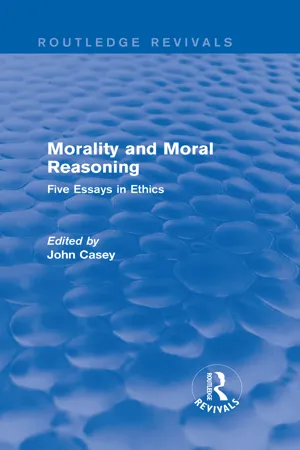
- 208 pages
- English
- ePUB (mobile friendly)
- Available on iOS & Android
eBook - ePub
About this book
Information
1 Morality and the Emotions1
Bernard Williams
Recent moral philosophy in Britain has not had much to say about the emotions. Its descriptions of the moral agent, its analyses of moral choice and moral judgement, have made free use of such notions as attitude, principle and policy, but have found no essential place for the agent’s emotions, except perhaps for recognizing them in one of their traditional roles as possible motives to backsliding, and thus potentially destructive of moral rationality and consistency. Much the same is true when one turns to what has been said about the objects of moral judgement: here there is much discussion of what it is to judge favourably or unfavourably actions, decisions, principles, states of affairs, intentions; indeed, men and men’s characters. There is less, however, about what a man ought or ought not to feel in certain circumstances, or, more broadly, about the ways in which various emotions may be considered as destructive, mean or hateful, while others appear as creative, generous, admirable, or – merely – such as one would hope for from a decent human being. Considerations like these certainly play a large part in moral thought, except perhaps in that of the most restricted and legalistic kind; but it is my impression that the part they play has not adequately been mirrored in the recent concerns of moral philosophers.
There are a number of reasons for this neglect. Some of the reasons are no doubt of mainly historical or sociological interest, but others are of more direct concern to philosophical theory; and of these, there are two that seem to me particularly significant. The first is connected with questions about language. The second consists in a combination of two things – a rather simple view of the emotions, and a deeply Kantian view of morality. The first part of what I have to say will be about language; this will lead into those other issues, about which I shall try to say something in the latter part.
The first reason, then, for the neglect of the emotions lies in some considerations about language. In these years philosophy has found its way to lie in reflection on language, and moral philosophy in reflection on the language of morality. Now this tendency, in itself, does not exclude much; for the diversity of what can be called ‘reflection on language’ is equalled by the diversity of what can be called ‘the language of morality’, and there was no basic reason why a generous approach to the linguistic endeavour should not have embraced those features of our speech about morality that reveal or suggest the parts played by the emotions; such features, as I shall try to show, certainly exist. What has largely inhibited this development is something over and above the linguistic programme itself: this is the preoccupation with the distinction between fact and value. This preoccupation has been inevitable. It has also, in many respects, been valuable. But there is no doubt that some of its consequences have been unfortunate. Since the preoccupation is one with fact and value as such, it has imposed on the linguistic enterprise a concentration on the most general features of moral language, or indeed, yet more widely, of evaluative language. Thus the attention goes to such very general linguistic activities as ‘commendation’, ‘evaluation’ and ‘prescription’, and to such very general terms as ‘good’, ‘right’ and ‘ought’, and the more specific notions in terms of which people a lot of the time think and speak about their own and others’ conduct have, with the exception of one or two writers, largely gone by default.
This concentration has helped to push the emotions out of the picture. If you aim to state the most general characteristics and connections of moral language, you will not find much to say about the emotions; because there are few, if any, highly general connections between the emotions and moral language. It has been all the easier for recent analytical philosophy to accept this truth (as I take it to be) because of the evident failings of a theory, itself one of the first in the linguistic style, which claimed precisely the contrary. This was emotivism, which offered a connection between moral language and the emotions as straightforward and as general as could be conceived, in the form of the thesis that the function and nature of moral judgements was to express the emotions of the speaker and to arouse similar emotions in his hearers. This theory not proving very plausible, and the interest in the highly general questions remaining, it was natural enough to look to things quite other than the emotions for the answers. Not that emotivism has ceased to be mentioned. It is mentioned in order to be refuted, and indeed the demolition of emotivism has almost come to take the place in undergraduate exercises that used to be held (as Stephen Spender comically recalls in his autobiography World Within World) by the equally mechanical dismembering of Mill’s Utilitarianism. The emotivist is specially suitable for this role of sacrificial victim because he is at once somewhat disreputable (emotivism being regarded as irrationalist) and at the same time embarrassingly likely to be taken for a close relative. But there are things to be learned from emotivism which do not always emerge in the course of the ritual exercises; and it is some of these that I shall now go on to consider. My aim will not be to reconstruct emotivism, but to steal from it; not to rebuild the pagan temple, but to put its ruins to a holier purpose.
Emotivism held that there were two purposes of moral judgements: to express the emotions of the speaker, and to influence the emotions of his hearers. I want to concentrate on the first of these. Now it was clearly the intention of emotivism, in referring to the expression of emotions, to offer a view about the nature of moral judgements, a view of their logical and linguistic character; it was not offering merely an empirical claim to the effect that moral judgements (themselves identified in some other way) always do express the emotions of their utterers. This being so, it must be part of an emotivist thesis that there are some kinds of linguistic rule associating moral judgements with the expression of emotion. What form might such linguistic rules take? Here there are two importantly different possibilities, which must be distinguished. On the one hand, they might be rules about the correct use of certain sentences or forms of words – those forms of words, namely, in uttering which we make a moral judgement; and the rules would state that unless those forms of words were used in expression of emotion, they were being misused. In this form, the rules would be about the correct use of the sentences that we use in making moral judgements, laying it down about those sentences that their correct use lies partly in the expression of emotion. The second possibility is that the linguistic rules should concern not the correct or incorrect use of those sentences, but should rather regulate the application of the expression ‘moral judgement’. In this form, the rules would not lay it down that a speaker would be guilty of a misuse of certain sentences if he used them not in expression of his emotions; it would merely lay down that if he did so use them, he would not count as making a moral judgement. In slightly more technical terms, one might say that the first possibility concerns the semantics of a certain class of sentences, while the second possibility concerns the definition of a certain speech-act, the speech-act of making a moral judgement. I shall consider these two possibilities in turn.
On the first possibility, that the requirement for expression of emotion actually enters into the semantic rules of sentences employed in moral judgements, it might be wondered whether there are any sentences at all whose use was governed by semantic rules of this type. There certainly are. I shall leave out the case of sentences which also say something explicitly about the speaker’s emotional state, e.g.
I am extremely angry with you;
these raise interesting problems about the relations between statement and expression,1 but they are not likely to provide much direct help in the present question. But consider a sentence like
He has broken his tricycle again, blast him.
Here it seems reasonable to say that the use of this sentence is governed by the requirement that the speaker be expressing irritation, or some feeling of that sort. We encounter here the matter of intonation in utterances of this sort; it is notable that there is a large range of intonations in which the sentence would be inappropriate, and others in which it would be appropriate, and if the latter were employed when the speaker was not irritated, his utterance would be misleading, even deceitful.
In this case, these features of the sentence of course centre on one word, the expletive; and this backs up the account of these features in terms of the semantics of the sentence, for they are features connected with the use of this expression: if someone did not know that the expression worked like this, he would be ignorant of a fact about the English language. That the features centre on this expression makes this example particularly simple in a certain way; the inclusion of the expletive merely adds something to what, without it, would be a straightforward statement of fact. That statement by itself could of course also be made in a manner expressive of irritation, but it does not have to be; the addition of the expletive gives a way of making that same statement of fact which is restricted to cases in which its utterance is to be taken as expressive of irritation. This is the sort of case to which one can straightforwardly apply the old New Yorker request: Just Stick to the Facts, Please.
The most primitive type of emotivist theory assimilated moral judgements to this type of utterance: statement of fact plus expletive addition. This, as has been often pointed out, will not do. It is only too obvious that the moral judgement
He did wrong in not going to the appointment
is not necessarily expressive of indignation or any other emotion; though of course a particular utterance of it may be expressive of some emotion, just as a statement of fact may be. Apart from this, expletives are not logically manoeuvrable enough to provide a model for moral, or any other value judgements. To adapt to this question an argument that has been used by J. R. Searle1 against a more sophisticated thesis, it is notable that you cannot make conditional the expressive functions of an expletive. Thus the sentence
If he has broken his tricycle again, blast him, he’ll go without his pocket money
obeys the same sorts of rules as the simpler sentence considered before; it can be appropriately used only by someone who is already irritated. But even if I shall be indignant if I believe that he did wrong in not going to his appointment, it is clear that the sentence, uttered when I am still in doubt about the circumstances,
If he did wrong in not going to the appointment, I shall have something to say to him,
does not express existing indignation, my indignation remaining as hypothetical as the truth of the antecedent. A similar point can be shown with negation. If A asks
Has he broken his tricycle again, blast him?
and B replies
No, he has not broken his tricycle again, blast him
either B is himself irritated, or (just possibly) he is sarcastically quoting A’s expletive.
The same consideration can be applied to cases more sophisticated than the simple occurrence of expletives. If my infatuated friend says
Lisa looks incomparable lovely tonight
it scarcely seems open to me, even if I wish to disagree with his estimate of Lisa’s appearance, to do so by just denying his assertion in its own terms:
No, she does not look incomparably lovely tonight
would be an odd thing to say, and would have a place, I suspect, only if I were in effect quoting him, as above – and thus being very rude – or possibly, and more interestingly, if I were myself fairly infatuated, and disagreeing only about the incomparability of her loveliness tonight; in which case, paradoxically, the denied expressive terms are still doing their expressive job. This resistance to losing their force in conditional, negative, etc., contexts may well be a mark of sentences which semantically incorporate the expression of emotion. Those sentences which are used to make moral judgements do not in general have this peculiarity, and the first possibility for a general emotivist link between moral language and the emotions fails.
While this is so, it is not the end even of this part of the story. While those sentences that are used to make moral judgements do not in general semantically incorporate the expression of emotion, it seems clear that some of them do. For instance,
Of course, he went back on his agreement when he got to the meeting, the little coward
seems to be reserved for use in circumstances where certain emotions, such as contempt, are felt by the speaker. What else does the utterance of this sentence do? First, it states or implies certain facts, as that he made an agreement, and went back on it at the meeting; and second, it imports an explanation, since ‘cowardice’ is an explanatory notion (the speaker would be taking a different view of what had happened if, equally unamiably, he called the man an ‘ambitious little crook’). Is this all? If so, we can analyse the utterance into statement of fact, suggestion of explanation and (something like an) expletive addition: i.e. as merely a slightly more complex example of the ‘blast him’ sort. But this seems to leave something out, since one would be naturally disposed to think that the original remark also embodied some moral opinion or assessment of the man’s behaviour. On the present analysis, it looks as though this function will be borne only by the expletive addition – that is to say we shall be accepting for this case the primitive emotivist account which has been in general rejected. If this is not acceptable, it seems that there should be some way of representing the moral assessment feature independently of the expletive addition; so that the removal of the expletive addition will leave us with a triple core, of stating facts, suggesting explanation and making a moral assessment. If this is so, we should be able in principle to isolate this care without the expletive trimmings – obeying, as it were, an amplified New Yorker instruction: Just Stick to the Facts, Explanations and Moral Assessments, Please.
What would the isolated core look like? Here there are difficulties which particularly centre on the expression ‘little coward’. While ‘coward’ is an explanatory term, it is not a very unemotional one; and if ‘little’ refers to the man’s moral, rather than his physical stature, it is not (at least in this collocation) a very unemotional way of making a moral assessment. This phrase seems inextricably linked to the expletive addition, and so cannot appear in the core. The core is, then, going to look something like this:
As might have been predicted, he went back on his agreement at the meeting through fear; which he ought not to have done (or this was a bad thing).
This sentence is supposed to stand in the same relation to its earlier emotional counterpart as ‘he broke his tricycle’ does to ‘he broke his tricycle, blast him’; i.e. in this more complex case, it states the same facts, suggests the same explanation and makes the same moral assessment. All that the replacement sentence has supposedly lost are the expletive additions. But is this in fact so?
It is made a little easier to agree to this by my having introduced a term that is sometimes introduced in this sort of connection, viz. ‘moral assessment’, since there is a satisfactory sense of ‘assessment’ in which you and I give the same assessment merely if we are both ‘pro’ or both ‘con’ or, perhaps, both ‘neutral’. Certainly in the present case both the original sentence and its non-emotional replacement equally reveal the speaker as ‘con’. In one sense of the phrase ‘moral judgement’, the notion of ‘same moral judgement’ might be adequately modelled on this very skeletal pattern of ‘assessment’; this is where ‘judgement’ is something offered by a judge, one who applies such labels as ‘pass’ or ‘fail’, ‘first’, ‘second’, ‘highly commended’ and so forth. In this sense, we might say that the original sentence and its replacement embodied the same moral judgement. But, as has been quite often pointed out, the technical phrase ‘moral judgement’ has other overtones, being virtually the only survivor into contemporary philosophical vocabulary of that Idealist usage by which beliefs and opinions, roughly, were called ‘judgements’. And these overtones have to be preserved if the phrase ‘moral judgement’ is to have any hope of doing adequate work in its exposed position in moral philosophy; since, in being interested in a person’s moral judgement, so called, we are in fact not merely interested in whether he is pro this and con that, whether he grades these men in one order or in another. We are interested in what moral view he takes of the situations, how those situations look to him in the light of his moral outlook. Could we in this broader sense of ‘moral judgement’ say – to revert to our example – that the replacement sentence expressed the same moral judgement as the first one? Does it lay before us the same moral view of the situation? Scarcely so. To agree to this would commit us to saying that the contempt (or something like it) that the speaker of the first sentence felt and put into his words was not an integral part of his moral view of the situation; that contempt was an adventitious addition to his low rating of the man’s behaviour at the committee, as my irritation is no doubt an adventitious reaction to my learning that Tommy has broken his tricycle again. Something like this could be true; but very obviously, it need not be so. Indeed, it is far from clear what content is to be assigned, in the moral connection, to the bare notion of ‘grading low’; this is an idea which seems much more at home in highly structured professional or technical kinds of comparison. In the present case, the mode in which this man’s behaviour appeared bad may precisely have been that of its being contemptible; and if the person who made the remark comes not to think of it in those terms, he will cease to take the same moral view as before of this man’s behaviour. Where this is so, we may not be able to isolate the moral-judgement content of the utterances from what makes them expressive of emotion.
We shall get back to this area again. Now, however, let me take up what I mentioned earlier as the second line by which an emotivist type of theory might seek to make a direct link between the making of moral judgements, and the expression of emotion. This was the suggestion that the expression of emotion might be logically involved, not in the semantics of certain sentences that people utter, but in the description that we give of their uttering them: that a speaker’s expressing emotions should ...
Table of contents
- Cover
- Half Title
- Title Page
- Copyright Page
- Original Copyright Page
- Contents
- Preface
- 1 Morality and the Emotions
- 2 Attitudes, Beliefs and Reasons
- 3 Moral Realism
- 4 Evaluation and Speech
- 5 Actions and Consequences
- Index
Trusted by 375,005 students
Access to over 1.5 million titles for a fair monthly price.
Study more efficiently using our study tools.
Frequently asked questions
Yes, you can cancel anytime from the Subscription tab in your account settings on the Perlego website. Your subscription will stay active until the end of your current billing period. Learn how to cancel your subscription
No, books cannot be downloaded as external files, such as PDFs, for use outside of Perlego. However, you can download books within the Perlego app for offline reading on mobile or tablet. Learn how to download books offline
Perlego offers two plans: Essential and Complete
- Essential is ideal for learners and professionals who enjoy exploring a wide range of subjects. Access the Essential Library with 800,000+ trusted titles and best-sellers across business, personal growth, and the humanities. Includes unlimited reading time and Standard Read Aloud voice.
- Complete: Perfect for advanced learners and researchers needing full, unrestricted access. Unlock 1.5M+ books across hundreds of subjects, including academic and specialized titles. The Complete Plan also includes advanced features like Premium Read Aloud and Research Assistant.
We are an online textbook subscription service, where you can get access to an entire online library for less than the price of a single book per month. With over 1.5 million books across 990+ topics, we’ve got you covered! Learn about our mission
Look out for the read-aloud symbol on your next book to see if you can listen to it. The read-aloud tool reads text aloud for you, highlighting the text as it is being read. You can pause it, speed it up and slow it down. Learn more about Read Aloud
Yes! You can use the Perlego app on both iOS and Android devices to read anytime, anywhere — even offline. Perfect for commutes or when you’re on the go.
Please note we cannot support devices running on iOS 13 and Android 7 or earlier. Learn more about using the app
Please note we cannot support devices running on iOS 13 and Android 7 or earlier. Learn more about using the app
Yes, you can access Morality and Moral Reasoning (Routledge Revivals) by John Casey in PDF and/or ePUB format, as well as other popular books in Philosophy & Philosophy History & Theory. We have over 1.5 million books available in our catalogue for you to explore.