Gorbachev's accession to General Secretary promised great changes to the Soviet Union and its relationship with the rest of the world. This book, first published in 1987, discusses the problems faced by Gorbachev when he entered office and how he planned to tackle them. Gorbachev was a figure of genuine debate in the mid-1980s, raising doubts from Western specialists regarding his radicalism and ability to reform the Soviet economic system in particular. Here, Dyker and his colleagues assess the changes Gorbachev had already made to consolidate his power base, alongside those that he was proposing to make to agriculture, industry and foreign relations at the time of publication. The book speculates about how Gorbachev might implement his proposed political and economic reforms, what opposition he might encounter and how successful he would be. A fascinating insight into Soviet economic and political policy in the years leading up to the Union's collapse, this work will be of particular importance to students and academics researching the personality of Gorbachev and the political and economic history of the Soviet Union.
eBook - ePub
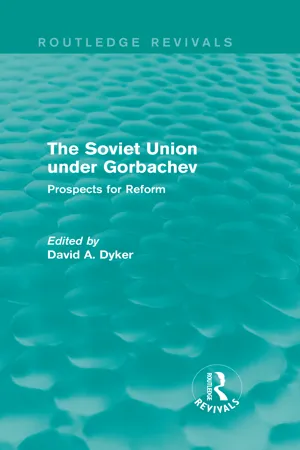
The Soviet Union under Gorbachev (Routledge Revivals)
Prospects for Reform
- 228 pages
- English
- ePUB (mobile friendly)
- Available on iOS & Android
eBook - ePub
About this book
Information
1
Introduction
David A. Dyker
In the period since the 1985 change in the Soviet leadership there has been, understandably, a good deal of emphasis on Gorbachev the personality. In terms of self-projection, handling of the media, and presentation of policy departures, the new General Secretary has undoubtedly struck a new note, set a new style. The aim of the present work is to try to get beyond the stage management, to peel off the packaging, and evaluate the policy departures on their own merits. In so doing we have not lacked for formal pronouncements to serve as a starting point. With planning experiments, agricultural reorganisations and arms reduction proposals, not to mention intra-Comecon vicissitudes and ubiquitous personnel changes, our problem in the present context was rather one of selection. The principle we chose emerges directly from our title. We are interested in prospects for reform. That is why we have not devoted special chapters to, for instance, nationality relations, religion and political dissent. In terms of evaluation of likely secular trends in Soviet polity and society, those and other dimensions may be as important as any. But it is very improbable that they will be the subject of specific, major legislation or negotiation this year or next. That is why we have concentrated on Gorbachev’s internal politics, Soviet foreign policy in all its ramifications, and economic reform. Other issues are introduced to the extent that they shed light on these, our central concerns. They are, needless to say, intertwining themes. We have tried to point up the linkages as we go along, and to pull together as many threads as possible in our Conclusion. Certainly the full pattern has not yet been revealed to us, and in the last analysis this must remain a provisional assessment. But, of course, ‘il n’y a rien qui dure que le provisoire’.
What do we mean by ‘reform’?
Why has ‘reform’ been such a dominant theme in the Soviet Union, and in Soviet studies, for over a quarter of a century now? Other countries, it seems, can get by without reforms, so why not the Soviet Union? The simplest answer is that in a system so highly centralised, so heavily based on the military principle of command, very little can change without express permission from Party and government. In our search for a workable definition, then, we begin by contrasting ‘reform’ to ‘evolution’.
There can be no doubt, however, that in the Soviet Union itself, under Brezhnev, ‘reform’, like ‘experiment’, became a weasel word. In practice, through a period of overwhelming inertia in policy-making, reforms and experiments served as substitutes for policies, rather than their foundations. After the emasculation of the 1965 industrial planning reform (see below) for example, the principle was established that nothing that changed anything should ever be generalised to the level of the economic system as a whole. That is why Gorbachev talks of the need for ‘radical reform’ — not to imply necessarily that he wants to turn the whole system upside down, but simply to indicate that he means business in a way that Brezhnev did not. In our treatment we also proceed on the basis of a concept of radical reform. By ‘reform’ we imply ‘a policy of social and economic reforms by gradual stages rather than by revolutionary change’ (Bullock and Stallybrass, 1977, p. 532). Our understanding of ‘radical’ does not pre-empt the discussion — which indeed forms the main part of this book — of just how far Gorbachev needs to go. But it certainly implies that he will have to go very much further than any of his predecessors have gone. Agnes Heller writes that ‘the absolute and necessary precondition of genuine reform is at present totally absent from the Soviet scene. This precondition is a thoroughgoing structural critique of the past: one that is not limited to vague references in misty party documents, but goes on in open public debate’ (Heller, 1985, p. 26). We may baulk a little at the strength of the conclusion, but can hardly dispute the rightness of the emphasis on the assessment of the past, on that which is structural/systemic, and on the importance of open discussion.
Background: the roots of the economic problem
It is in the economic sphere that the leitmotif of reform has recurred most frequently since the death of Stalin, and this has reflected an extreme tension between the pressures of economic development and the forms of economic administration. For however sharp may be the underlying technological or social pressures, they cannot get through to the socio-economic system without the consent of the authorities. Pace Galbraith, there can be no technological imperatives in the Soviet system, only political ones. At the same time Party and government are constrained in their freedom to respond or not respond to pressures by the need to survive. This is where the theme of dirigisme becomes more complex and interesting, for it is precisely the principle of centralisation which stands in greatest need of reform from the point of view of planning and management itself.
The Soviet planning system developed at a time, and in circumstances, unique in Soviet, and indeed world experience. Under the leadership of Joseph Stalin, a man obsessed with the role of political control, and in the context of severe economic backwardness, the Soviets developed an approach which attacked the economic development problem through an essentially political process of mobilisation. It was within that framework that a high degree of centralisation was seen as essential, that the principle of command was purposefully extended through the whole of the Soviet economy, starting with collectivisation of agriculture by force in 1930–2. For rapidly growing Soviet industry that meant the imposition of a hierarchical system of planning, running from the State Planning Commission (Gosplan) at the centre, down through a number of industrial-sectoral ministries to the enterprise at the bottom of the ladder. Every enterprise was set an obligatory production target, and bonuses, promotion and even survival depended on fulfilment of that target. Reluctant collective farmers were kept on their toes through the medium of compulsory procurement quotas — whether they had enough left after fulfilment of those quotas to feed themselves was viewed as strictly their problem (Dyker, 1985, ch. 1).
There can be no doubt that the system worked well as a vehicle of rapid growth, particularly industrial growth. Over the first 40 years of its existence it reported rates of growth of National Income consistently above 5 per cent per annum, and industrial rates of growth which often reached double figures. Equally important, the Nazi onslaught of 1941–2 was repulsed. The experience of other countries suggests that the same results might have been achievable on a different institutional basis. Nevertheless it is fair to say that the sheer weight of Stalin’s mobilisatory impetus proved highly effective in implementing very rapid structural change in the Soviet economy. Massive transfers of labour out of overpopulated agriculture permitted the development of a labour-intensive industrial infrastructure to complement the highly capital-intensive ‘grand projects’, while compulsory grain procurement quotas ensured that there would always be enough food (if only just) to feed the new proletariat. Many of the grand projects in turn focused on bringing into play the massive reserves of industrial raw materials present in the Urals and West Siberia regions. Once on stream, these projects ensured plentiful and cheap supplies of ores and energy materials to manufacturing industry. Thus Stalin could count on abundance of labour and raw materials. The latter point is particularly important in that it freed the Soviet Union from the kinds of Balance of Payments worries which afflict most developing countries as they set out on industrialisation programmes, with all that that means in terms of the demand for oil, etc. The only thing that Stalin did have to obtain from the outside world was technology, and just because the USSR was in those early days so very far behind, that could on the whole be acquired quite cheaply. Thus in putting maximum pressure on enterprises to produce as much as quickly as possible, the Soviet leadership could feel confident that enterprise managers would not run into unbreakable bottlenecks, whether in terms of labour or materials supply. Bottlenecks certainly did emerge, but they were negotiable ones, and Stalin actually used them to pinpoint the priorities of the industrialisation programme (Wilber, 1969, ch. V). Through the system of Material Balances, which charted supply and demand for each product on a double-entry book-keeping basis, the planners disposed of a crude, but flexible tool of product-flow planning which fitted in ideally with Stalin’s ‘priority principle’ approach. And because of the unconstrained resource situation the Soviet planners were able to force out rapid aggregate growth without having to worry too much about productivity and cost trends. This is the essence of the ‘extensive growth’ pattern.
By the 1960s all of this was changing. As the scope for further transfers of labour from the countryside became increasingly limited, as the female participation rate rose to levels which seriously threatened the rate of natural increase in European parts of the USSR, so the labour supply situation became increasingly strained. Meanwhile hydrocarbon deposits west of the Urals were being depleted, and in 1963–4 commercial exploitation of West Siberian oil and gas began. There is no disputing the richness of hydrocarbon deposits in Siberia, but difficult geographical and climatic conditions ensure that capital costs are very high. By the early 1970s the most accessible of the West Siberian deposits were themselves being depleted, and capital costs rose remorselessly as prospectors were forced farther north and east. Unit capital costs in gas extraction doubled 1970–3 (Dyker, 1983, p. 161), and by 1980 output at the great Samotlor oil field had peaked and gone into decline. There were to be no more Samotlors. Faced, then, with a sharply rising long-run marginal cost curve in energy production, the Soviet authorities found themselves under severe pressure to cut back on energy consumption so as to give the Oil and Gas Ministries some breathing space in relation to the exploitation of more marginal fields. Whether in terms of human or material resources, then, the priority had now to shift onto productivity and cost-effectiveness.
The traditional system of planning was, however, peculiarly illsuited to this task. The tyranny of monthly or quarterly output targets had given enterprise directors every reason to want to hang onto surplus labour ‘just in case’, the more so that central planning had proved especially bad at providing industrial establishments with ‘fiddly’ components. To this day, for instance, Soviet engineering factories find it necessary to make their own nuts and bolts. Soviet lorry drivers would get their bonuses for fulfilling targets for ton/kilometres, estimated on the basis of petrol consumption. So if something went wrong and they were unable to do the ton/kilometres, they might just pour off some petrol down the gutter, to keep up appearances (Turovsky, 1984, pp. 163–4). Oil and gas extraction enterprises in Western Siberia, suffering on the same treadmill of endless production quotas for their ‘name’ product, have found little incentive to do anything with valuable accessory gas and gas condensate (Dyker, 1983, pp. 169–70). Lack of sensitivity to costs apart, the system of centralised planning showed itself increasingly helpless in the face of the burgeoning complexity of a rapidly growing economy. This manifested itself initially in increasing disarray on the investment front — Khrushchev’s first, rather ineffectual, round of planning reforms was, indeed, focused specifically on that issue. By the 1970s the problem of overcentralisation was taking a new twist, as technical progress revolutionised the electronics and communications industry. In the age of the micro-chip the idea of planning through output targets began to seem positively antediluvian. But as the planning system itself became increasingly obsolescent, so it tended to condemn its ‘victims’ to the same fate. Once again, the tyranny of short-term output targets creates a powerful disincentive for the enterprise manager to do anything which disrupts continuous production, i.e. anything involving fundamental technical change. However committed the central authorities may be to innovation, they simply did not dispose of a vehicle adequate to implement it.
The evolution of Soviet agriculture presented an altogether different picture. The impact of collectivisation was largely negative right from the start — on agriculture itself and indeed on the Soviet economy as a whole. Stalin’s theory of ‘pumping-over’ resources from agriculture to finance the ‘primitive socialist accumulation’ required by the industrialisation drive found little applicability during the crucial period of the 1930s, because the process of forcible collectivisation itself was so damaging to agriculture as to leave nothing to pump over. Even so, millions of peasants died of starvation in the early 1930s. There was more effective pumping-over during the Second World War, and in the post-war recovery period, but while this may have aided the causes of victory and industrial reconstruction, it deepened profoundly a process of demoralisation of the peasantry which had been begun by collectivisation itself. The demographic impact of extensive industrialisation (43.4 million people migrated from country to town 1926–39 — Gregory and Stuart, 1986, p. 113), combined with the appalling loss of life during the war itself, left the rural population skewed towards the middle-aged and the female, and added specific manpower shortages to morale problems. It is not surprising, then, that on Stalin’s death agricultural output was not much greater than it had been in the late 1920s.
Khrushchev attacked these problems on two main fronts. On the one hand he raised agricultural procurement prices sharply. This improved incomes and incentives for the peasants and facilitated sharp increases in the flow of investment into agriculture. On the other, he sought to strengthen the state and collective farms through amalgamations and through the transfer to them of the machinery previously held by the Machine Tractor Stations. At the same time he tried to make the internal organisation of the farms more flexible by encouraging development of the ‘link’ system, under which small, peasant work-teams are allowed a certain degree of operational autonomy. The merits of at least some of these policies was reflected in a 50 per cent increase in aggregate agricultural output between 1953 and 1958. But this was followed by a new period of stagnation, as the policy package started to break up under pressure. Khrushchev felt by the late 1950s that there had been enough price increases already, although transfers of MTS machinery to collective farms — which had to be paid for — placed a big extra burden on farm finances. As a result agricultural investment trends lost their buoyancy, while peasant incomes fell. Meanwhile the link system was running into difficulties, and Khrushchev had taken to repressive policies to stop peasants spending too long on their private plots. At the same time the costly Virgin Lands scheme, a classic example of extensive development tactics in agriculture as marginal lands were brought into cultivation for the first time, had run out of steam. By the time Khrushchev fell from power, then, most of the agricultural problems he had inherited from Stalin were still, in some degree, on the agenda.
Background: the evolution of the political system
Stalin was a tyrant. For better or worse he ruled by imposing his personal will through lieutenants responsible only to him. He was quite uninhibited about using terror as a means of keeping the population at large in submission and as a way of preventing his lieutenants from developing any political independence. Having originally risen to power by building up support in the Communist Party, he then largely destroyed the apex of the Party in the Great Purges of 1936–8. From that time until his death he chose to rule largely through the medium of the secret police, though the Party continued to play an important role, politically and economically, at the provincial and city level. After Stalin’s death a power struggle between his lieutenants developed. It was won by Nikita Khrushchev, who had taken over Stalin’s position as head of the Party secretariat (Khrushchev called himself First Secretary rather than General Secretary). Beria, the police chief, was shot, and Malenkov, who took over the premiership in 1953, had by 1957 been forced into retirement. Political adroitness apart, the basis for Khrushchev’s success was the fact that he allied himself with a resurgent Party identity. Central Committee Plena and Party Congresses became more frequent, and the Politburo (known as the Presidium during the Khrushchev period) began to take on some of the characteristics of a genuine cabinet, with policy issues playing counterpoint to personality clashes. Thus the Party, and in particular its professional apparatus — the Central Committee secretariat and the national network of regional secretaries — re-emerged with something like its old ‘vanguard of the proletariat’ image. However the socio-political content of this re-emergence was anything but radical. For the apparatus, and for Khrushchev, Stalin’s greatest crime had been to oppress and abuse the Party. Now that Stalin was gone, the Party could look forward to a future freed of the threat of terror, in which political careers could be built on solid foundations. It was only a short step from notions such as these to the reality of consolidation of privilege, including the privilege of passing on your status to your children, of political ‘family circles’ which sought to ensure survival through mutual back-scratching — in a word to the development of Djilas’s new class.
We should certainly not exaggerate the extent of collective leadership under Khrushchev. Especially after his defeat of the so-called Anti-Party Group in 1957, the First Secretary enjoyed a position of political dominance. He even felt strong enough, in 1962, to split the Party into two separate hierarchies, one for agriculture, one for industry, in an attempt to raise the political status of an agricultural sector still shell-shocked from Stalin’s rough treatment. In so doing he inevitably disturbed the family circles, and disrupted normal patterns of promotion. Perhaps that was why, less than two years later, the Central Committee of the Communist Party voted him out of office. Both Lenin and Stalin died in office. Khrushchev’s dismissal, by the highest organ of the Party, seemed to promise a new phase in Soviet history, a new quasi-constitutionality in the Soviet mode of political succession.
That promise was not, in the event, fulfilled. All Soviet General Secretaries (Brezhnev revived Stalin’s title) since Khrushchev have died in office. The spectacle of Brezhnev’s last years, when personal physical decline highlighted policy drift, underlined how embarrassing the issue of political succession remains in the Soviet Union. On Andropov’s death in 1983, only a year after his succession to Brezhnev, the Central Committee does, indeed, seem to have deemed it best to choose a General Secretary with one foot already in the grave. But this is not to say that the Central...
Table of contents
- Cover
- Half Title
- Title Page
- Copyright Page
- Original Copyright Page
- Contents
- Preface
- 1 Introduction
- 2 The Consolidation of Gorbachev’s Political Power — a Springboard for Reform?
- 3 Industrial Planning — Forwards or Sideways?
- 4 Agriculture: the Permanent Crisis
- 5 Gorbachev and the World — the Economic Side
- 6 Gorbachev and the World — the Political Side
- 7 Conclusions
- Postscript
- Glossary
- Index
Trusted by 375,005 students
Access to over 1.5 million titles for a fair monthly price.
Study more efficiently using our study tools.
Frequently asked questions
Yes, you can cancel anytime from the Subscription tab in your account settings on the Perlego website. Your subscription will stay active until the end of your current billing period. Learn how to cancel your subscription
No, books cannot be downloaded as external files, such as PDFs, for use outside of Perlego. However, you can download books within the Perlego app for offline reading on mobile or tablet. Learn how to download books offline
Perlego offers two plans: Essential and Complete
- Essential is ideal for learners and professionals who enjoy exploring a wide range of subjects. Access the Essential Library with 800,000+ trusted titles and best-sellers across business, personal growth, and the humanities. Includes unlimited reading time and Standard Read Aloud voice.
- Complete: Perfect for advanced learners and researchers needing full, unrestricted access. Unlock 1.5M+ books across hundreds of subjects, including academic and specialized titles. The Complete Plan also includes advanced features like Premium Read Aloud and Research Assistant.
We are an online textbook subscription service, where you can get access to an entire online library for less than the price of a single book per month. With over 1.5 million books across 990+ topics, we’ve got you covered! Learn about our mission
Look out for the read-aloud symbol on your next book to see if you can listen to it. The read-aloud tool reads text aloud for you, highlighting the text as it is being read. You can pause it, speed it up and slow it down. Learn more about Read Aloud
Yes! You can use the Perlego app on both iOS and Android devices to read anytime, anywhere — even offline. Perfect for commutes or when you’re on the go.
Please note we cannot support devices running on iOS 13 and Android 7 or earlier. Learn more about using the app
Please note we cannot support devices running on iOS 13 and Android 7 or earlier. Learn more about using the app
Yes, you can access The Soviet Union under Gorbachev (Routledge Revivals) by David A. Dyker in PDF and/or ePUB format, as well as other popular books in Politics & International Relations & American Government. We have over 1.5 million books available in our catalogue for you to explore.