Ismail Fahmy was Minister of Foreign Affairs and Deputy Premier of Egypt, but resigned in protest against President Sadat's visit to Jerusalem in 1977. This book, published in 1983, presents the first portrait of Sadat from within the Arab ruling elite, and gives unique coverage of the crucial negotiations that took place between Arab leaders, which determined the key events during this period. Fahmy vividly recounts the years when prospects for a permanent peace in the Middle East seemed a real possibility and presents a damning portrayal of the roles that Kissinger, Nixon and Carter played in events. This is a fascinating account of the struggle for peace in the Middle East, written from the unique perspective of a hugely influential contemporary at the heart of the dialogue.
- 332 pages
- English
- ePUB (mobile friendly)
- Available on iOS & Android
eBook - ePub
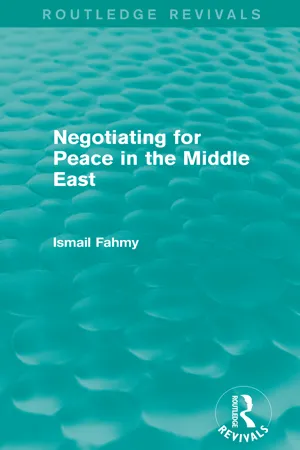
Negotiating for Peace in the Middle East (Routledge Revivals)
About this book
Information
1 SADAT AND I
The beginning of 1972 had brought heightened tension and internal crisis to Egypt. President Sadat, having failed to fulfill his promise that 1971 would be the ‘year of decision’, was faced with an increasingly rapid drop in his already low domestic popularity. Students and blue collar workers, faced with the dismal economic situation, challenged his authority. Egypt’s internal problems, coupled with the war situation on the Israeli front, gave no hope for optimism. Israeli intransigence prevented progress toward peace. The Soviet Union’s hesitancy in providing Egypt with sufficient armaments for the liberation of the occupied territory in Sinai damaged Sadat even more. A new initiative in Egypt’s internal and international policies and priorities was necessary. However, in the international arena at that time the highest priorities were Vietnam and the scheduled summit meeting between Nixon and Brezhnev; the Middle East was dismissed as a secondary, if troublesome, area of the world.
The Symposium at Al-Ahram
The Centre for Political and Strategic Studies at Al-Ahram organised a symposium in May 1972 to discuss the forthcoming USA–USSR summit meeting in the light of the sudden United States decision to block and mine the port of Haiphong in Vietnam. Egyptian intellectuals from different governmental and nongovernmental institutions were invited to participate. I attended in my capacity as Under-Secretary of State at the Ministry of Foreign Affairs.
President Nixon had decided to mine Haiphong harbour just a few days before the scheduled opening of the summit meeting in Moscow. The decision was extremely provocative, and presented an unprecedented challenge to the Soviet Union both in form and timing. The participants at the symposium were of the view that the summit meeting, as a result of the United States decision, would either be cancelled or postponed. I was the only one to hold a contrary opinion, arguing that the summit meeting would take place as scheduled because of the superpowers’ desire for détente.
The discussion inevitably led us to an extensive appraisal of the Middle East crisis and to a reassessment of Egypt’s relations with the superpowers, especially with the Soviet Union, relations with the United States being almost non-existent. At this point the discussion focused exclusively on our foreign policy. I had given much thought to these issues and I took advantage of the opportunity to make my ideas public. I pointed out that the overall situation in the Middle East had to be reappraised and that Egypt could not continue to vacillate in a precarious state of ‘no peace, no war’. This term was later picked up by others and used to describe the situation in the Middle East. Internal as well as external pressures made change imperative, but any new move would have to be planned carefully and take into account our relationship with both superpowers. I argued that it was high time we examined our relationship with the Soviet Union and then confronted the Soviet leadership with our own idea of how our relations should be reshaped and redirected. I suggested that the superpowers were contributing to the maintenance of ‘no peace, no war’, because a permanent settlement in the Middle East had low priority for them. Détente was likely to make this priority even lower, as the two superpowers would now be preoccupied with safeguarding their new rapprochement. As a consequence, the Soviets would become even more reluctant to provide Egypt with the arms it needed for a new confrontation with Israel. I made it clear that without such confrontation there would be no incentive for the superpowers to work for a comprehensive peace in the Middle East. I suggested that the symposium should concentrate on analysing the causes of the state of ‘no peace, no war’ and how it had been perpetuated by the conflicting interests of the superpowers. The Soviets must understand that we wanted their friendship, but were not prepared to accept indefinitely the state of ‘no peace, no war’. I argued that if the Soviets were actually unaware that Egypt, backed by the Arab world, was rejecting the stalemate of the state of ‘no war, no peace’ and that it had no alternative but a new confrontation with Israel, they were making a colossal mistake in their calculations. I was convinced that in Moscow they were aware of the implications of their policy.
Whereas the Soviets policy objective was intentionally to limit the Egyptian military option, on the other hand they grossly miscalculated the effect that policy had in discrediting them with the Egyptians and thereby the negative impact it had on their interests in the region. Moreover, it was clear that the Soviet advice to the Egyptian side not to start military operations was due to Moscow’s fear that once a war started events might lead to a greater confrontation between the two superpowers in the Middle East.
The state of ‘no peace, no war’ was causing a gradual haemorrhage of Egypt’s resources. Egypt therefore had to take a military initiative to revitalise the crisis, but before embarking on such a course of action, Egypt had to mobilize all her resources and those of the entire Arab world. In particular I expanded on the importance of using oil as a major political weapon.
This symposium was the first frank and public discussion of Egyptian foreign policy and the options open to us since 1952. The discussion was not meant specifically as a criticism of the Soviet Union. Rather, it was an attempt to re-examine Egypt’s own interests and to invite the Soviet Union to review its attitude and policy toward Egypt, so that our relationship might serve the interests of both countries and thus be strengthened. But in the course of the discussion it also became clear to us that we should seek to re-establish relations with the United States. Egypt simply could not afford to ignore one superpower, becoming totally dependent on the other.
The discussion which had taken place at the symposium was published on 19 May 1972 in Al-Ahram and was the first serious evaluation of the situation to appear in print in Egypt. We expected that the publication of the symposium would create much interest, but we also expected problems, for President Sadat, in an address to the People’s Assembly in early May had proclaimed: ‘I shall take strong measures against people who criticise Egypt’s major ally, Russia, rather than Cairo’s enemy, the United States.’
The report of the meeting was greeted with all the more interest because it was widely assumed that my intervention represented an official government position. Nobody could quite believe that statements deviating from the government position could have been made in public without Sadat’s consent. As a result, it was thought that the symposium had been conceived by Sadat as a trial balloon. In fact, I had never even met Sadat at that time. In addition, I had been invited to participate in the symposium just three hours before it was to start, and I had hardly had time to prepare myself, let alone clear my comments with anybody.
The Soviets, too, assumed that the symposium had been inspired by the government, and formally protested. As a result the Foreign Minister, Dr Mourad Ghaleb, decided to submit for Sadat’s signature a presidential decree to the effect that I should be relieved of my duties as Under-Secretary of State for Foreign Affairs but should remain in the Ministry of Foreign Affairs as ambassador. Ghaleb’s position was understandable in view of his personal status: after many years as Egyptian ambassador to Moscow, he regarded himself as a pillar of Soviet-Egyptian relations. When the Soviet Union protested about the symposium, he felt compelled to remove me as the principal offender. In private, however, he praised my evaluation: This is the best analysis I have come across in a long time,’ he told me. When Ghaleb presented the decree to remove me for Sadat’s signature, however, the President refused to sign it. By this time Sadat had read my statement and had apparently been impressed by the ideas I had set forth; he started implementing some of the suggestions made at the symposium. This at least was the assessment of Dr Mahmoud Fawzi, at that time Vice-President of Egypt. ‘Sadat,’ he told me a month later, ‘has started implementing the policies you outlined at the symposium.’ I have no way of knowing whether this was in fact the case, because I did not yet belong to Sadat’s inner circle. However, there was no reason why Fawzi should invent this and Sadat’s foreign policy certainly started changing in the direction I had suggested.
There was a reevaluation of Egypt’s relation with the great powers. Undoubtedly, this was facilitated by the fact that Sadat had had problems with the Soviets ever since he came to power. The Soviets had originally preferred Ali Sabri to Sadat. After Sabri’s defeat, they appeared to accept Sadat, but he always doubted whether the acceptance was real. He remained extremely distrustful of the Soviets although he had rushed to sign the Treaty of Friendship and Cooperation with them in May 1971. The problems with the Soviets had led Sadat to establish contacts with the United States. All exchanges remained covert, but they were numerous. The most important intermediary between Egypt and the United States at this point was a highly-placed Saudi official whom Sadat had known for a long time. The conclusions of the symposium thus struck a chord with Sadat. While it did not cause him to move in a completely new direction, it did provide a much clearer focus and strategic underpinning for his foreign policy.
By way of first blood, Sadat expelled the Soviet military experts from the Egyptian army on 18 July 1972. Inevitably, the decision angered the Soviet Union, and a delegation sent by Sadat to Moscow in October met with an icy reception. However, one member of the Egyptian delegation, General Ahmed Ismail, had fruitful exchanges with KGB representatives. Later, in March 1973, General Ismail, now Minister of War, led a further delegation to Moscow and successfully negotiated a very large arms deal. Clearly, the Soviets had got the message that they could not take Egypt for granted and had to take positive measures to maintain good relations. Although only a third of the promised arms were actually delivered, this was enough for Egypt to launch the war with Israel in October 1973. The remaining arms were not delivered until two years after, as we shall see later. Another positive effect of the expulsion of the Soviet experts was that it made it possible for Egypt to establish its credentials as a military power capable of challenging Israel on its own during the October War. Had the Soviet experts remained with the Egyptian army, our successes would have undoubtedly been attributed to the USSR.
Sadat also took some steps to broaden his contacts with the United States. Hafez Ismail, his national security advisor, travelled to the United States to meet with Henry Kissinger and Richard Nixon in February 1973 and saw Kissinger again in France in May. An official CIA representative also came to Cairo with Sadat’s consent and approval in July 1972. However, the main ‘back channel’ between the United States and Egypt still passed through the Saudi Arabian counsellor.
The symposium also had considerable impact on my personal career, because it caught Sadat’s attention, eventually leading to my appointment as Foreign Minister. Until that time, I had not been an insider within either the Nassar or the Sadat régime. As a career diplomat, I had been posted abroad during most of the Nasser era and I had never met him personally, although I was occasionally recalled to Cairo for consultations by one or another member of the Revolutionary Council. In fact, one of them, upon assuming a new important post, asked me to come back to Cairo and become his personal assistant for foreign affairs. The offer was attractive in terms of the rank and other prerogatives of the post itself, but I decided not to accept it because I had reservations about the system prevailing under Nasser and did not want to become closely associated with it.
I also turned down another assignment during the Nasser years, which was quite revealing of the policies Nasser was following in this period. In late 1960 I was recalled to Cairo for consultations. When I arrived I was told that Nasser had agreed to a request by Patrice Lumumba, then Prime Minister of the Republic of the Congo, that Egypt provide him with a foreign policy advisor, and had chosen me for that post. It will be recalled that Egypt at this point had decided to throw its weight behind Lumumba in his struggle for control of the country, and had established a large diplomatic and military mission in Brazzaville. Furthermore, Nasser had also contributed Egyptian troops to the United Nations forces in the Congo. I was both surprised and irritated by this appointment. Nasser did not know me personally, and I found it surprising that he should have chosen me for a delicate post; when I commented about this, it was explained to me that the President ‘knew everybody’. But I was also very irritated by Nasser’s methods, because he had informed Lumumba of the appointment without knowing my reaction. In addition, it was clear that it had not occurred to Nasser or those around him to check whether the advisor they sent to Lumumba agreed that the policy favoured by Nasser, namely to build up Lumumba into a radical, anti-Western leader, was in the Congo’s best interest. I was convinced that Nasser was encouraging Lumumba on a disastrous course. If I had served as Lumumba’s advisor, I would have felt compelled to suggest that he follow a more moderate policy. I explained this to the government official who had conveyed Nasser’s message to me, but I had a very hard time: he had never considered the possibility that an advisor appointed by Nasser might support policies other than those favoured by Nasser. In the end the President cancelled my appointment, which was most fortunate because shortly afterwards the Congo fell into total shambles and Lumumba was deposed and later assassinated.
Anwar el Sadat was not one of the members of the Revolutionary Council with whom I dealt in this period. In fact, I had seen him only once in 1967 at a formal luncheon given by the Soviet ambassador in Cairo. This was supposedly a purely social event, but Sadat was most unsociable, sitting silently picking at his food and ignoring his neighbours. At the end of the lunch, the Soviet ambassador and the Egyptian Foreign Minister said a few polite words about the relations between their countries. Just then, when everybody assumed that the social event was over, Sadat stood up and delivered a long rambling speech about Soviet-Egyptian relations, hailing the help the Soviets had given Egypt and concluding that indeed the USSR and the Eastern European countries were Egypt’s only friends. It was a strange performance, particularly since the occasion did not demand that a speech be made. I was also rather surprised by the fact that Sadat had been the only member of the Revolutionary Council at the lunch. I inquired about this, and was told that in this period Nasser had delegated Sadat to maintain close contacts with the Soviets, meeting with them on a weekly basis. These close contacts in Nasser’s time did not smooth Sadat’s relations with the Soviets later; he never understood, liked or trusted them, and this attitude was amply reciprocated by the Soviets.
After Nasser’s death, I remained for several years outside Sadat’s inner circle. I was serving as ambassador to Austria when Nasser died, and stayed on in that post until I was recalled in 1971, at the request of Mahmoud Riad, then Foreign Minister and later Secretary-General of the Arab League. Riad wanted me to take the post of Under-Secretary of State for Foreign Affairs in order to help him reorganise the ministry. Sadat had to approve the nomination, a rather delicate matter because it meant that I would be promoted ahead of colleagues with greater seniority. However, he accepted Riad’s recommendation, and I had to leave the Austrian capital quickly and return to Cairo.
I was thus serving in Cairo at the time of the symposium, still as a career diplomat and not as a confidant of the President. But the symposium changed the situation. Initially, to be sure, it caused me problems, including the new Foreign Minister’s attempt to relieve me of my post. But gradually Sadat started consulting me on some decisions, although through third parties, rather than personally. In particular, he sought my opinion on a decision to revoke Egypt’s support of Security Council Resolution 242 which he had taken but not made public. Such revocation would have represented a hardening of the Egyptian position, since Resolution 242 called for recognition of the right of all states in the Middle East to live in peace. As requested, I prepared a memo for the President outlining the overall situation, spelling out the various options open to us and their probable consequences, and finally making my recommendation that Egypt’s support of Resolution 242 should not be revoked. He accepted my recommendation and often cited this episode to prove he was open minded and a real democrat. I believe that what impressed Sadat was not only the logic of my opinion, but also the fact that somebody had dared to disagree openly with him. The tendency in Egypt has unfortunately always been to find arguments to support and glorify the President and his decision.
In April 1973, Sadat decided to reestablish diplomatic relations with Bonn, which had been severed seven years earlier because West Germany had shipped arms to Israel. He designated me to be ambassador to that country. The post, I was led to understand, was doubly important because Sadat intended to strengthen his relations with the United States through Germany. I never found out whether in fact Sadat had this intention because I never took up my new post. By this time, Sadat was in the midst of reshuffling his cabinet in preparation for the war with Israel. When I requested a meeting with the President to take my leave before going to Bonn, I was initially told he was too busy, so I decided to leave without the customary ceremonial meeting. However, Sadat unexpectedly decided to receive me. I went to see him at the residence near the Barrage outside Cairo, where he often stayed, and spent with him not the customary few minutes but two and a half hours.
This was my first meeting with Sadat, and it was marked by extreme frankness on both sides. I was astonished by the openness with which he talked to me, expounding his views and asking for my opinion on a very wide range of topics. However I also surprised him by putting my cards on the table from the outset. I told him that I had greatly appreciated what he had done for me in the past, by agreeing to my appointment as Under-Secretary of State, refusing to sign the presidential decree relieving me from that post, and finally appointing me as ambassador to Bonn. But I also warned him that he should not expect that my gratitude would result in my agreeing with him all the time. If our relationship continued, I made clear, I would always tell him exactly what I thought, in line with my convictions and my conscience. President Sadat listened to me in surprise. ‘Ismail, it is very strange,’ he said. ‘Not many people would tell me what you just said.’
The most important part of our discussion centred on the possibility of a new war with Israel. Sadat told me that he saw no way out of the impasse with Israel other than by initiating a war. Strangely, he justified his decision to go to war by declaring, ‘I want to awaken the Egyptian people.’ I have to admit that I was rather shocked by this statement, not because I was against military action, but because I thought it too drastic a step merely to awaken Egypt. Furthermore, Sadat did not have any convincing answers when I asked him whether politically Egypt was ready for war. On the contrary, he was very critical of the internal situation. He astonished me by systematically attacking every high official in his cabinet, making belittling comments about their ability and performance. Only at the very end of the meeting did he refer to the purpose for which I had come, namely my appointment as ambassador to Bonn. Instead of giving me instructions, however, he asked me to postpone my departure until the new cabinet was formed.
I left Sadat with rather mixed and confused impressions. He seemed to be a natural and sincere man, somewhat complex but not sophisticated, willing to say what he thought. But he also seemed to be very isolated, with no special relationship with anybody, in fact distrustful and contemptuous of those around him. He did not appear to have any clear ideas about long-term policies, but rather to be inclined to live from one day to the next, in fact from moment to moment, dealing piecemeal with problems as they arose. I was much more impressed by his human qualities than by his genius, and was rather apprehensive about what might happen to Egypt with Sadat ...
Table of contents
- Cover
- Half Title
- Title Page
- Copyright Page
- Original Copyright Page
- Contents
- Dedication
- Introduction
- 1. Sadat and I
- 2. October Victory
- 3. My First Encounter with Nixon
- 4. Kissinger Starts his Adventures in the Middle East
- 5. The End of the Oil Embargo and the Syrian–Israeli Disengagement
- 6. New Frontiers for Egyptian Foreign Policy
- 7. Behind the Kremlin’s Walls
- 8. Brezhnev Falls Sick
- 9. Ford and Kissinger: The End of an Era
- 10. Exit Visa for the Soviet Union
- 11. Carter Seeks a Comprehensive Settlement
- 12. A Just and Final Peace is on the Horizon
- 13. More Progress Towards Geneva
- 14. Why I Resigned
- 15. A Precarious Peace
- 16. Begin’s Full Autonomy
- 17. The Middle East: Diagnosis and Therapy
- Chronology
- Index
Trusted by 375,005 students
Access to over 1.5 million titles for a fair monthly price.
Study more efficiently using our study tools.
Frequently asked questions
Yes, you can cancel anytime from the Subscription tab in your account settings on the Perlego website. Your subscription will stay active until the end of your current billing period. Learn how to cancel your subscription
No, books cannot be downloaded as external files, such as PDFs, for use outside of Perlego. However, you can download books within the Perlego app for offline reading on mobile or tablet. Learn how to download books offline
Perlego offers two plans: Essential and Complete
- Essential is ideal for learners and professionals who enjoy exploring a wide range of subjects. Access the Essential Library with 800,000+ trusted titles and best-sellers across business, personal growth, and the humanities. Includes unlimited reading time and Standard Read Aloud voice.
- Complete: Perfect for advanced learners and researchers needing full, unrestricted access. Unlock 1.5M+ books across hundreds of subjects, including academic and specialized titles. The Complete Plan also includes advanced features like Premium Read Aloud and Research Assistant.
We are an online textbook subscription service, where you can get access to an entire online library for less than the price of a single book per month. With over 1.5 million books across 990+ topics, we’ve got you covered! Learn about our mission
Look out for the read-aloud symbol on your next book to see if you can listen to it. The read-aloud tool reads text aloud for you, highlighting the text as it is being read. You can pause it, speed it up and slow it down. Learn more about Read Aloud
Yes! You can use the Perlego app on both iOS and Android devices to read anytime, anywhere — even offline. Perfect for commutes or when you’re on the go.
Please note we cannot support devices running on iOS 13 and Android 7 or earlier. Learn more about using the app
Please note we cannot support devices running on iOS 13 and Android 7 or earlier. Learn more about using the app
Yes, you can access Negotiating for Peace in the Middle East (Routledge Revivals) by Ismail Fahmy in PDF and/or ePUB format, as well as other popular books in Scienze sociali & Diplomazia e trattati. We have over 1.5 million books available in our catalogue for you to explore.