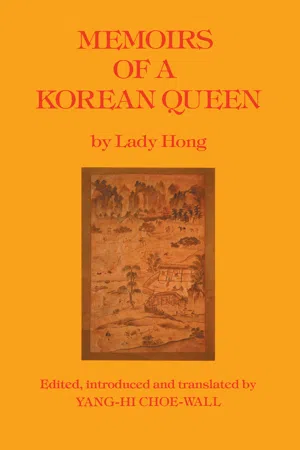
First published in 1985. The memoir of Lady Hong of Hyegy ng Palace (Hanjung nok, 1796) is one of the rare historical examples of literary composition by a Korean woman of the Yi dynasty (1392-1910).
I was a mere child when I came to the court, and wrote twice a day to my parents. However, none of this correspondence has survived, because at the time my father warned me not to leave my mother's letters lying about the court, nor to write at too great length myself, but rather to send back a short greeting appended to each note from my mother. This I did, and once the note, with my few words of greeting, had been read by my parents, the brush-strokes were erased.
My nephew Su-y
ng kept begging me to write some sort of record which would be kept as a family heirloom. He thought this would be an admirable undertaking, and I quite agreed with him, but I never seemed to find the time to carry out the idea. Now, however, I am in my sixtieth year, and while the passing of the years seems rather to have intensified the pain I feel at recollections of my late lord, nevertheless my memory will merely get weaker with the passage of time. And so I am setting down all those old experiences and thoughts, although I fear I can only recall a small fraction of them.
I was born during the reign of King Y
ngjo, at noon on 6 August 1735, at my mother's family home in K
p'y
ng-dong, Pangsong-bang. One night, before I was born, my father had dreamed of a black dragon coiled around the rafters of my mother's room, but the birth of a daughter did not seem to fit the portent of his dream.
My paternal grandfather, Lord Ch
ng-h
n, came to look at me, and took an immediate fancy to me, declaring, ‘Although it is a girl, this is no ordinary child!’ As I grew up, he became so fond of me that he was reluctant to let me leave his lap. He would say jokingly, ‘This girl is quite a little lady already, so she is sure to grow up quickly!’
When I was three weeks old, mother returned with me to the family home. There my great-grandmother, Lady Yi, saw me, and was filled with high hopes for my future. ‘This child is no ordinary girl,’ she said. ‘Be sure to bring her up very carefully.’ She set about arranging a wet nurse for me.
When I came to the court, I recalled the prophecies of these two generations of grandparents, and although I did not enjoy court life, my future somehow seemed linked to their words.
I had one sister, and my parents treasured us like two precious jewels. However my sister died very young, and so all my parents’ affection was lavished on me. They brought me up very strictly, and my eldest brother — your father — also helped in my upbringing. My father had a special tenderness for me, because I was a girl, and I, for my part, used to feel completely lost when he was away. I always tried to be close to both my parents, and with increasing maturity I strove to return their tremendous love by never causing them the least anxiety. Although I could never truly repay them, being a girl, I was still deeply and sincerely grateful for all they had done for me. Whenever I recall their great love for me, I feel a lump in my throat, for I cannot help feeling that the intensity of their love was somehow preordained, as was the fact that they were to lose me so soon to the palace.
Our family is descended from a royal son-in-law, and belongs to a great clan which has produced generations of senior government officials. My grandfather, Lord Ch
ng-h
n was the great-grandson of the royal son-in-law Prince yo
gan, and grandson of Lord Ch
ng-gan. As the second son of Lord Ch’
m-j
ng, he built a separate mansion in An'guk-dong, and established a cadet family. Although the house looked as splendid as that of a court minister, life was difficult there, since he received only a very small share of the family fortune. Still, he was well treated by my great-uncle who was a deputy board minister. When my father was a child, the latter used to pat him on the head and say that he was like Yun O-
m,1 and that although he was then very poor, he was destined to be an exceptional man who would one day be very rich. For, from ancient times, those destined to lasting happiness in their later years have felt obliged to endure hardships in their youth. Accordingly my great-uncle did not share the family fortune with his brother but rather loved him from a distance, and was praised by the entire family for this behaviour. But in our case circumstances were very difficult. Grandfather, though minister of the board of rites, was a very upright and honest man with no great career ambitions, and his house was quiet and unfrequented, like that of a poor scholar.
Grandfather's second wife was the daughter of a Confucian scholar, and consequently well-educated. She was a clever, virtuous and gracious woman, who treated her husband with the respect due to an important guest. She ran the household plainly, in keeping with her husband's principles. This was the reason why my mother, although married to the eldest son of a ministerial family, had not even one silk garment hanging in her closet, very few jewels in her jewel-box, and only one set of clothes for each season. When these clothes became soiled she would make no fuss about washing them herself at night. She also wove her own cotton cloth and did all her own sewing. As she disliked being praised for her diligence by the maidservants, she would cover the windows with cloth, so that her light could not been seen, and would continue working late into the cold night, until her hands were worn. She dressed us children as she did herself, in very plain cotton, but the clothes were always clean and in keeping with the season. You can imagine from all this how frugal and tidy she was. But though uncompromising in these respects, she had a placid nature and was not lightly moved to joy or anger.
The womenfolk of our family were all connected with the most respected clans of the day. My mother came from the Yi family — an upright clan. My father's eldest sister was married to a famous magistrate; while his second sister was a daughter-in-law of Prince Ch’
ng-n
ng; and his youngest sister a daughter-in-law of the minister of the board of civil office. Despite these connections, they were not haughty or extravagant, as is so often the case. When the family gathered together on festival days, my mother always treated the elder members with respect, and greeted the younger ones with a kind smile and an affectionate word. Father's second brother's wife was likewise virtuous, and her esteem for my mother was exceeded only by that for her mother-in-law. She was an outstanding woman — noble-minded and well educated. She was very fond of me; taught me my Korean alphabet and instructed me in a wide range of subjects. I loved her like a mother, and indeed mother used to say that I had grown too close to her.
Grandfather died in 1740, and I was much affected by my father's distress. He made offerings at his father's shrine twice daily for three years, and afterwards erected a memorial tablet. Although I was too young to understand all this, I shall certainly never forget the filial piety my father displayed towards his ancestors. He was a model of filial behaviour, visiting the shrine early every morning, and then going to see his stepmother, bowing to her and comforting her with gentle words and little acts of kindness. Everyone said grandmother loved him and expected more of him than she would have done if he had been her own child. He was devoted to his two elder sisters, and also did all he could to help in the upbringing of his three younger brothers. He could not have done more if he was grandmother's own son.
In 1741 his eldest sister contracted an infectious disease. Her blood relatives hurriedly left, all except my father, who looked after her, saying, ‘If one does not help one's own brothers and sisters when they...
Table of contents
Front Cover
Half Title
Title Page
Copyright
Contents
Preface
Introduction
Chapter I
Chapter II
Chapter III
Appendix I: Biographical Index
Appendix II: Maps
Notes
Trusted by 375,005 students
Access to over 1.5 million titles for a fair monthly price.
Study more efficiently using our study tools.
Frequently asked questions
Yes, you can cancel anytime from the Subscription tab in your account settings on the Perlego website. Your subscription will stay active until the end of your current billing period. Learn how to cancel your subscription
No, books cannot be downloaded as external files, such as PDFs, for use outside of Perlego. However, you can download books within the Perlego app for offline reading on mobile or tablet. Learn how to download books offline
Perlego offers two plans: Essential and Complete
Essential is ideal for learners and professionals who enjoy exploring a wide range of subjects. Access the Essential Library with 800,000+ trusted titles and best-sellers across business, personal growth, and the humanities. Includes unlimited reading time and Standard Read Aloud voice.
Complete: Perfect for advanced learners and researchers needing full, unrestricted access. Unlock 1.5M+ books across hundreds of subjects, including academic and specialized titles. The Complete Plan also includes advanced features like Premium Read Aloud and Research Assistant.
Both plans are available with monthly, semester, or annual billing cycles.
We are an online textbook subscription service, where you can get access to an entire online library for less than the price of a single book per month. With over 1.5 million books across 990+ topics, we’ve got you covered! Learn about our mission
Look out for the read-aloud symbol on your next book to see if you can listen to it. The read-aloud tool reads text aloud for you, highlighting the text as it is being read. You can pause it, speed it up and slow it down. Learn more about Read Aloud
Yes! You can use the Perlego app on both iOS and Android devices to read anytime, anywhere — even offline. Perfect for commutes or when you’re on the go. Please note we cannot support devices running on iOS 13 and Android 7 or earlier. Learn more about using the app
Yes, you can access Memoirs Of A Korean Queen by Lady Hong,Hong in PDF and/or ePUB format, as well as other popular books in Social Sciences & Anthropology. We have over 1.5 million books available in our catalogue for you to explore.