- 384 pages
- English
- ePUB (mobile friendly)
- Available on iOS & Android
eBook - ePub
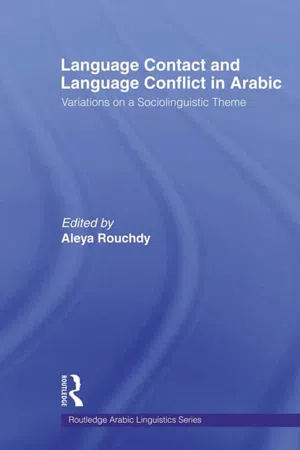
Language Contact and Language Conflict in Arabic
About this book
This book contains 17 studies by leading international scholars working on a wide range of topics in Arabic socio-linguistics, divided into four parts. The studies in Part 1 address questions of national language planning in a diglossic situation, with a particular focus on North Africa. Part 2 explores the relationship of identity and language choice in different Arabic-speaking communities living both within and outside the Arab World. Part 3 examines language choice in such diverse contexts as popular preaching, humour and Arab women's writing. Part 4 contains 5 papers in which variation, code-switching and generational language shift in the Arabic-language diaspora in Europe and the USA are the focus. The collection as a whole provides wide-ranging introduction to key areas of current research, which will be of interest to the general sociolinguist as well as the Arabic language specialist.
Information
P A R T I
Diglossia and Language Planning
C H A P T E R O N E
Approaching Diglossia: Authorities, Values, and Representations
THE DIMENSIONS OF LINGUISTIC VARIABILITY
Linguistic variation in a speech community may be viewed in a number of dimensions: a “horizontal” one of geographical dialect spread and contact, or a “vertical” one of sociolects and prestige and stigmatized dialects. It may furthermore be given a temporal dimension and be viewed through the prism of historical dialect change and the “rise and fall” of prestige forms. To each one of these may be added a further cultural, political, or gendered dimension, detailing the relative power of certain groups or discourses within a speech community at one period in time or over the course of time. Arabic diglossia in modern linguistic discourse has been examined primarily in a vertical dimension, as embodying a distinction between an archaic but prestige literary form and a related but stigmatized spoken form in a given speech community. Diglossia in Arab traditionalist discourse has taken a quite different form, one which problematizes it in educational and cultural terms, drawing on a long cultural legacy of situating Arabic and its speakers in relation to other languages, ethnicities, religions, and polities.
Each of these ways of viewing the peculiarities of linguistic variation in the Arab world contains insights about the linguistic reality which it represents, but they are subject to limitations which are an inherent feature of any cognitive representation of reality. The epistemological limitations of these kinds of representation are due in large part to the pressures exerted on a discourse by sociocultural and political factors seemingly extraneous to it but which nevertheless exert an influence on it by shaping it to the cultural and discipline-specific expectations of its intended audience. That is, language specialists have certain expectations and values which must be met in a linguistic representation or else it is deemed unacceptable, and these values are derived in part from the historical development of the discipline in a particular place at a particular time. Also, the sociocultural predispositions and assumptions which delimit and frame the representations of language specialists may derive in part from (or be a negative reaction to) the predispositions and assumptions which help to shape native language users perceptions (conscious or not) of their language. These views and values of nonspecialist language users may be reflected in their own linguistic usage and behavior, and may in turn be influenced (either positively or negatively) by the opinions and values of language specialists, especially if these values are institutionalized in the form of authorizing traditions such as educational systems, literary canons, and the like.
In this paper I will examine linguistic representations of Arabic diglossia and dialects as it relates to the above question, which may be paraphrased as examining the sociocultural limitations of specialists’ representations of others’ language behavior and nonspecialists’ considerations of their own behavior. The framework in which this will be carried out is a sociological one, derived from Pierre Bourdieu's notion of the theory of practice, supplemented with Bakhtin's notion of “dialogism” as well as my own extensions of the theory. I will briefly outline the presuppositions and bases of this framework, and then proceed to examine the rhetoric of traditional Arab discourse on Arabic before turning to modernist linguistic analyses of variation in Arabic deriving from European and American linguistic discourses.
The construction of knowledge about language
The most basic notion underlying the present approach is that human beings view the world (indirectly) through the medium of “representations,” through a process of objectification or object construction. Representations such as this have also been termed ideologies, “theories” (whether as academic ones or metaphorically to refer to “ordinary” people's representations), and have been treated under the notion of “mimesis.” These representations are constructs determined by social, cultural, and individual experience. They are social-historical phenomena or “practices,” and are by their very nature limited (focused on selected features) and contingent (rooted in a specific time and place – that is, they reflect a perspective).
The representation of “language” is one such cultural artifact. In one culture language may be viewed in several different fashions, as reflected in the popular, everyday notions about the way people speak (e.g., attitudes toward accents), what they mean or didn’t mean, word play, etc. At the other end of the spectrum there are the notions that language specialists have developed about language, whether as an object of study in itself (linguists), or as a subject to be taught in a curriculum of study (grammarians, first-and second-language teachers), or as a medium of literature (philologists). Each of these fields of representation has a history and reflects a particular social, cultural, and academic milieu. They may share culturewide presuppositions about language and its function in the society, or may conflict with one another, or both. They may also derive from or be influenced by interactions with other cultures or subcultures.
This notion of a “field” of representation is derived from the sociology of Pierre Bourdieu which offers a general and wide-ranging epistemological framework in which one can develop a critical approach to linguistic theorizing and language attitudes. This is because Bourdieu's approach to language (and other types of social constructs) hinges on a dichotomy between two ways of approaching an object of study: viewing it “objectively,” from the outside, as a structuralist might proceed in uncovering the underlying structures of social relations or linguistic patterning, or viewing it “subjectively,” through the viewpoint of the object itself or the individuals involved in it, as is done in phenomenological approaches.
Rather than choosing between the two alternatives (subjectivism versus objectivism), Bourdieu works toward integrating them both into the analysis, as well as toward taking into account the stance of the analyst and how that might affect the representation. Another way of phrasing this, relating it to my previous comments, is to say that human perceptions and the representations that they give rise to are necessarily limited or biased in some way, and this approach offers a way of incorporating the consciousness of this bias into the evaluation of the representation.
Unlike Bourdieu, however, I assume that within a society there may be a number of such authorizing discourses, which I term “regimes of authority,” which may involve notions such as dominance, solidarity, opposition, etc. Each of the regimes of authority present in a society/culture may have an effect on the kind of language which is valorized, and on the metalinguistic views of language in general, and ultimately on the views and analyses of language professionals themselves (linguists, grammar specialists, language teachers, L1 and L2), who participate as well in their own discursive regimes of authority. In the present paper I will be referring to these regimes primarily in terms of the value systems which they incorporate, as expressed in the form of the cultural topoi or commonplaces which are found in specialists’ writings and nonspecialists’ views on language in general, and on the Arabic language in particular. It must be noted at this point that I view these regimes of authority as being alternative representations of linguistic reality (for specialists), as well as alternative inventories of linguistic forms (for nonspecialists) from which individuals select the forms which suit their own particular vision of that reality. For each of these regimes there may be greater or lesser opportunity for choice depending on the society, or field, or discourse. More important, however, is the way that individuals react to and interact with, adopt or reject these systems of authorization, a process which I conceive to be “dialogic” in fashion. That is, as noted in Layne,
Bakhtin's concept of dialogization has been glossed by Holquist as the process whereby “a word, discourse, language or culture ... becomes relativized, de-privileged, aware of competing definitions for the same things” (Bakhtin 1981:427). Dialogism refers to the constant interaction between meanings, all of which have the potential of conditioning others. (Layne 1989:24–5)
That is, individuals do not always adopt the value system of one regime of authority alone and for all time, but rather manipulate the various regimes of authority and their differing systems of values (and thus the meanings that inhere in them) in fashioning their own identity. This dialogic manipulation of values is reflected both in nonspecialists’ use of language itself and in their metalinguistic views of it, as well as in specialists’ methods of argumentation about how to represent certain linguistic phenomena. Rather than there being only one “dominant” against which individuals line up for or against, there are multiple regimes of domination or authority to which individuals situate themselves, fashioning an identity which is partially imposed and partially of their own choosing, and which may be at times rather fluid. So too specialists’ views of linguistic representation, and of Arabic diglossia in particular, participate in a number of different regimes of authority and domination, and may touch upon or be influenced by different ones, even when the argument is overtly directed against these other regimes.
In the following I will present a brief overview of the value system of the most dominant form of the Arabic language regime of authority, and then I will briefly outline some of the most salient aspects of the various regimes of authority in Western linguistic discourse, before examining in more detail the various approaches which have been adopted in analyzing linguistic variation in Arabic, especially of the diglossic type.
TRADITIONS OF LINGUISTIC REPRESENTATION EAST AND WEST
Issues in Arab discourse on language
The Arabic language occupies a central place in Arabic culture, both classical and modern, and is connected intimately with the place of Islam as the dominant religion of that culture. I have identified four recurrent motifs or topoi in the most dominant tradition about which Arab representations of Arabic cluster.1 These topoi are based in large part on the historical narrative of the Arab cultural tradition, tracing its rise, efflorescence, and recrudescence through the Middle Ages, and its rebirth and renewed efflorescence in the modern period.
First is the topos of UNITY: the Arabic language prior to Islam – as recorded in the collection of pre-Islamic poetry called the mu’allaqaat – is a single language, UNITING Arabs in SINGLE culture. With the appearance and spread of Islam this aspect of Arabic takes on a religious case and becomes even more pronounced: the Quran has been revealed in a “clear” language, understood by all Arabs, thus uniting them linguistically as Islam unites them doctrinally. Islam and the demands of the new Arab empire lead to the institutionalization and “authorization” of Arabic, which introduces a second topos, that of PURITY: The Arabic of the Quran is taken to be the dialect of the Prophet's tribe, Quraysh, which is thereby granted the status of being the “b...
Table of contents
- Front Cover
- Half Title
- Routledge Arabic Linguistics Series
- Title Page
- Copyright
- Dedication
- Contents
- Contributors
- Preface
- Introduction
- Part I: Diglossia and Language Planning
- Part II: Language and Identity
- Part III: Language Choice
- Part IV: Arabic in the Diaspora
- Index
Trusted by 375,005 students
Access to over 1.5 million titles for a fair monthly price.
Study more efficiently using our study tools.
Frequently asked questions
Yes, you can cancel anytime from the Subscription tab in your account settings on the Perlego website. Your subscription will stay active until the end of your current billing period. Learn how to cancel your subscription
No, books cannot be downloaded as external files, such as PDFs, for use outside of Perlego. However, you can download books within the Perlego app for offline reading on mobile or tablet. Learn how to download books offline
Perlego offers two plans: Essential and Complete
- Essential is ideal for learners and professionals who enjoy exploring a wide range of subjects. Access the Essential Library with 800,000+ trusted titles and best-sellers across business, personal growth, and the humanities. Includes unlimited reading time and Standard Read Aloud voice.
- Complete: Perfect for advanced learners and researchers needing full, unrestricted access. Unlock 1.5M+ books across hundreds of subjects, including academic and specialized titles. The Complete Plan also includes advanced features like Premium Read Aloud and Research Assistant.
We are an online textbook subscription service, where you can get access to an entire online library for less than the price of a single book per month. With over 1.5 million books across 990+ topics, we’ve got you covered! Learn about our mission
Look out for the read-aloud symbol on your next book to see if you can listen to it. The read-aloud tool reads text aloud for you, highlighting the text as it is being read. You can pause it, speed it up and slow it down. Learn more about Read Aloud
Yes! You can use the Perlego app on both iOS and Android devices to read anytime, anywhere — even offline. Perfect for commutes or when you’re on the go.
Please note we cannot support devices running on iOS 13 and Android 7 or earlier. Learn more about using the app
Please note we cannot support devices running on iOS 13 and Android 7 or earlier. Learn more about using the app
Yes, you can access Language Contact and Language Conflict in Arabic by Aleya Rouchdy in PDF and/or ePUB format, as well as other popular books in Languages & Linguistics & Languages. We have over 1.5 million books available in our catalogue for you to explore.