In this interdisciplinary anthology, essays study the relationship between the imagination and images both material and mental. Through case studies on a diverse array of topics including photography, film, sports, theater, and anthropology, contributors focus on the role of the creative imagination in seeing and producing images and the imaginary.
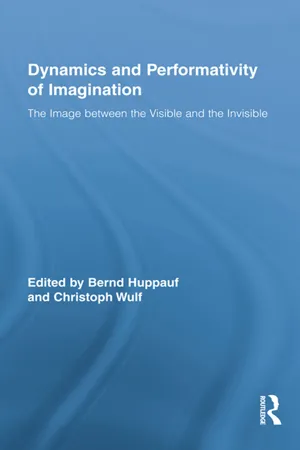
eBook - ePub
Dynamics and Performativity of Imagination
The Image between the Visible and the Invisible
- 372 pages
- English
- ePUB (mobile friendly)
- Available on iOS & Android
eBook - ePub
Dynamics and Performativity of Imagination
The Image between the Visible and the Invisible
About this book
Information
1 Introduction
The Indispensability of the Imagination
1 Absence of the Imagination
When one considers the semantics of the current debate on images and the iconic turn, it may seem anachronistic to refer to the imagination. This book wants to turn this anachronism into a provocation. The imagination is absent from current discourse on images and imagery and this is not a matter of semantics but is the result of specific interpretations of and attitudes towards images. These interpretations do not form a homogenous group, but are guided by different intentions and objectives. Most are informed by scientific ideals and share a common aversion to the imagination. This, it seems to us, is the result of a certain understanding of the concept of the image and of contempt for the imagination. We briefly address both of these aspects and then suggest how the imagination’s relationship to the image might be reconsidered, including technologically advanced constructions that have little in common with traditional images and which, in spite of their playing with the very possibility of representation, retain a remnant of the images’ claim to representation. We wish to argue that computer-generated digital constructions must be included within the concept of the image and that these, as all images, need the productive imagination.
2 Imagination
The imagination’s bad reputation has a history that is much older than its recent decline that is inked to a new ascent of naturalism. The imagination was abused at times for political and anti-political purposes and, as a result, has fallen out of favour in theories of perception and public discourse. In the aftermath of the radical sixties, scepticism towards the social and political power of the imagination became popular. A political interpretation of the imagination created great expectations but they, it turned out, were mistaken. The aphorism of the late sixties, greeted with enthusiasm and repeated ad nauseam “L’imagination au pouvoir!”, was renounced as an illusion. Short-lived euphoria gave way to disillusionment. The imagination seemed to be a miss-fit in modern societies. False hopes needed to be acknowledged and were replaced by pragmatic concepts adapted to the requirements of reality, its competition and speed and the new computerization of private and business life. The imperatives of economic rationality and market principles soon came to power and superseded old-fashioned imagination.1 As far as public discourse on perception and the image is concerned, the current domination of the sciences has even less tolerance for the imagination. The latter has the ring of speculation and romanticism. Experimental theories of perception and cognition, the neural sciences and technologies of the media seem much more promising and productive in terms of theorizing visual perception and answering the question of what an image is than a return to the long and dubious history of the imagination.
The imagination has had an uneven and controversial history in the modern period. For most of the time it was considered secondary and ancillary and sometimes even a dangerous human faculty. It was condemned as the origin of idolatry and in early Christianity its product, the “cupiditas oculorum”, was believed to separate man from God. In the intellectual battles of the age of reason the imagination came under attack as the apparent opposite of reason and was suspected of favouring the non-rational human faculties and perpetuating a tradition of perception and imaging that was considered obsolete. It was placed among the weaknesses of the human nature and, at the same time, seen as an origin of the fear of losing control over reality. It seemed irreconcilable with the ideal of self-determination through the production of knowledge in scientific disciplines. In his Critique of Reason (1781/87), Kant writes of the imagination’s wrongs. He warns that the unrestrained imagination is insanity’s close neighbour and that it has the power to play with human beings, and the unfortunate person who is driven by the imagination loses control over him- or herself. He demands its “domestication”. In the course of the 18th century this assessment changed. In conjunction with the late 18thcentury re-evaluation of the emotions and the senses, the imagination was rehabilitated. Theories based on an anti-Cartesian reading of Spinoza evolved that credited the imagination with emancipation and freedom, and it was linked to the image of an independent self as creator of new worlds. The overheated theories of the late 18th century about man as god-like genius and the Promethean power of creation were a consequence of this fundamental re-evaluation of the imagination. Kant’s writings are a good example of this shift. His takes issue with the sensualist (Hume) conception of a combinatory imagination that is identified with an extended memory. His first Critique introduces the term “productive imagination”. He defines it as a precondition for forming images of the real and his anthropological treatises elaborate the imagination’s productivity. It was adopted as a key concept in Romantic theories of creativity and was elevated to the status of a universal ideal. Schelling and other philosophers and writers of the late 18th and early 19th centuries made an attempt to reverse the derogatory view of the imagination by crediting it with the secularised divine power of creation and gave equal prominence to its dark and destructive powers, as associated with E. T. A. Hoffmann, William Blake, Charles Baudelaire, Edgar A. Poe, and others. This line of thinking, critical of scientific progress and often associated with an openly anti-modern confrontation, moved the imagination, together with the world of dreams and reveries, to the centre of the definition of the human. The imagination was seen as the faculty for imaging what cannot be seen, potentiality, and it also had the potential to create new worlds born of mental images. It needs to be emphasized that this remained an undercurrent of European thought. It was and remains a minority position in philosophy and literature and in the theory of art. In the age of science and technology, the imagination was an illegitimate power associated with disturbing implications. It challenged the basic maxims of a culture dominated by science which, consequently, remained adverse to the vagaries of the imagination. It was a touchstone for the separation of the two cultures later diagnosed by C. P. Snow (1962).
In the current period of stunning progress in the technological means of creating images that in medicine, astronomy, particle physics and other sciences make a reality hidden from the eye visible for analysis, it may sound like intellectual folly to return to this dubious concept of the imagination impregnated with Romantic speculation. Further, advanced digitalisation seems to render superfluous and even undesired the free play of the imagination. Apparently growing scientific evidence of the illusory nature of the concept of the free will, the tendency to reduce emotions to mere chemistry of the body and its brain, and other similar reductionist simplifications marginalize the imagination. They have serious implications for the conception of image building and the ways we see images. At the same time, however, we can observe growing scepticism in relation to technological progress and to evidence that is attributed to the visible and to images as pure signs.
Can this scepticism prepare a space in the current world of images for the introduction of the imagination once again? The rationale of progress and development holds the image market in its firm grip. The flood of images is hostile to the imagination and the noise from battles over the construction of worlds of the mind drowns it out. The result of this flood of images is that each individual image is emptied and is threatened with abjection when it does not conform to the standards of a market dominated by commercial interests. This constellation threatens to overpower the obstinate imagination. In contrast to a successful image industry of memory, the imagination is feeble. Will it be possible to reclaim the imagination under the adverse conditions created by digital technologies and an overpowering market? And what would be the rationale of such an attempt? Which of the different definitions of the concept seems most productive for a contemporary image theory?
We argue that the absence of the term is not a matter of terminology but signifies a deficiency of the current concept of the image. Some of the earlier criticism labelled at the imagination was undoubtedly justified, but the crisis of representation that is at the same time also a crisis of the imagination in relation to images and perception is not a justification for abandoning the unifying concept of the image or of the imagination’s productivity. On the contrary, as we try to demonstrate, images need the imagination, its dubious history notwithstanding.2 In the absence of an adequate theory of the imagination, the recent debates about the concept of the image have made use of individual and collective techniques of seeing that are best understood as imaginative. The imagination needs to be lifted from its flawed history and reconsidered as an indispensable faculty for an understanding of modernity and its images at the time of its reconstitution. Distanced from Kantian definitions and Romantic speculative enthusiasm in relation to creativity and reconstituted under the conditions of digital technologies, it has the potential to denote a complex that is constitutive for the postmodern and its image worlds and also indispensable for theorizing them. Theories of the productive imagination can make a substantial contribution to our understanding of the new images and the emergence of new ways of seeing. Among the few attempts to rehabilitate the imagination, its fusion with semiotics is leading to interesting results, but there are other ways of returning to the imagination, and exploring its connections with phenomenology, iconology or psychoanalysis is producing promising results. It is the aim of this book to stimulate a re-assessment of the imagination for theorizing the return of images in the historical moment that has been labelled a pictorial turn. This re-assessment requires a close examination of images that operate on the threshold of the representable.
3 We No Longer Know What an Image Is
The emergence of a new type of image and new ways of thinking about images is significant for the present. It has been frequently stated that, at present, we are witnessing a triumph of the image. We are, it is constantly reiterated, surrounded by images that are overpowering—but can we be certain that we know what this critical statement means?
We no longer know what an image is and have only a vague understanding of the power of images. When in the late twenties of the last century, Walter Benjamin wrote about the end of an epoch and linked the beginning of a new era to the mechanical reproducibility of images, he could be certain as to what he was referring to. There was no reason for him to doubt that he meant what he said: he wrote about pictures exhibited in public museums and galleries that could be visited; their aura was present and could be sensed by an eye educated in focussing on the surface of canvases, papers and other types of materials; he argued that these images were giving way to a new type of images, produced and reproduced by the new technologies of photography and film that required a different gaze. Benjamin’s juxtaposition of pictures of traditional art history and new images resulting from the new techniques of unlimited reproduction of the same accounted for a fundamental change in the history of images and the visual and he re-examined this relationship favouring the images of the new media. His evaluation reversed customary views of art in favour of the new technologies and associated ways of seeing. He refused to consider the new type of images and the related attitudes as lacking in comparison to the legitimate old,3 and saluted the new attitudes and ensuing social constellations and political practices. This was an attempt to justify the image representative of the modern period and an attitude towards it that did not require, he argued, focus and concentration but dispersed senses. Yet in spite of his justification of the modern, interpreted in the context of an expanded art history, his opposition continued earlier theories of the image.
His security in relation to knowledge of the subject of the debate has vanished in recent years. If “aura” ever was an appropriate term for signifying the difference between images of the past and images of the age of mechanical reproduction, it has lost its significance for an understanding of the current conditions of producing and receiving images. Uncertainty regarding the new technologies of image production erodes clear positions in relation to the image question. New images and corresponding techniques of dealing with them have emerged and continue to develop at an unbelievable speed. They present a challenge for our attempts at understanding images not least because they appear to leave no room for the imagination. To be sure, pictures are still produced and looked at; amateur photography is as popular as never before and produces millions of pictures every day around the globe. Art exhibitions in galleries register record numbers of visitors, and while cinemas are dying, television, video, DVD and other systems of dispersing images make sure that hundreds of millions of people are supplied with running images around the clock. Early media theories of the years following the First World War did not foresee this rapid and gigantic expansion. It cannot be understood as a continuation of the development diagnosed by Benjamin. The change in terms of the question of what an image is and what we do when we look at images is fundamental. The technological images of the media and the calculated images of the sciences in the digital age in combination with a changed market for pictures and strategies for making visible culminate in a deep caesura. Benjamin’s enthusiasm for the future of the technological media project was not borne out by these later developments. His main assumption that linked the ideal of political and social emancipation to the advancement of technologies was clearly wrong. The recent emergence of calculated technological images, in the sciences as well as in the entertainment industry, introduces a new category of images. In conjunction with the gigantic market for images, it threatens to eliminate any space of subjective freedom and liberation of the eye. If the indeterminacy of images and their borderline position between sign and invention, between perceiving and dreaming was ever to be associated with the shaping of future and an emancipatory project, this expectation is now lost and the connection to the productive imagination jeopardized.
4 The New Images and the End of Representation
The present can be associated with the end of representation. We are witnessing not so much the return of images, as is often argued, but are involved in the process of the emergence of a new relationship between images and image makers and recipients. Computerisation and digitalisation are developing technologies for the production of a type of image that cannot be understood as a continuation of images from art history. The most noticeable characteristic of this relationship is that it experiments with the limits of representation. The productive power of advanced technology makes images hover on the threshold between the visible and the invisible and demonstrates that the concept of proper representation is no longer adequate. Juxtaposing these new images with pictures in museums and galleries, as well as with images in film and photography, reveals the depth of the discontinuity. Their purpose, it has been argued, is the documentation of a trace that gives away the language of the phenomena.4 Do the phenomena have a language? It is more appropriate to perceive these images in terms of a realization of scientific principles of construction. They create abstract visual worlds guided by the rules of the media and the sciences, which, instead of representing or documenting, take the place of that which under an earlier ocular regime was represented. Images that used to be exemplary for the understanding of images and imaging could well become the exception. Pictures of the modern battlefield are a striking example. The widely publicized images from the first Iraq war no longer showed a field for military action but presented an abstract construction of space based on electronic data sent around the world via satellite for processing. Computer technology creates a secret path for calculated and technical images to become a model. Common computerised images together with scientific images produced in a number of the sciences, for example in astronomy, electro microscopy or for medical diagnosis, that use combinations of programs, instruments and apparatuses, transformation techniques and signals (from galaxies, molecular structures or organs and tissues), give rise to a new category of images. The new images have been labelled calculated images.5
In spite of obvious differences they share a common neglect of conventions of visual representation. The main characteristics of the new images can be determined in terms of a negative comparison with traditional images. They do not represent, do not show, are not expressive or aesthetic and seem to leave no room for subjectivity. They make it possible for the viewer to encounter a simultaneity of what is real and can be shown with what is completely...
Table of contents
- Cover Page
- Half Title Page
- Routledge Research in Cultural and Media Studies
- Title Page
- Copyright Page
- Contents
- List of Figures
- Acknowledgments
- 1 Introduction The Indispensability of the Imagination
- Part I Imagination, Fantasy and Creativity
- Part II A Look at Pictures—Pictures Look Back
- Part III Body Images and Body Imaginations
- Part IV Indeterminacy and Fuzziness of Images
- Part V Constructions of the Visual
- Contributors
- Index
Trusted by 375,005 students
Access to over 1.5 million titles for a fair monthly price.
Study more efficiently using our study tools.
Frequently asked questions
Yes, you can cancel anytime from the Subscription tab in your account settings on the Perlego website. Your subscription will stay active until the end of your current billing period. Learn how to cancel your subscription
No, books cannot be downloaded as external files, such as PDFs, for use outside of Perlego. However, you can download books within the Perlego app for offline reading on mobile or tablet. Learn how to download books offline
Perlego offers two plans: Essential and Complete
- Essential is ideal for learners and professionals who enjoy exploring a wide range of subjects. Access the Essential Library with 800,000+ trusted titles and best-sellers across business, personal growth, and the humanities. Includes unlimited reading time and Standard Read Aloud voice.
- Complete: Perfect for advanced learners and researchers needing full, unrestricted access. Unlock 1.5M+ books across hundreds of subjects, including academic and specialized titles. The Complete Plan also includes advanced features like Premium Read Aloud and Research Assistant.
We are an online textbook subscription service, where you can get access to an entire online library for less than the price of a single book per month. With over 1.5 million books across 990+ topics, we’ve got you covered! Learn about our mission
Look out for the read-aloud symbol on your next book to see if you can listen to it. The read-aloud tool reads text aloud for you, highlighting the text as it is being read. You can pause it, speed it up and slow it down. Learn more about Read Aloud
Yes! You can use the Perlego app on both iOS and Android devices to read anytime, anywhere — even offline. Perfect for commutes or when you’re on the go.
Please note we cannot support devices running on iOS 13 and Android 7 or earlier. Learn more about using the app
Please note we cannot support devices running on iOS 13 and Android 7 or earlier. Learn more about using the app
Yes, you can access Dynamics and Performativity of Imagination by Bernd Huppauf,Christoph Wulf in PDF and/or ePUB format, as well as other popular books in Art & Art Theory & Criticism. We have over 1.5 million books available in our catalogue for you to explore.