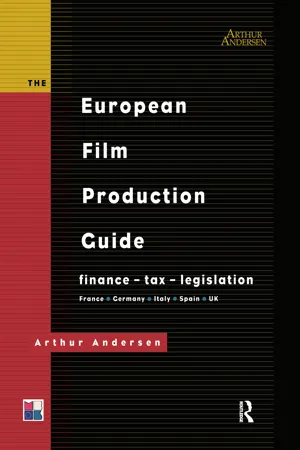
The European Film Production Guide sets out in one comprehensive volume the major economic, financial and business considerations which independent producers need to bear in mind when making films in or with other countries within Europe. Arthur Andersen provides creative solutions for its clients through audit, tax, business advisory and speciality consulting services. Its professsionals combine extensive technical competence and industry experience with innovative and progressive thought, enabling Arthur Anderson to exceed client expectations.
eBook - ePub
The European Film Production Guide
Finance - Tax - Legislation France - Germany - Italy - Spain - UK
- 480 pages
- English
- ePUB (mobile friendly)
- Available on iOS & Android
eBook - ePub
The European Film Production Guide
Finance - Tax - Legislation France - Germany - Italy - Spain - UK
About this book
Information
1
Chapter
Incorporating a film company
Subject
General procedures for incorporating a company
General company registration procedures
Specific procedures for incorporating companies in Europe
Germany
France
Italy
United Kingdom
Spain
Exhibits
Structure of the deed of incorporation
Structure of company bylaws
Criteria for classifying companies by size
Summary of legal provisions governing the appropriation of profits to obligatory reserves
Other aspects of mercantile law companies
Most common type of company in each of the countries covered by the Reference Book
Basic mercantile legislation
Average office rents in the main cities
Subject
This chapter summarizes the main considerations to be borne in mind when incorporating a company to engage in film production.
Specifically, our analysis of procedures summarizes the following points:
- The procedure for incorporating a company, giving particular attention to:a)
Ways of forming a company. b)Procedure for subscribing a company’s capital stock. c)Disbursement of subscribed contributions. d)Basic documentation required to form a company (deed of incorporation and company bylaws). e)Registration of corporate resolutions. f)Liability of founders. - Procedure for publicly registering a company to be incorporated.
- Structure and content of the most common clauses in the basic documents required to incorporate a company, specifically the following:a)
The company’s public deed of incorporation. b)The company’s bylaws. - Approximate cost of incorporating a company in each country.
- Various aspects of corporate operations in each country, concentrating particularly on such matters as distribution of profits, criteria for classifying companies by size, the most common corporate forms in each country, etc.
- Main company law legislation in each of the countries analyzed in this Reference Book.
- A listing of the main agencies which are generally involved in the incorporation process.
The chapter also includes a description of the various types of company permitted under company law legislation in each of the countries (corporations, limited liability companies, cooperatives, etc).
The incorporation procedures common to all eight countries are addressed in the section General procedures for incorporating a company.
However, there are many specific points to be borne in mind and requirements to be met when incorporating a company (minimum capital, minimum number of shareholders, etc.). These depend on the regulations governing corporate operations in the country of incorporation and are described in the section Specific procedures for incorporating companies in Europe.
General procedures for incorporating a company
The general procedures for incorporating a company are summarized below:
General aspects
General factors to be borne in mind prior to forming any type of company.
The main aspects to be taken into account are as follows:
- The company’s incorporation must be formalized in public deeds and documents.
- The documents setting out the incorporation agreement must be registered with the relevant public registers.
- The company acquires legal capacity upon incorporation in accordance with these requirements.
Formation
The shareholders or founders must firstly define the company’s corporate purpose and activity, and include this definition in the company’s bylaws.
The company acquires legal capacity upon formation.
The main ways of forming a company are:
Simultaneous formation
The founding shareholders directly subscribe the shares which represent capital stock at the time of incorporation. The deed of incorporation is executed at this time.
Simultaneous formation is the usual ...
Table of contents
- Cover
- Half Title
- Title Page
- Copyright Page
- Table of Contents
- Introduction
- Acknowledgements
- 1. Incorporating a film company
- 2. Disclosure requirements and presentation of results. Company accounting
- 3. Specific accounting aspects of the film industry
- 4. Tax aspects
- 5. Employment aspects
- 6. Contracts with the creative team and cast
- 7. Acquisition of rights to literary works
- 8. Summary of general aspects of film-industry financing by country
- 9. Sources of public-sector financing or the film industry. General aspects
- 10. Sources of public-sector financing for the development stage
- 11. Sources of public-sector financing for the production stage
- 12. Other aid for film production
- 13. Presentation of projects and agreements with potential private investors
- 14. Sources of bank financing for the film industry
- 15. International co-productions
- 16. Television. Types of financing and support to the nun industry
- 17. Other forms of film financing
- 18. Film distribution
- List of Arthur Andersen’s offices
- Index
Trusted by 375,005 students
Access to over 1.5 million titles for a fair monthly price.
Study more efficiently using our study tools.
Frequently asked questions
Yes, you can cancel anytime from the Subscription tab in your account settings on the Perlego website. Your subscription will stay active until the end of your current billing period. Learn how to cancel your subscription
No, books cannot be downloaded as external files, such as PDFs, for use outside of Perlego. However, you can download books within the Perlego app for offline reading on mobile or tablet. Learn how to download books offline
Perlego offers two plans: Essential and Complete
- Essential is ideal for learners and professionals who enjoy exploring a wide range of subjects. Access the Essential Library with 800,000+ trusted titles and best-sellers across business, personal growth, and the humanities. Includes unlimited reading time and Standard Read Aloud voice.
- Complete: Perfect for advanced learners and researchers needing full, unrestricted access. Unlock 1.5M+ books across hundreds of subjects, including academic and specialized titles. The Complete Plan also includes advanced features like Premium Read Aloud and Research Assistant.
We are an online textbook subscription service, where you can get access to an entire online library for less than the price of a single book per month. With over 1.5 million books across 990+ topics, we’ve got you covered! Learn about our mission
Look out for the read-aloud symbol on your next book to see if you can listen to it. The read-aloud tool reads text aloud for you, highlighting the text as it is being read. You can pause it, speed it up and slow it down. Learn more about Read Aloud
Yes! You can use the Perlego app on both iOS and Android devices to read anytime, anywhere — even offline. Perfect for commutes or when you’re on the go.
Please note we cannot support devices running on iOS 13 and Android 7 or earlier. Learn more about using the app
Please note we cannot support devices running on iOS 13 and Android 7 or earlier. Learn more about using the app
Yes, you can access The European Film Production Guide by Arthur Andersen in PDF and/or ePUB format, as well as other popular books in Social Sciences & Media Studies. We have over 1.5 million books available in our catalogue for you to explore.