eBook - ePub
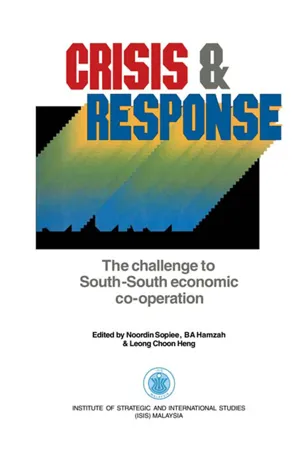
Crisis & Response
The challenge to South-South economic co-operation
- 256 pages
- English
- ePUB (mobile friendly)
- Available on iOS & Android
eBook - ePub
Crisis & Response
The challenge to South-South economic co-operation
About this book
First Published in 1989. It was time for countries of the South to establish a body of men who would help chart the way forward for the world's developing countries of Africa and Latin America. This volume has been developed from the time when Third World Foundation and the Malaysian Institute of Strategic and International Studies convened in Kuala Lumpur a meeting of 100 scholars and statesmen from 23 countries of the South in May 1986, called 'South-South II: Charting the Way Forward', and actions by the Steering Group since.
Information
A keynote address to the South
DATO’ SERI DR MAHATHIR MOHAMAD
WE meet today at a time of severe adversity for the peoples of the South; economically, socially and politically. The undermining of the economies of our countries is unprecedented in scope. Here and there we see military assaults, either directly or through proxies. For some the fight for independence is not over yet. The blacks of South Africa are being hounded and hunted in order to sustain the most despicable system ever invented by man — apartheid. The indebtedness of the South is now legendary. They are weighed down by debt burdens which will subject them to all manner of manipulations and economic oppression for the foreseeable future. The terms of trade get worse and worse with the passage of time, with seemingly no hope of ever getting alleviated. We meet indeed at a time of severe adversity for us and it behoves us to bear this in mind all the time we discuss our problems and suggest solutions to them.
Let us take firstly the economic situation of the South. We are by and large exporters of primary commodities. We hope that with the foreign exchange we earn we could develop our countries and purchase the manufactured goods we need.
But in the last few months there has been a total collapse of all commodity prices. An economic journal estimated that at prices prevailing three months ago the developed countries would save US$60 billion on the commodities they import. The figure must be more now as prices have plunged deeper. The aid given by developed countries to the South never came anywhere near this figure. Yet now, de facto, the developing South is aiding the developed North by over US$60 billion a year.
But what of the manufactured goods the South imports from the North? One would think that with cheaper raw material inputs the prices would go down. The fact is that they have not. The old escalating prices of manufactures remain and are aggravated by the appreciation of the currencies of the North against the South. The terms of trade have thus become worse and along with it the poverty of the South. It is ridiculous to suggest that the developing countries are now smiling because reduction in petroleum prices has brought relief. The fact is that reduction of crude prices by 65 per cent has not resulted in the same degree of reduction in petroleum product prices. Other costs intervene and these costs are not due to the producers.
At the very same time, we are bearing a heavier burden in servicing our debts. When the countries of Europe got together with Japan to solve the problem of excessive exports to the United States, they decided to revalue upwards their currencies. They succeeded, but their trade problems refused to go away. However, for the developing countries, debt servicing has become more burdensome as their currencies depreciated against those of Europe and Japan and even against the US dollar.
As devaluing the dollar has not decreased European and Japanese exports to the US, they are now investing more in the United States to get around United States protectionism. Thus the investment funds that could help develop the South have been diverted, leaving the South with only a trickle in capital inflow. It looks like the North has become an enlarged economic bloc, buying only cheap raw materials from the South, and dumping their excess of manufactured goods. The markets of the North are almost completely closed to manufactured products of the South. While the North continuously search for substitutes for the raw materials of the South, they also work to ensure a glut so as to bring down the price of these materials.
In the meantime direct and indirect military attacks and subversion of the developing countries continue. Colonialism is not dead. It has merely taken new forms. A weak and unstable government is as good an excuse for military assaults as is a strong government. Indeed all the governments of developing countries are made out to be bumbling, incompetent and corrupt — as if the North is totally free from these traits.
The South African government remains the most blatantly racialist regime in the history of the world. That it can exist in this day and age is due in part to the support it gets from its sympathisers in the North. People who are prepared to take direct military action against a government for allegedly promoting terrorism, advocate gentle persuasion when dealing with the open terrorism practised by the South African government. We do not expect the Pretoria regime to be bombed out of existence because we do not believe in such a line of action. But when will those with the economic clout apply sanction? Or is it that African lives are cheap, and that investments in South Africa are too profitable?
The broad-based and multi-directional attack on us is no less serious because we cannot identify a single enemy state. It is no less devastating because we do not see armed and uniformed men invading our shores. We have won the right to govern our own countries but whether we are independent is another thing. Economically, of course, we have never been independent. We have no control over transport and insurance, marketing and prices and at times even over production. Our situation can only be described as deplorable. Before we can make it any better, we must prevent it from getting worse.
The holding of this conference on South-South co-operation could not have come at a more opportune time. Looking back on the past three years since the first South-South conference was held in Beijing, we must all feel deeply conscious of the suffering and trauma experienced by practically every single country throughout the South during this period. The problem of plummeting prices for the fruits of our labour and our soil, the problem of mounting debt in many countries, especially those in Latin America, have imposed unbearable strains on our economies. In Africa the battle for survival remains as grim as ever. In Asia too, after making some headway we are experiencing sizeable declines in our growth rates as more and more barriers go up against our exports. It is frightening to realise that we are not in charge of ourselves and that a few countries, indeed a handful of people can make or break us.
A few years ago we proposed a New International Economic Order. It was an equitable proposal, considering that all countries are interdependent and that even the North must depend on the South for prosperity. We are their market for goods as well as loans. Surely the prosperity of the South will lead to greater prosperity for the North. We asked only for an equitable share.
But we have to acknowledge now that the New International Economic Order was a non-starter. The developed countries turned it down flat. The laws of supply and demand, the market place, they say, must prevail. We must not meddle with them through artificial policy decisions.
But is it true that the laws of supply and demand determine the economy of the world? Is protectionism a part of that law? Is subsidy an integral part of the market place? How does a poor country compete when conditions are placed on aid; conditions not to buy from other sources, not to set up industries of a certain kind? How do poor countries with no ability to subsidise exports compete with the rich? How do we counter the practice of dumping excess goods at below cost.
We have tried to bring order to trade in commodities by elaborate commodity agreements and the operation of stockpiles. But they have never really worked, despite the prohibitive cost. Many of us with pressing needs for funds, bypass the Agreement. Many others refuse to join. The recent massive glut has dealt a death blow to commodity agreements. We the producers of the South are more vulnerable than ever. We have nothing to fall back on. All the other commodities are equally affected. We have no manufactured products to export in place of commodities.
The collapse of the commodity trade results in unemployment which in turn leads to political instability. If the government is weak it may fall. The succeeding government can do no better because the causes of economic recession are external, beyond the control of the government. Political instability would then become continuous, further preventing economic recovery. A vicious circle is started which escalates inexorably.
The seven major industrialised countries of the North are today meeting in Tokyo at their annual economic summit. Their deliberations and decisions, whether these relate to the debt problem, interest rates, protectionism, exchange rates or to global liquidity, will all have far-reaching impact on the global economy. And yet we in the South whose lives will be crucially affected by the decisions of this summit will have absolutely no say in their deliberations. It would seem that not only is the New International Economic Order rejected but the North has responded by closing their ranks and creating their own economic order for the world.
In the face of this refusal by the rich to consider even enlightened self-interest when dealing with the South, how should we react? Should we set up an organisation of the states of the South as the United Nations was set up? Should we put up a united front? Should we draw up a comprehensive policy which will govern all our actions when dealing with the North?
We already have the Non-Aligned Movement, largely an organisation of the South. We have the Group of 77, also a grouping of the South. We have the Organisation of Islamic Conference or OIC, the OAS and others. Would a new organisation do any better?
The answer is obvious. We do not need another organisation. All we really need is the recognition that unless we help to strengthen each other we are not going to be in a position singly, or in a group to get fair treatment from the North. The North believes in strength. They deal differently with the strong and differently again with the weak. Obviously the best results can only be obtained by us if we are strong.
But how do we become strong, if we cannot unite? Of course, it would be good if we can unite. But too many countries with too many different interests just cannot unite. We have to recognise this and do the next best thing. We can co-operate bilaterally or regionally, so long as our partners are from the South. It is not something that can be achieved overnight. Nor will the result of co-operation manifest itself immediately. But any intercourse between the countries of the South must lead to a strengthening of their position, just as any quarrel between them must open them to all kinds of manipulation by outsiders.
Many of us in recent years have made special efforts to strengthen our bilateral co-operation with countries in the South. We in Malaysia have devoted most of our energies to strengthening our co-operation with our ASEAN neighbours and with a cross section of countries in the Asia and Pacific region. We have also made a special effort, notwithstanding the problem of distance, of trying to develop areas of co-operation with some countries in Africa.
Take education for example. The setting up of an international university can effectively reduce part of the billions that flow North because we send students there. These students studying in developing countries together with others also from developing countries will develop contacts that will help our relations later on.
Educational institutions are just an example of how we can help ourselves. There are many other practical areas which will help us reduce our dependence on the rich while saving our hard-earned money. Since money means power, we will in fact be contributing towards the power of the South.
Although commodity agreements have not proven successful, Malaysia feels there is merit in co-operation among commodity producers in research and development, the dissemination of relevant information and marketing. It is for these reasons that we have formed the Tin Producers Association and the Association of Natural Rubber Producing Countries. In the past, research and development and even marketing was done by the major consumer countries. Naturally their priority is to economise on consumption and possibly develop substitutes—both of which are detrimental to our exports. By doing our own research and development we hope to discover new usage and to enhance the value of our produce.
We feel that bilateral co-operation and regional groupings have a lot to contribute towards South-South co-operation. The fact that two countries of the South are working together outside the Group of 77 or the Non-Aligned Movement does not mean that the objectives of South-South co-operation are not being achieved. A multiple of groups of twos or regional groups helping each other is as good as having a full-scale South-South co-operation. Even if they compete with each other it is not too harmful. Sooner or later they will have to come to terms with each other if they wish to survive.
It would be wonderful if all the hundred over countries of the South can stand united and co-operate with each other in order to overcome economic, political and social problems. But the truth is that that scenario can only happen in dreams. Bilateral or group co-operation on the other hand is real and practical. While we wait for the ideal, we should do the possible.
At the Non-Aligned Summit in New Delhi in 1983, we adopted a Declaration on Collective Self-Reliance. According to this declaration, the leaders of the South pledged themselves to strengthen South-South co-operation on a priority basis. The...
Table of contents
- Front Cover
- Title Page
- Copyright
- Contents
- Preface
- Introduction: The global economic crisis — the challenge to the South
- SOUTH-SOUTH CO-OPERATION: CHARTING THE WAY FORWARD
- SOUTH-SOUTH TRADE
- CO-OPERATION IN PRIMARY COMMODITIES
- CO-OPERATION IN FINANCE
- CO-OPERATION IN TECHNOLOGY, INFORMATION AND ENERGY
- CO-OPERATION IN EDUCATION
- REAFFIRMING NORTH-SOUTH RELATIONS
- APPENDIX
Trusted by 375,005 students
Access to over 1.5 million titles for a fair monthly price.
Study more efficiently using our study tools.
Frequently asked questions
Yes, you can cancel anytime from the Subscription tab in your account settings on the Perlego website. Your subscription will stay active until the end of your current billing period. Learn how to cancel your subscription
No, books cannot be downloaded as external files, such as PDFs, for use outside of Perlego. However, you can download books within the Perlego app for offline reading on mobile or tablet. Learn how to download books offline
Perlego offers two plans: Essential and Complete
- Essential is ideal for learners and professionals who enjoy exploring a wide range of subjects. Access the Essential Library with 800,000+ trusted titles and best-sellers across business, personal growth, and the humanities. Includes unlimited reading time and Standard Read Aloud voice.
- Complete: Perfect for advanced learners and researchers needing full, unrestricted access. Unlock 1.5M+ books across hundreds of subjects, including academic and specialized titles. The Complete Plan also includes advanced features like Premium Read Aloud and Research Assistant.
We are an online textbook subscription service, where you can get access to an entire online library for less than the price of a single book per month. With over 1.5 million books across 990+ topics, we’ve got you covered! Learn about our mission
Look out for the read-aloud symbol on your next book to see if you can listen to it. The read-aloud tool reads text aloud for you, highlighting the text as it is being read. You can pause it, speed it up and slow it down. Learn more about Read Aloud
Yes! You can use the Perlego app on both iOS and Android devices to read anytime, anywhere — even offline. Perfect for commutes or when you’re on the go.
Please note we cannot support devices running on iOS 13 and Android 7 or earlier. Learn more about using the app
Please note we cannot support devices running on iOS 13 and Android 7 or earlier. Learn more about using the app
Yes, you can access Crisis & Response by Noordin Sopiee,B.A. Hamzah,Leong Choon Heng,Sopiee in PDF and/or ePUB format, as well as other popular books in Social Sciences & Anthropology. We have over 1.5 million books available in our catalogue for you to explore.