- 256 pages
- English
- ePUB (mobile friendly)
- Available on iOS & Android
eBook - ePub
Japanese Business Language
About this book
First Published in 1996. The quickest way to understand another culture is through its language. This is because language is a living thing, an everchanging system of words and meanings that mirrors the society that it describes and defines. This is the background to the writing of Japanese Business Language. Having recognized the persistent difficulties foreign executives in Japan have in understanding Japanese business practices and being equally well aware of the difficulties Japanese executives abroad experience in trying to explain their ways to foreigners, the Mitsubishi Corporation compiled a reference work of key Japanese business terms rendered and explained in English, for the use of its own clients and executives.
Information

abura wo uru
“What is he doing?” “He’s selling oil.” This is a respectable activity, but if the answer were translated directly into simple Japanese, it can take on a derogatory meaning describing the way a person applies himself to his job. This is because abura wo uru has another meaning beside “to sell oil”. The other meaning is “to loaf on the job”.
In the days before electricity, street vendors went around town selling rapeseed oil for use in lanterns. As they didn’t seem to be applying themselves very assiduously to their work, the term abura wo uru was born which nowadays is frequently used to describe a businessman who slips out of the office to pass time away in a coffee shop.

aisatsu-mawari
After the week-long year-end and New Year holidays, government offices and commercial houses reopen for business on January 4 or 5. But the foreign businessman who visits a Japanese company on that day expecting to conduct business is often frustrated.
Offices reopen, but the main business of the day is aisatsu-mawari after the employees have listened to the president’s traditional New Year speech in which he outlines his plans and expectations for the new year and exhorts the staff to greater endeavors. Aisatsu-mawari is “making a round of courtesy calls”. The employees make calls not only on people in other departments of the same company but also on outside clients to say, “Happy New Year! Please continue to favor us this year again”.
The term is not limited to New Year’s courtesy calls. The courtesy calls which an executive makes when he takes up a new post in Japan are also aisatsu-mawari.
→ Gashi-kõkan
ago
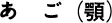
In some cases where an English metaphoric expression uses the word “nose”, the Japanese counterpart uses the word ago (chin). According to one wag, this is because the Japanese have a low nose which isn’t very expressive and it is easier for them to move their chin. Anyway, ago de tsukau (use with the chin) means “lead a person by the nose” and ago de ashirau (handle with the chin) means “turn up one’s nose at a person”.
A dictatorial boss disregards the feelings of his subordinates and “drives them with the chin” and, if the subordinate should voice dissatisfaction, he would thereafter “handle him with the chin”.
Even a competent and humanistic boss would sometimes set a high target for a subordinate to attain and order him to attain it. When the subordinate does his very best but is unable to attain the target, he would ago wo dasu (stick out his chin), which means “get exhausted”.
It can be said that the boss who manages his people with this in mind is an outstanding boss. He will know how to listen to his subordinates’ woes and comfort them while drinking with them at an aka-chōchin.
→ aka-chōchin

aka-chõchin
Many Japanese corporate workers make it a habit to drop in at an aka-chõchin before they head for home after a day’s work. Aka means red and chõchin lantern, but don’t jump to the conclusion that the phrase means a “red light” establishment.
This huge lantern, about a meter in diameter and made of paper pasted over bamboo ribbing is prominently displayed in front of typically Japanese drinking establishments. It is an indication that the shop serves sake and simple popular dishes, that its prices are cheap and that an informal camaraderie prevails. A person can enjoy himself for a couple of hours at a cost of less than $10. The aka-chõchin may be considered the Japanese counterpart of the English pub.
In addition to the red lantern, there hangs above the doorway a nawa-noren, a short curtain with the shop’s name on it. Thus, both aka-chõchin and nawa-noren can be used to mean an inexpensive drinking place.
→ Noren, Chotto ippai

aku
This is the Japanese word for “lye” which is made by mixing ash with water. The Japanese word also refers to the strong astringent fluid found in some plants. From this, the word began to be used to describe a person of somewhat unrefined personality who is very self-assertive.
Kare wa aku ga tsuyoi (He is strong in lye.) means that the person is strongly self-assertive, high-handed, and abrasive. Such a man, of course, is not popular among his fellows. Sometimes an aggressively able person is so described by jealous colleagues.
On the other hand, kare wa aku no nuketa hito da (he is a man with the lye extracted) means a refined or polished person who has no offensive traits, is not greedy and not affected. He is the type who is liked by all around him. However, this expression is often used sarcastically in reference to a person who lacks spirit. Therefore, if you are so described it may be the better part of wisdom not to become instantly elated but to ponder the nuance.

ama-kudari
Ama-kudari is written with the Chinese ideograms which mean “to descend from heaven”. The character for ama (heaven) stands for the emperor, shogun, or the central government. The expression is used to mean the taking of a top post in a private company by a person who has retired from high government office.
Ama-kudari is also used to refer to a person coming from a different division in a government ministry or business corporation to become the head of another division or section, or to a manager in a parent company being appointed president of a subsidiary.
In Japan, personnel shifts between companies are rare and the manager of a department in a big corporation is almost invariably promoted from among the staff of that department. Consequently, an ama-kudari appointment has a somewhat unpleasant ring to the staff of a department which gets a manager from the outside.
In Japan of the Middle Ages, the word ame no shita (literally, under the heaven) meant not just all Japan but the entire world. Another way of pronouncing the ideogram for ame no shita is tenka, and even today, election as the prime minister of Japan or an exceptional rise to a top position is referred to as tenka wo toru (to take or seize power).
→ Chũto-saiyo, Sekigahara, Tozama

aota-gai
Aota-gai is a phrase which originally was used in agriculture. Today, it is scarcely used in the farming communities but has become an indispensable part of the industrial vocabulary.
In the old days, it meant “buying rice on the stalk” before it was harvested. It is similar to buying beef on the hoof or wool on the sheep’s back. Poor farmers in need of cash received money from merchants in exchange for a promise to deliver the rice when it was harvested.
Aota-gai (literally, to buy a green paddy field) is used today to describe the act of companies “raiding” schools to “sign up” students who are scheduled to graduate in the spring of the following year. Sometimes, instead of aota-gai, people use aota-gari (to harvest the green paddy) to describe the intensity with which companies conduct their premature recruiting.
→ Shin·nyũ-shain

apointo
The Japanese lexicon is full of words borrowed from foreign languages and altered somewhat in form and sometimes even in meaning to make them fit into Japanese life. Apointo is a corruption of “appointment”.
Although it is used in the standard sense to mean a prearranged meeting, it is not uncommon for a visitor with an apointo to be kept waiting because someone got there before him, quite often a person who dropped in without an appointment. The fact that a person “just happened to be in the neighborhood” ...
Table of contents
- Cover
- Halftitle
- Title
- Copyright
- Introduction
- Chapter
Trusted by 375,005 students
Access to over 1.5 million titles for a fair monthly price.
Study more efficiently using our study tools.
Frequently asked questions
Yes, you can cancel anytime from the Subscription tab in your account settings on the Perlego website. Your subscription will stay active until the end of your current billing period. Learn how to cancel your subscription
No, books cannot be downloaded as external files, such as PDFs, for use outside of Perlego. However, you can download books within the Perlego app for offline reading on mobile or tablet. Learn how to download books offline
Perlego offers two plans: Essential and Complete
- Essential is ideal for learners and professionals who enjoy exploring a wide range of subjects. Access the Essential Library with 800,000+ trusted titles and best-sellers across business, personal growth, and the humanities. Includes unlimited reading time and Standard Read Aloud voice.
- Complete: Perfect for advanced learners and researchers needing full, unrestricted access. Unlock 1.5M+ books across hundreds of subjects, including academic and specialized titles. The Complete Plan also includes advanced features like Premium Read Aloud and Research Assistant.
We are an online textbook subscription service, where you can get access to an entire online library for less than the price of a single book per month. With over 1.5 million books across 990+ topics, we’ve got you covered! Learn about our mission
Look out for the read-aloud symbol on your next book to see if you can listen to it. The read-aloud tool reads text aloud for you, highlighting the text as it is being read. You can pause it, speed it up and slow it down. Learn more about Read Aloud
Yes! You can use the Perlego app on both iOS and Android devices to read anytime, anywhere — even offline. Perfect for commutes or when you’re on the go.
Please note we cannot support devices running on iOS 13 and Android 7 or earlier. Learn more about using the app
Please note we cannot support devices running on iOS 13 and Android 7 or earlier. Learn more about using the app
Yes, you can access Japanese Business Language by Mitsubishi Corporation,Mitsubishi in PDF and/or ePUB format, as well as other popular books in Social Sciences & Anthropology. We have over 1.5 million books available in our catalogue for you to explore.