- 256 pages
- English
- ePUB (mobile friendly)
- Available on iOS & Android
eBook - ePub
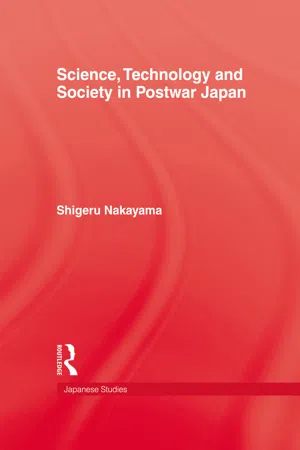
Science, Technology and Society in Postwar Japan
About this book
First published in 1991. The study of Japanese science and technology (especially technology) is a fashionable subject at the present time, and numerous English language works appear month by month claiming to explain the 'miracle' of the recent rise of Japanese technology. Most of these works are, however, seem to be superficial treatments of Japan's recent technological performance, lacking in historical insight. This book is an attempt to introduce a critical examination of the mechanisms by which Japan has promoted science and technology by looking at its post-war historical development.
Information
1 Introduction
Prelude
In the controversial events surrounding the promotion of nuclear reactors, which frequently occurred during the 1970s and 80s in Japan (as well as in most industrialized nations), the scientific profession has been divided into many sectors.
Those nuclear scientists, who worked at governmental laboratories such as the Atomic Energy Research Laboratory of the Science and Technology Agency in Japan, plan for the autonomous development of feeder reactors and accordingly write budget allocation proposals. The primary concern of their laboratories is to promote expensive nuclear research and development, irrespective of its economic feasibility. Their plan is promoted by the bureaucrats whose major achievements are measured by their success in securing maximum budget allocation and its accompanying power within the government sector, rather than any perceived long-range social benefits of the project.
Scientific personnel in private utility companies, such as Tokyo Denryoku (Tokyo Electric) have a slightly different stance from that of government scientists. They assess and adopt whatever system of energy-furnace as long as it proves to be economically agreeable. Although they are heavily influenced by governmental decisions on energy policy, they are in the final analysis profit-oriented and hence quite often prefer buying imported technology rather than the product of endogenous governmental development. In general, they welcome nuclear energy that is most centrally controllable by utility companies rather than decentralized alternative energy sources, such as solar energy.
Academic scientists, notably physicists in major Japanese universities, support in principle the peaceful application of nuclear energy but are quite critical regarding the hasty application of nuclear physics. They claim that more basic research, essentially more funding, is needed in the academic sector, before putting it into practical commercial use. Their warning of nuclear hazards often gets into technical details, upon which anxiety-driven local residents at reactor sites depend.
Finally, there are ecology-minded citizen groups, who oppose nuclear energy itself. Unlike those in the three sectors above-mentioned, they are the people who do not draw any direct advantage out of current scientific research and development. Freed from vested interest in its promotion, they take a fundamentalist stance in criticism of and opposition against the current practice of science and technology. One typical group is the ‘Entropy society’ which was organized in the mid-1980s in Tokyo. It was a gathering of activist citizens, in which some concerned scientists participated. Such scientists are only a very small minority in the existing scientific community; their voices not being well heard and treated lightly. But they have a wider audience amongst not only activists but also the general public who are not necessarily explicit in expressing their concern.
Four-sector approach
As I have shown in the above example, postwar science and technology has been an area where the interests of various sectors of society have clashed. Science and technology develops according to the dynamics of the relationship between the interests of the following four social sectors: academic, public, private and citizen (see the next section for the definition and explanation of the four sectors). The nature and characteristics of a nation’s science and technology are determined by the nature of the equilibrium maintained among these sectors. We shall, throughout the present work, consciously analyse the benefits to each of the four sectors and treat issues according to their conflict and compatibility in relation to these four sectors.
It is generally believed that present-day science and technology is promoted via the cooperation (and conflict) of three sectors: academic, public and private. The citizen sector, on the other hand, is considered to be the outsider with respect to scientific and technological endeavour. Few works have dealt with the scientific activities of the citizen sector because of its low profile in comparison to the other three. In this work, we hope to advance an understanding of citizen participation in the assessment of science and technology by developing a conceptual framework of four, rather than three sectors.
Conceptual Apparatus Employed
In the preceding section, I introduced an example to distinguish several kinds of scientific activity and to highlight the involvement of various sectors in science. In the following, I shall define these activities from the viewpoint of the sociology of science.
In order to illustrate the special features of postwar Japanese scientific performance, it is no longer adequate to employ only the traditional taxonomy of science, such as science as distinguished from technology and to maintain a dichotomy between basic and applied sciences. I shall, therefore, introduce a conceptual apparatus which is employed throughout this study.
Indistinguishability of Science and Technology
Although the conventional distinction between science and technology still largely holds now, it would be misleading to adhere to it in its strict sense. Before World War II, when academic science dominated knowledge production, there was a clear distinction between science and technology. Academic science was strictly science (an activity concerned with obtaining objective knowledge of nature) and did not refer to technology (activities that were useful to some social sectors).
The postwar mainstream scientific activities (such as nuclear fusion projects and satellite programs) are heavily funded and assessed by sponsors (in public or private sectors) who stand outside the scientific community and tend to have little or no interest in or respect for science for its own sake, resulting in no sharp distinction between science and technology in their minds. Hence in the postwar period, science and technology have been inextricably combined so that distinctive terminology has become increasingly meaningless. In common English language usage, ‘science and technology’ used to be grammatically plural, while ‘it’ now has become singular.
Such scientific activity can now be called ‘sponsored science’. I believe that, in the postwar world, the distinction between academic and sponsored science is far more significant than the traditional differentiation between science and technology.
Science Classified and Defined According to Assessors
The crucial factors differentiating the several types of scientific endeavor can be found in the social and sociological mechanism by which each is assessed and utilized. In other words, the question of for whom scientific research is addressed is the most important factor in shaping and defining the character of each scientific activity. Other distinctions such as research location, form of presentation and sources of funds are not necessarily essential and often remain derivative.
Academic Sector and Academic Science
Firstly, we can posit a sector or group of practitioners, scientists and technologists, who act as the promoters of and determinant force in the history of science and technology. Conventional internal historians of science and technology would probably reconstruct postwar history by simply drawing up a chronological list of the achievements of scientists. Such an internalistic approach was viable in the age of academic science before World War II, when most scientific achievements were attributed to talented individuals within the academic scientific community, without reference to any other social sectors. I refer to this sort of scientific activity as ‘academic sector science’ or simply ‘academic science.’
In the case of ‘academic science’, assessment is conducted by fellow scientists. This tradition has been maintained since the establishment of modern science in the seventeenth century. It is a form of science which is based on the principle of publishing or making the results of research available to the scientific community.
Within the scientific community, members present their research for debate, discussion and criticism by their colleagues. Their work is sometimes recognized by publication in the proceedings of a scientific society or its journal. Research is initiated out of individual interest and pursued for reasons of personal honour and distinction meted out through a referee system. Thus, even in technological fields, if a professor in engineering submits his work to an academic journal, he is considered to be an academic scientist and his work viewed as the academic science of engineering.
This mechanism has guaranteed and strengthened the universality and objectivity of modern science. Classical advocates of academic science attempt to promote science for its own sake, science as a self-justifying, value-free activity possessing an objectivity that transcends secular interests. Albert Einstein and Hideki Yukawa were probably representatives of the last generation to embody this mythology of academic science in an age when science has progressively become more influenced by outside forces. Particularly in the case of costly big academic science, public sponsorship is imperative. It is here where tensions emerge between the mechanisms for assessment and sponsorship. Such conflict between assessor and sponsor is, however, not explicit in public and private science.
The best location for conducting academic science in Japan, as well as in the United States, is generally thought to be universities1, where the traditional ideal of academic freedom is supposed to be maintained. Scientists argue for the academic freedom necessary to advance this vision of science and the autonomy required to defend that freedom. Even today, these ideas continue to influence the values and standards of university men and women and are still used to promote research in the basic sciences.
Public Sector and Public Science
The main current of postwar science and technology has not been characterised by such academic scientists alone. Few would disagree that, apart from the academic sector, the outstanding feature of postwar science and technology has been the way in which the policies of bureaucrats-the public sector-have determined to a large extent the major direction in which science and technology has progressed, for the sake of national defence and welfare or simply the strengthening of bureaucratic power.
This trend was already evident from the 1930s when the tradition of German academia, which held the premier position in the world at the time, collapsed and scientists were alienated from the cosmopolitan values they had embraced and were forced to subordinate their values to those of the Nazis. Furthermore, under the government wartime mobilization of science, which included the Manhattan Project during World War II, scientists and technologists in all countries found themselves in roles subordinate to the political system. Governments were encouraged by the good results scientists had achieved during wartime and thus gave their full support to organized and planned mission-oriented research, such as the atomic bomb programs, the success of which guaranteed the continuation of this type of planned and organized research into the postwar era.
Throughout history, the government’s contact point with science has been primarily focused on defence-related research for the purpose of improving national security. Other scientific activities can also be found in a modern state. Nationwide surveying of resources, the maintenance of national standards, the health care system and even industrial development are included in its agenda. These activities are mostly performed in the in-house public laboratories and hence we shall define it ‘public sector science’ or ‘publicly-performed science.’ In the postwar period, however, the government sponsorship was extended to academic and private sector; thus it could be called ‘publicly-sponsored science’. The major direction of ‘publicly-sponsored science’ is set and its output assessed and appraised by bureaucrats. Since we tend to place more emphasis on assessors than performers, we define it ‘public science’.
Private Sector and Private Science
Similarly, ‘privately-sponsored science’ as practised in the private sector is appraised by private enterprises in order to increase profits. Thus we name it ‘private science’. This R & D is defined as developmental research guided by entrepreneurial principles governing the industrial production of commodities.2 While the bulk of defence science and civil engineering falls in to the domain of public science, mechatronics (Japan-made English to denote a combination of mechanical engineering and electronics) belongs to private science.
Between the two world wars, American private research laboratories accounted for two-thirds of total national spending for research and development (R & D) in the U.S. The hallmark of postwar Japanese research and development is, as is now internationally recognized, the predominance of ‘private science’ over ‘public science,’3 for the sake of maximum corporate profit.
Sponsored Science, Technocratic Science
Public and private sciences have many common features which derive from the effect of evaluation by sponsors rather than academic peers. When I emphasize this common...
Table of contents
- Cover
- Halftitle
- Title
- Copyright
- Contents
- Preface
- Acknowledgements
- 1 Introduction
- 2 Democracy Versus Technocracy in Science
- 3 Changing Models of Japanese Universities
- 4 Expansion and Limit of Academic Science
- 5 High Economic Growth and Private Science
- 6 Weakness of National Projects – Public Science
- 7 Grassroots Revolt – Possibility of Service Science
- 8 Microelectronics Revolution
- 9 Competition and Cooperation Japan-USA Phase
- 10 Looking to the Future
- Index
Trusted by 375,005 students
Access to over 1.5 million titles for a fair monthly price.
Study more efficiently using our study tools.
Frequently asked questions
Yes, you can cancel anytime from the Subscription tab in your account settings on the Perlego website. Your subscription will stay active until the end of your current billing period. Learn how to cancel your subscription
No, books cannot be downloaded as external files, such as PDFs, for use outside of Perlego. However, you can download books within the Perlego app for offline reading on mobile or tablet. Learn how to download books offline
Perlego offers two plans: Essential and Complete
- Essential is ideal for learners and professionals who enjoy exploring a wide range of subjects. Access the Essential Library with 800,000+ trusted titles and best-sellers across business, personal growth, and the humanities. Includes unlimited reading time and Standard Read Aloud voice.
- Complete: Perfect for advanced learners and researchers needing full, unrestricted access. Unlock 1.5M+ books across hundreds of subjects, including academic and specialized titles. The Complete Plan also includes advanced features like Premium Read Aloud and Research Assistant.
We are an online textbook subscription service, where you can get access to an entire online library for less than the price of a single book per month. With over 1.5 million books across 990+ topics, we’ve got you covered! Learn about our mission
Look out for the read-aloud symbol on your next book to see if you can listen to it. The read-aloud tool reads text aloud for you, highlighting the text as it is being read. You can pause it, speed it up and slow it down. Learn more about Read Aloud
Yes! You can use the Perlego app on both iOS and Android devices to read anytime, anywhere — even offline. Perfect for commutes or when you’re on the go.
Please note we cannot support devices running on iOS 13 and Android 7 or earlier. Learn more about using the app
Please note we cannot support devices running on iOS 13 and Android 7 or earlier. Learn more about using the app
Yes, you can access Science, Technology and Society in Postwar Japan by Shigeru Nakayama,Nakayama in PDF and/or ePUB format, as well as other popular books in Social Sciences & Anthropology. We have over 1.5 million books available in our catalogue for you to explore.