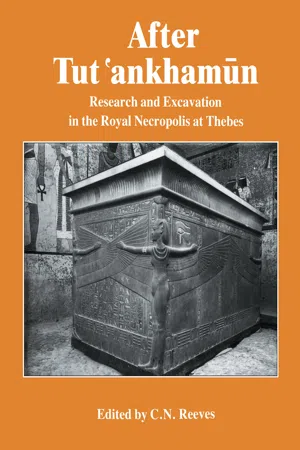
First published in 1992. This book includes research and excavation in the Royal Necropolis at Thebes presented a meeting to mark seventy fifth anniversary of 1915 when the Earl of Carnarvon and Howard Carter had embarked upon their search for Tut'ankhamiin, a search destined to be crowned with such stunning success eight years later. What has happened in the Valley of the Kings since that discovery was the theme of our meeting, a theme addressed over the following two days by an international panel of leading Egyptologists.
ankhamūn include a surprising number of objects inscribed with the names of others: officials, ancestral royalty, and members of the Amarna court — notably Akhenaten and
Ankhkheprurē
: Nefernefruaten.1 A very few of these objects may not in fact have belonged to the burial, but the majority certainly did, whatever the reasons for their inclusion.
The presence of some intrusive items cannot be discounted, in view of the state of the tomb and its early vicissitudes. When Tut
ankhamūn was buried, the passage was probably empty except for the refuse embalming material, but after the tomb had been broken into (right through to the Treasury) the refuse embalming material was removed to the cache and the passage was filled up with rubble brought in from outside. When intruders broke in for a second time, a tunnel was made through this filling and some of the rubble pushed out again, and then, when the tunnel in turn was blocked, more rubble was introduced. The status of objects that came from the debris outside on the staircase or in the passage itself is therefore equivocal: small items may have been dropped by robbers or carried in accidentally with the rubble, and then, in the course of subsequent tidying-up, have been thrown into boxes or tossed through into the Annexe.2
Apart from the vintners recorded on wine-jar dockets,3 none of whom had to do with the tomb, the names of four other officials occur, on nine objects in all. They are the overseer of the treasury Maya, the military officer Nakhtmin,4 a scribe Tuthmosis, and a vizier Pentu — the name of the last on a wine-jar, Obj.no.490, and, therefore, of doubtful relevance.5 In the case of Maya and Nakhtmin the inscriptions are dedications on funerary gifts, all of them placed in the Treasury where they were found untouched,6 whereas the name of the scribe Tuthmosis is written in ink on the concave base of a calcite stand, Obj.no.620(116)=620(122), from under the debris thrown into the Annexe. The graffito reads simply ‘the scribe Tuthmosis, the son of Ḥatiay’,7 and the name of the father suggests that this is the same Tuthmosis who, in year 8 of Ḥaremḥab, had a hand in renewing the burial of Tuthmosis IV, acting as Maya’s assistant.8 If so, it is probable that he scribbled his name on the stand when engaged in a similar task in the tomb of Tut
ankhamūn, although perhaps at a slightly earlier period.9
Activity of this kind would indeed be further confirmed if a sealing, type ‘Q’, on objects both in the Treasury and in the Burial Chamber were clearly identifiable as belonging to Ḥaremḥab.10 The reading, however, is questionable and the signs are not in a cartouche — nor would one expect the nomen alone to be found in this context. A fragmentary sealing, ‘S’, with parts of the two cartouches of Ay, from the floor of the Antechamber, may, on the other hand, point to a formal inspection connected with robbery, although it may equally date from the time of the actual burial and relate to a ritual gift or to some action performed by Ay as the rightful heir, as on the walls of the Burial Chamber.
Objects associated, directly or indirectly, with four of Tut
ankhamūn’s predecessors as king were among the material found in the tomb, although it is evident that, for the most part, their presence had little to do with ancestral pietas.
Two of the calcite vessels stacked on the floor of the Annexe, Obj.nos.404 and 410, display the cartouches of Tuthmosis III, but, like the vessel of Ḥatshepsut from the king’s household at el-
Amarna,11 they were doubtless no more than convenient storage containers, taken presumably from a royal magazine. A glazed steatite scarab with the prenomen of Tuthmosis III, Obj.no.1a, was found in the rubbish that filled the staircase in front of the entrance, and one of two blue glass persea fruits, Obj.no.585u, from a box in the Annexe, is also inscribed with his name.12 The status of neither is certain: the scarab may well be extraneous, and the persea fruit, however it came to be there, can scarcely have been an ‘heirloom’. Moreover, of the two following kings of the dynasty, Amenophis II and — more importantly — Tuthmosis IV, there are no objects of any kind.13
Two more of the calcite vessels piled into the Annexe have inscriptions relating to Amenophis III. One, Obj.no.588, has his prenomen and nomen together with Tiye’s cartouche, but with the nomen then altered so as to duplicate the prenomen, while on the other, Obj.no.483, the two cartouches, both of which show the prenomen, are clearly intact and original.14 The replacement of Amenophis by Nebma
rē
points to the reign of Akhenaten, and it is probable, therefore, that the two vessels, transferred at some stage from a storehouse at el-
Amarna, were used in the burial simply as storage jars.15 The same will apply to a wine-jar, Obj.no.563, docketed in a year 31 which can only be that of Amenophis III,16 as well as a pottery fragment, alleged to have borne his name, which came from the debris outside the entrance.17 A model adze, Obj.no.44p, with the prenomen...
Table of contents
Cover
Halftitle
Title
Copyright
Contents
Plates
Text Figures
Foreword
Acknowledgements
Abbreviations
Introduction
Royal Mummies of the Eighteenth Dynasty: A Biologic and Egyptological Approach
Some Observations Concerning Uninscribed Tombs in the Valley of the Kings
An Interim Report on Work in KV 39, September–October 1989
A Preliminary Report on the Re-clearance of the Tomb of Amenophis III
Akhenaten and Nefernefruaten in the Tomb of Tut‘ankhamūn
Royal Figures from Tut‘ankhamūn’s Tomb: their Historical Usefulness
The Sarcophagus in the Tomb of Tut‘ankhamūn
Zum Grab Sethos’ I. in seinem ursprünglichen Zustand
The Theban Mapping Project and Work in KV 5
The Tomb of Merenptah and its Sarcophagi
Bemerkungen zu den neu gefundenen Daten im Grab der Königin Twosre (KV 14) im Tal der Könige von Theben
The Structure of the Decoration in the Tomb of Ramesses IX
Aspects of the History of the Valley of the Kings in the Third Intermediate Period
List of participants and invited guests
Trusted by 375,005 students
Access to over 1.5 million titles for a fair monthly price.
Study more efficiently using our study tools.
Frequently asked questions
Yes, you can cancel anytime from the Subscription tab in your account settings on the Perlego website. Your subscription will stay active until the end of your current billing period. Learn how to cancel your subscription
No, books cannot be downloaded as external files, such as PDFs, for use outside of Perlego. However, you can download books within the Perlego app for offline reading on mobile or tablet. Learn how to download books offline
Perlego offers two plans: Essential and Complete
Essential is ideal for learners and professionals who enjoy exploring a wide range of subjects. Access the Essential Library with 800,000+ trusted titles and best-sellers across business, personal growth, and the humanities. Includes unlimited reading time and Standard Read Aloud voice.
Complete: Perfect for advanced learners and researchers needing full, unrestricted access. Unlock 1.5M+ books across hundreds of subjects, including academic and specialized titles. The Complete Plan also includes advanced features like Premium Read Aloud and Research Assistant.
Both plans are available with monthly, semester, or annual billing cycles.
We are an online textbook subscription service, where you can get access to an entire online library for less than the price of a single book per month. With over 1.5 million books across 990+ topics, we’ve got you covered! Learn about our mission
Look out for the read-aloud symbol on your next book to see if you can listen to it. The read-aloud tool reads text aloud for you, highlighting the text as it is being read. You can pause it, speed it up and slow it down. Learn more about Read Aloud
Yes! You can use the Perlego app on both iOS and Android devices to read anytime, anywhere — even offline. Perfect for commutes or when you’re on the go. Please note we cannot support devices running on iOS 13 and Android 7 or earlier. Learn more about using the app
Yes, you can access After Tutankhamun by Reeves,C.N. Reeves in PDF and/or ePUB format, as well as other popular books in History & Ancient History. We have over 1.5 million books available in our catalogue for you to explore.