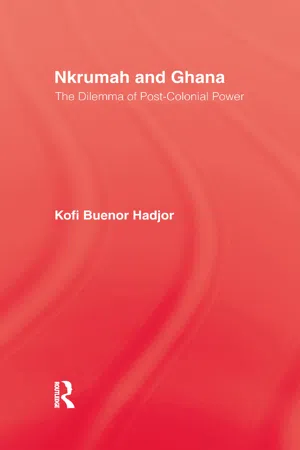
- 134 pages
- English
- ePUB (mobile friendly)
- Available on iOS & Android
eBook - ePub
About this book
First published in 1989. During the days following Kwame Nkrumah's death in 1972, the idea of writing this book first took form. During the past fifteen years, Africa has gone through a major trauma. The events of these years help throw light on the Nkrumah experiment, and underline its continued relevance for Ghana and for Africa.
Information
Chapter 1
Ghana in History
In the very early days of the Christian era, long before England had assumed any importance, long before even her people had united into a nation, our ancestors had attained a great empire which lasted until the eleventh century, when it fell before the attacks of the Moors of the North. At its height that empire stretched from Timbuktu to Bamako and even as far as the Atlantic. It is said that lawyers and scholars were much respected in that empire and that the inhabitants of Ghana wore garments of wool, cotton, silk and velvet. There was trade in copper, gold and textile fabrics and jewels and weapons of gold and silver were carried.1
Kwame Nkrumah, like other Pan-Africanists before him (W. E. B. DuBois, George Padmore and Sylvester Williams), was determined to rescue Africa’s glorious history from colonialism. Across the continent the European colonisers had sought to deny Africa a history, partly because of their own ignorance and laziness and partly as a means to justify the atrocities of colonialism. After all, if you are dealing with ignorant savages without a history of their own, the colonisers reasoned, how can it be a crime to come and take over their society and get what you can in the process? Nkrumah wanted to nail that lie right away. Of course, Africa and Africans had a history – in fact, it is a history that goes back further than that of the so-called civilised peoples of Europe. Indeed, Africa is today regarded by most archaeologists and anthropologists as the cradle of humankind, and it is thought that the first Homo sapiens originated from the area now known as Kenya several million years ago.
Africans can cite many texts in support of their arguments – a Spanish Arab called Al-Bakri wrote extensively about the Ghana empire as a highly organised society in 1067. This was just one year after the Angles and Saxons in Britain had been invaded by William the Conqueror. There are successive accounts given by European traders of the conditions in West Africa in the fourteenth and fifteenth centuries which indicate a high level of organisation and planning. For example, a Dutch traveller visiting the city of Benin described it thus:
When you go into it you enter a great broad street, which is not paved and seems to be seven or eight times broader than the Warmoes Street in Amsterdam. This street is straight and does not bend at any point. It is thought to be four miles long. The houses in this town stand in good order one close and evenly placed with its neighbour, just as the houses in Holland stand. They have square rooms, sheltered by a roof that is open in the middle, where the rain, wind and light come in. The Kings yard is very great. It is built around many square-shaped yards. These yards have surrounding galleries where sentries are placed.2
And down in southern Africa are the remnants of a settlement called Great Zimbabwe. The buildings which comprise Great Zimbabwe were of such a degree of sophistication that Cecil Rhodes and his band of colonisers – misled by their own racism and wishful thinking – said that the settlement must have been constructed by earlier European visitors. And it was only in the second half of this century that there was enough evidence to prove that the stone settlement had been built by Africans. So history is not just another subject to be taught to schoolchildren, or an interesting series of stories; it affects the way in which we see ourselves and our capabilities. That is why Nkrumah and his colleagues used to say: ‘Know your history to help share your future!’
Nkrumah and his colleagues in the independence movement insisted that the name ‘Gold Coast’ – the colonial name for Ghana – should not be used. What’s in a name? you might ask. The answer is that by calling our country ‘Gold Coast’ the colonisers were saying their prime interest in the land was the valuable minerals in our territory, and not the people and their development. Otherwise, why did they not call Britain ‘Island of Coal’? Of course they did not because such a name would be derogatory to the people and their culture. Accordingly, one of the strongest demands of Nkrumah and the independence movement was to change the colonisers’ name of ‘Gold Coast’ to ‘Ghana’ as a tribute to the history of our various peoples. Again in his Motion of Destiny speech, Nkrumah told the Legislative Assembly in Accra:
We take pride in the name of Ghana, not out of romanticism, but as an inspiration for the future. It is right and proper that we should know about our past. For just as the future emerges from the present, so has the present emerged from the past. Nor need we be ashamed of our past. There was much in it of glory. What our ancestors achieved in the context of their contemporary society gives us confidence that we can create, out of the past, a glorious future, not in terms of war and military pomp, but in terms of social progress and peace.3
History too, Nkrumah pointed out, teaches us what others have achieved before us and how we can build on the best of these traditions:
As with our enslaved brothers dragged from these shores to the United States and to the West Indies, throughout our tortuous history we have not been docile under the heel of the conqueror. Having known by our own traditions and experienced the essentiality of unity and of government, we constantly formed ourselves into cohesive blocks as a means of resistance against the alien force within our borders.4
Ghana at the Beginning
The earliest written records that refer to Ghana date back to about AD 770, when it was described as the ‘land of gold’ by an Arab traveller called Al-Fazari. But Ghana was originally the name given to the state of Wagadu, which was one of the biggest in ancient West Africa. We must go back even further to see how West Africa developed as a distinct region from North and East Africa. For since that time, West Africa has always been in a unique position: because of its isolation it has been able to preserve much of its culture and tradition, but at the same time it has been cut off from some of the more important intellectual and technological developments in the rest of the world.
West Africa’s isolation was brought about by the gradual encroachment of the Sahara Desert. Around 2000 BC – that is, about a thousand years after the people of West Africa had started organising agriculture and farm settlements – the rivers of the Sahara began to fail, and, gradually, its farming people moved away, dispersing to West, North and East Africa. This migration was completed around 500 BC when most of the discoveries of the New Stone Age had been taken into the West African region, though there is growing, but not yet conclusive evidence that the early West Africans had developed their own forms of agriculture, developing unique strains of rice.
Because of the lack of written records about West Africa at this time, we are dependent on archaeological evidence for these developments, and on our own oral history which has been passed down from generation to generation. For example, the Akan and Nzima say their ancestors came from far in the north, perhaps during the great migration in the face of the spreading Sahara, while the Ga and Ewe peoples say their ancestors came from the east.
Of course, these legends and traditions refer to a small group who set out from the previous homeland to find new areas of habitation where they would meet other traditions. These migrations – this mixing of old and new cultures – is what makes up history, but it is important to understand that in the West African context most of the migrations after 500 BC were confined to within the West Africa region. So nearly all the inhabitants of West Africa today are descendants of people who have lived in this region for over 1,500 years.
Iron and Trade
The development of organised agriculture increased the supplies of food which in turn increased the size of the populations, as well as allowing these societies to support persons who neither grew nor gathered food. These peoples were then free to develop primitive technology, like the making of simple tools. The ancient Africans (in what is now called Egypt) were making tools with copper and gold more than five thousand years ago, but these metals were unsatisfactory – both because they were too scarce and therefore valuable in themselves and because they were too soft to make durable tools.
It was the Asian people called the Hittites who discovered in 1500 BC how to make iron, a metal out of which hard tools and weapons could be forged. These techniques reached the Nile Valley and the ancient Ethiopians by about 600 BC, and took another three hundred years to get to the West Africans. The archaeological evidence is that West Africa’s first iron smelters lived by the banks of the Benue and Niger rivers, but quickly spread their knowledge in the region. Iron meant better tools and better weapons. Iron enabled travellers to clear a way through the forest to reach other areas and hunters to capture and kill wild animals. And iron also brought a new source of military power. Those who had the better iron weapons were able to conquer and rule their neighbours, and, as the groups came into conflict, the stronger ones would predominate and set up simple forms of government to control the people they had conquered. As the societies grew more complex, labour was divided between the farmers, the hunters, the tool-makers, the warriors and the traders, and to hold all this together they needed some forms of basic political organisation.
With these technological developments people expanded trade with each other – exchanging produce and tools, as they exchanged knowledge and cultures. The early history was entirely a history of battle after battle. The development of the early states was then subject to the level of technology that had developed, the organisation of their labour force, their geographical locations, the natural resources available to them, and their trading relationships with the outside world.
As a general rule, those states situated on the main trade routes tended to be more centrally controlled, needing as they did to make firm decisions about the sale and purchase of products, whereas those groups who lived away from the main centres of trade tended to develop looser, less centralised systems of government.
Ancient Ghana
Early records place the origins of the Ghanaian empire at about AD 300. The state grew out of its peoples’ need to protect their trade and its heart lay in the market centres around the upper waters of the Niger and the Senegal rivers. These markets stood where trading routes which came northward from the gold-producing areas of West Africa met trading caravan routes which crossed the Sahara from North Africa. So the traders in these market centres developed by buying gold and ivory from the traders of West Africa and selling these goods to the traders of North Africa in exchange for Saharan salt and other North African produce. This strategic position also meant that they needed a strong system of government to defend their markets and play some role in the control of the respective trade routes.
The evidence is that it was the Soninke people who founded ancient Ghana – a state which, through commercial influence and military power, developed into an empire controlling a large region all around it (see map). Again the evidence from the written records found in Timbuktu is that the first Ghanaian king was crowned around AD 300. Not much is known about how the line of the Soninke kings started, but it is presumed that the merchants decided to choose a king from one of their number as a means of regulating their trade, as well as having religious and other cultural leadership functions.
The Spanish Arab traveller Al-Bakri, who collected together several accounts of the Ghanaian empire, describes how the expansion of the kingdom’s trade increased the wealth of the kingdom so that the king could control all the smaller kingdoms in the surrounding areas, employ hundreds of messengers and other servants and develop the means to organise such an empire. Piecing together accounts from Muslim travellers of the day, Al-Bakri described the court of the Ghanaian emperor, King Tunka Manin, in about Ar 1065 thus:
When the king gives audience to his people, to listen to their complaints and to set them to rights, he sits in a pavilion around which stand ten pages holding shields and gold mounted swords. On his right hand are the sons of princes of his empire, splendidly clad with gold plaited into their hair. The governor of the city is seated on the ground in front of the king and all around him are his counsellors in the same position. The gates of the chamber are guarded by dogs of an excellent breed. These dogs never leave their place of duty. They wear collars of gold and silver, ornamented with metals. The beginning of a royal meeting is announced by the beating of a kind of drum they call deba. The drum is made of a long piece of hollowed wood. The people gather when they hear its sound.5
Other later accounts substantiate these descriptions of the sumptuous Ghanaian court. A writer in Timbuktu called Mahud Kati describes how a Ghanaian king called Kanissa’ai possessed a thousand horses and how ‘each of these horses slept only on a carpet with a silken rope for halter’, and would have three personal attendants and was generally looked after like royalty itself. Other stories – doubtless embroidered with the passage of time – tell how the Ghanaian kings would hold banquets for ten thousand people at a time and dispense gifts to all comers.
We do know from available archaeological evidence that Ghana’s last capital at Kumbi Saleh – about 320 miles north of modern Bamako – was the biggest West African city of its day, with a population of over fifteen thousand. And again, according to Al-Bakri, the ancient Ghanaian kings were masters of a large empire and a formidable power: they could put two hundred thousand warriors into the field, with more than forty thousand of them armed with bows and arrows.
Governing Ghana’s empire
Ghana’s position as middleman at the crossroads of trade between the gold and ivory producers of the south and the Berber traders of the north was a great commercial strength, but it also meant that the kingdom would have to develop defences against attack.
The state had the means to protect itself. It had a large population and it had the iron-making technology to produce effective weapons, so the Ghanaian rulers developed a type of security zone around their state. They strengthened their position as middleman by bringing lesser states like Takur under their control and pushed southwards to where the gold and ivory were coming from.
They also pushed northwards and took over southern Saharan cities like Audoghast. As the empire and the trading network expanded, so the system of government grew more sophisticated. A Ghanaian king then appointed lesser kings as governors to look after his interests in distant provinces in return for specified remunerations. The number of a Ghanaian king’s subjects grew as more and more people gave their loyalty – and paid their taxes – to the central government.
Ghana’s Riches
Both the resplendent appearance of the court and the fact that a king could put so many men under arms indicate that he must have been fabulously wealthy. He obtained his money primarily through taxes: he levied a tax on goods coming into the state and another, higher tax on all goods going out. These taxes applied to all goods of value like gold, salt and copper.
Apart from this a Ghanaian king decreed that all gold found in the state belonged to him, which was both a means of building up the royal wealth and of controlling the sale of gold so as to keep its price high. Just like today’s mineral monopolies which seek to control the price of diamonds, gold and platinum, the ancient Ghanaian kings used their power of monopoly to protect their incomes. In this, Ghana’s trading position was crucial. About the time of the rise of Ghana, the gold mines of Europe and western Asia were being exhausted. Thus began the history of European trade with West Africa – a trade primarily in search of gold. Ghana really began the trade in gold and, as time went by, other peoples began to copy Ghana’s success.
The Fall of the Ghanaian empire
As it was, the Ghanaian empire was not invincible, and various warring groups started making incursions into the empire in searc...
Table of contents
- Cover
- Halftitle
- Title
- Copyright
- Contents
- Dedication
- Preface and Acknowledgements
- Map of Ghana
- Introduction
- 1 Ghana in History
- 2 The British Move In
- 3 Young Nkrumah Goes Abroad
- 4 A Nation in Wait for a Tribune
- 5 The Painful Transition
- 6 On Borrowed Time
- 7 Giving Reality to the Pan-African Ideal
- Conclusion: Nkrumah for Our Times
- Bibliography
- Index
Trusted by 375,005 students
Access to over 1.5 million titles for a fair monthly price.
Study more efficiently using our study tools.
Frequently asked questions
Yes, you can cancel anytime from the Subscription tab in your account settings on the Perlego website. Your subscription will stay active until the end of your current billing period. Learn how to cancel your subscription
No, books cannot be downloaded as external files, such as PDFs, for use outside of Perlego. However, you can download books within the Perlego app for offline reading on mobile or tablet. Learn how to download books offline
Perlego offers two plans: Essential and Complete
- Essential is ideal for learners and professionals who enjoy exploring a wide range of subjects. Access the Essential Library with 800,000+ trusted titles and best-sellers across business, personal growth, and the humanities. Includes unlimited reading time and Standard Read Aloud voice.
- Complete: Perfect for advanced learners and researchers needing full, unrestricted access. Unlock 1.5M+ books across hundreds of subjects, including academic and specialized titles. The Complete Plan also includes advanced features like Premium Read Aloud and Research Assistant.
We are an online textbook subscription service, where you can get access to an entire online library for less than the price of a single book per month. With over 1.5 million books across 990+ topics, we’ve got you covered! Learn about our mission
Look out for the read-aloud symbol on your next book to see if you can listen to it. The read-aloud tool reads text aloud for you, highlighting the text as it is being read. You can pause it, speed it up and slow it down. Learn more about Read Aloud
Yes! You can use the Perlego app on both iOS and Android devices to read anytime, anywhere — even offline. Perfect for commutes or when you’re on the go.
Please note we cannot support devices running on iOS 13 and Android 7 or earlier. Learn more about using the app
Please note we cannot support devices running on iOS 13 and Android 7 or earlier. Learn more about using the app
Yes, you can access Nkrumah and Ghana by Hadjor,Kofi Buenor Hadjor in PDF and/or ePUB format, as well as other popular books in Social Sciences & Anthropology. We have over 1.5 million books available in our catalogue for you to explore.