- 156 pages
- English
- ePUB (mobile friendly)
- Available on iOS & Android
eBook - ePub
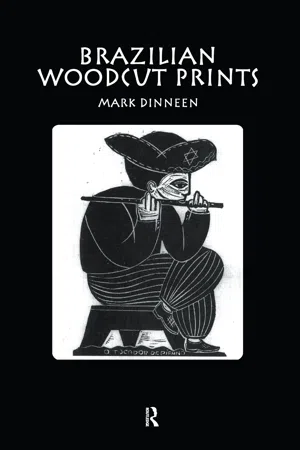
Brazilian Woodcut Prints
About this book
First published in 2001. The North East of Brazil is renowned for its rich and vibrant popular culture. The region's festivals, music, poetry and popular religious rituals have attracted increasing interest from around he world in recent decades, and the woodcuts that are the subject of this book are one of the most striking expressions of that cultural dynamism. They have been a significant art form in Brazil since the 1940s, when they began to be produced in large quantities as illustrations for the covers of cheap pamphlets of poetry sold in streets and markets throughout the North East, where they were known as Literatura de Cordel or 'string literature' - so-called because the pamphlets were frequently displayed on cords hung between posts. This work, the first detailed study of Brazilian woodcut prints in the English language deals with the origins and development of the art form, its themes, the traditions and culture of the Brazilian North East, social and political issues, humour and satire, all lavishly illustrated. As this superb study shows, the Brazilian woodcut print has all the power, quickness and wit of a great popular art.
Information
1
Introduction
The North East of Brazil is renowned for its rich and vibrant popular culture. The region’s festivals, music, poetry and popular religious rituals have attracted increasing interest from scholars from around the world in recent decades. The woodcuts that are the subject of this book are one more expression of that cultural dynamism. They have been a significant art form in Brazil since the 1940s, when they began to be produced in large quantities as illustrations for the covers of cheap pamphlets of poetry sold in streets and markets throughout the North East. In subsequent decades, however, the woodcuts assumed larger and more complex forms, and they are now regularly made as posters, prints for framing and wall hangings for sale to collectors and tourists. Today, alongside the stark, rustic woodcut prints on age-old themes, produced in the same way as they have been for decades, there are more polished and stylish versions, influenced by modem painting and sculpture.
Some of the artists involved, most of whom come from the poorest sectors of North East society, and are invariably self-taught, now live entirely from the proceeds of their woodcuts, although usually precariously. At the same time as their work has received increasing recognition from a wider public, both within Brazil and beyond, it has also influenced a number of well-known erudite artists in Brazil, who have assimilated formal and thematic aspects of the popular woodcut into their own artistic production. Such growing attention is easily explained. These stark and often dramatic prints are a direct and effective means of communication. The simple images vividly capture contemporary issues and events of national concern, as well as numerous aspects of the distinctive social and cultural life of the Brazilian North East. Both traditional and modem themes are continually given original expression as they are reinterpreted by the woodcut artist according to the values and perceptions of his own community.
The Origins and the Development of the Woodcut
The printing of an image from a carved relief has a long history. The earliest forms are generally traced to China, where it is believed that wooden stamps were used to print on calico long before the Christian era, though the precise date of the first woodcut is unknown. Evidence suggests that textile printing flourished many centuries before paper, which was invented in China in 105 A.D., became widely available and dramatically expanded the possibilities for woodcut art. It was in China that the first woodcut prints on paper appeared. The earliest in Europe are believed to have been made in approximately 1400, though the first to include dates on them are a print of the Madonna made in Brussels in 1418, and one of St. Christopher, of German origin, of 1423.
Religious themes predominated in the European woodcuts of the early 1400s, with images of saints, the Virgin Mary and episodes from the life of Christ. Many of these prints were used to illustrate prayer sheets. They were simple, stark and bold. As the century progressed, topics became more varied, as woodcut prints were increasingly used to illustrate books and the broadsides of poetry, news and proclamations that were sold in the streets. At the same time, form and style became more sophisticated, with more attention given to detail and to background. From the mid-fifteenth century, block books served as an important vehicle for the development of the woodcut. These were books whose text and illustrations were printed entirely from wooden blocks. Major centres for woodcut printing were quickly established in Germany, Italy, France and the Netherlands. The art form was slower to develop in England, but it grew in importance from the 1480s onwards, when woodcuts provided illustrations for books produced by William Caxton.
The production techniques employed during the first century or so of woodcut printing in Europe were extremely simple. Two different individuals were generally involved in creating the woodcut. An artist drew the design, and a skilled woodworker then cut it on to the block of wood. The drawing was either executed directly on the wood, or produced first on paper and then transferred to the block. The background was then cut away, leaving the main subject of the design in relief, to be printed in black. The illustrations that resulted were often crude, but for some critics they have a vitality and a visual power which is lacking in most of the more elaborate and refined prints produced during later centuries (Hayter, 1992, 8). As for the process of printing, the presses used became steadily more sophisticated, especially as book production expanded in the late-fifteenth century following the introduction of printing from movable type.
The woodcut did not merely serve as decoration for those early books. It was increasingly used to convey information. There were prints of plants and herbs for books on botany, for example, and woodcut scenes of cities for works on foreign travel. In the early-sixteenth century, books on a whole range of scholarly subjects stimulated the production of woodcuts of increasing complexity and detail. At the same time, such celebrated artists as Albrecht Dürer (1471-1528) and Hans Holbein (1497-1543) sought to perfect the technique of woodcutting, resulting in prints of unprecedented artistic refinement, far removed from the bold simplicity and spontaneity that characterized Europe’s earliest woodcuts. The period from 1470 to 1580 represented a golden age for woodcut art in Europe. It was the dominant form of illustration, its diverse subjects including portraits, political satire, mythological figures and scientific illustrations. It attained a level of popularity and diffusion that it would never equal again.
Metal plate engraving, which could produce far more detailed prints, eventually undermined the dominant role of the woodcut throughout Europe. By the eighteenth century, only a few specialist books made use of woodcut illustrations, which were now most commonly employed in the cheap broadsides and chapbooks sold in the streets. Other forms of illustration were developed and enjoyed periods of popularity. One of the most notable was wood engraving, which was much used at the end of the eighteenth century. Whereas in woodcutting, the surface of the block used runs parallel to the grain, for wood engraving the block is cut against the grain. Before long however, industrialization ushered in a new period of mass production of illustrations, soon to be dominated by photography. The use of the traditional woodcut, now seen as antiquated and unfashionable, dwindled further. Its qualities, however, have continued to attract the attention of artists in Europe. The Norwegian, Edvard Munch, did much to revive its popularity as an art form in the early twentieth century, and the work of such major figures as Pablo Picasso, Paul Gaugin and Fernand Léger includes notable examples of woodcut expression.
The Origins of Woodcut Art in North East Brazil
The popular woodcuts of the Brazilian North East appear to have much in common with early European prints. There are similarities in their form and their uses, most notably in their role as illustrations for popular literature sold in streets and fairs. However, there is no evidence to show a clear link between European and Brazilian woodcuts. The origins of woodcut art in Brazil, known as xilogravura, are shrouded in mystery. One theory suggests that missionaries carried the tradition to Brazil, using woodcut prints to illustrate church notices and prayer sheets (Pontual, 1970, 58). What is clear, however, is that xilogravura did not develop into a significant popular art form in the North East until well into the twentieth century. Woodcuts were sometimes used as illustrations for some of the region’s newspapers, but what transformed them into a major form of artistic expression was the steady expansion in production of pamphlets of popular narrative poetry. These became known as literatura de cordel — string literature – because they were traditionally displayed hanging on a line of string when sold in markets and public squares. Used to provide eye-catching covers for these chapbooks, the woodcut began to acquire new prominence.
For many centuries, the popular poetic tradition of the North East, which has its roots in the epic poetry of Medieval Europe, existed only in oral form. Many popular poets achieved fame in the rural interior for their virtuosity in composing verses and their skill in reciting them. In the late-nineteenth century, some of those poets began to produce cheap pamphlets or folhetos of their poems on simple hand presses, similar in form to earlier European pamphlet poetry. Selling these folhetos in the fairs held regularly in towns throughout the North East was a valid alternative to working on the land, or in low-paid employment in the towns. Gradually, the process of production of the pamphlets became more sophisticated. Their increasing popularity not only generated more professional poets, but also led to the emergence of specialized pubüshers and travelling salesmen who could also earn their living from pamphlet poetry. In the 1940s and 1950s, folheto production was dynamic, with scores of printer’s shops established throughout the North East, together with hundreds of resellers who ensured widespread distribution.
Traditional themes which can be traced back to the Iberian romance have been reworked by many poets, right up until recent times. Ballads of religious content have the longest tradition of all, and numerous folhetos have been produced on the life of Christ and the saints, and on miracles that have transformed people’s lives. There are also new versions of old chivalric romances, above all about the life of Charlemagne. Over the years, however, the folheto has incorporated an increasing array of contemporary themes, including national and international news, current social issues and local events that have caught the imagination. To ensure he sells his poetry, the poet has to refashion whatever material he uses to give it direct significance for his public, which traditionally has comprised the poorest sectors of North East society. He links his verses to their daily experience, and employs a language and system of symbols which they identify as theirs. It was also with a view to sales that poets sought striking covers for their folhetos, as a way of enticing customers.
For many years, folheto covers were plain, with nothing more than the title of the poem, and the name of the poet and the publisher. To make them more attractive however, various forms of illustration were gradually introduced, including the lithograph, metal engraving and photographs. Woodcut prints were occasionally used in the early decades of the twentieth century, but it was in the 1940s that they came to dominate folheto covers. Woodcuts were cheap and easy to produce, and the r...
Table of contents
- Cover
- Half Title
- Title Page
- Copyright
- Acknowledgements
- Contents
- 1. Introduction
- 2. Religious Themes
- 3. Adventure, Romance and the Fantastic
- 4. Life, Traditions and Culture of the Brazilian North East
- 5. News and Social and Political Issues
- 6. Humour and Satire
- 7. Bandits
Trusted by 375,005 students
Access to over 1.5 million titles for a fair monthly price.
Study more efficiently using our study tools.
Frequently asked questions
Yes, you can cancel anytime from the Subscription tab in your account settings on the Perlego website. Your subscription will stay active until the end of your current billing period. Learn how to cancel your subscription
No, books cannot be downloaded as external files, such as PDFs, for use outside of Perlego. However, you can download books within the Perlego app for offline reading on mobile or tablet. Learn how to download books offline
Perlego offers two plans: Essential and Complete
- Essential is ideal for learners and professionals who enjoy exploring a wide range of subjects. Access the Essential Library with 800,000+ trusted titles and best-sellers across business, personal growth, and the humanities. Includes unlimited reading time and Standard Read Aloud voice.
- Complete: Perfect for advanced learners and researchers needing full, unrestricted access. Unlock 1.5M+ books across hundreds of subjects, including academic and specialized titles. The Complete Plan also includes advanced features like Premium Read Aloud and Research Assistant.
We are an online textbook subscription service, where you can get access to an entire online library for less than the price of a single book per month. With over 1.5 million books across 990+ topics, we’ve got you covered! Learn about our mission
Look out for the read-aloud symbol on your next book to see if you can listen to it. The read-aloud tool reads text aloud for you, highlighting the text as it is being read. You can pause it, speed it up and slow it down. Learn more about Read Aloud
Yes! You can use the Perlego app on both iOS and Android devices to read anytime, anywhere — even offline. Perfect for commutes or when you’re on the go.
Please note we cannot support devices running on iOS 13 and Android 7 or earlier. Learn more about using the app
Please note we cannot support devices running on iOS 13 and Android 7 or earlier. Learn more about using the app
Yes, you can access Brazilian Woodcut Prints by Dinneen,Mark Dinneen in PDF and/or ePUB format, as well as other popular books in Social Sciences & Anthropology. We have over 1.5 million books available in our catalogue for you to explore.