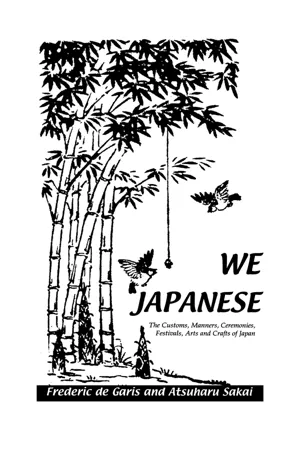
'We Japanese', is a collection of answers to questions that the author as a hotel manager in Japan has answered for hotel guests over the years. He was the manager for over 28 years at the Fujiya Hotel at Miyanoshita. These are naturally questions concerning those things which are different in Japan from the countries from which the visitors come. First published in 2006. Routledge is an imprint of Taylor & Francis, an informa company.
- 618 pages
- English
- ePUB (mobile friendly)
- Available on iOS & Android
eBook - ePub
We Japanese
About this book
Information
We Japanese
Book I
Written by
for
Managing Director
The National Flag of Japan
Hinomaru (“The Round of the Sun”)
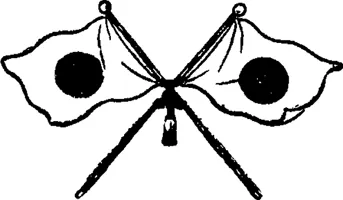
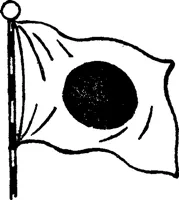
Flags showing the rising sun were used by some of the noted clan heads in ancient days. A record of these flags appears in annals written about 600 years ago. When the ban against building large vessels was lifted—after the advent of Commodore Berry’s squadron in 1853-54—the necessity arose to distinguish Japanese ships in foreign commerce, and the flag, about as it now appears, was suggested as a national ensign by Lord Nariakira Shimazu, head to the Satsuma clan.
By official proclamation issued in January, 1870, the standard form and size of the flag were fixed in a rectangular proportion of 3 for the length and 2 for the width, with the diameter of the sun three-fifths of the width, placed in the center of the flag. The material, whether silk, cotton or muslin, was not stipulated. This ordinance was made to clarify the confusion then existing relative to the flag. The flag-staff universally used is of bamboo, painted black every few inches. It is capped with a golden ball.
The first display of the sun flag as the symbol of the nation was on the occasion of the trip to the United States, in 1860, of the first embassy ever sent abroad by the government. It numbered 70 in all. The Powhattan, a steamship of the U. S. navy, was placed at the disposal of the Shogunate for this purpose. The ship flew the American flag at the stern, the Japanese flag at the bow. In a national rite the flag was first used in Yokohama on the occasion of the opening of the first railway in Japan, by Emperor Meiji, on September 17, 1872. The people of Yokohama and those who lived along the rail line hit upon the happy idea of displaying sun flags in front of every house in honor of the Emperor, and in celebration of the occasion.
Kimigayo
(“Sovereign Reign”)
The National Anthem of Japan
The Kimigayo is recognized as one of the most dignified and most beautiful national anthems in the world. This noble and sonorous melody was harmonized by a German bandmaster, Franz Eckert, director of the Marine Band of Japan from 1879-98. He also founded the military band of Toyama Gakko, Tokyo, and established the military band of the Imperial Guards. In his selection and harmonization of the Kimigayo, Herr Eckert’s own modest statement is recorded in the Asiatic Society Transactions:
“Some time ago I was asked by the Ministry of Marine to compose a national anthem, as one did not exist at that time. Having asked for them, I received several Japanese melodies from which I selected the following. I harmonized it and arranged it for European instruments. As I think it unnecessary to write down the instrumentation, I give the original melody only. The poem is from the famous Kokinshu and is about a thousand years old.”
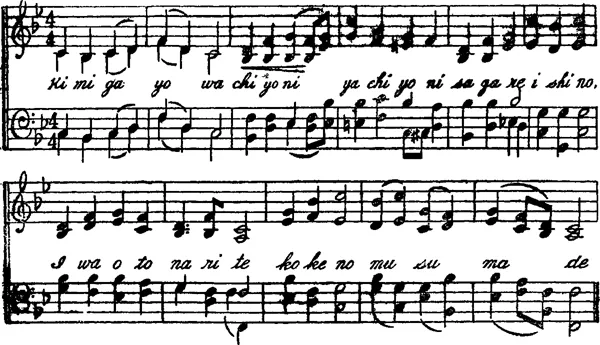
This stirring and impressive anthem is liberally translated by Professor B. H. Chamberlain, author of “Things Japanese”, as follows:
| Kimi ga yo wa | Ten thousand years of happy reign be thine ; |
| Chiyo ni yachiyo ni | Rule on, my lord, till what are pebbles now |
| Sazare ishi no | By ages united to mighty rocks shall grow |
| I wao to nari te | Whose venerable sides the moss doth line. |
| Koke no musu made. |
The Kimigayo was played for the first time at Court on the birthday of Emperor Meiji in 1880.
Eras—Year Names (“Nengo”)
Time, in Japanese chronology, is not reckoned as in Christian countries. It is divided into eras with variable numbers of years, which now correspond with the reigns of the respective Emperors, each era being designated by a particular name called a “year name.” For instance, 1933 was the 8th year of Showa— the 1st year of the present Showa being 1926—and this Showa is the 230th era. Also, Japanese chronology is dated from the ascension to the throne of the first Emperor, Jimmu Tenno, in 660 B.C.—by which reckoning 1933 becomes 2593—a system employed in Government offices, including post offices, by some historiographers, and in school textbooks. The word Tenno is the equivalent of the English word, Emperor.
The meanings of recent eras are: Meiji (“Enlightened Era”)— 1868-1912, Taisho (“Way of Heaven” or “Era of Great Equity”)— 1912-26, Showa (“Radiant Peace”)—1926-
There are advocates who desire that this system be reformed, as with it Japanese history and other records are perplexing even to Japanese. For instance, it is recorded that major earthquakes in Japan occurred in the 13th year of the Hakuho Era, the 7th year of the Meio Era, the 1st year of the Keicho Era, the 6th year of the Genroku Era, the 1st year of the Bunka Era, the 4th year of the Koka Era, the 1st year of the Ansei Era, and so on, but offhand it is difficult to determine how long the intervals were between these occurrences. Reference tables are required by the average person to obtain such information. The difficulties of this system are further illustrated in relation to the present Showa Era, which began, automatically, at 1.25 a.m., December 25, 1926, upon the death of Emperor Taisho— which, up to the moment of the Empreror’s death, was the 15th year of the Taisho Era. At the Emperor’s death the era year became Showa 1, and at 1 a.m. of January 1, 1927, it was Showa 2, which began one hour before, at midnight, in accordance with the Japanese custom. Thus there were three era years in one week. It is worth noting that as Showa 1 was less than a week in length, this fact will cause considerable confusion to future students of Japanese chronology. However, so long has this system been followed, it is not anticipated that it will be changed.
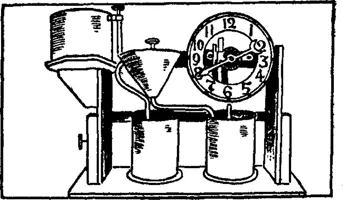
An ancient Japanese clock and Sun dial.
Officially, for communications and transactions with foreign Governments and peoples, the Christian (Gregorian) calendar went into effect in Japan on January 1, 1873, and unofficially this calendar is becoming widely used in popular and technical literature.
Volcanoes in Japan
Situated as she is in a volcanic zone, Japan suffers from fre-quentae earthquakes and consequently from many volcanic eruptions, which, according to the ancient idea of the Japanese, are a furnace for burning up all dust and garbage of the sea. This is so because our ancients believed that a crater leads to the bottom of the sea. According to tradition, Mt. Fuji made its sudden appearance simultaneously with Lake Biwa in one night in the 6th month (June) in the 5th year (286 B.C.) during the reign of the Emperor Korei (the 7th).
The first volcanic eruption recorded in Japanese history took place on the 14th day of the tenth month (October) in the 12th year (684 A.D.) of the reign of the Emperor Temmu (the 40th), when a new island appeared to the north-west of an Izu island. In the 3rd month (March) of the following year, because of ashes falling from heaven, “all plants in the province of Shinano were killed.” During a period of 1246 years, 684 to 1931, 61 mountains erupted 761 times in Japan.
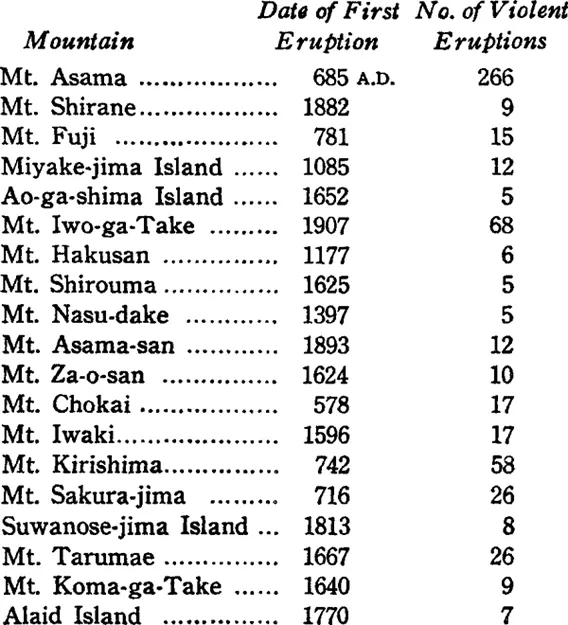
Active volcanoes: There are some active volcanoes in Japan and the following list gives the names of some of the chief ones and the date and number of their eruptions:
Banzai-The Japanese “Hurrah”
Banzai (Ban—“10,000”; zai, or sai—“years”)
Ban-Banzai (“Ten Times Ten Thousand Years”)
Wan-sui (Chinese), its characters being read “Banzai” in Japan.
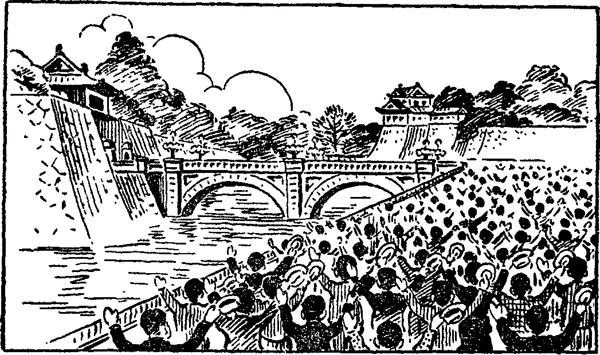
A Banzai at the Niju-bashi Bridge of the Imperial Palace, Tokyo.
What is generally considered to be the origin of Banzai occurred during the Chinese Chin Dynasty (255–207 B.C.) when the King-Emperor Chou of that dynasty, coveting a famous jewel, called Ho-Shih-Pi (“Gem of Ho-Shih,” a man’s name), owned by King Hui of the Chou Dynasty, offered a considerable territory in exchange for the jewel. Hui, fearing the powerful Chou, had to comply with what was practically a demand. He sent Lin-Hsiang-Ju as his messenger to present the jewel to Chou. When this was done all the courtiers of Chou joined in a mighty shout, “Wan-sui” (Banzai).
There are a number of joyous occasions recorded during t...
Table of contents
- Cover
- Half Title
- Title Page
- Copyright
- Contents
- My Honorable Bow
- Preface for Combined edition
- Prefaces
- Book I
- Book II
- Book III
- Index
Trusted by 375,005 students
Access to over 1.5 million titles for a fair monthly price.
Study more efficiently using our study tools.
Frequently asked questions
Yes, you can cancel anytime from the Subscription tab in your account settings on the Perlego website. Your subscription will stay active until the end of your current billing period. Learn how to cancel your subscription
No, books cannot be downloaded as external files, such as PDFs, for use outside of Perlego. However, you can download books within the Perlego app for offline reading on mobile or tablet. Learn how to download books offline
Perlego offers two plans: Essential and Complete
- Essential is ideal for learners and professionals who enjoy exploring a wide range of subjects. Access the Essential Library with 800,000+ trusted titles and best-sellers across business, personal growth, and the humanities. Includes unlimited reading time and Standard Read Aloud voice.
- Complete: Perfect for advanced learners and researchers needing full, unrestricted access. Unlock 1.5M+ books across hundreds of subjects, including academic and specialized titles. The Complete Plan also includes advanced features like Premium Read Aloud and Research Assistant.
We are an online textbook subscription service, where you can get access to an entire online library for less than the price of a single book per month. With over 1.5 million books across 990+ topics, we’ve got you covered! Learn about our mission
Look out for the read-aloud symbol on your next book to see if you can listen to it. The read-aloud tool reads text aloud for you, highlighting the text as it is being read. You can pause it, speed it up and slow it down. Learn more about Read Aloud
Yes! You can use the Perlego app on both iOS and Android devices to read anytime, anywhere — even offline. Perfect for commutes or when you’re on the go.
Please note we cannot support devices running on iOS 13 and Android 7 or earlier. Learn more about using the app
Please note we cannot support devices running on iOS 13 and Android 7 or earlier. Learn more about using the app
Yes, you can access We Japanese by Frederick De_Garis,De_Garis in PDF and/or ePUB format, as well as other popular books in Social Sciences & Anthropology. We have over 1.5 million books available in our catalogue for you to explore.