First published in 1968. This re-issues the revised edition of 1979.
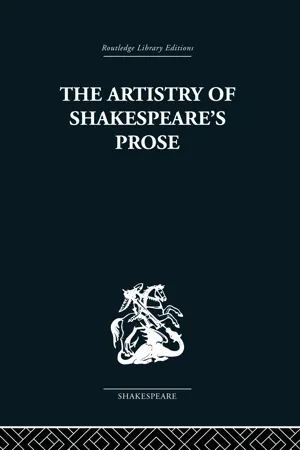
The Artistry of Shakespeare's Prose is the first detailed study of the use of prose in the plays. It begins by defining the different dramatic and emotional functions which Shakespeare gave to prose and verse, and proceeds to analyse the recurrent stylistic devices used in his prose. The general and particular application of prose is then studied through all the plays, in roughly chronological order.
- 464 pages
- English
- ePUB (mobile friendly)
- Available on iOS & Android
eBook - ePub
The Artistry of Shakespeare's Prose
About this book
Information
CHAPTER I
Shakespeare’s Use of Prose
Shakespeare’s supremacy as a dramatist has always been recognized as stemming from a mastery of language. At one extreme he is the dramatic poet above all, so much so that ‘Shakespearian’ has become a tag to describe any poetry of richness and complexity, while at the other his proverbs have passed into the common speech. Of course much of his particular greatness is not to be limited to purely linguistic effects, and we have to neglect the detail of his language to consider such things as the whole meaningful development of an action, the adaptation of sources to make structures in every way superior to the original, the creation of characters, the representation and analysis of human motives and feelings, and the confrontation of varying emotional states: all these elements of a play go beyond its language. But nevertheless (and it is the constant paradox of a literary work) these larger elements are only created and apprehended through the language, and it seems reasonable to say that if we approach the words with a keen imaginative sympathy we should best be able to appreciate what lies behind them. The study of its language is indisputably a valid way of entry into any literary work – some would say the most valuable – but I think it should be used in harness with our response to the work as a whole, and in conjunction with all other profitable critical methods. Yet this is an approach which has been little applied to Shakespeare.
One of the critical revolutions of the last age was a reaction away from the excessive interest in Shakespeare’s characters back to ‘the words on the page’. Given this general interest in such things as imagery, poetic textures, ambiguity, irony, it may seem that by now the study of Shakespeare’s language would be exhausted. But in fact there has been less detailed and intelligent study of Shakespeare’s style since this movement than there was before it, and the lasting work that has been done has occurred outside the movement.1 For these critics (and I refer to the work of Wilson Knight, L. C. Knights, D. A. Traversi, J. F. Danby and a host of followers) approached plays as if they were lyric poems, abstracting ‘themes’ and ‘symbols’ from the whole complex development of drama. Furthermore, if they were interested in imagery, it was not essentially because of the poetic value of the image but rather for the idea behind it: they looked for image-patterns, as revealing thematic meaning. In addition to the principal dangers2 inherent in extracting a theme (which often turns out to be a moral commonplace) from the living tissue of a play, and implicitly suggesting that Shakespeare was offering a discussion of Appearance and Reality, or the effects of Time and Mutability, this approach does not recognize two characteristic features of Shakespeare as a dramatist. One is his remarkable self-awareness, his propensity to comment on what he is doing: if a play involves within its action the mounting of another play (as in A Midsummer Night’s Dream, say, or Hamlet) there will be discussions of the art and styles of acting, the role of imagination, the nature of illusion – these discussions hardly constitute a ‘theme’ in the accepted meaning of the word.
Similarly if the plot involves a disguise, or a failure in trust, then there will inevitably be a comment on the discrepancy between appearance and reality (but how inadequate it is to describe Much Ado About Nothing as ‘a play about Appearance and Reality’).
Secondly we should consider how his characters react to their situation with comparable awareness: if the plot involves total confusion about identity, as does The Comedy of Errors (though not about ‘identity’ in a modern psychological sense) then it is perfectly natural for characters to say that they are bewitched, and thus some recent discussions of this play in terms of its ‘witchcraft’ or ‘loss of identity’ themes are not only heavy-handed but misleading, in that they mistake accident for essence. Again such a remark as that in 2 Henry IV that ‘We are time’s subjects, and time bids be gone’ (I, iii) ends a scene with the message ‘we must really get a move on’ (which is not altogether inappropriate for men of business such as rebels are). But it is not to be taken as evidence of ‘the Mutability-theme’: similar stock remarks are found in many plays (e.g. Coriolanus) where they are as functionally relevant but as thematically irrelevant as they are here. In both these latter examples there may be more to it than this, but critics must be more careful than they have been so far about how they extract their ‘themes’.
I am not suggesting that Shakespeare’s comments are not sometimes so frequent or so important that they amount to a thematic status, nor that one cannot still gather valuable insights from The Wheel of Fire or Some Shakespearean Themes, but I think that this is a critical approach which is almost fully worked out, and which – more to the point – is not very helpful to the understanding of Shakespeare’s style in the context of drama. Shakespeare’s plays are not ‘dramatic poems’ but ‘poetic dramas’, and although that seems a small readjustment much is involved in it. Our starting-point must be the simple principle, stated with clarity by A. S. Downer, that
The drama is a unique form of expression in that it employs living actors to tell its story; its other aspects – setting, characters, dialogue, action and theme – it shares with others forms of communication. But the fact that the dramatist is not dealing with characters merely, but with three-dimensional persons is paralleled by the fact that he is not dealing with a setting verbally described but three-dimensionally realized, with action that actually occurs in time and space, with dialogue which is spoken by human voices for the human ear.3
It follows that the critic must consider the physical representation of the drama – such things as visual imagery, significant groupings or stage-movement – and that the student of Shakespeare’s style must try to relate these and such other factors as ‘setting, characters, dialogue, action and theme’, to the language of the plays. Shakespeare’s language is an increasingly subtle medium for reflecting the differences and interactions between characters, situations and moods, thus we must approach the words not as abstractable entities but as the expression of the particular attitudes of quite distinct characters in equally distinct dramatic situations. The nature of Shakespeare’s language is organically related to the development of each play.
Within the plays as a whole Shakespeare makes considerable use of prose, and before studying this aspect of his art it is as well to remind ourselves of the extent of his usage. In terms of quantity, we can observe a steady growth4 in the amount of prose through the early comedies and histories, reaching a peak in The Merry Wives of Windsor, which is largely a prose comedy, but having the dominant part in Much Ado, As You Like It and Twelfth Night, being almost equal in bulk (and in excellence possibly superior) to the verse of Henry IV parts I and 2, Henry V, and All’s Well, while playing a very significant part in three other comedies, Love’s Labour’s Lost, Troilus and Cressida and Measure for Measure. From those elementary statistics we can deduce two points: that prose is largely the vehicle of comedy and the comic parts of the histories, and (although this would involve extensive argument) that Shakespeare’s prose came to maturity before his poetry. But at once we must make an important qualification, for the prose does not go into a decline in quality as it does in quantity in the period of the great tragedies; it is now applied with increasing skill to the whole design of the play, and in many ways the prose of the tragedies is Shakespeare’s greatest achievement. On first thought we might connect tragic prose with a few isolated clown scenes, but in fact prose occupies roughly a quarter of the whole in Hamlet, Lear, Timon of Athens and Coriolanus, while its importance for Mercutio or Iago bulks far larger than the statistics would suggest. To mention these two essentially prose characters (although of course both are also given verse) is to think of others whose very existence depends on prose: Bottom, Shylock, Falstaff, Shallow, Mistress Quickly, Beatrice and Benedick, Dogberry and Verges, Rosalind and Touchstone, Sir Toby Belch, Thersites, Parolles, Autolycus and the clown in The Winter’s Tale. And to think of the variety of character-creation shown here, and the importance that each has in the play as a whole, may help to justify this study of Shakespeare’s prose by itself (though I will approach each play as a structure, and in practice will have to consider some of the verse too). Obviously the detailed study of the prose will result in a limited vision of some plays – The Comedy of Errors, say, or Romeo and Juliet, or The Tempest, for the dominant life of the play is elsewhere. But nevertheless prose provides a viewpoint which Shakespeare created and shared for some parts of the play, and although these parts may be limited in themselves they are not to be ignored, in the way that so many modern accounts of Measure for Measure or The Winter’s Tale just do not mention the lower worlds of Pompey and Mistress Overdone, or Autolycus and the clowns. And if sometimes of restricted value, in other plays the study of the prose will reveal a central aspect of the action (as in the middle-period comedies and histories), or a vital phase in the development of characters and motifs shown elsewhere mainly in verse (Iago, Hamlet, Edgar). I think that on balance the advantages of this detailed study of one medium outweigh its obvious limitations – and I hope that it could be used as a basis for the much harder but more rewarding analysis of the poetry.
Indeed this relative ease in studying Shakespeare’s prose compared to his verse (but it is only relative) has produced a number of useful studies5 (especially those by Richard David and Elizabeth Tschopp), which are also probably more searching than anything yet done on the poetry in its dramatic context, with the exception of Wolfgang Clemen’s admirable book on the imagery. Happily I can say at the outset that whatever virtues or faults that they have, these studies all limit themselves to general considerations of how Shakespeare used prose in the plays, and not to the specific nature of that prose. However, a number of valuable guiding principles have been exposed which must be the basis of any more detailed analysis. Some of the principles on which Shakespeare used prose have been so long recognized as to be common property, such as, for example, the general conventions in Elizabethan drama which determined the suitable occasions for prose. These can be grouped under two main heads: first, letters and proclamations, which enter into the play from the outside world, have their separateness marked off by being in prose: in Shakespeare such are the letters of Armado, Falstaff, Hamlet and others (Verdi in his setting of Macbeth duplicates the effect of Lady Macbeth reading her husband’s prose letter by making her do it in a dry recitative on one held note), and such formal pronouncements as the peace-contract between Henry VI and the French King (2 H VI, I, i), Edgar’s Challenge, or the accusation of Hermione. Secondly, a much larger group which is also based on the sense of the ‘otherness’ of prose, conveying information about particular characters who are below the dignity and norm of verse, for a variety of reasons: in Elizabethan drama generally prose is the vehicle of an inferior class, such as servants and clowns – this is so in Shakespeare for most of the time, though many of his noblemen speak prose too (the categories are not exclusive). Similarly prose is used for those below dignity and seriousness generally, such as the clowns, who have a peculiar brand of clowns’ prose, ‘exuberant and original’ as Richard David describes it (p. 81). Some clowns (the bumbling type) also come into the next category, that of those below the normal level of human reason, such as drunks (the porter in Macbeth, characters in the drinking-scenes in Henry IV, Antony and Cleopatra, and Othello), and lastly madmen, the use of prose showing both the feigned madness of Hamlet and the real madness of Ophelia, a contrast which is repeated with still greater intensity between Edgar and Lear.
This last category raises a very important point about the alternation between prose and verse. Given that the norm of the plays, with some few exceptions, is blank verse, then prose must always have been felt as a deviation from it, and one made for a particular reason, such as for these elementary categories which we have been considering. This sense of the otherness of prose is exceptionally strong in the case of madness, and everyone sees the significance of the degeneration of Othello into a frenzy or Lady Macbeth into her sleepwalking being matched by a parallel decline from blank verse into prose, thus echoing on the stylistic level the falling-off from reason so evident in the action. But it does not seem to be commonly appreciated that the historical significance of this extreme contrast is the same as that of the more general alternation between verse and prose, namely that the Elizabethan audience must have been aware of the difference between the media in a way that no modern audience is. Miss Tschopp has finely analysed the scene in As You Like It (IV, i) where Jaques and Rosalind have been sparring in witty prose when Orlando, entering, is given one decasyllabic line:
Good day and happiness, dear Rosalind.
Jaques’ response is sardonic and instantaneous:
Nay then God b’wi’you, an you talk in blank verse. [Exit.]
Miss Tschopp’s conclusion is that ‘the audience must obviously be sensitive to the change from verse to prose and must react to it quickly’ (p. 4), for indeed the whole point of that exchange is lost if we do not at once spot the difference. I think that the same principle applies for the distinction between prose and verse (if seldom so urgently) in all Elizabethan drama. The importance of this principle is largely stylistic, but it has a significant by-product for our knowledge of Elizabethan acting, which must in any case have used a fairly formalized style given the enormous pressure of their repertory system,6 and would thus seem to have employed a more stylized delivery for verse and a more relaxed one for prose.7 A confirming detail for this deduction comes from Marston’s Malcontent, where Milton Crane notes that ‘At one point in the opening scene of the play, Malevole, left alone with a trusted friend, drops his disguise and speaks verse in his own character of Altofronto; when a third person enters, he returns to prose. The change is strikingly emphasized by the stage direction: Malevole shifteth his speech’ (p. 156).
The stylistic implication of this difference in the tone or speed of enunciation is that we must accept the alternations between prose and verse as being not accidental but deliberate on the part of the author, and with a definite aesthetic intent which would have been perceived by the audience. An analogy prompts itself from another art, for we could compare the switch from verse to prose with that from a major to a minor key in classical music: the analogy is not exact, of course, but it does suggest that in both cases we are dealing with an alternation of media according to certain definite artistic conventions (and in both arts the changes have emotional connotations). The distinction must have been noticeable, then, otherwise those departures from the norm of our first simple categories for prose would not have been appreciated. So Falstaff the prose-speaking clown par excellence is occasionally given verse – but only to mock it (Crane, p. 5). In the drinking-scene in Othello, amid the general prose, ‘Iago’s verse asides reveal him still completely self-possessed’ (David, p. 88). Lear mad is brought down to prose but is returned to verse during his madness when given royal dignity, or perhaps the superior authority of moral perception.8 Again in Merry Wives, the first time that Ford reaches a mood of dignity after his jealous madness, he...
Table of contents
- Cover
- Half Title
- Title Page
- Copyright Page
- Preface
- Table of Contents
- Title Page
- Original Copyright Page
- Dedication
- 1 Shakespeare’s Use of Prose
- 2 A Critical Method
- 3 From Clown to Character
- 4 The World of Falstaff
- 5 Gay Comedy
- 6 Two Tragic Heroes
- 7 Serious Comedy
- 8 Tragic Prose: Clowns, Villains, Madmen
- 9 The Return of Comedy
- Conclusion
- Notes
- Index
Trusted by 375,005 students
Access to over 1.5 million titles for a fair monthly price.
Study more efficiently using our study tools.
Frequently asked questions
Yes, you can cancel anytime from the Subscription tab in your account settings on the Perlego website. Your subscription will stay active until the end of your current billing period. Learn how to cancel your subscription
No, books cannot be downloaded as external files, such as PDFs, for use outside of Perlego. However, you can download books within the Perlego app for offline reading on mobile or tablet. Learn how to download books offline
Perlego offers two plans: Essential and Complete
- Essential is ideal for learners and professionals who enjoy exploring a wide range of subjects. Access the Essential Library with 800,000+ trusted titles and best-sellers across business, personal growth, and the humanities. Includes unlimited reading time and Standard Read Aloud voice.
- Complete: Perfect for advanced learners and researchers needing full, unrestricted access. Unlock 1.5M+ books across hundreds of subjects, including academic and specialized titles. The Complete Plan also includes advanced features like Premium Read Aloud and Research Assistant.
We are an online textbook subscription service, where you can get access to an entire online library for less than the price of a single book per month. With over 1.5 million books across 990+ topics, we’ve got you covered! Learn about our mission
Look out for the read-aloud symbol on your next book to see if you can listen to it. The read-aloud tool reads text aloud for you, highlighting the text as it is being read. You can pause it, speed it up and slow it down. Learn more about Read Aloud
Yes! You can use the Perlego app on both iOS and Android devices to read anytime, anywhere — even offline. Perfect for commutes or when you’re on the go.
Please note we cannot support devices running on iOS 13 and Android 7 or earlier. Learn more about using the app
Please note we cannot support devices running on iOS 13 and Android 7 or earlier. Learn more about using the app
Yes, you can access The Artistry of Shakespeare's Prose by Brian Vickers in PDF and/or ePUB format, as well as other popular books in Literature & Literary Criticism. We have over 1.5 million books available in our catalogue for you to explore.