- 284 pages
- English
- ePUB (mobile friendly)
- Available on iOS & Android
eBook - ePub
Low and High Style in Italian Renaissance Art
About this book
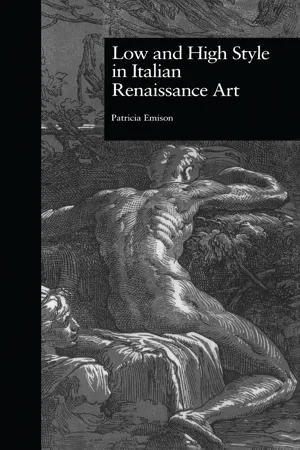
During the later 15th and in the 16th centuries pictures began to be made without action, without place for heroism, pictures more rueful than celebratory. In part, Renaissance art adjusted to the social and economic pressures with an art we may be hard pressed to recognize under that same rubric-an art not so much of perfected nature as simply artless. Granted, the heroic and epic mode of the Renaissance was that practiced most self-consciously and proudly. Yet it is one of the accomplishments of Renaissance art that heroic and epic subjects and style occasionally made way for less affirmative subjects and compositional norms, for improvisation away from the Vitruvian ideal. The limits of idealizing art, during the very period denominated as High Renaissance, is a topic that involves us in the history of class prejudice, of gender stereotypes, of the conceptualization of the present, of attitudes toward the ordinary, and of scruples about the power of sight Exploring the low style leads us particularly to works of art intended for display in private settings as personally owned objects, potentially as signs of quite personal emotions rather than as subscriptions to publicly vaunted ideologies. Not all of them show shepherds or peasants; none of them-not even Giorgione's La tempesta -is a classic pastoral idyll. The rosso stile is to be understood as more comprehensive than that. The issue is not only who is represented, but whether the work can or cannot be fit into the mold of a basically affirmative art.
Information
CHAPTER 1
Beyond Istoria
Ne' piccioli suggetti è gran fatica;
Ma qualunque gli esprime ornati e chiari,
Non picciol frutto del suo ingegno coglie47
The dominant model in modern art history for explaining Renaissance imagery has been Leon Battista Alberti's in De pictura (1435). The apex of a painter's achievement, he declares, is the istoria, a copious narrative showing various dignified, beautiful figures engaged expressively in a didactic, coherent narrative. Linear perspective construction insures that the viewer looks, as though through a window, into a more orderly world; inventio and compo-sizione provide that what is seen there is more perfect and more comprehensible than nature; disegno, and colorito (in Alberti's language, “circonscrizione” and “recezione di lumi”) that it is nevertheless lifelike. As in portraits, the vivid image exerts authority over viewers and demands respect, whether by making them quiver before their absent general or allowing them to witness Peter's walk upon the Sea of Galilee. That which Giotto and the ancients have done before, Alberti now expects of Donatello, Ghiberti, and Luca della Robbia.48
According to this model, Renaissance images derive their inventio, their conceptual nugget, from literary or philosophical texts, to which authority they remain symbiotically linked;49 the principal figures in a composition have a commanding and dignified presence; and such works reinforce the prevailing political, social, and economic structures. Simply put, one of the objectives of this art of the istoria is obedience; Alberti recommends, in Book III, an art which “terrà gli occhi e l'animo di chi la miri” (will abstract the eyes and the soul of whoever looks at it).50 In so doing he is a good humanist, for verbal eloquence likewise was recommended for its effectiveness in teaching a morality appropriate to civic behavior.
By what means, then, should this new art impress? Not, it seems, by conjuring up the splendours of the kingdom of heaven, for, whereas Abbot Suger was quite definite about the analogy he wished to create between heavenly and earthly courts by sponsoring the new Gothic style, Alberti recommended plain white church interiors. In On Painting, he discouraged reliance on gold leaf: the painter's ingenium was to be displayed rather than the patron's wealth. Although Alberti was an advocate of a grand and imposing visual art, he did not want the artist to rely upon rich materials to achieve that grandeur.
As a writer Alberti praised poverty. “Lieta poverta inimica delle sollecitudini contenta di picciole & facile cose quale con pocha faticha & presto si truovano & octengonsi” (Happy poverty, unfriendly to cares, content with small and convenient things which one finds and obtains quickly and with little effort).51 Poverty, it is claimed, is the choice of the man who is a friend both to nature and himself.52 Lionardo, an interlocutor in Delia famiglia, asserts that, “piú troverrai virtuosi poveri che ricchi… Assai sarà ricco chi viverà contento” (you will find more virtuous poor than rich… he who will live content will be very rich).53 Alberti appears to have been personally sympathetic with these sorts of homilies.
Alberti also poked fun at metaphorical wealth, borrowing from an aesthetic of poverty to justify his own, relatively plain, literary style. Probably in the late 1430s, Alberti dedicated Book II of the Intercenales (short prose pieces for dinnertime) to Leonardo Bruni, the Aretine-born humanist who became Chancellor of Florence in 1427. Book II contains essays on the right and wrong use of money. Since Bruni was famous partly as the translator of a book on economics ascribed to Aristotle, the dedication had its polite pretense. But Bruni was also rumored to be parsimonious and seems to have resented the dedication, in which Alberti ironically praised Brum's “wealth of talent and learning.”54 Bruni is said to possess this wealth of learning to less avail than the poorer Alberti: “we think that greater praise accrues to us if our puerile and unpolished style moves peasants in the streets to dancing and merriment, than if we grow old in silence devising countless ornaments.”
Alberti anticipated no corresponding crux between rich and poor style in the case of the visual artist, for he thought that the problem of visual style resolved itself in an awe-inspiring imitation of nature, the match to awe-inspiring magnificence. Nevertheless, his dedication to Bruni is pertinent here for showing an incipient mistrust of the prerogatives of wealth. (As an illegitimate son of an exile, dependent upon the patronage of princes, popes, and merchants, Alberti was in a more delicate position than Bruni, whose wealth and prestige grew with that of Florence.) The open letter also testifies to his awareness of the restricted, perhaps overly restricted, scope of a learned and rhetorical literature. As a writer avowedly ready to please the peasants, Alberti proudly portrays himself as modestly immodest and artfully artless. In De pictura Alberti, following Apelles' precedent in listening to the shoemaker, allows for the judgment of unlearned men: “L'opera del pittore cerca essere grata a tutta la moltitudine. Adunque non si spregi il giudicio e sentenza della moltitudine, quando ancora sia licito satis-fare a loro oppenione.” (The painter's work seeks to be pleasing to the populace. Therefore don't spurn the judgment and sentiment of the masses, whenever it is legitimate to satisfy their opinion.)55
Leonardo da Vinci in his notebooks, the earliest and most fruitful commentary on Alberti's ideas for painting, comments on the breadth of kinds of beauties to be found in nature. He understood not only the drive for beauty in art but also the allure of ugliness. Well-dressed gentleman though he may have aspired to be, nevertheless Leonardo went so far as to ask whether what pleases the simple peasant is not actually more natural than what pleases the city slicker:
non vedi tu, che infra le humane bellezze il viso bellis-simo ferma li viandanti, et non gli loro richi ornamenti? et questo dico à te, che con oro od altri ricci freggi adorni le tue figure. Non vedi tu isplendenti bellezze della gioventù diminuire di loro eccellenza per li ecces-sivi e troppo culti ornamenti? non hai tu visto le mon-tanare involte negl inculti e poveri panni acquistare maggior bellezza che quelle che sono ornate?56
(Do you not see that among human beauties the very beautiful face stops passersby, and not their rich adornments? And I say this to you, who dresses up with gold and other pompous trimmings. Do you not see that the splendid adornments of the youth reduce their excellence by being overly refined and precious? Haven't you seen that the mountain folk wrapped in rough and poor clothes possess greater beauty than those who are adorned?)
In his caricatures Leonardo exposes the lesser examples of humankind to mockery; here he makes the more radical move òf suggesting that humble people deserve admiration relative to fine ones. The peasant, traditionally seen as ridiculous or hateful,57has been idealized in much the same way as the Arcadian shepherd. Leonardo, who, like Alberti, was both illegitimate and an exile of sorts from Florence, had much in common with him as aesthetician, not least in this matter of using the peasant as one available yardstick of the natural.58 Alberti and Leonardo thus provided the beginnings of a theory of an art deliberately limited in its means, adjunct to their primary emphasis on the power of elaborate art.59
When you depart this life, you will leave these things behind.
Naked, impoverished, deserted, you will descend into Hell to plead
your case, without the aid of a lawyer, and you will tremble before
a judge who cannot be corrupted by gold.60
The fifteenth century was characterized by a new enthusiasm for the judicious use of wealth. Wealth was lauded in no small part for making possible the patronage of art with resulting benefits to church and state. Much of the art produced at this time provided a vision of opulence, was itself opulent, and was seen in an opulent setting. At the same time, and in orthodox accord with Livy as well as with Franciscan teaching, avarice (taken to be roughly synonymous with the misuse of wealth) was routinely vilified.61Humanists worked to justify wealth used for patronage, whether religious, civic, or intellectual. A painting, sculpture, or building represented money that might have been spent directly on charity; artist and patron needed to convince themselves and others that such diversion nevertheless served virtuous causes.
The standard apology for wealth in fifteenth-century Italy, and especially in Florence, where the prominence of banking and commerce made the issue most pressing, is presented by Matteo Palmieri (1406–75) in his Libro della vita civile.62 Money in itself is neither good nor bad, only the uses to which it is put. Like art, it must obey the laws of decorum. Magnificence is the reserve of the “richi, & potenti” (rich and powerful) to the explicit exclusion of the “poveri & mezani” (poor and middling).63 Magnificence should be exercised in public projects, not in private ones, and its object is to excite wonder. Nobility—and here Palmieri shows his republican stripes—is not requisite. The lesser activities of liberality and beneficence are the duty of all, albeit within a fairly strict sense of hierarchy:
Innanzi siamo obligati alia patria poi al padre, & alia
madre, dopo sono i figliuoli & la propria famiglia, ap-presso i coniuncti gli amici, i vicini, & cosi di grado in grado misurando tutta la Citta, le provincie, le lingue, & finalmente tutta la generatione humana è duno natu-rale amore insieme collegata, cosi si debbono i favori del vivere distribute, & secondo detti gradi concedere.64
(First we are obliged to our homeland, then to our father and mother, then to children and our own family, afterwards to our in-laws, friends, neighbors, and so forth gradually including the whole city, all the provinces, all languages, and finally all of humankind pulled together into one natural love. Thus the goods of life ought to be given out, and granted in accordance with the aforestated r...
Table of contents
- Cover
- Half Title
- Full Title
- Copyright
- Dedication
- Table of Contents
- List of Illustrations
- Acknowledgements
- Introduction
- Chapter 1 Beyond Istoria
- Chapter 2 Picturing Pastoral
- Chapter 3 Inverting Low and High
- Postscript
- Bibliography
- Index
- Illustrations
Trusted by 375,005 students
Access to over 1.5 million titles for a fair monthly price.
Study more efficiently using our study tools.
Frequently asked questions
Yes, you can cancel anytime from the Subscription tab in your account settings on the Perlego website. Your subscription will stay active until the end of your current billing period. Learn how to cancel your subscription
No, books cannot be downloaded as external files, such as PDFs, for use outside of Perlego. However, you can download books within the Perlego app for offline reading on mobile or tablet. Learn how to download books offline
Perlego offers two plans: Essential and Complete
- Essential is ideal for learners and professionals who enjoy exploring a wide range of subjects. Access the Essential Library with 800,000+ trusted titles and best-sellers across business, personal growth, and the humanities. Includes unlimited reading time and Standard Read Aloud voice.
- Complete: Perfect for advanced learners and researchers needing full, unrestricted access. Unlock 1.5M+ books across hundreds of subjects, including academic and specialized titles. The Complete Plan also includes advanced features like Premium Read Aloud and Research Assistant.
We are an online textbook subscription service, where you can get access to an entire online library for less than the price of a single book per month. With over 1.5 million books across 990+ topics, we’ve got you covered! Learn about our mission
Look out for the read-aloud symbol on your next book to see if you can listen to it. The read-aloud tool reads text aloud for you, highlighting the text as it is being read. You can pause it, speed it up and slow it down. Learn more about Read Aloud
Yes! You can use the Perlego app on both iOS and Android devices to read anytime, anywhere — even offline. Perfect for commutes or when you’re on the go.
Please note we cannot support devices running on iOS 13 and Android 7 or earlier. Learn more about using the app
Please note we cannot support devices running on iOS 13 and Android 7 or earlier. Learn more about using the app
Yes, you can access Low and High Style in Italian Renaissance Art by Patricia Emison in PDF and/or ePUB format, as well as other popular books in Media & Performing Arts & Music. We have over 1.5 million books available in our catalogue for you to explore.