Witchcraft and magical beliefs have captivated historians and artists for millennia, and stimulated an extraordinary amount of research among scholars in a wide range of disciplines. This new collection, from the editor of the highly acclaimed 1992 set, Articles onWitchcraft, Magic, and Demonology, extends the earlier volumes by bringing together the most important articles of the past twenty years and covering the profound changes in scholarly perspective over the past two decades. Featuring thematically organized papers from a broad spectrum of publications, the volumes in this set encompass the key issues and approaches to witchcraft research in fields such as gender studies, anthropology, sociology, literature, history, psychology, and law. This new collection provides students and researchers with an invaluable resource, comprising the most important and influential discussions on this topic. A useful introductory essay written by the editor precedes each volume.
eBook - ePub
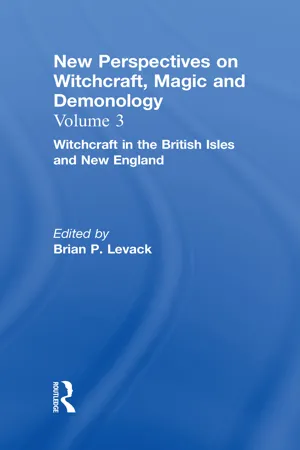
Witchcraft in the British Isles and New England
New Perspectives on Witchcraft, Magic, and Demonology
- 350 pages
- English
- ePUB (mobile friendly)
- Available on iOS & Android
eBook - ePub
Witchcraft in the British Isles and New England
New Perspectives on Witchcraft, Magic, and Demonology
Witchcraft and Conflicting Visions of the Ideal Village Community
Anne Reiber De Windt
In the fallen world, communities (patterns of interaction) arc endlessly dying and being born. The historian's job is to specify what, at a given moment, is changing into or being annihilated by what.1
In the fall of 1589, ten-year-old Jane Throckmorton pointed to the old woman who had settled into a seat in her family's cavernous stone hearth and cried out, “Looke where the old witch sitteth … did you ever see … one more like a witch then she is?” With those words the child set in motion a four-year-long drama that culminated in the hanging of three of her neighbors from their fenland village of Warboys in north Huntingdonshire. Within weeks after the executions, Jane's father and uncle, with the help of a trial judge and the local parson, published their version of this tragic story in a pamphlet that now resides in the British Library.2
After Jane Throckmorton and her sisters had shared symptoms such as violent sneezing and grotesque seizures for several weeks, and two medical doctors at Cambridge had suggested the possibility of witchcraft, Gilbert Pickering—a relative from Northamptonshire— arrived at the Warboys manor house to conduct numerous experiments with Jane and her neighbor, Alice Samuel. His intention was to demonstrate that the old woman was the cause of the girl's symptoms. In February 1590 one of the sisters was taken to the Pickering home in Northamptonshire where the results of further experiments were recorded for eventual inclusion in the pamphlet.
Soon after that child left Warboys, the wife of the lord of Warboys arrived at the Throckmorton house to confront Mother Samuel. The encounter between Alice Samuel and Lady Cromwell was tense and highly charged, and words were exchanged whose horrible significance became clearer as time passed.3 In fact, Lady Cromwell herself became ill after this meeting and died about a year later.4
Robert Throckmorton dispersed his children to the households of friends or relatives, and little information is provided about their activities during 1591 and early 1592. Tensions mounted again in September of 1592 when one of the children's aunts gave birth at Warboys, and Mother Samuel arrived with other neighbors to look in on the new mother and her baby. Young Jane Throckmorton experienced a dramatic change in her own condition upon encountering the old woman, and for the next several weeks one of the older sisters described a series of encounters with spirits that were sent and controlled by Mother Samuel. When those spirits, speaking through the girls, began to accuse Mother Samuel, the girls' father brought the old woman into their household, where she slept in the same room with her host and hostess. While in such close quarters with the victims and their parents, Mother Samuel weakened to the point of confessing some form of responsibility for the children's illnesses, and on Christmas Eve of 1592, she appeared in the Warboys parish church as a penitent sinner.
However, when she returned to her own home that night, her husband and daughter vehemently reproached her weakness and gave her the courage to recant on the following day, Christmas morning. Robert Throckmorton then managed to arrange another confession and turned her and her daughter Agnes over to the constable who took them to the Justices of the Peace. After the Huntingdon assizes in April 1593, all three members of the Samuel family were found guilty of bewitching Lady Cromwell to death, and they were all hanged.5
The plight of the Throckmorton and Samuel families has excited the attention of students of the witchcraft phenomenon since the time the pamphlet was first published in 1593.6 Modern historians of the witchcraft persecutions have been struck by the relatively high status of the victims' family as well as of the witches themselves, by the pamphlet authors' meticulous descriptions of the symptoms of spirit possession, and, above all, by evidence for the mingling of popular and elite beliefs about witches, fueled as they were in this case by the medical establishment at Cambridge.7 Furthermore, the active roles taken by the sick girls in this case and the suggestions of rivalries between two elderly female neighbors invite investigations into the role of gendered social networks in fueling this conflict.8
But the Warboys story is not just a witch story. In this essay no attempt will be made to suggest or describe the multiple and complex causes behind the accusations of witchcraft against the Samuels.9 Instead I propose here that the evidence associated with the Warboys case makes an important contribution to historians' discussions of the evolving nature of community. Both medievalists and early modernists have participated in the task of describing “community” and tracing the various manifestations of its presumed existence over varying time spans. Important studies of individual villages and towns, on one hand, and county-wide networks of gentry families and their patronage and tenant networks, on the other hand, have been offered to this end by historians of the thirteenth through the seventeenth centuries. As a result, the term “community” appears in the title of books and articles with a wide variety of sociological concerns and historical themes. Put most simply, a dichotomy has developed along spatial, or geographical, lines. For some historians, the English county provides the focus, whereas for others, the community is confined to the boundaries of the parish or village.10 In each case, issues of definition and attempts to analyze the characteristics of “community” are sometimes ignored as the meaning of the term is taken for granted and is simply used to refer to the geographical territory within parish or county boundaries. In other studies, more attention is given to theoretical discussions which draw upon sociological and anthropological analyses.11
Regardless of the geographical scope of the territory under study, several themes have emerged from the scholarly debates. One of these concerns the nature of the relationship between local (viilage or county-wide) power elites and national legal and administrative institutions channeling power from Westminster to the “periphery.” For example, how did villagers become drawn into a genuinely national framework of legal and administrative responsibility, and to what degree is there significant change over time in the intensity and nature of that involvement?12 Did the county gentry owe primary allegiance to their region rather than to their nation or monarch, and if so, what factors encouraged those attitudes to change over time?13
Other scholars are more interested in the changes taking place within parish and/or village boundaries and attempt to trace transformations in the institutions of local village and town government. They have noticed that access to the village court jury or to the status of town burgess became more restricted over time.14 Associated with that development were dramatic economic and social changes that resulted in heightened tensions among the villagers themselves. Keith Wrightson and Martin Ingram, among others, have noted that the late sixteenth-century English countryside experienced a dramatic polarization between the wealthy and the poor. As the population increased, the ranks of the laboring poor doubled in size.15 Both historians expected such social polarization to result in growing disagreements about the types of behavior required of successful community life.16 In Terling, conflict developed between innovating yeomen and the families of laboring poor “whose behavior they regarded as morally and socially reprehensible.” Puritan sentiment among those yeomen families exacerbated this sense of social alienation between the two groups.17
Related to that concern are the debates over the relationship in rural village life between the tendency to group action in pursuit of corporate or “communal” interests and the centrifugal forces of “individualism.”18 Alan Mcfariane and Keith Thomas suggested that conflicting ideals of community life inspired many of the Essex witchcraft prosecutions, as villagers clung to traditional communal values of mutual assistance while craving the economic opportunities promised by greater individual freedom—a freedom that required release from restrictive obligations to one's less fortunate neighbors.19 Medievalists have noted similar tensions as far back as the fourteenth century.20
For some early modernists, changing religious beliefs are credited with important changes in ritual community identity and, in some cases, with the disintegration of older communal ideals. Many Puritans disapproved of traditional village rites and ceremonies such as church ales, or May revels. As William Hunt argues, “The Preachers proposed to substitute for the culture of neighborhood and good fellowship a new culture of discipline.”21 Spufford pointed out that in some Cambridge parishes Dissenters, as a small minority of the population, were forced to abandon their local parish churches and recreate religious communities of their own that transcended their traditional neighborhoods. But she also points out the dangers of assuming that issues of social control were new to the sixteenth century.22
The Warboys witchcraft case can contribute to several of these ongoing conversations. On the one hand, its drama arose from a highly localized dispute between neighbors within the boundaries of a single parish, but it also fed upon the Puritan zeal of gentry kin from another county and eventually attracted the full weight of royal justice. Boundaries were fluid, and communities of varying scope merged with one another and periodically reconstituted themselves as they became relevant.23 Neighbors drew upon parish-wide witnesses in support of their cause. Kin from another county assisted in drawing the witches to the attention of a local Huntingdonshire J.P. who in turn prepared the case to be heard before assize judges sent from Westminster. Other kinds of boundaries were violate...
Table of contents
- Cover
- Information
- Half Title
- Series
- Full Title
- Copyright
- Contents
- Introduction
- Witchcraft Beliefs and Criminal Procedure in Early Modern England
- Possession, Witchcraft, and the Law in Jacobean England
- Women, Witchcraft and the Legal process
- The Lancashire Witch Trials of 1612 and 1634 and the Economics of Witchcraft
- Witchcraft, Politics, and "Good Neighbourhood" in Early Seventeenth-Century Rye
- Witchcraft and Conflicting Visions of the Ideal Village Community
- Witchcraft in Early Modern Kent: Stereotypes and the Background to Accusations
- Witchcraft in Seventeenth-Century Yorkshire: Accusations and Countermeasures
- Shakespeare and the English Witch Hunts: Enclosing the Maternal Body
- Ghost and Witch in the Sixteenth and Seventeenth Centuries
- Desire and Its Deformities: Fantasies of Witchcraft in the English Civil War
- Witchcraft and Power in Early Modern England: The Case of Margaret Moore
- The Devil in East Anglia: the Matthew Hopkins Trials Reconsidered
- Witchcraft Repealed
- The Fear of the King is Death: James VI and the Witches of East Lothian
- The Bargarran Witchcraft Trial: A Psychiatric Reassessment
- Irish Immunity to Witch-Hunting, 1534-1711
- Like Images Made Black with the Lightning: Discourse and the Body in Colonial Witchcraft
- Tituba's Story
- Spectral Evidence, Non-Spectral Acts of Witchcraft and Confessions at Salem in 1692
- New England Witch-Hunting and the Politics of Reason in the Early Republic
- Eros, the Devil, and the Cunning Woman: Sexuality and the Supernatural in European Antecedents and in the Seventeenth-Century Salem Witchcraft Cases
- Acknowledgments
Trusted by 375,005 students
Access to over 1.5 million titles for a fair monthly price.
Study more efficiently using our study tools.
Frequently asked questions
Yes, you can cancel anytime from the Subscription tab in your account settings on the Perlego website. Your subscription will stay active until the end of your current billing period. Learn how to cancel your subscription
No, books cannot be downloaded as external files, such as PDFs, for use outside of Perlego. However, you can download books within the Perlego app for offline reading on mobile or tablet. Learn how to download books offline
Perlego offers two plans: Essential and Complete
- Essential is ideal for learners and professionals who enjoy exploring a wide range of subjects. Access the Essential Library with 800,000+ trusted titles and best-sellers across business, personal growth, and the humanities. Includes unlimited reading time and Standard Read Aloud voice.
- Complete: Perfect for advanced learners and researchers needing full, unrestricted access. Unlock 1.5M+ books across hundreds of subjects, including academic and specialized titles. The Complete Plan also includes advanced features like Premium Read Aloud and Research Assistant.
We are an online textbook subscription service, where you can get access to an entire online library for less than the price of a single book per month. With over 1.5 million books across 990+ topics, we’ve got you covered! Learn about our mission
Look out for the read-aloud symbol on your next book to see if you can listen to it. The read-aloud tool reads text aloud for you, highlighting the text as it is being read. You can pause it, speed it up and slow it down. Learn more about Read Aloud
Yes! You can use the Perlego app on both iOS and Android devices to read anytime, anywhere — even offline. Perfect for commutes or when you’re on the go.
Please note we cannot support devices running on iOS 13 and Android 7 or earlier. Learn more about using the app
Please note we cannot support devices running on iOS 13 and Android 7 or earlier. Learn more about using the app
Yes, you can access Witchcraft in the British Isles and New England by Brian P. Levack in PDF and/or ePUB format, as well as other popular books in History & Early American History. We have over 1.5 million books available in our catalogue for you to explore.