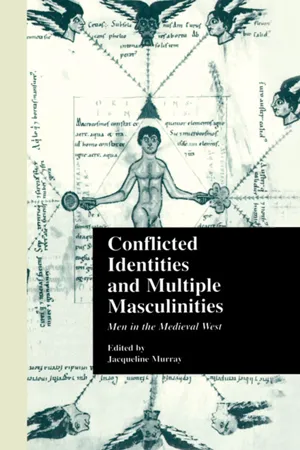
Conflicting Identities and Multiple Masculinities takes as its focus the construction of masculinity in Western Europe from the early Middle Ages until the fifteenth century, crossing from pre-Christian Scandinavia across western Christendom. The essays consult a broad and representative cross section of sources including the work of theological, scholastic, and monastic writers, sagas, hagiography and memoirs, material culture, chronicles, exampla and vernacular literature, sumptuary legislation, and the records of ecclesiastical courts. The studies address questions of what constituted male identity, and male sexuality. How was masculinity constructed in different social groups? How did the secular and ecclesiastical ideals of masculinity reinforce each other or diverge? These essays address the topic of medieval men and, through a variety of theoretical, methodological, and disciplinary approaches, significantly extend our understanding of how, in the Middle Ages, masculinity and identity were conflicted and multifarious.
Among the some forty Old Norse narratives classified as the sagas of Icelanders (or family sagas), is a subgroup labeled “skald sagas” because in each the chief character is an Icelandic skald or poet.1 The group contains a core of four, in which the major theme, expressed in several stanzas, is the poet’s unhappy love for a woman. At least four other narratives focus on a hero for whom love and poetry are found among his many preoccupations.2 These men are presumed to have lived in the ninth century, their poetry kept alive orally until the thirteenth century, when prose authors wrote their biographies and inserted the poetry into the texts. The consequence of this theory, if correct, would postulate that expressions of romantic love and longing in the north predated by several centuries similar articulations emanating from France.
These articulations of heterosexual love in the skald sagas and their dating have long preoccupied Old Norse scholarship. Of no less interest is the possibility that these narratives can also be used to explore other aspects of sexuality. A growing awareness of men’s bisexuality in the classical Greek civilizations has inspired scholars to look for similar manifestations elsewhere.3 Increasingly it appears that, in the premodern world, a man’s sexual choice was not an either/or but a both/and.4
MALE BONDING IN OLD NORSE
Initially, it would seem that the Germanic/Nordic world might furnish apposite settings for a wide spectrum of same-sex relations among men. As the first manifestation of the Männerbund, the comitatus, identified by Tacitus among the ancient Germans, was the first social group of nonkin. In our time, it is difficult to believe that the bonds of affection between chieftain and warriors, which extended to a willingness to die for the leader, would have excluded homoerotic feelings. Perpetuating the comitatus, the Viking band, which was the Nordic version of the Männerbund, was in decline by the time of the saga age, but the old system of male bonding persisted in royal circles, where it was expressed in affection of court poets for their king and leader. References to love or friendship [kœrleikr] between and among men are numerous in all saga genres (although rare between a man and a woman), but these do not seem to carry homoerotic connotations. At best, only the telltale sign of jealousy raises its head. Thus, Pjóðólfr, King Haraldr Sigurðarson’s chief skald, became jealous [
fundsjúkr] of the other men surrounding the king because he and Haraldr had “the greatest love and friendship [kœrleikr]” for each other.5
From saga passages and legal texts it is, nonetheless, obvious that the Norse world was familiar with homosexual acts. If such activity became known, little opprobrium accrued to the person who had played the active role, but the passive partner was so despised that the mere accusation by a third party that one male had been penetrated by another was sufficient to allow the victim of the words to kill his accuser, who also could expect outlawry by the community. Most often appearing in the form of sexual libel, references to homosexual acts reflect power struggle and domination rather than eroticism and affection. As evidence of phallic aggression, some of the alleged cases may have existed only in the accuser’s imagination, and others may be classified as male rape, but sufficient evidence remains to suggest that Norse men did engage in homosexual acts.6 The category of cinaedus, the male who was willing to be penetrated, has not been identified in Norse culture.7 It is likely, therefore, that a man alternated between the active and the passive role, but since the latter was despised, any man engaging in same-sex activities ran the risk of exposure. For this reason, the problem may largely have been suppressed in the sources, and rumors of passive homosexuality emerged only when sufficient hostility had accumulated.
Although best known for their love poetry, the poets in the skald sagas also had careers as court poets, but it is difficult to identify homo-erotic feelings between them (or the other court poets) and the king. Since the skald sagas portray the poet’s unhappy love for a woman, the situation often involves a triangle where the poet loses to a rival. Recently, gay and lesbian scholars, working under the label of “queer theory,” have revived Rene Girard’s idea of triangularity in the modern novel. A generation ago Girard proposed that the modern novel was dominated by the systematic metaphor of the triangle, within which two rivals compete for the same object, often a woman. Despite the competition, the bond between the men is as intense as that which links either of the rivals to the desired object.8 Focusing entirely on the erotic aspect of the triangle, Eve Kosofsky Sedgwick has coined the term “homosocial desire” to identify a continuum of bonding between men.9 The seeming contrast between “homosocial” and “desire” is intended to draw the social and political relations back into the area of the erotic and to suggest that men—whether married or not—enjoyed the former as well as the latter. The triangular scheme lends itself well to an analysis of this bonding because it allows a comparison of male/male and male/female relations at close quarters.
TRIANGULARITY IN BJARNAR SAGA HITDŒLAKAPPA
The theme of triangularity can be pursued in several of the skald sagas, but most successfully in Bjarnar saga Hítdœlakappa.10 The story deals with two male poets, the older þórðr and the younger Bj
rn, and their love for the woman Oddný. I want to show tha...
Table of contents
Front Cover
Half Title
Garland Medieval Casebooks
Title Page
Copyright
Contents
Acknowledgements
Introduction
An Unresolved Syllogism: The Search for a Christian Gender System
Secular and Spiritual Fatherhood in the Eleventh Century
Jean Gerson and Traumas of Masculine Affectivity and Sexuality
Mystical Castration: Some Reflections on Peter Abelard, Hugh of Lincoln and Sexual Control
Medieval Masculinities and Modern Interpretations: The Problem of the Pardoner
Triangularity in the Pagan North: The Case of Bjorn Arngeirsson and þórðr Kolbeinsson
Steel Corpse: Imaging the Knight in Death
Chivalric Conversation and the Denial of Male Fear
Separating the Men from the Goats: Masculinity, Civilization and Identity Formation in the Medieval University
Gravitas and Consumption
Men and Masculinity in Late Medieval London Civic Culture: Governance, Patriarchy and Reputation
“Loved Him—Hated Her”: Honor and Shame at the Medieval Court
Contributors
Index
Trusted by 375,005 students
Access to over 1.5 million titles for a fair monthly price.
Study more efficiently using our study tools.
Frequently asked questions
Yes, you can cancel anytime from the Subscription tab in your account settings on the Perlego website. Your subscription will stay active until the end of your current billing period. Learn how to cancel your subscription
No, books cannot be downloaded as external files, such as PDFs, for use outside of Perlego. However, you can download books within the Perlego app for offline reading on mobile or tablet. Learn how to download books offline
Perlego offers two plans: Essential and Complete
Essential is ideal for learners and professionals who enjoy exploring a wide range of subjects. Access the Essential Library with 800,000+ trusted titles and best-sellers across business, personal growth, and the humanities. Includes unlimited reading time and Standard Read Aloud voice.
Complete: Perfect for advanced learners and researchers needing full, unrestricted access. Unlock 1.5M+ books across hundreds of subjects, including academic and specialized titles. The Complete Plan also includes advanced features like Premium Read Aloud and Research Assistant.
Both plans are available with monthly, semester, or annual billing cycles.
We are an online textbook subscription service, where you can get access to an entire online library for less than the price of a single book per month. With over 1.5 million books across 990+ topics, we’ve got you covered! Learn about our mission
Look out for the read-aloud symbol on your next book to see if you can listen to it. The read-aloud tool reads text aloud for you, highlighting the text as it is being read. You can pause it, speed it up and slow it down. Learn more about Read Aloud
Yes! You can use the Perlego app on both iOS and Android devices to read anytime, anywhere — even offline. Perfect for commutes or when you’re on the go. Please note we cannot support devices running on iOS 13 and Android 7 or earlier. Learn more about using the app
Yes, you can access Conflicted Identities and Multiple Masculinities by Jacqueline Murray in PDF and/or ePUB format, as well as other popular books in Literature & Literary Criticism. We have over 1.5 million books available in our catalogue for you to explore.