The book's focus is the hegemonic role of so-called modernist, Western epistemology that spread in the wake of colonialism and the capitalist economic system, and its exclusion and othering of other epistemologies.
Through a series of case studies the book discusses how the domination of Western epistemology has had a major impact on the epistemological foundation of the education systems across the globe. The book queries the sustainability of hegemonic epistemology both in the classrooms in the global South as well as in the face of the imminent ecological challenges of our common earth, and discusses whether indigenous knowledge systems would better serve the pupils in the global South and help promote sustainable development.
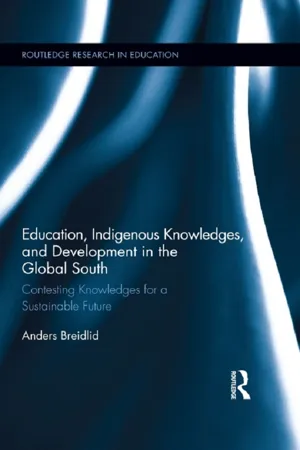
eBook - ePub
Education, Indigenous Knowledges, and Development in the Global South
Contesting Knowledges for a Sustainable Future
- 244 pages
- English
- ePUB (mobile friendly)
- Available on iOS & Android
eBook - ePub
Education, Indigenous Knowledges, and Development in the Global South
Contesting Knowledges for a Sustainable Future
About this book
Information
1 Introduction
One cannot expect positive results from an educational or political action program that fails to respect the particular view of the world held by the people. Such a program constitutes cultural invasion, good intentions notwithstanding.
—Paulo Freire, Pedagogy of the Oppressed (1970, p. 84)
I do not see a delegation
For the four-legged.
I see no seat for the eagles.
We forget and we consider
Ourselves superior.
However, we are after all
A mere part of Creation.
And we must consider
To understand where we are.
And we stand somewhere between
The mountain and the Ant
Somewhere and only there
As part and parcel
Of the Creation.
For the four-legged.
I see no seat for the eagles.
We forget and we consider
Ourselves superior.
However, we are after all
A mere part of Creation.
And we must consider
To understand where we are.
And we stand somewhere between
The mountain and the Ant
Somewhere and only there
As part and parcel
Of the Creation.
— Chief Oren Lyons, from an address to the Non-Governmental Organizations of the United Nations, Geneva, Switzerland, 1977. (Source, Wall and Arden, 1990, p. 71)
The focus of this book is the hegemonic role of so-called modernist, Western epistemology that spread in the wake of colonialism and the capitalist economic system, and its exclusion and Othering of other epistemologies. The book’s concern is how the domination of Western epistemology has had a major impact on the identity construction of the Other, and how the people in the South have been marginalized and subalternized due to the imposition of Western epistemology.
The term Western is here used to identify the hegemonic Eurocentric knowledge system, which originated in 16th -century Europe and together with industrial capitalism produced a specific kind of knowledge that is embodied in modern science. Modern science with its mechanistic view of the world is founded on the Cartesian-Newtonian version of science as something universal and objective. It is related to the so-called logical and empirical way in which science examines information (Merton 1973). Western and Eurocentric are used interchangeably in the book. ‘Epistemology’ refers to the traditional meaning of the word, that is, the ‘theory of knowledge.’ Epistemology deals with questions of what knowledges are and how they are acquired—in other words, the nature, scope, and sources of knowledges. This is in line with Bateson (1979) who defines epistemology as “the way people view and make sense of the world according to what they have learned and what they believe. This implies interaction and recursiveness between what we know and what we see, which can further influence what we know” (in van Rooyen, 2010, p. 6). I use epistemology and knowledge in the singular when referring to Western hegemonic epistemology/knowledge because the focus is on a particular version of that epistemology and knowledge, which assumes a hegemonic role globally.1 Epistemologies and knowledges in the plural are used to denote the multiplicity of indigenous epistemologies/knowledges.
The book discusses how the domination of Western epistemology has had a major impact on the epistemological foundation of the education systems across the globe—in the South as well as in the North.2 In other words: what are the consequences of this epistemological hegemony, which permeates the global architecture of education and its presumed universality? The “global architecture of education”3 is defined as a common epistemological discourse,4 which dominates most educational systems in the South and the North, even though there are, as I show in this book, Islamist and (although more debatable) socialist exceptions to this rule (Jones, 2007, p. 325).
In addition to interrogating the impact of Western epistemology on nation building, education systems, and the citizens in the South, the book queries the sustainability of hegemonic epistemology in the face of the imminent ecological challenges of our common earth.
The book seeks the points of view, the insights, and sensitivities of primarily marginalized and dominated groups, and it explores indigenous knowledges as alternatives or supplements to the hegemonic Western knowledge system both educationally and in terms of the sustainability of the globe.
1.1 THE REASONS FOR WRITING THIS BOOK
The reasons for writing this book are multiple, but it was my many visits to schools and classrooms in the South that convinced me that there is something fundamentally problematic with the educational discourses in many of the countries visited. This, I felt, had to be interrogated.
There is a sense of alienation when entering a primary school classroom where a colonial language is spoken (often rudimentarily by the teacher and even more so by the students) and where the contents of the teaching are minor adaptations of what is being taught in the West/North. Students not only battle to understand what is actually being taught because of the language barrier, but they are located in a space where their own cultures and worldviews are seldom, if ever, taken into account beyond their folkloristic aspects. While the cognitive and learning problems of not being taught in the students’ mother tongue during formative years are well researched, less attention has been paid to the alien epistemological universe that many students encounter in the classroom. It is my contention that this affects the learning of these students and impairs identity construction. One reason for writing the book is to highlight these cognitive and epistemological issues, which, I argue, are at least partly due to the gap between curricula content, the students’ home environment, and epistemological orientation. In other words, I query the hegemonic Western knowledge system that is pervasive in the education systems across the globe (the global architecture of education) and discuss the ways in which indigenous knowledges have been marginalized and subalternized over the centuries.
In the current economic and ecological crisis that the world is facing, the cognitive issues discussed above transcend the challenges on the individual, micro level. The dislocation of indigenous knowledges in the curriculum and in the classrooms seems to signal that Western knowledge/epistemology is the only game in town, and that indigenous knowledges are more or less irrelevant in addressing the critical global issues of our time. In this book I attempt to join those scholars and activists who want to resurrect indigenous knowledges from oblivion, both on the micro and macro level, by claiming that indigenous knowledges have important assets that need to be seriously considered in a world that is completely dominated by Western epistemology and knowledge production.
1.2 THE STRUCTURE OF THE BOOK
Chapter 2 (after this introduction) first outlines the trajectory of Western hegemonic knowledge production and its Othering of alternative knowledges. It then sets out to discuss issues revolving around the co-existence of hegemonic Western knowledge, colonialism, and capitalism, as well as the impact and consequences of modernity, modernization, and globalization. The chapter briefly analyses the relativity of Western science’s truth claims, as well as the merits and demerits of modern science. In particular, ecological challenges as a consequence of the exploitation of the earth’s finite resources are reviewed. By way of conclusion, the chapter examines the critique of Western knowledge production from within its own ranks.
The next chapter (Chapter 3) examines the debates about who is indigenous and what are indigenous knowledges/epistemologies. The chapter proceeds to discuss the assets and the problematic aspects of indigenous knowledges. It further examines the potential for co-existence between Western and indigenous knowledge systems, the potential for a third space, and the application of cultural-historical activity theory to accommodate negotiations between Western and indigenous knowledge systems.
The chapter goes on to discuss the global architecture of education and its alienating effects on students with an alternative epistemological background. By discussing the potential of a decolonized curriculum, the chapter exposes the debate between modern science and ethno-science in order to situate science in its cultural context. The chapter’s concluding section analyses the interventions of, for example, the World Bank and UNESCO in education in the South and queries to what extent alternative epistemologies are taken on board when strategies and interventions are being implemented.
The book’s next chapters (Chapters 4, 5, 6, and 7) represent case studies from four (now five) countries, South Africa, South Sudan and Sudan (one country prior to July 9, 20115), Cuba, and Chile. The discussion in the four chapters is based on field-work of varying lengths during the first decade of the 21st century. The focus in all the case studies is the relationship between educational discourses and epistemological orientation, and it centers in different ways around the students’ learning in the various epistemological settings. Moreover, the chapters discuss issues related to indigenous knowledges and sustainable development in the schools and beyond. Sustainable development refers to ‘development at a level which can be maintained, within the limits imposed by the carrying capacity of the planet, indefi-nitely’ (Towards Sustainability, 2011). Sustainability as a notion in an ecological context has emerged as a result of major concerns about the social, economic, and environmental consequences of the unbridled exploitation of the earth.
The selection of these four (five) countries is due to the fact that the countries, besides representing two continents in the South, illustrate different trajectories of the global architecture of education with the Islamist government in Khartoum (and to a lesser extent Cuba) as interesting contrasts. Even though the thematic focus is similar in all of the cases, the chapters are not neatly patterned in the same way for a variety of reasons linked to, for example, historical, political, ethnic, and epistemological factors, and the fact that the field-work took place at different periods of time. While the case studies focus on what I have termed indigenous populations (with the exception of Cuba), only the chapter on Chile is entirely devoted to a minority people, that is, the Mapuche. The chapter on South Africa also focuses on an indigenous ethnic group, the Xhosa, but I consider the Xhosa as part of the majority black population in the country. The chapter on Cuba is included because the country is reputed both to have one of the best education systems in the South (see UNESCO, EFA Global Monitoring Reports), as well as offering an alternative educational discourse unlike the majority of discourses in the South. Moreover, the country’s focus on sustainable development is reviewed both in the classroom and in the society at large.
Since the focus of the book is the dislocation of indigenous knowledges, the case studies do not highlight how indigenous knowledges are applied and represent sustainable development in all the cases. It is the purpose of the book and the case studies to explore to what extent the global architecture of education is hegemonic and to what extent the cultures, values, and epistemological orientation of indigenous peoples are included in educational and political discourses in the South. The cases try, in varying degrees, to explore the worldviews and knowledge production of indigenous peoples and how their role, if any, in the educational discourses impacts indigenous identity construction, learning, sustainability, and sustainable development.
The complexity of issues related to both knowledge production and change and sustainable development should not be underrated, but the book suggests that the faith in “solutions” based solely on Western epistemology continues to be overvalued. Since the book addresses “the big issues” both related to epistemologies and sustainability there are obviously many areas of relevance that can only be briefly touched on within the scope of this book.
As a privileged scholar from the North I do not pretend to speak on behalf of indigenous peoples and their struggle for epistemic recognition. Such a pretension is reminiscent of Spivak’s rhetorical question: can the Subaltern Speak? The underlying assumption is that someone has to speak on their behalf. The problem is that the West speaks on behalf of the subaltern without, as it were, taking their epistemological basis into consideration. The Mapuche fight for epistemic, cognitive, and territorial autonomy in Chile; they network and seek alliances between indigenous and non-indigenous peoples in Chile, the rest of Latin America, and the world. Indigenous and non-indigenous alliances cut across localities, nations, and continents and signal a need for reassertion of epistemologies that were drowned in the wake of Western colonization and imperialism. Such a struggle for reassertion is urgent in terms of recovering indigenous peoples’ identities and in terms of global sustainability, and it knows no borders.
2 The Hegemonic Role of Western Epistemology
2.1 INTRODUCTION
People were always getting ready for tomorrow.
I didn’t believe in that.
Tomorrow wasn’t getting ready for them.
It didn’t even know they were there.
I didn’t believe in that.
Tomorrow wasn’t getting ready for them.
It didn’t even know they were there.
—Cormac McCarthy The Road (2006), p.168
For purposes of world history, the margins sometimes demand more attention than the metropolis. Part of the mission... is to rehabilitate the overlooked, including places often ignored as peripheral, peoples marginalized as inferior and individuals relegated to bit-parts and footnotes.
—Felipe Fernandez-Armesto Millennium (1995), p. 8
An important concern in this book is the hegemonic role of Western epistemology and knowledge production. This chapter explores the genesis and trajectory of Western hegemonic epistemology in the wake of colonialism and capitalist expansion and how it has excluded or “Othered” non-hegemonic epistemologies in world history with dire consequences.
Boaventura de Sousa Santos, João Arriscado Nunes, and Maria Paula Meneses’s description of the trajectory of Western epistemology is noteworthy:
From the fifteenth century onwards, the constitution of the modern/colonial world-system... rested upon multiple “creative destructions,” often carried out on behalf of “civilizing,” liberating, or emancipatory projects, which aimed at reducing the understandings of the world to the logic of Western epistemology. Examples of this were the conversion of the knowledges of colonized peoples and of the diversity of their cultures and cosmologies to expressions of irrationality, of superstition... (2008, p. xxxiii)
It is one of the characteristic traits of colonialism that it denied diversity, epistemic diversity, and created instead inferiority. The production of the hegemonic epistemology necessitated the Other, which was characterized as uncivilized, irrational, superstitious.
This inferiorization or Othering was done in terms of race, gender, knowledges, and education systems, whereas hegemonic epistemology was, in the wake of modernity, hailed as the savior and the only means with which to achieve progress and development. The Othering not only alienated students in school but also defined what kind of development to pursue in the reconstruction of the South after the demise of colonialism. Therefore, there are reasons to question the hegemonic development paradigm, which according to Vincent Tucker can be defined as “the process whereby other peoples are dominated and their destinies are shaped according to an essentially Western way of conceiving and perceiving the world” (1999, p. 1). Such a hegemonic perception of the world is also problematic in light of the pending ecological crisis, so the chapter queries to what extent a Western epistemology, with its attendant view of nature, is sustainable. It is one of the normative assumptions of this chapter and the book as a whole that the dominant epistemology is incapable of resolving key crises confronting the globe in its own terms, that the concepts of “green development” and the belief in technological innovations and breakthroughs are insufficient to break with the hegemonic paradigm; therefore, a more fundamental critique and reconstruction is needed. This is one reason why it is important to explore indigenous knowledges, that is, when considered in a non-romanticized and critical spirit as supplements to the hegemonic knowledge system.
2.2 THE EPISTEMIC AND ECONOMIC MARGINALIZATION OF THE SOUTH
The Hegemonic Role of Western K...
Table of contents
- Front Cover
- Education, Indigenous Knowledges, and Development in the Global South
- Routledge Research in Education
- Title
- Copyright
- Contents
- Figures
- Acknowledgments
- 1 Introduction
- 2 The Hegemonic Role of Western Epistemology
- 3 Indigenous Knowledge Systems, Sustainability, and Education in the Global South
- 4 Indigenous Knowledges and Education: The Case of South Africa
- 5 Education in Sudan and South Sudan: Tension and Struggles Between Epistemologies
- 6 The Educational Discourse of Cuba: An Epistemological Alternative for Other Countries in the Global South?
- 7 Cognitive Violence Against Minority Groups: The Case of the Mapuche in Chile
- 8 Protest and Beyond: A Case for Optimism?
- Notes
- Bibliography
- Index
Trusted by 375,005 students
Access to over 1.5 million titles for a fair monthly price.
Study more efficiently using our study tools.
Frequently asked questions
Yes, you can cancel anytime from the Subscription tab in your account settings on the Perlego website. Your subscription will stay active until the end of your current billing period. Learn how to cancel your subscription
No, books cannot be downloaded as external files, such as PDFs, for use outside of Perlego. However, you can download books within the Perlego app for offline reading on mobile or tablet. Learn how to download books offline
Perlego offers two plans: Essential and Complete
- Essential is ideal for learners and professionals who enjoy exploring a wide range of subjects. Access the Essential Library with 800,000+ trusted titles and best-sellers across business, personal growth, and the humanities. Includes unlimited reading time and Standard Read Aloud voice.
- Complete: Perfect for advanced learners and researchers needing full, unrestricted access. Unlock 1.5M+ books across hundreds of subjects, including academic and specialized titles. The Complete Plan also includes advanced features like Premium Read Aloud and Research Assistant.
We are an online textbook subscription service, where you can get access to an entire online library for less than the price of a single book per month. With over 1.5 million books across 990+ topics, we’ve got you covered! Learn about our mission
Look out for the read-aloud symbol on your next book to see if you can listen to it. The read-aloud tool reads text aloud for you, highlighting the text as it is being read. You can pause it, speed it up and slow it down. Learn more about Read Aloud
Yes! You can use the Perlego app on both iOS and Android devices to read anytime, anywhere — even offline. Perfect for commutes or when you’re on the go.
Please note we cannot support devices running on iOS 13 and Android 7 or earlier. Learn more about using the app
Please note we cannot support devices running on iOS 13 and Android 7 or earlier. Learn more about using the app
Yes, you can access Education, Indigenous Knowledges, and Development in the Global South by Anders Breidlid in PDF and/or ePUB format, as well as other popular books in Education & Comparative Education. We have over 1.5 million books available in our catalogue for you to explore.