- 256 pages
- English
- ePUB (mobile friendly)
- Available on iOS & Android
eBook - ePub
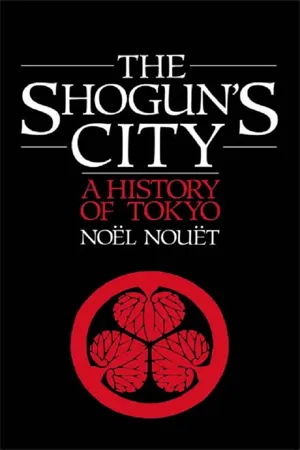
Shoguns City
About this book
First Published in 1995. Some thirty years have passed since the death of Noel Nouet. He was a revered teacher, historian, writer and talented woodblock artist who became the author's person friend during the 1950s in Japan. The original French edition of this book (1961) began with Noel Nouer's description of what he intended his book to be. He had no claims, he said, to have written a scholarly work. Rather he wanted 'to present a kind of emakimono, picture-scroll, of Tokyo' that would be 'pleasant to peruse'.
Information
1
The Birth of Edo and the Tokugawa Shoguns

TOKYO LIES AT the mouth of a small river which was of great importance in former times, and on the shores of a bay in the Pacific Ocean. This bay has thrust itself deep inland and its waters are quite shallow. A large part of the modem city has been developed on land gradually recovered from the sea, either as a result of the natural rising of the ground or as a result of long-term reclamation schemes. On the opposite side, Tokyo lies at the end of a wide plain — one of the few but also one of the largest in Japan — called the Musashi plain, which for a long time was swamp-land and is a name which appears in the poems of the Manyoshu,an eighth-century anthology.
Not a stone is to be found in the sub-soil of the town, only alluvium, lava and ashes. But the site has been lived on for many centuries, for more neolithic remains have been found there than in any other part of Japan. In some of Tokyo’s parks there are small grass-covered mounds composed of heaps of shells, which are the remains of the shellfish eaten by early inhabitants; also, there are many ancient tombs, particularly in Shiba.
To what race did these people belong? For a long time it was thought that they were a Caucasian white race, a few tribes of which still exist under the name of Ainu in Hokkaido. It was thought that the whole of Japan had been occupied by Ainu before the arrival of those other immigrants who formed the Japanese race. Some roots of the Ainu language can be found in a few of the place names in Tokyo and its environs. Ethnologists, however, still do not agree on who the first inhabitants were. The name of Edo itself, which some people claimed was an Ainu word, probably means, as the written characters imply, the ‘Gate of the Bay,’ or the ‘Mouth of the River.’ It is thought that at first there was no such small area called Edo, but that it was the name of the whole region, including several fishing villages.
Centuries passed by on this spot without leaving any traces, during which time the inhabitants of the island of Kyushu, and later of the Yamato plain, became civilised and learnt agriculture and copper-smelting. One must wait until the sixteenth or seventeenth century to see the culture of the Kansai in the west reaching as far as the Kanto in the east. According to tradition, the first temple of Asakusa dates from the seventh century, thus showing that Buddhism had already reached this spot.
In 737 AD the Emperor Shomu, who was established at Nara, ordered the building of a Buddhist temple and monastery in every province where the Yamato people had settled. This was the origin of the Kokubunji Temple in west Tokyo. The stone bases of fifty pillars can still be seen in the fields there. At the same time, Fuchu, not far from the Kokubunji, was the residence of the governor of Musashi. An official road was opened from Kozuke (Gunma Prefecture today) to Fuchu, across the still uninhabited plain, where hunters could find a great variety of game and where horses were probably beginning to be reared. Also, in the eighth century colonies of naturalised Koreans settled in the plain and in the valleys, as shown by names such as Komagori near Hanno.
A classical text, written by a woman in the first part of the eleventh century, in the form of a diary and called the Sarashina Nikki,gives a picture of the period. The authoress, taken away from Kyoto at an early age by her father who was the governor of a province in the north-east, returns there with a large escort. She relates the story of her journey, and notes the black colour of the sand on the beaches; she writes of the reeds which cover the plain and which are so tall that they hide the tops of the bows of her escorting knights; she also mentions the ruins of a temple or of a dwelling going by the name of Takeshiba, which is now reckoned to be situated near Mita. But she never mentions the name of Edo.
Meanwhile, rival clans grew up among the population; chiefs set themselves up and divided the land among each other. In the provinces where the central authority was strong, the name shoen was given to land granted by the Emperor to princes or high officials, who were exempt from taxes; but in the distant provinces, the clan chieftains gave the same title to their possessions. They built fortified dwellings on the hills, near rivers or in places where they could defend themselves against their rivals or marauders. In the twelfth century the dwelling house of Edo Shiro Shigetsugu was located on a mound close to the sea. Some claim that the name of Edo originated from this person, but the opposite is probably true, for history shows that the clan chieftains commonly took the name of the place in which they established their power.
In Tokyo at Akasaka, in Hitotsugi-machi, the remains of the residence of Imai Kanchira, a lord of the twelfth century who died in 1184, have been unearthed.
In 1192 during the Kamakura period, the Shogun, Yoritomo, had broken away from the refined atmosphere of the Imperial Court which he regarded as decadent, and set up in the Kanto region a vigorous regime based on the warrior code. Edo Taro Shigenaga, son of Shigetsugu, was one of his vassals. The road from Kamakura to the small stronghold of Edo had a halting place at Kasumigaseki where the Gaimusho (Foreign Office) was established in the nineteenth century. The other road from Fuchu to Kozuke was in constant use. It was along these two main highways that armed bands used to pass on their way to and from their battles which occurred so frequently in the middle ages. The meadows of Musashi had long been battlefields and many grey-stone stupas bear witness to these fierce but forgotten struggles. During this period Japan was ravaged from north to south by fighting, famine and disease.
Yoritomo was from the Minamoto family which, during the eleventh and twelfth centuries, had been in continual conflict with the Taira, another powerful clan, which was eventually defeated in 1185. It was at this time that the warrior caste of samurai or bushi,sprang up and who regarded faithfulness to their sovereign and scorn of death as cardinal virtues and developed the creed of the sword.
Another branch of the same Minamoto clan settled in Kozuke at Nitta. It fought during the thirteenth and fourteenth centuries, sometimes against the Hojo of Kamakura, sometimes against the Ashikaga Shoguns of Kyoto, and from it descended the Tokugawa family whose deeds hold a central place in the history of Edo. But before the Tokugawa settled in Edo at the end of the sixteenth century, they were to live, fight and grow powerful in the province of Mikawa, on the coast, not far from Nagoya.
It is not until the fifteenth century that Edo became important for the first time. The Ashikaga Shogun who had replaced the Kamakura government held the reins of government in Kyoto, but in the east and north-east a large number of feudal clans were continually warring. Various branches of the same clan often fought against each other. In about 1439 the Uesugi clan was powerful in the Kanto. At that time it consisted of two families, the Yamanouchi and the Ogigayatsu, sometimes allies, sometimes rivals. The Yamanouchi had imposed their control over the governor of the Kanto, who had his dwelling in Kamakura. At first, the Ogigayatsu supported them. They had as their first vassal a knight called Ota Sukekiyo, but he, having suffered various reverses, resigned, shaved his head (as was the custom on renouncing the world), adopted a Buddhist name and in 1455 handed over his office to his eldest son, Ota Sukenaga. The head of the Ogigayatsu, Sadamasa, commissioned the young twenty-three-year-old Ota to build castles, which were more like fortified camps, along the Musashi plain.
In 1456 Ota Sukenaga proceeded to Edo. The descendants of Edo Taro still lived there but as they did not want to enter into combat with the Uesugi clan, they abandoned their domain, and even the name of Edo, and withdrew from the Tamagawa river to the village of Kitami which still exists. Ota settled temporarily near Shinagawa, probably at the present Gotenyama, while he looked for a site that was more suitable for his schemes. Tradition has it that he hesitated between several hills around Akabane, Oji and Surugadai. He decided on one near the road to the north which was partly occupied by a peasant village called Chiyoda. Was it there that Edo Taro resided? One cannot know for certain, but it does seem probable because of the existence of a road in that area. The peasants were removed to other villages and the work of building the castle began. The castle was merely a square camp with earthen embankments on which were placed shrubs, bamboos and palisades, a few thatched wooden buildings, ditches and wells. It was a modest castle, certainly, but the spot was destined for greatness, for now the Imperial Palace stands there and the name Chiyoda has been taken up again as the name of the main part of the capital, which had previously been Kojimachi.
About 1458 Ota, following in his father’s footsteps, shaved his head and took the name of Dokan by which he has been known ever since. But he did not give up his active life; he dwelt in Edo for thirty years and gradually conquered the whole of the Musashi plain. At the same time, he enlarged the castle, and boats came as far as its gates, bringing rice, tea, fish, copper, iron and weapons. The area was very close to the sea and was crossed by the branches of the river Tone which flowed into Edo bay. There were many swamps and pools, amongst which clustered the villages of Takarada and Iwaida, parts of which are now covered by a section of the palace grounds. The word ending to or da so common in Japanese names, signifies rice fields such as those which were cultivated to replace the Musashi reeds. Some other village names in the vicinity of the castle can still be found in the capital today, such as Hibiya, Sakurada, Shiba, Mita and Iigura. A small town began to form to the east of the original fortification. This was Edo.
Ota Dokan was a writer as much as a warrior and, legend having taken hold of his name, many classical poems have been attributed to him. In 1464 he went to Miyako (another name for Kyoto), the Imperial capital, and was received by the Emperor and by the Shogun. Dokan and the Emperor were both men of letters and according to popular tradition, their meetings consisted of an exchange of poems. Ota described his residence in Edo in the classical manner: ‘From my dwelling among the pines near the sea I see Fuji’s peak rising into the heavens.’ The Emperor replied: ‘I thought only reeds grew in Musashi. I am astonished that such pretty flowers, in the shape of your words, spring there!’
Ota had the Hachiman shrine built on the hill of Ichigaya where it can be seen today. Formerly, there was a large pine tree in the garden called Dokan’s Pine. Next to the Hachiman, a secondary shrine appears to have been built some time later in honour of the Ota family, for the tiles bore his coat-of-arms, namely the kikyo flower, a sort of campanula. In the Imperial Palace a gate has the name Kikyo-mon. Also, a section of the water of the palace moat is called Dokan-ike, the pool of Dokan.
Meanwhile, the struggle continued among the ambitious Kanto clans, the major fighting being between the two main branches of the Uesugi family. Ota Dokan, who was devoted to Ogigayatsu Sadamasa, supported him as best he could. But Sadamasa was a suspicious person and had given heed to the calumnies of a traitor. He invited Ota to his house and while the old man was taking a bath, had him assassinated in a cowardly fashion (1486). His tomb is in a temple, the Doshoin, near Mount Oyama.
Ota Dokan is regarded as the father of Tokyo. His statue stands in front3 of the city hall. A monument with a long inscription also retains his memory beside the palace moat near Hirakawa-mon. Descendants of the Ota family apparently still exist.
The result of this rivalry among the Uesugi was that a new clan became powerful in the Kanto and the Hojo family from Odawara became dominant. In 1524 Hojo Ojitsuna fought against Uesugi Tomo at Kawagoe and captured the castle of Edo. The castle then passed into the hands of Ashikaga Shigeuji of Koga, but later returned to the Hojo clan. Their representative at Edo was a certain Toyama Shirobyoe Kaganao and descendants of his family are said to exist still. In 1563 a great-grandson of Ota Dokan tried to capture the castle founded by his ancestor, but was defeated, and the castle was to remain with the Hojo family until the time when that clan became rash enough to resist Hideyoshi and was in its turn defeated and destroyed. This was the turning point in the development of Edo.
The use of firearms, brought to the southern island of Kyushu by the Portuguese in 1542, slowly spread through the whole country. However, muskets were never to play a very important role. The bow, the lance and the sword — above all the sword — were to remain the principal weapons for soldiers. The warrior code, bushido (the way of the warrior), which was not to be fully formulated until a later date, governed the general conduct of the samurai. It required disinterestedness and loyalty to the sovereign. But were the chiefs going to submit to it? A close study of events reveals a striking spectacle of fierce ambition, rivalry, treachery, revenge and assassination everywhere.
When a clan chief decided he needed wider domains, he simply recruited supporters, made alliances which he guarded jealously, married his sons young in order to benefit from the support of grandsons, having also recourse to adoption when necessary, and married off his daughters so that his sons-in-law could best serve his interests. He also made carefully disguised plans, manoeuvred with the help of trusted advisers, and took hostages whom he killed, crucified, or impaled as it suited him. Naturally, he tried to keep on good terms with certain guardian deities and submitted to common superstitions; he built castles, bestowed favours, perhaps, on a few men of letters and some artists and went to performances of Noh plays. In victory he annexed whole provinces, gathered new followers and sought a title from the Imperial Court. In defeat, he committed harakiri or else hid, fled to another district, changed his name, recruited samurai not in the employ of a lord, formed a new army and sometimes succeeded in re-establishing himself. After a battle, he held a review of the heads he had severed. Of course, he might be killed in battle when still a young man. Occasionally, he withdrew from the world, shaved his head and disappeared into a Buddhist monastery where he recited sutra (Buddhist prayers) and wrote poetry. Meanwhile, all the peasants were working in a state of poverty cultivating rice and breeding silkworms. They frequently saw their fields laid waste and their homes razed to the ground, and yet then, as now, it was the peasants themselves who kept alive all the warring elements.
In 1560 a certain general came to the fore as a result of his superior intelligence, energy and skill, and through a wider conception of his destiny. His name was Oda Nobunaga. He came from the province of Owari in the region of Nagoya and was orphaned at the age of 15. He waged war against his neighbours and became strong enough to depose the Ashikaga Shogun and murder the Buddhist monks near Kyoto, who had become too rich and powerful. He put an end to the civil wars, received Imperial titles, interested himself in the foreigners who had landed in Japan, set to work organising the whole of the country, but died by the hand of an assassin at the age of 48. Although he does not appear to have concerned himself with Edo, it was soon to profit from his actions.
Oda had as his second-in-command Toyotomi Hideyoshi who was also orphaned at an early age and came from Owari. Hideyoshi distinguished himself in numerous campaigns and, following in the steps of his master, he imposed his power even more completely upon all the lords of the land. He was to move to Edo and to give it as fief to the head of his army, Tokugawa Ieyasu.
It is important at this stage to understand Ieyasu’s family and background. He was descended from the Minamoto, and neither Nobunaga nor Hideyoshi could claim such august origins. His ancestors had settled in the district of Nitta (Gunma Prefecture) during the twelfth century and at first took on its name. A branch had settled in the village of Serata in the same region but the family changed its name and adopted that of a nearby village called Tokugawa: this can be translated as River of Virtue, or Beneficent River. Later beaten in the struggle against the Ashikaga, the clan chieftain, disguised as a Buddhist priest, fled to the province of Mikawa, near Nagoya. There he settled and founded in the village called Sakai the family of this name. He founded a second family in the village called Matsudaira which also was to become one of the famous families of Japan. In feudal times it was a regular custom for families to take the name of the place in which they lived.
The Tokugawa family obtained a new domain for itself in the middle of the struggles of the fifteenth century. It had a castle at Okazaki and it was there that Ieyasu Matsudaira was born, the eighth descendant of the fugitive from Mikawa. So, like Nobunaga and Hideyoshi, he came from central Japan. At his birth he was given the name of Takechiyo and...
Table of contents
- Cover
- Half Title
- Full Title
- Copyright
- Contents
- Acknowledgements
- Foreword
- Introduction by Donald Richie
- 1 The Birth of Edo and the Tokugawa Shoguns
- 2 Ieyasu and the Building of Edo
- 3 The Struggle for Power
- 4 Ieyasu as Shogun
- 5 The Daimyo at Edo
- 6 Hidetada Closes Japan
- 7 The Story of Shogun Iemitsu
- 8 Early Edo: Low Life & High Life
- 9 The Fourth Shogun, Ietsuna, & the Sad Tale of Sakura Sogoro
- 10 Shogun Tsunayoshi, Kaempfer and the 47 Ronin
- 11 The Genroku Era: 1688-1703
- 12 Kabuki, the Yoshiwara & Shogun Ienobu
- 13 Edo at the Beginning of the 18th Century
- 14 The Life & Times of Yoshimune - the Eighth Shogun
- 15 Shogun Ieharu & the End of the 18th Century
- 16 Life in Edo in the Early 19th Century
- 17 Commodore Perry Challenges the Shogun - and Wins
- 18 The First Foreigners Arrive in Edo
- 19 Yoshinobu - the Last Shogun
- 20 Edo Becomes Tokyo: Japan's Modernisation Begins
- 21 The 20th Century: Troubled Beginnings
- 22 The Great Earthquake of 1923 & the Showa Era
- Conclusion
- Footnotes
- Index
Trusted by 375,005 students
Access to over 1.5 million titles for a fair monthly price.
Study more efficiently using our study tools.
Frequently asked questions
Yes, you can cancel anytime from the Subscription tab in your account settings on the Perlego website. Your subscription will stay active until the end of your current billing period. Learn how to cancel your subscription
No, books cannot be downloaded as external files, such as PDFs, for use outside of Perlego. However, you can download books within the Perlego app for offline reading on mobile or tablet. Learn how to download books offline
Perlego offers two plans: Essential and Complete
- Essential is ideal for learners and professionals who enjoy exploring a wide range of subjects. Access the Essential Library with 800,000+ trusted titles and best-sellers across business, personal growth, and the humanities. Includes unlimited reading time and Standard Read Aloud voice.
- Complete: Perfect for advanced learners and researchers needing full, unrestricted access. Unlock 1.5M+ books across hundreds of subjects, including academic and specialized titles. The Complete Plan also includes advanced features like Premium Read Aloud and Research Assistant.
We are an online textbook subscription service, where you can get access to an entire online library for less than the price of a single book per month. With over 1.5 million books across 990+ topics, we’ve got you covered! Learn about our mission
Look out for the read-aloud symbol on your next book to see if you can listen to it. The read-aloud tool reads text aloud for you, highlighting the text as it is being read. You can pause it, speed it up and slow it down. Learn more about Read Aloud
Yes! You can use the Perlego app on both iOS and Android devices to read anytime, anywhere — even offline. Perfect for commutes or when you’re on the go.
Please note we cannot support devices running on iOS 13 and Android 7 or earlier. Learn more about using the app
Please note we cannot support devices running on iOS 13 and Android 7 or earlier. Learn more about using the app
Yes, you can access Shoguns City by Noel Nouet,M. Mills,J. Mills in PDF and/or ePUB format, as well as other popular books in Social Sciences & Ethnic Studies. We have over 1.5 million books available in our catalogue for you to explore.