![]()
Part One
CHALLENGING THE INTERNATIONAL MARKETING LITERATURE
![]()
Chapter One
RESEARCH DEVELOPMENTS IN INTERNATIONAL MARKETING
A European perspective
DAVID FORD AND LEO LEONIDOU
This paper attempts to examine some of the trends in the literature on international marketing, and, in particular, it concentrates on some of the conceptual and methodological developments in the area. A number of points can be made initially.
First, there is a strong tradition in Europe of research into the dynamics of large-scale international business and the processes of organizational and strategic development within transnationals. Nevertheless, many large European companies are international rather than multinational in orientation. The difference between these orientations is seen in European companies in (perhaps) an inclination towards stronger centralized control of overseas sales and manufacturing operations than is the case in many US multinationals. This may be the reason why much European research has concentrated on the issues of development from a single country base, and the relationships between headquarter country operations and overseas. This means that it is difficult to draw a clear distinction between some of the ‘export literature’ and the ‘international marketing literature’
Second, there are perhaps almost as many studies in Europe as in North America into ‘Why do companies export?’ and ‘What makes for success in exports?’, etc. However, there is considerable research in Europe which starts from a non-normative perspective, and which has used international marketing as a suitable research situation in order to examine the relationships between buying and selling organizations in different circumstances (Hakansson 1982).
Third, and perhaps most important, there is a significantly different conceptual approach to marketing research in Europe. This approach many years ago realized the limitations of the marketing mix view as a way of describing and understanding market activity. Instead of the view of an active seller and a relatively passive buyer implicit in the mix approach, much European research has examined the interaction between two active parties, a buyer and a seller. This research is, of course, built in the context of industrial markets, and it involves understanding of the nature of the relationship which develops between the parties through their interaction. This approach of examining interaction and relationships also marks a move away from concentrating on the analysis of single purchases, of which the classic industrial buyer behaviour model’ is the best example. Instead, the research in Europe tends to see each purchase as an ‘episode’ in the close, or perhaps distant, relationship between the parties. Thus, the purchase can only be understood in the context of the previous and current relationship and the wider ‘network’ of relationships in which it is enmeshed (Cunningham 1980).
Fourth, the approach to marketing (and international marketing) which emphasizes the examination of relationships has led to a distinctive methodological approach. This approach has relied on large-scale, in-depth empirical studies. For example, the original IMP study in Europe was based on 1,300 interviews. Perhaps, more importantly, the approach has rested on empirical analysis in both the selling and buying parties, to ensure a view of the relationship is obtained as seen from both sides (Hakansson 1982).
Fifth, much of the European research has concentrated on international marketing within Europe and from Europe to US/Japan. However, more recently there has been a tendency to extend these studies. This has occurred in analysis of international marketing from Europe to the Third World, and most recently in examining international marketing from the Third World to the USA and Europe (Ford and Djeflat 1983, Ford et al. 1987).
A REVIEW OF DEVELOPMENTS IN THE LITERATURE
This review is based on the literature which sees international marketing as a process of initiation and development through a series of stages. This is the ‘classic’ approach to the area and provides a useful context for some of the more recent work on buyer–seller relationships in international markets.
THE INITIATION PROCESS
Much of the published work on international marketing limits itself to describing the firm’s initial motives towards export, which are perhaps the most dynamic elements in the decision to ‘go international’.
Export stimuli are often classified into those arising within the firm, that is, internal or proactive stimuli, and those exogenous to it, stemming from its environment, that is, external or reactive stimuli (Olson and Wiedersheim-Paul 1978, Wiedersheim-Paul et al. 1978, Cavusgil and Nevin 1980). According to Wiedersheim-Paul et al. (1978), the above classification of export stimuli is important because ‘it provides a framework for examining whether a firm’s export start was stimulated mainly by the internal qualities of the firm or due to factors operative in its environment’.
Internal export stimuli are any excess capacity in the firm’s resources (for example management, marketing, production, and finance) and/or any unique competence, for instance product superiority (Olson and Wiedersheim-Paul 1978, Wiedersheim-Paul et al. 1978). On the other hand, external export stimuli are unsolicited orders from foreign customers, entry of domestic competitors into foreign markets, increase of competition in the domestic market caused by domestic or foreign competitors, government stimulation measures, and various market opportunities (Simpson and Kujawa 1974, Wiedersheim-Paul et al. 1978, Olson and Wiedersheim-Paul 1978).
The decision to export which has been stimulated by internal or proactive stimuli is characterized as rational, objective-oriented behaviour, and a problem-oriented adoption process, while the stimulation of the export decision by external or reactive stimuli is described as less rational, less objective-oriented behaviour, and innovation-oriented adoption process (Simpson and Kujawa 1974, Lee and Brasch 1978).
A large number of research studies have been conducted in order to find out the kind of stimuli which influence the firm’s export decision (Simpson and Kujawa 1974, Tesar and Tarleton 1982, Joynt 1982, Brooks and Rosson 1982). A summary of their findings indicates that the company’s export initiation is stimulated by both internal or proactive, and external or reactive factors, which appear with different rank order in each case. Of significance is the fact that among the external or reactive stimuli, the most popular was an unsolicited order from a foreign customer (Groke and Kreidle 1967, Simmonds and Smith 1968, Simpson and Kujawa 1974, Pavord and Bogart 1975, Tesar 1975, Welch and Wiedersheim-Paul 1980). This is the first indication in the literature of the recognition of the active customer.
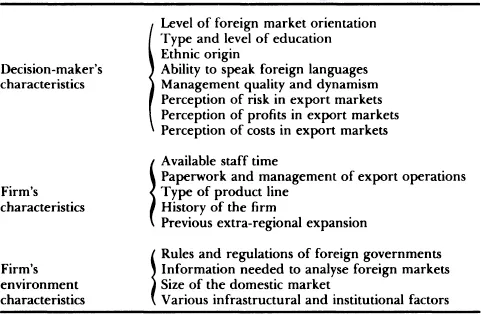
Despite the importance of the export stimulus in the export decision, its existence or its emergence is a necessary but not sufficient condition for the firm’s decision to look abroad (Aharoni 1966, Simpson and Kujawa 1974). Rather, ‘it depends on various feelings and social and organizational structures, on previous events in the company’s history and on other problem areas facing the company’ at the time this stimulus has arisen (Aharoni 1966). In other words, only in conjunction with certain opinions and attitudes of the decision-makers concerned will these latent motives become effective. The decision-maker’s opinion and attitude towards exporting is influenced by facilitating and inhibiting factors which are derived mainly from three major areas: the decision-maker’s characteristics, the firm’s characteristics, and the firm’s environmental characteristics (Wiedersheim-Paul et al. 1978, Brooks and Rosson 1982, Garnier 1982). These are summarized in table 1.1.
A number of facilitators and inhibitors to the export decision can be seen in the literature. Examples are the decision-maker’s foreign market orientation (Wiedersheim-Paul et al. 1978, Cavusgil and Nevin 1980), his/her type and level of education (Brooks and Rosson 1982, Garnier 1982), his/her ethnic origin (Simmonds and Smith 1968, Garnier 1982), his/her ability to speak foreign languages (Brooks and Rosson 1982, Joynt 1982), his/her management quality and dynamism (Groke and Kreidle 1967, Bilkey and Tesar 1977, Ogram 1982), his/her perception of profits (Simpson and Kujawa 1974, Roy and Simpson 1980, Ogram 1982), and his/her perception of costs (Simpson and Kujawa 1974, Roy and Simpson 1980, Brooks and Rosson 1982, Joynt 1982). More specifically, firms with decision-makers possessing foreign market orientation, better type and level of education, foreign country origin, foreign language proficiency, and high management quality and dynamism are more likely to become exporters. In addition, firms with a decision-maker perceiving risk in the export market as being lower versus risk in the domestic market, profits in the export market as being higher versus profits in the domestic market, and costs in the export market as being lower versus costs in the domestic market are more likely to become exporters.
Table 1.1 Facilitators and inhibitors to the export initiation decision
Firm’s characteristics which provide another form of facilitators and inhibitors in the export decision are the following: available staff time (Rabino 1980, Cavusgil and Nevin 1980, Cavusgil 1982, Kaynak and Kothari 1984b), the paperwork and management of export operations (Cavusgil and Nevin 1980, Cavusgil 1982, Ogram 1982, Albaum 1983, Kaynak and Kothari 1984b), type of product line (Wiedersheim-Paul et al. 1978), history of the firm (Wiedersheim-Paul et al. 1978), and previous extra-regional expansion (Wiedersheim-Paul et al. 1978, Garnier 1982). More specifically, firms with lack of staff time, preoccupying themselves with day-to-day affairs, perceiving foreign documentation as difficult and enormous, producing a bulky product, having a lack of realized goals, possessing unfavourable past behaviour and actions towards exporting, and undergoing no previous extra-regional expansion, suffer from inhibiting gaps, and are less likely to become exporters.
Facilitators and inhibitors in the firm’s decision to go abroad stemming from its environment are the following: rules and regulations of foreign governments (Pavord and Bogart 1975, Bilkey and Tesar 1977, Rabino 1980, Albaum 1983, Kaynak and Kothari 1984b), information needed to analyse foreign markets (Pavord and Bogart 1975, Wiedersheim-Paul et al. 1978, Albaum 1983, Kaynak and Kothari 1984b), size of the domestic market (Rabino 1980, Kaynak and ...