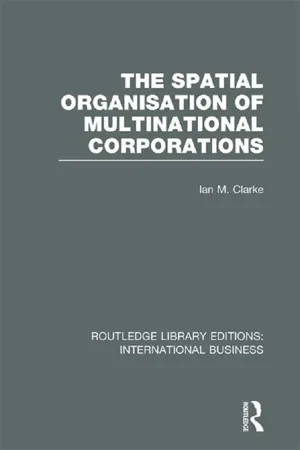
This book, based on extensive original research, examines the spatial structure and geographical implications of modern multinational corporations. It looks at the geography of multinational corporations, relates this geography to management and decision making structures and discusses how these items are changing. Exploring the themes of centre and periphery in the corporation it surveys the impact of corporate change and restructuring on regional economies.
eBook - ePub
The Spatial Organisation of Multinational Corporations (RLE International Business)
- 4 pages
- English
- ePUB (mobile friendly)
- Available on iOS & Android
eBook - ePub
The Spatial Organisation of Multinational Corporations (RLE International Business)
1 Introduction
Having exposed the tremendous magnitude of the task of formulating a theory of space economy, Weigmann stops for breath. How to locate the basic form? How to represent as an empirical Gestalt unit the multitude of interlaced, mutually related individual markets, market strata, and market densities? (Walter Isard, 1956, Location and Space Economy, p. 39.)
The rate of industrial restructuring has quickened markedly in the world economy during the 1970s and early 1980s and one of the most potent vehicles of change is said to be the multinational corporation, a form of capitalist enterprise with an unprecedented scale and scope of operations. Geographers, economists and regional scientists alike have gradually awoken to ‘the plain fact . . . that national economies no longer are “isolated states” of the kind originally hypothe-sised in location analysis by von Thünen’ (Holland. 1976a, p. 39), dominated and interlaced as they are, to a greater or lesser extent, by large multi-locational, multi-product, multi-divisional organisations. These trends need little elaboration. Hymer's (1960) classic study of the international operations of international firms was followed by other works on the implications of multinational corporations for uneven development (e.g. Hymer, 1972; Palloix, 1977, Holland, 1976b) and, more specifically, on their role in regional crisis formation (Man-del, 1978; Wallerstein, 1979; Carney, Hudson and Lewis, 1980). In geography alone, a succession of recent publications have offered insights into the structure, workings and effects of these large corporations at regional, national and international levels (e.g. Massey and Meegan, 1979b, 1982, Watts, 1980a; Townsend, 1982b; Taylor and Thrift, 1982d), with the changing geography of employment being a prominent focus of these studies.
The publication in English of The New International Division of Labour (Fröbel, Heinrichs and Kreye, 1980) has acted as an analytical benchmark and as a fulcrum for research in this respect by providing an overall explanation of the simultaneous occurrence of growing structural unemployment in industrialised countries and industrialisation in developing countries. The continued success of most large companies amidst economic, social and political problems in western industrialised countries, formed the backcloth for Fröbel et al.’S thesis, which argued that there had been a fundamental change in the structure of the world economy in the second half of the twentieth century, resulting in the creation of a ‘new’ international division of labour, as opposed to the ‘old’ international division of labour which had been a characteristic of the first half of the twentieth century. A radical shift in the spatial organisation of production in the world economy is integral to this change: from an old division of labour which was largely the outcome of the preponderance of wage labour as the basis of manufacturing in the industrial centres of Europe, USA and Japan, and coupled with a peculiar form of wage labour as the basis for the extraction and production of raw materials for export to world markets in the enclaves of Latin America, Africa and Asia; to a new division of labour resulting from a substantial growth in the orientation of industrialisation of the developing countries to world markets. The latter phase has been enabled by the creation of an almost inexhaustible supply of disposable labour in the developing countries, the division and subdivision of the production process to allow manufacturing to be performed with minimum levels of skill and the development of techniques of transport and communication allowing production to be located at almost any site in the world. According to Fröbel et al. (1980, p. 13), the coincidence of these three preconditions:
has brought into existence a world market for labour and a real world industrial reserve army of workers, together with a world market for production sites. Workers in the already established countries are now placed in a world-wide labour market and forced to compete for their jobs with their fellow workers in the developing countries.
An important corollary of this argument is that companies wishing to survive in the new operating environment of the world economy are forced to initiate a transnational reorganisation of production (Fröbel, Heinrichs and Kreye, 1980). However, a critical weakness of the perspective is that it treats the company simply as a reactive element in the restructuring process, and fails to give adequate emphasis to the opportunities companies may have to initiate restructuring of the space economy. The difficulty here is in providing an analytical framework within which the concept of the new international division of labour can be operationalised, explained and assessed. In part, the weakness stems from an inability to show as well as to realise that ‘globally organised production must logically be tackled from a global perspective, otherwise we will fail to understand the subtle reorganisations taking place’ (Forbes, 1982, p. 107).
Thus, although the concept of a new international division of labour was quickly embraced by industrial geographers, it has remained a catchword, even though it has the potential to unite otherwise separate research emphases. This failing is made evident in a review of the field by Wood (1980) which catalogued five main foci of research in industrial geography: measures of regional economic change; prediction and policy evaluation; ‘components of change’ studies; the growing dependence of regional economies on outside control; and the implications of multinational activity for regional policy. Although these areas of study are valuable in their own right, no adequate link has yet been forged between them. As a means to uncover this link and to tie together facets of a new international division of labour, three approaches within industrial geography can be considered.
The broadest of the approaches is the ‘industrial systems’ framework advocated by Hamilton and Linge (1979), which examines the enterprise itself and its environment, as well as relationships between the two. In a recent comment on the state of industrial geography, Malecki (1982, p. 1572) noted that this framework:
is perhaps best described simply as a very large umbrella, since it concerns nearly any topic concerning firms to be within its purview; however, it does not provide an explicit structure for analysis.
The second approach which may offer an integrative framework is the ‘structuralist’ form of analysis expounded by Massey and Meegan (1979b). In this methodology, the authors detail three analytical steps which they regard as necessary to understand changes in the structure of industry: an analysis of national and international economic trends; an examination of the implications of these trends for each firm; and an evaluation of how these affect the form of production and hence employment. Marshall's (1982) assessment of the structuralist framework is that it argues against adopting ‘functionalist’ concepts (especially from the organisational sciences) because these are conservative in their own right, and he advances that ‘firms are grouped on the basis of their experience of economic change, rather than in terms of their organisational characteristics’ (Marshall, 1982, p. 1675).
These industrial systems and structuralist approaches differ in the amount of emphasis they place on studying the individual business organisation. Whilst possibly overstating the case, Wood's (1981, p. 416) comment that ‘if we must study the whole economic order as a prelude to the explanation of any specific location problem it may not result in very much progress in the field’, holds some truth with respect to these approaches. Thus, while the two approaches act to integrate material and analysis at a number of levels, particularly that of political economy, with factors which directly affect the organisation, they fail to provide a central, identifiable and tangible analytical focus for the separate elements of industrial geography.
A third framework in industrial geography which might help provide a mechanism to link the aspects of a new international division of labour is the ‘enterprise approach’. Pioneered by McNee's (1958; 1960) work over two decades ago, and followed by a stream of articles by a number of authors (e.g. Krümme, 1969, 1981; Watts, 1974, 1978, 1982; Steed, 1971; Dicken, 1976; Rees, 1972), the enterprise approach takes as its main focus the behaviour and spatial ramifications of corporate activity. With regard to the five main research foci of industrial geography outlined above, therefore, the enterprise approach provides a central theme of investigation by focusing on the corporation as the main agent of spatial change. However, even the enterprise approach as it stands has made only limited inroads into understanding the principles of corporate organisation, and in establishing possible causal effects, for example, on employment at an international level.
It can be asserted that these three main approaches are limited in their capacity to develop deeper insights into the causes of the changing spatial division of labour, either because they fail to situate the business organisation as a principal mechanism creating and altering spatial structures, or because of an overly regional emphasis. Thus, although the object of this study is the multinational corporation, the organisations approach which is adopted to study it seeks to explain spatial change through the structural characteristics and behaviour of individual business organisations. A business organisation framework operates on the assumption that the individual enterprise is the most tangible and fundamental unit of the economy, the nexus or crucible in which macro- and micro-scale processes are played out (Baran and Bielby, 1980; Taylor and Thrift, 1983), and it attempts to establish principles the spatial and organisational structure of these enterprises, as well as their behaviour. In this respect, the approach is much wider than that of the ‘enterprise school’, which has tended to focus largely on firm behaviour. Consequently, the aim of this book is to sketch, in a preliminary way, some of the main organisational dimensions of corporate space, into which otherwise disparate and disaggregated spatial events can be integrated. By using an organisations approach, the aim is to examine the effects of the organisational structure of the multinational corporation on the new and changing international division of labour.
This brief introductory chapter therefore has a threefold purpose. The first objective is to examine some of the principal features of multinational corporations in order to see how they might affect the spatial division of labour. A second objective is to describe some of the more recent trends which are emerging in organisational structures and thereby to identify some of the more problematic areas which require attention. These two objectives will be discussed in the first two sections of the chapter. In the final section, the objective is to draw together these basic tenets and to outline the aims and organisation of the book.
Multinational Enterprise and the Changing Spatial Division of Labour
The growth of the multinational form of enterprise has increased in a series of quantum leaps from the late 1960s for several reasons, including developments in manufacturing technology and communications, the formation of trading blocs (such as the EEC and ASEAN) and the opening up of financial, resource and labour markets on a world scale, a form of ‘global sourcing’ by the multinational corporation (Palloix, 1977). As a direct result of these trends, the opportunities for large corporations to spread their geographical production networks have increased dramatically. A useful indicator of this trend is the sudden increase in the level of foreign investment in manufacturing production in the 1970s, which grew by 82 per cent between 1971 and 1976 (UNESCO, 1978). Most of this growth was controlled by slightly more than 400 large multinational corporations operating at a global level (Stopford, Dunning and Haberich, 1980). It is not surprising, therefore, that the multinational corporation has become a focus of study in its own right in disciplines as diverse as geography, economics and sociology, and central to the work in each of these disciplines has been a search for an overarching theoretical explanation of present international industrial trends.
In geography, for example, attention has concentrated on the expanded use of space on a global scale as an integral part of a multinational's organisation. This process has forced dramatic alterations in the spatial organisation of production, as centres of capital and administration have become separated from nodes of production on a global scale (see Forbes, 1982). The so-called ‘internationalisation’ thesis (Gibson, 1980; Fagan, 1980) has emphasised labour (e.g. Clark and Massey, 1982; Storper and Walker, 1983), capital (e.g. Walker and Storper, 1981) and resources (e.g. Forbes, 1982; Geddicks, 1977) as the main generating forces in this, the latest stage of international capitalist development.
A review of the economics literature on multinationals is beyond the scope of this discussion and, in any case, one has already been compiled by Caves (1983), albeit from a very specific viewpoint. Nevertheless, it is useful to note that modern economic theory on multinational enterprise has shifted somewhat from the established neo-classical theories of foreign direct investment and notions of comparative advantage, because of flaws which had appeared in the theory. One of the more interesting schools of thought to be developed in economics is represented by the broadly termed internal-isation thesis (e.g. Buckley and Casson, 1976; Rugman, 1982). According to this theory, which implicitly parallels the geographic theory of internationalistion, multinational corporations are encouraged to internalise their activities and technologies because of market failures, regulations and tariff structures imposed by governments. Dunning (1979) has proposed his own ‘eclectic’ theory of the growth of multinationals, but it is only an amalgam of ideas which can be inserted under the. internalisation banner. The eclectic theory points out that firms will tend to undertake foreign direct investment when two basic conditions are met: whether or not the firm will benefit from internalising its overseas activities, compared to exporting goods or licensing production to foreign firms; and whether or not the firm has any locational and ownership advantages over other firms to enable it to achieve internalisation.
In sociology, very few researchers have taken the multinational corporation as the explicit object of study, although a valuable contribution has been made towards understanding the structure of firms by organisation theorists. This omission has been bemoaned by Evans (1981) in his review of sociological research on multinational corporations. Even so, he does point out the considerable wealth of research sources available within the discipline, ranging from theories of the firm and product life-cycle theory (e.g. Vernon, 1979), to the work of the d...
Table of contents
- Front Cover
- Half Title
- Title Page
- Copyright
- Title Page
- Copyright
- Contents
- List of Figures
- List of Tables
- Preface
- 1. Introduction
- 2. The Organisation of Corporate Space
- 3. The Structure of Business Organisations in the Chemicals Industry
- 4. The Geography of Corporate Restructuring: A Case Study of lCI
- 5. Plant Centrality in Organisational Structure
- 6. The Effects of Plant Centrality on Labour Dynamics
- 7. The Technological Basis of Plant Peripherality
- 8. Summary and Conclusions
- References
- Subject Index
- Author Index
Trusted by 375,005 students
Access to over 1.5 million titles for a fair monthly price.
Study more efficiently using our study tools.
Frequently asked questions
Yes, you can cancel anytime from the Subscription tab in your account settings on the Perlego website. Your subscription will stay active until the end of your current billing period. Learn how to cancel your subscription
No, books cannot be downloaded as external files, such as PDFs, for use outside of Perlego. However, you can download books within the Perlego app for offline reading on mobile or tablet. Learn how to download books offline
Perlego offers two plans: Essential and Complete
- Essential is ideal for learners and professionals who enjoy exploring a wide range of subjects. Access the Essential Library with 800,000+ trusted titles and best-sellers across business, personal growth, and the humanities. Includes unlimited reading time and Standard Read Aloud voice.
- Complete: Perfect for advanced learners and researchers needing full, unrestricted access. Unlock 1.5M+ books across hundreds of subjects, including academic and specialized titles. The Complete Plan also includes advanced features like Premium Read Aloud and Research Assistant.
We are an online textbook subscription service, where you can get access to an entire online library for less than the price of a single book per month. With over 1.5 million books across 990+ topics, we’ve got you covered! Learn about our mission
Look out for the read-aloud symbol on your next book to see if you can listen to it. The read-aloud tool reads text aloud for you, highlighting the text as it is being read. You can pause it, speed it up and slow it down. Learn more about Read Aloud
Yes! You can use the Perlego app on both iOS and Android devices to read anytime, anywhere — even offline. Perfect for commutes or when you’re on the go.
Please note we cannot support devices running on iOS 13 and Android 7 or earlier. Learn more about using the app
Please note we cannot support devices running on iOS 13 and Android 7 or earlier. Learn more about using the app
Yes, you can access The Spatial Organisation of Multinational Corporations (RLE International Business) by Ian Clarke,Ian M Clarke in PDF and/or ePUB format, as well as other popular books in Business & Business General. We have over 1.5 million books available in our catalogue for you to explore.