eBook - ePub
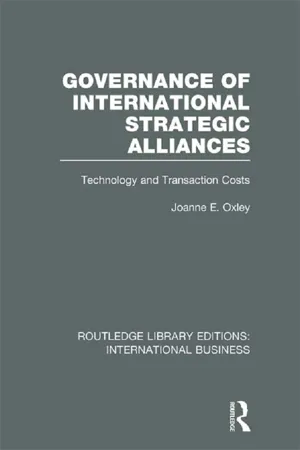
Governance of International Strategic Alliances (RLE International Business)
Technology and Transaction Costs
- 16 pages
- English
- ePUB (mobile friendly)
- Available on iOS & Android
eBook - ePub
Governance of International Strategic Alliances (RLE International Business)
Technology and Transaction Costs
About this book
International joint ventures and strategic alliances built on recent theoretical developments in Transaction Costs Economics (TCE) and the factors influencing the formation and governance of these alliances are examined in this analytical text. By bringing rigorous empirical analysis to an arena which has largely been pursued through speculative and theoretical approaches, this book will prove to be an insightful contribution to international business, strategy, and economics.
FOUR
An Empirical Study of Appropriability Hazards in International Strategic Alliances Stage 1: US-Based Firms
In this chapter and in Chapter 5, I report the results from a two-stage empirical study of appropriability hazards in international strategic alliances. Specifically, I address the following research questions: When two or more firms decide to form a strategic alliance for the development and/or exploitation of technology, how is the particular mode of cooperation chosen? How do appropriability hazards affect this choice? What attributes of the project (transaction), the partner firms and the national setting determine the level of appropriability hazards?
A basic premise of this research is that international strategic alliances are susceptible to the same analytical framework as domestic alliances, albeit with some extensions. The empirical study was therefore designed to be conducted in two-stages: Stage 1 (presented in this chapter) examines domestic and global alliances between US-based firms only,1 and Stage 2 of the study (in Chapter 5) analyzes alliances between firms of different nationalities.
The principal source of data for the study is the Cooperative Agreements and Technology Indicators (CATI) information system, a relational database covering over 9,000 cooperative agreements involving parent companies in many countries. The organizational form of each agreement is identified in the database, allowing placement on the “market-hierarchy continuum” of inter-firm alliances. The severity of appropriability hazards is modeled as a function of the type of transaction, the geographic and technological scope of the activities governed by the alliance, and the strength of protection of intellectual property rights. Discrete choice methods are used to test the hypothesis that greater appropriability hazards lead firms to choose more hierarchical types of alliance. Results from an examination of horizontal production alliances involving US-based firms provide strong support for this hypothesis: more hierarchical alliances are chosen when technology is difficult to specify, and when the scope of activities is wider, so that monitoring of activities is hampered. Thus, as appropriability hazards increase, unilateral licensing agreements give way to cross-licensing agreements, and eventually to equity joint ventures.2
Inclusion of firm-level variables in the empirical model illuminates a source of confusion in previous empirical studies. In the international management literature, empirical studies of governance choice in inter-firm alliances increasingly rely on the logic of transaction cost economics (Agarwal & Ramaswami, 1992; Gomes-Casseres, 1989; Hennart, 1991; Hladik, 1985) but almost without exception, these studies use firm-level characteristics (R&D spending, advertising, firm size, etc.) to proxy for the transaction-level characteristics featured in TCE. This mismatch between the underlying phenomenon and the empirical measures is reflected in inconsistencies in the observed effects of firm-level variables in these previous studies.3 In the empirical analysis reported here, firm-level characteristics do not have statistically significant effects. This confirms that, in line with transaction cost theory, it is attributes of the transaction (i.e. the project), and not those of the firm as a whole, that determine the more efficient mode of governance in alliances.
HYPOTHESES
The starting point for the empirical analysis is the proposition, developed in Chapter 3, that if appropriability hazards are present to a sufficient degree, contractual relationships should give way to hybrid or (in the limit) hierarchical forms of organization. Where we are concerned with the choice of mode within the general class of hybrid organizations (or strategic alliances), this logic can be summarized in the following proposition: More hierarchical alliance modes will be chosen in the presence of greater appropriability hazards, i.e. when property right security is uncertain, and ‘leakage’ would result in significant loss of value.
Development of testable hypotheses for the empirical analysis requires that this proposition be operationalized, by identifying those characteristics of the transaction, the participating firms and/or the institutional environment which the theory posits will lead to increased appropriability hazards, and thus to adoption of a more hierarchical alliance form. The three aspects of the “appropriability problem” identified in Chapter 3 — property right specification, monitoring and enforcement — facilitate this, since increases in the difficulty or cost of any of the identified features leads to greater appropriability (contracting) hazards and the adoption of a more hierarchical mode of governance.
Specification
It was previously argued that the ease with which property rights can be specified will depend on whether the purpose of the alliance is the creation or exploitation of technological assets, plus the age/novelty and the degree of “tacitness” of the know-how embodied in the technology. Information on the age of a technology and direct measures of “tacitness” are not obtainable in the kind of dataset used in this empirical analysis. We can nonetheless draw some inference about the ease or difficulty of property rights specification from the types of activities involved in the alliance.
In Chapter 2, the case was made that ordering of hybrid organizations along a governance continuum can only be undertaken within certain general activity categories. Direct comparisons across categories are not valid, given the current state of understanding, without considerable additional microanalytic data. Specifically, it is important to distinguish vertical from horizontal relationships, and to separate R&D activities from the more “routine” organizational activities of product design, production and marketing. Thus, in the empirical analysis, we restrict our attention to horizontal technology transfer alliances. Such alliances are primarily concerned with the exploitation of existing technologies, but they nonetheless may involve product or process design, production and marketing, or some mixture of these activities. Among these different “transaction types,” those which include design activities are most likely to involve the creation or significant modification of technology, so raising the difficulty of adequate specification of contractual terms. Alliances involving these activities are therefore expected to present greater appropriability hazards than are “pure” production and marketing agreements, and hence adoption of a more hierarchical governance structure is predicted, ceteris paribus.
H1: A more hierarchical governance mode will be chosen when an alliance involves product or process design than when only production or marketing activities are undertaken.
Monitoring
While monitoring is essentially a governance attribute in the TCE model, there are aspects of the transaction that affect the adequacy of the “external...
Table of contents
- Front Cover
- Half Title
- Title Page
- Copyright
- Dedication
- Contents
- List of Figures
- List of Tables
- Acknowledgments
- ONE Introduction
- TWO The Market-Hierarchy Continuum of Hybrid Organizations
- THREE Appropriability Hazards and Governance
- FOUR An Empirical Study of Appropriability Hazards in International Strategic Alliances Stage 1: US-Based Firms
- FIVE An Empirical Study of Appropriability Hazards in International Strategic Alliances Stage 2: Cross-National Comparisons
- SIX Conclusions and Suggestions for Future Research
- Endnotes
- References
- Index
Trusted by 375,005 students
Access to over 1.5 million titles for a fair monthly price.
Study more efficiently using our study tools.
Frequently asked questions
Yes, you can cancel anytime from the Subscription tab in your account settings on the Perlego website. Your subscription will stay active until the end of your current billing period. Learn how to cancel your subscription
No, books cannot be downloaded as external files, such as PDFs, for use outside of Perlego. However, you can download books within the Perlego app for offline reading on mobile or tablet. Learn how to download books offline
Perlego offers two plans: Essential and Complete
- Essential is ideal for learners and professionals who enjoy exploring a wide range of subjects. Access the Essential Library with 800,000+ trusted titles and best-sellers across business, personal growth, and the humanities. Includes unlimited reading time and Standard Read Aloud voice.
- Complete: Perfect for advanced learners and researchers needing full, unrestricted access. Unlock 1.5M+ books across hundreds of subjects, including academic and specialized titles. The Complete Plan also includes advanced features like Premium Read Aloud and Research Assistant.
We are an online textbook subscription service, where you can get access to an entire online library for less than the price of a single book per month. With over 1.5 million books across 990+ topics, we’ve got you covered! Learn about our mission
Look out for the read-aloud symbol on your next book to see if you can listen to it. The read-aloud tool reads text aloud for you, highlighting the text as it is being read. You can pause it, speed it up and slow it down. Learn more about Read Aloud
Yes! You can use the Perlego app on both iOS and Android devices to read anytime, anywhere — even offline. Perfect for commutes or when you’re on the go.
Please note we cannot support devices running on iOS 13 and Android 7 or earlier. Learn more about using the app
Please note we cannot support devices running on iOS 13 and Android 7 or earlier. Learn more about using the app
Yes, you can access Governance of International Strategic Alliances (RLE International Business) by Joanne Oxley in PDF and/or ePUB format, as well as other popular books in Business & Business General. We have over 1.5 million books available in our catalogue for you to explore.