William Blake's work demonstrates two tendencies that are central to social media: collaboration and participation. Not only does Blake cite and adapt the work of earlier authors and visual artists, but contemporary authors, musicians, and filmmakers feel compelled to use Blake in their own creative acts. This book identifies and examines Blake's work as a social and participatory network, a phenomenon described as zoamorphosis, which encourages — even demands — that others take up Blake's creative mission. The authors rexamine the history of the digital humanities in relation to the study and dissemination of Blake's work: from alternatives to traditional forms of archiving embodied by Blake's citation on Twitter and Blakean remixes on YouTube, smartmobs using Blake's name as an inspiration to protest the 2004 Republican National Convention, and students crowdsourcing reading and instruction in digital classrooms to better understand and participate in Blake's world. The book also includes a consideration of Blakean motifs that have created artistic networks in music, literature, and film in the twentieth and the twenty-first centuries, showing how Blake is an ideal exemplar for understanding creativity in the digital age.
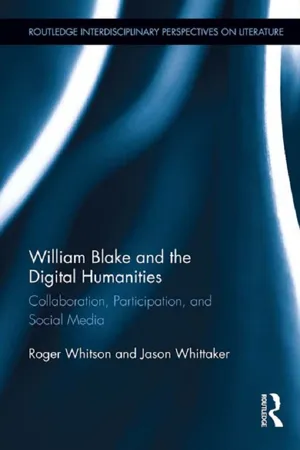
eBook - ePub
William Blake and the Digital Humanities
Collaboration, Participation, and Social Media
- 212 pages
- English
- ePUB (mobile friendly)
- Available on iOS & Android
eBook - ePub
William Blake and the Digital Humanities
Collaboration, Participation, and Social Media
About this book
Information
1 Archives and Ecologies
VIRTUAL BLAKE
In A Critique of Modern Textual Criticism, in which he argued for a socialized conception of editing whereby publishing is to be seen as part of a series of “literary productive relations” of which authorial intentions are only one, often problematic, component when devising copy texts for later editions, Jerome McGann makes some rather curious comments on Blake:
When Blake assumed the roles of author, editor, illustrator, publisher, printer, and distributor, he was plainly aspiring to become a literary institution unto himself. Unfortunately, he could not also assume the role of one crucial component of that institution as it existed in his period: the reviewer. As a consequence, his work reached only a small circle of his contemporaries. Also, his productive processes were such that he could not mass produce his works, so that his fame, his full appreciation and influence, had to wait upon his death, and the intervention of a number of important persons who never even knew him. The mechanical reproduction of his rare original works was a final, splendid insult to the equally splendid principles of a genius. Had that insult never been delivered, Blake would have been no more than one of those who ‘bare of laurel … live, dream, and die.’” (47)
Considering that A Critique was published in the same year as McGann's The Romantic Ideology, this extract is fascinating. Whereas McGann devotes considerable efforts to promoting the social theory of editing and publication, Blake is seen as almost entirely outside that mode of production and thus occupies a different category. His works are autographic rather than allographic, the products of “splendid principles of a genius”, and to reduce the aura of these products to mechanical reproduction is a “splendid insult”, bringing them at last into the drive towards material production and consumption. In The Textual Condition, McGann directs this accusation of “mechanical reproduction” squarely at the Erdman edition of Blake's writings, which was first published in 1965 and then in revised versions in 1982 and 1988: after making the important point that Erdman's decision to reproduce only the lexical and grammatical levels of Blake's works, thereby omitting the visual and iconic, represents adherence to a fundamentally different bibliographical code, he once again tropes Blake as an exceptional case:
Blake is unique in the history of English literature precisely because of his effort to bring every aspect of the signifying process, linguistic as well as bibliographical, under authorial control: in fact, to make the author's intention what many textual critics believe it is and ought to be, the ultimate and sole authority of the entire text. (57)
Blake, as McGann points out, was unable to bring every factor of the bibliographical code under his control (perhaps an implicit reference to the lack of reviewers), but the depiction of the sole author working in an “act of resistance to those collaborative inertias as they were undergoing a new expansion at the dawn of the age of mechanical reproduction” (58) appears incredibly romantic, even heroic.
McGann's socialized theory of editing and publishing made an important, if not uncontroversial, contribution to problematizing essentialist and idealized notions of copy-texts and the status of the author. Blake obviously wrote, designed, and printed his own illuminated books, and, as such, he would appear to be in complete control of what he has manufactured. However, as a number of writers have demonstrated in the past two decades in particular, what precisely such control means is not automatically self-evident: Blake's texts were often dictated by the accidents of his production techniques, as well as the fact, argued persuasively by Viscomi, that his illuminated printing had to be squeezed in between commercial considerations.1 The use of the term “resistance” when describing Blake's attitude to collaborative publishing cannot help but invoke an attitude of heroic defiance, presumably, in this case, to the capitalist opportunities that were enabled by co-operation. Certainly Blake is an exceptional case in the publishing world, but this is because the rare combination of artistic and poetic skills was combined with the even rarer commercial potential for application due to his skill in engraving, which Blake appears to have tried to capitalize on repeatedly. If Joseph Johnson had gone ahead with publication of The French Revolution and then become a distributor, even publisher, for Blake's other works, taking on the role that Bernard Quaritch was to offer to William Muir,2 Blake would have happily entered the fold of collaborative publishing.
Viscomi's Blake and the Idea of the Book was a revolutionary publication in Blake studies and rightly so. Viscomi corrected the attitudes of scholars who had blithely neglected the provenance—indeed, the ontology—of the books they had been using, especially within a critical framework where the abstract text had supplanted the material book in a metaphysical sleight-of-hand. From our introduction, it should come as no surprise that we share Viscomi's concerns with the concrete, immanent, and particular instance of the book as medium. It should also come as no surprise that we do not share Viscomi's reduction of Blake to the material originality of his books, which is limited in its application to the understanding of virtual Blake. Important as Viscomi's methods are, our own task is more concerned with zoamorphosis, the collaborative, often contradictory process of creative reception in which Blake's own works are one important object in a flat ontology punctuated by the Gutenberg parenthesis of print. By “virtual Blake” we are drawing off of thinking surrounding virtuality begun by Henri Bergson, and developed by Gilles Deleuze and Levi Bryant. For Bergson, memory does not simply represent some original perceptive experience. “There is no perception,” he argues, “which is not full of memories. With the immediate and present data of our senses, we mingle a thousand details out of our past experience” (33). Deleuze seizes upon Bergson's conception of memory and perception to question the traditional relationship between virtuality and possibility. Deleuze sees the possible as being
opposed to the real; the process undergone by the possible is therefore a ‘realisation.’ By contrast, the virtual is not opposed to the real; it possesses a full reality by itself. The process it undergoes is that of actualisation. […] The virtual […] is the characteristic state of Ideas: it is on the basis of its reality that existence is produced, in accordance with a time and a space immanent in the Idea. (Difference 263)
Virtuality is not, in Bergson's and Deleuze's thought, some lesser state of being that has not fully actualized itself—and is simply possible. Rather, as Levi Bryant points out, “[t]he virtual is the condition under which the actual actualises itself” (Democracy 106).
We see Blake's virtuality as manifested in critical, editorial, and creative work and as a condition under which different Blakes are produced and reproduced. We suggest, contra materialist scholars like Viscomi, that any Blake we encounter is articulated by the powers and potentialities of this virtual Blake, a Blake whose image is constructed out of a cultural apparatus forming an institutional memory.
Yet it is also important to note that the virtual Blake is not ontologically or temporally prior to what could be called an “actual Blake”: that is, either the Blake who actually lived from 1757 to 1827, or one of the several fictional or biographical Blake s who in habit novels or criticaleditions of his work. Bryant is careful to suggest that the virtual does not simply determine the actual, such that the essence of William Blake is simply a series of texts or a historical discourse. Even if a god-like entity could view all perceptive accounts of Blake from his birth to the present day it would still not fully understand William Blake, because actuality is not a totality but merely a manifestation. The actual Blake perceived by this divinity would simply be yet another manifestation, with virtual Blakes withdrawing from view and potentially determining manifestations on other planes of existence. Both virtual and actual are enmeshed; they form what Bryant calls the tendency of objects to be split between substance and quality. “Because substance changes,” he argues, “because it is capable of carrying contrary qualities, substance, in its proper being, must differ from its qualities” (Democracy 104). Virtuality is the power or potential of an object to be actualized in a particular manifestation. It is, in other words, Blake's virtuality that calls to individual editors and demands creative attempts to revise, preserve the integrity of his work, or make him something different altogether.3
That the illuminated books cannot, for example, now be separated from the critical apparatus of the industry surrounding Blake studies starts to indicate some of the ways that we should consider the archive not as a self-sustained entity but part of a wider virtual ecosystem. McGann's social text editing is, in this context, an important if incomplete editorial model. Wayne C. Ripley has argued that social text editing “provides the most appropriate editorial model for Blake's illustrations of other authors,” while pointing to The Rossetti Archive as the best example of social text editing. According to Ripley, The Rossetti Archive
brings facsimiles, transcriptions, and critical notes of all the contemporary editions of Rossetti's writings together with all states and reproductions of his paintings, drawings, and prints. It also includes the writings and visual arts of his circle and important influences and documents regarding his reception history. (Para 6.)
For Ripley, as well as Jerome McGann, D. F. McKenzie, and many of the authors who have developed the ideas surrounding social text editing, individual literary works are part of a larger “social text” that should be traced by the scholarly edition. McGann sees the social text editing as admitting two propositions: “first, that the apparitions of text—its paratexts, bibliographical codes, and all visual features—are as important in the text's signifying programs as the linguistic elements; second, that the social intercourse of texts—the context of their relations—must be conceived as an essential part of the ‘text itself’” (Radiant 11–12).
Social text editing represents an important advance in editorial theory, yet Ripley's article on “delineation editing” is also important for its suggestion that editorial policies must apply Blake's conception of the bounding line to make distinctions between what should be included in a collection and what should not. We suggest, however, that both McGann and Ripley base their editorial theories on conceptions of individual and social imagination that are correllationist and fail to account for the acts of reception that are involved in editorial processes. Such discussions form an important point in attempting to locate more firmly the historical Blake in a social locus of production and consumption. Viscomi, Eaves, Essick, Bentley, Davies, and many other scholars concerned with the manufacture and distribution of Blake's works have demonstrated how authorial intentions are far from the only concern for determining how the archive of Blake's materials has influenced his reception in the near two centuries since his death. Here, in the vast majority of cases, what we are dealing with is the “splendid insult” of mechanical reproduction. Whether in facsimile or conventional typography, what readers of Blake almost inevitably read is a text that has emerged from the various processes associated with nineteenth- and then twentieth-century publishing. As Ripley observes in relation to Blake's texts themselves: “Blake's extensive use of different media forms has meant that the first task of every editor has been to remediate this work—to translate it to a new medium, which irrevocably changes its form, context, circulation, and meaning” (par. 3). Nearly every encountered text of Blake's is virtual in the sense that it is not one of his originals. The task for the reception scholar is to map out the fields created by these virtual texts insofar as they help to create a potential horizon of expectations in which an imagined community may explore Blake's art and writings. Whereas McGann may see Blake as occupying a “unique” category in which the norms of social publishing are held in abeyance, the vast majority never read those originals but rather publications that very clearly are the products of communal, commercial, technological, and editorial processes over which Blake exercised no control whatsoever. As Ripley, drawing on McLuhan, observes, professional editing began with John Sampson's recognition of the “disservice” that an editor must do to Blake's intentions.
Considering the social nexus within which publication operates (a nexus that, most importantly, requires readers in order to proceed), this returns us to what David Greetham refers to as the “ontology of the text”. The tendency to treat the text as an abstract entity ignores the fact that it requires performers, and thus cannot be conceived independently from its physical manifestation. As Roger Chartier remarks:
Readers, in fact, never confront abstract, idealized texts detached from any materiality … In contrast to a purely semantic definition of the text, which characterizes not only structuralist criticism in all its variants but also literary theories concerned with reconstructing the modes of reception of works, it is necessary to maintain that forms produce meaning, and that even a fixed text is invested with new meaning and being (statut) when the physical form through which it is presented for interpretation changes. (50)
Although Greetham does not insist on a choice between physical and essentialist positions with regard to the status of the text, seeing this as part of a debate going back (at least) to arguments between the librarians of Alexander and Pergamon in the fourth century BC (50), it is the investment of the “fixed text” in a new physical form that is important to creating the horizon within which reception of Blake's works takes place. Here, Greetham's discussion of iterability after Derrida's critique of J. L. Austin's and John Searle's distinction between “felicitous” (perfected, complete) versus “parasitic” (figurative, enacted) speech acts is extremely useful, drawing attention to the ways in which iteration produces a sort of “universal variation” that produces textual instability in the transmission of text: “the very language of bibliography—reprint, reissue, copy—demonstrates the discipline's concern with repetition” (34). For Derrida, the limits of iterability are social conventions rather than inherent in the medium itself, and if no statement is inherently authoritative or constative, but always performative, then there is no final appeal to the empirically grounded referent of the constative.
Foucault saw the archive as a system of dispersion that constitutes the historical statements—the network of rules—that establish what is meaningful and operate through the materiality of the medium itself. Discursive formations lay down the conditions for which enunciations can be made, and from the regularity of which characteristics of a group of statements can be formulated. As such, it “is not an atemporal form, but a schema of correspondences between several temporal series” (74). The influence of these temporal series can be seen with regard to a particular type of discursive formation that contributes to the development of a Blake archive: the collected edition. Rather than a simple, unified progression of ideas that have brought us ever closer to a perfected understanding of Blake, these objects, the collection of written texts, constitute schema that help to explain some of the preconditions in which the subject of Blake may be formulated. In terms of the writings (and the artworks form their own important schema in terms of gallery collections and catalogues), it has long been recognized that the majority of texts that we read and that bear the name of the author “William Blake” have a radically divergent relationship to the illuminated books that he actually printed, most clearly in those editions that present the relief printed books as conventional typography. When we read Blake, in all but a few circumstances we are reading the formulation of a virtual Blake transmitted to us via a series of editors, and so powerful is this structure that it frames how we even read the originals: one does not simply “forget” The Complete Poetry and Prose of William Blake or similar texts when confronted with Copy E of Jerusalem. After Deleuze and Guattari, we may say that this virtual Blake is a mapping of relations, the “plane of consistency” that provides the space to be populated by objects, the “plane of organization” (Thousand 270). The effects of seeing Copy E on a reader will be manifestly different to those of the Erdman edition, not least because of the rarity of the event and its presentation as an artistic artifact, but in evaluating those effects we should never make the common mistake of ascribing some greater ontological reality to the original.
The relation between Blake as both subject (the writer/artist who produces the text/artworks that we read/see) and referent (the object of interpretation constituted by the arrangement of those texts/artworks) is frequently the object of such slippage in his reception history. To take an example that arose during Blake's lifetime and dominated his reception during the three decades or so after his death: mad Blake produced mad texts, the madness of those texts proving the underlying reality of the madness of the subject. The crudeness of that sentence is intended to highlight a caricature of the discourse, its self-fulfilling circularity. But in fact that discourse as a set of statements on “mad Blake” was itself contradicted by other statements by figures such as John Linnell and Samuel Palmer, largely neglected from 1827 to 1863, that took an oppositional position in relation to a dominant discursive field; oppositional, that is, until the publication of Gilchrist's Life, whereby mad Blake was replaced by Saint William, to offer another caricature, in which the inspired devotion Blake's works were capable of producing thus proved the devotional inspiration of the artist who made them. Alongside this simple, even naïve construct, was a related conception of Blake as lyric poet whose attempts at epic and prophetic verse were unsustainable, an interpretation validated by the fact that no editor until the final decade of the century thought it relevant to publish the vast majority of the prophetic works. This changed with publication of the Yeats/Ellis edition of 1893, one that began to swing the pendulum the other way, towards a Blake of profound and erudite—if sometimes erratic—subtlety, one who promises a system if only the appropriate reader can be found. Although the opinions of Yeats and Ellis have been largely superseded, their approach to the systematic Blake was in many respects ...
Table of contents
- Cover
- Half Title
- Routledge Interdisciplinary Perspectives on Literature
- Full Title
- Copyright
- Contents
- List of Figures
- Acknowledgments
- Introduction: Zoamorphosis and the Digital Humanities
- 1 Archives and Ecologies
- 2 The Tyger
- 3 Jerusalem
- 4 Digital Creativity: Teaching William Blake in the Twenty-First Century
- 5 Blake and His Online Audiences
- 6 Folksonomies and Machine Editing: William Blake's New Aesthetic on Flickr, Wikipedia, and YouTube
- Coda: Dust and Self-Annihilation
- Notes
- Bibliography
- Index
Trusted by 375,005 students
Access to over 1.5 million titles for a fair monthly price.
Study more efficiently using our study tools.
Frequently asked questions
Yes, you can cancel anytime from the Subscription tab in your account settings on the Perlego website. Your subscription will stay active until the end of your current billing period. Learn how to cancel your subscription
No, books cannot be downloaded as external files, such as PDFs, for use outside of Perlego. However, you can download books within the Perlego app for offline reading on mobile or tablet. Learn how to download books offline
Perlego offers two plans: Essential and Complete
- Essential is ideal for learners and professionals who enjoy exploring a wide range of subjects. Access the Essential Library with 800,000+ trusted titles and best-sellers across business, personal growth, and the humanities. Includes unlimited reading time and Standard Read Aloud voice.
- Complete: Perfect for advanced learners and researchers needing full, unrestricted access. Unlock 1.5M+ books across hundreds of subjects, including academic and specialized titles. The Complete Plan also includes advanced features like Premium Read Aloud and Research Assistant.
We are an online textbook subscription service, where you can get access to an entire online library for less than the price of a single book per month. With over 1.5 million books across 990+ topics, we’ve got you covered! Learn about our mission
Look out for the read-aloud symbol on your next book to see if you can listen to it. The read-aloud tool reads text aloud for you, highlighting the text as it is being read. You can pause it, speed it up and slow it down. Learn more about Read Aloud
Yes! You can use the Perlego app on both iOS and Android devices to read anytime, anywhere — even offline. Perfect for commutes or when you’re on the go.
Please note we cannot support devices running on iOS 13 and Android 7 or earlier. Learn more about using the app
Please note we cannot support devices running on iOS 13 and Android 7 or earlier. Learn more about using the app
Yes, you can access William Blake and the Digital Humanities by Roger Whitson,Jason Whittaker in PDF and/or ePUB format, as well as other popular books in Literature & Communication Studies. We have over 1.5 million books available in our catalogue for you to explore.