The main thrust of Part 1 is to give some understanding of the concept of 'global competition'. In doing so, the chapters rely heavily on industrial studies. Part 2 deals with two different aspects of this change viewed from two different perspectives. The one is economic and more macro: the other political and social and more micro, being concerned with the way in which companies have to utilize their various organisational units and integrate information on a fragmented environment into a strategic whole. Part 3 deals specifically with technology, as the particular segment of the environment which often has the largest impact on future strategies. In Part 4 the perspective of global competition is applied at industry, country and company levels and it is shown that this perspective adds new dimensions to old problems. The final parts address the problem of management in global competition.
eBook - ePub
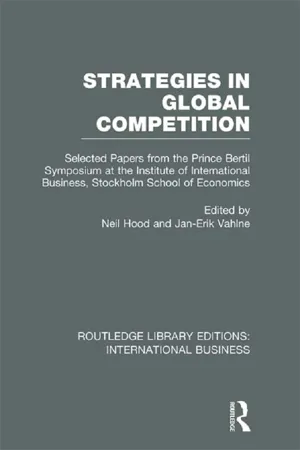
Strategies in Global Competition (RLE International Business)
Selected Papers from the Prince Bertil Symposium at the Institute of International Business
- 20 pages
- English
- ePUB (mobile friendly)
- Available on iOS & Android
eBook - ePub
Strategies in Global Competition (RLE International Business)
Selected Papers from the Prince Bertil Symposium at the Institute of International Business
Part One
Concepts and Constructs of Strategy in Global Competition
Introduction
Even if ‘strategies in global competition’ can be regarded as a fairly new area of research, the principal problem of strategy is the same: how to position and adapt the company to the changing environment. As will be evident from the chapters of this book, however, the environmental change of globalisation introduces more complex problems for managers to solve than other changes they have had to deal with so far. During the multinational — or multidomestic — era the foreign operations were run by subsidiary managers, and co-ordination across national borders was kept at a minimum. Often headquarters monitored by financial co-ordination and the organising of intermittent transfer of technology from the company's central research and development (R&D) unit.
In global competition — implying interdependence between national and regional markets more or less around the globe — many more activities have to be looked after by central management. In addition, the environment will be extremely complex as markets and regions will differ in characteristics such as culture, levels of technology, buying capacity and governmental regulation. Inevitably the speed of change in these and other respects will vary between countries and regions. On top of this, imagine a number of more or less powerful competitors being able to progress along a whole series of competitive parameters in many different geographical locations, and the level of complexity becomes immense. Researchers are trained to deal with complexity through finding the relevant questions, concepts and relationships. This opening part is thus instrumental in that respect.
In the first chapter Hamel and Prahalad argue against too simplistic a view of what global competition is about. It is not only about standardisation and low cost. Referring to the Japanese example they see the intent of global brand dominance and ability to cross subsidise across product segments and national borders as intrinsic aspects of global competition. However, they also identify other types of intents and advantages and apply these to the global television industry. From this Hamel and Prahalad deduce new concepts in labelling potential advantages and analysing competitors in global competition. They also draw conclusions regarding the organisation of global companies, questioning whether the sub-organisation is in principle optimal, say for purposes of allocation, in the global environment.
Research on global competition — and to some extent also competitiveness in general — is still in its infancy: hence, there is a need for exploratory empirical studies. In stressing the competitive aspect, the ‘industry study’ is the method widely used, industry in this case being defined as the companies competing with each other. In the second chapter McGee and Thomas argue convincingly for rich, fine-grained, in-depth, longitudinal studies to identify the complexities associated with global competition. As can be seen from the typology they introduce, industry studies are themselves a complex phenomenon, taking on many different characteristics. The authors’ quest for continual methodological refinement in order to secure, for example, replicability and the integration of different theoretical constructs, seems therefore extremely relevant. McGee and Thomas also review some important concepts like ‘the value-chain’ and ‘the strategic group’ as tools of analysis of global industries. The concept of the strategic group is applied to the office reprographics industry and is instrumental in identifying different advantages and strategies. However, these chapters are very ‘rich’ in terms of concepts, approaches and ideas. They thus help the reader to understand ‘the dynamic nature of industrial evolution’ which is so central in global competition.
1
Creating Global Strategic Capability
1.1 WHAT IS ‘GLOBAL COMPETITION’?
As currently used, the terms, ‘global business’, ‘global competition’, ‘global company’ and ‘global strategy’ are at best ambiguous and at worst misleading. They have been invoked to describe activities as diverse as:
(1) Establishing a manufacturing operation overseas in an attempt to match the lower labour costs of foreign competitors (e.g. General Electric's production of audio products in Singapore);
(2) Expanding internationally to amortise investment in world-scale plants or to generate funding for a world-class R&D programme (e.g. Japan's computer chip producers);
(3) Rationalising foreign national product lines to take advantage of scale economies in design, purchasing and manufacturing, (e.g. SKF's attempts to reduce the number of national variations in its ball-bearing product line);
(4) Restructuring the organisation to consolidate strategic responsibility for a particular business at headquarters (e.g. General Motors’ plans for a new pan-European headquarters).
Without a clearer understanding of what drives the new international competition, any response is likely to be misdirected and ill-timed.
Existing approaches to understanding the process of globalisation emphasise an economic impetus that drives the business from being local to global. Factors often mentioned are: asset intensity, technology intensity, low labour costs or other factor advantages, extra-national economies of scale, multinational customers and universality of customer needs.1 A global business is often seen to imply world-standardised products. Levitt argues that companies exploiting global scale-economies are able to offer products of such value that foreign customers lay aside cultural biases regarding product features, appearance and usage.2 On this view, homogenisation of international markets is driven by the same scale-based cost advantages that are presumed to lead to global competition. The automobile, motorcycle, consumer electronics and semiconductor industries are used to illustrate this view of globalisation.3
However, is this the whole story? The evidence suggests a more complex process. Firstly, in competitive terms the tyre industry has undergone a dramatic transformation during the last decade. During the early 1970s, while tyre manufacturers operated in multiple markets, each country operation was seen as strategically and operationally independent. The competitive balance was struck on a country-by-country basis. Yet in the late 1970s and early 1980s three truly global competitors had begun to emerge — Goodyear, Michelin and Bridgestone. If we consider only manufacturing and distribution economies of scale, most of the critical industrialised countries can support an efficient-sized operation. Cross-shipment of tyres between North America, Europe, Japan and Latin America remains uneconomical for all but speciality tyres, and distribution is also country-specific. Yet competition is clearly recognised to be global. Why is this?
Secondly, while the US market for consumer electronics is the largest in the world, and can easily justify investments in R&D and manufacturing that exhaust existing economies of scale, today one finds no indigenous manufactuers in growing product categories like video recorders and 8mm video cameras. Even firms which were traditionally strong in consumer electronics — RCA, Zenith and GE — source these products from Japanese competitors. Fifteen years ago American firms controlled the pace of technology development and enjoyed a virtually unchallenged position in the world's largest market. Just how did they lose out?
Traditional views of the globalisation process offer only a partial explanation of the dramatic competitive shifts outlined above. Yet analysts continue to suggest that a simple low-cost ‘generic’ strategy is the primary driving force behind globalisation. We believe this preoccupation reflects an incomplete view of Japanese competitive advantage. Implicit in this view is the notion that the overriding advantages of Japanese competitors are cost and quality. Participative company cultures, statistical quality control and world product standardisation either support or flow from this central emphasis on cost.
Both factor costs and scale have played a major role in the competitive success of Japanese firms. However, this static view of the Japanese competitive advantage, circa 1975, provides few clues to the competitive advantage enjoyed by these firms in the late 1980s and consequently offers few insights into the nature of the threat presently facing US and European firms.
1.1.1 Strategic intent: a dynamic view of global competitive advantage
In analysing the Japanese experience, a critical missing link has been an understanding of the long-term ‘strategic intent’ of Japanese competitors. Once strategic intentions become clear, we are able to distinguish between staging tactics and endgame objectives in the process of globalisation.
For many Japanese firms, the ultimate strategic objective has always been worldwide distribution and global brand dominance, rather than simply low-cost manufacturing and superior quality. In less than two decades, Japanese companies have built a significant and identifiable worldwide market presence. Today, Sony, Casio, Seiko, Canon, Toyota and Honda enjoy the same recognition that was once reserved for names like Coca-Cola, Kodak, Nestle and Philips. This reflects the enormous investments in distribution made by Japanese firms in the most recent stage of their global competitive onslaught.
1.1.1.1 Layers of advantage
The Japanese assault was a step-wise process in which location-specific advantages, including low labour costs, were used to gain access to critical large volume markets, principally the United States. In many industries, Japanese firms chose to enter Western markets through private labelling and collaborative ventures. The advantages were clear: minimum initial investment in channel development, access to market intelligence and product design expertise, and a chance to build a large volume base rapidly and reduce experience disadvantages vis-à-vis larger competitors.
However, it would seem that Japanese companies early recognised the transience of location-specific cost advantages. Labour costs, for example, change with economic development, exchange rate movements, shifts in government policy and the growth of organised labour. Thus, while initial factor cost advantages were used as a wedge to gain entry to critical markets, once a foreign volume base had been secured, Japanese firms were quick to make pre-emptive investments in large-scale plants and automation. Scale-based cost advantages provided some protection against factor cost changes, yet were also vulnerable, particularly to radical changes in process technology and protectionism in export markets. In an attempt to provide yet another buffer against the impermanence of a cost-based competitive position, many Japanese companies invested heavily to create worldwide distribution networks and global brands. This brand strength and control over distribution channels bought them ‘breathing space’ to respond to ever-changing manufacturing economics.
1.1.1.2 Leveraging the global distribution in vestment
The size of investment required to build a global distribution system and worldwide brand franchise make investments in a single world-scale plant pale in comparison. To understand fully the willingness of Japanese companies to undertake this massive investment, one must note the way in which their global distribution positions have been leveraged through efforts to accelerate product life cycles rapidly. Thus, for example, in a recent model year, Honda introduced 40 new motorcycle models. In automobiles, watches, calculators, motorcyles, hi-fi equipment, and machine tools, Japanese firms seem to introduce new models almost monthly. This increases channel throughout and shortens the payback on the distribution investment. With the same logic, many Japanese companies have been quick to capitalise on their brand franchise by rapidly expanding across product categories. Today, the name Sanyo is carried on everything from refrigerators to personal computers. Competitors have often been ‘blind-sided’ by this horizontal segment expansion. This phenomenon is not limited to consumer products companies. Industrial products companies like Fujitsu, Mitsubishi, NEC, and Komatsu have invested heavily to create global corporate brands.
International distribution investments that appear unprofitable to competing firms may not be so unattractive when predicated on a rapid acceleration of product life cycles and expansion into adjoining product segments. Predictably, companies with narrow product lines (e.g. Whirlpool in the US) or sleepy product development departments (e.g. Harley Davidson) have been caught short. Global distribution is the new barrier to entry. Economies of scope have become as important as economies of scale; and if world brand presence is the end to which the new global competitive game is played, cross-subsidisation of national market-share battles is the means by which it is played.
1.1.2 Cross-subsidisation: the essence of global competition
In the past, several observers, including ourselves, drew a distinction between ‘multi-domestic’ and ‘global’ businesses or firms.4 We believe that this distinction misses the central reality of the new international competition.
1.1.2.1 Industry economics or competitive interaction
We believe that the process of globalisation begins with a particular sequence of competitive action and reaction, namely:
(1) An aggressive competitor decides to use the cash flow generated in its home market(s) to cross-subsidise an attack on the home market(s) of foreign-based competitors.
(2...
Table of contents
- Front Cover
- STRATEGIES IN GLOBAL COMPETITION
- Title Page
- Copyright
- Title Page
- Copyright
- Contents
- List of Figures
- List of Tables
- List of Contributors
- Foreword
- Preface
- Part One: Concepts and Constructs of Strategy in Global Competition
- Part Two: Global Environmental Change
- Part Three: Technology and Global Competition
- Part Four: Global Competition and Strategy — Industry and Country Studies
- Part Five: Frameworks for Analysing Global Competition
- Part Six: Strategic Management for Global Competition
- Concluding Perspectives
- Index
Trusted by 375,005 students
Access to over 1.5 million titles for a fair monthly price.
Study more efficiently using our study tools.
Frequently asked questions
Yes, you can cancel anytime from the Subscription tab in your account settings on the Perlego website. Your subscription will stay active until the end of your current billing period. Learn how to cancel your subscription
No, books cannot be downloaded as external files, such as PDFs, for use outside of Perlego. However, you can download books within the Perlego app for offline reading on mobile or tablet. Learn how to download books offline
Perlego offers two plans: Essential and Complete
- Essential is ideal for learners and professionals who enjoy exploring a wide range of subjects. Access the Essential Library with 800,000+ trusted titles and best-sellers across business, personal growth, and the humanities. Includes unlimited reading time and Standard Read Aloud voice.
- Complete: Perfect for advanced learners and researchers needing full, unrestricted access. Unlock 1.5M+ books across hundreds of subjects, including academic and specialized titles. The Complete Plan also includes advanced features like Premium Read Aloud and Research Assistant.
We are an online textbook subscription service, where you can get access to an entire online library for less than the price of a single book per month. With over 1.5 million books across 990+ topics, we’ve got you covered! Learn about our mission
Look out for the read-aloud symbol on your next book to see if you can listen to it. The read-aloud tool reads text aloud for you, highlighting the text as it is being read. You can pause it, speed it up and slow it down. Learn more about Read Aloud
Yes! You can use the Perlego app on both iOS and Android devices to read anytime, anywhere — even offline. Perfect for commutes or when you’re on the go.
Please note we cannot support devices running on iOS 13 and Android 7 or earlier. Learn more about using the app
Please note we cannot support devices running on iOS 13 and Android 7 or earlier. Learn more about using the app
Yes, you can access Strategies in Global Competition (RLE International Business) by Neil Hood,Jan-Erik Vahlne in PDF and/or ePUB format, as well as other popular books in Business & Business General. We have over 1.5 million books available in our catalogue for you to explore.