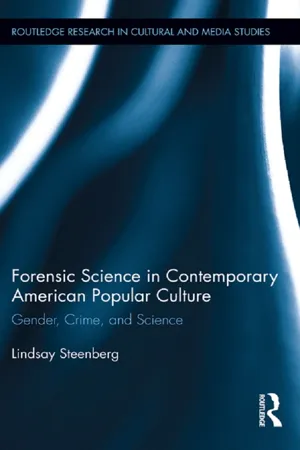
This book identifies, traces, and interrogates contemporary American culture's fascination with forensic science. It looks to the many different sites, genres, and media where the forensic has become a cultural commonplace. It turns firstly to the most visible spaces where forensic science has captured the collective imagination: crime films and television programs. In contemporary screen culture, crime is increasingly framed as an area of scientific inquiry and, even more frequently, as an area of concern for female experts. One of the central concerns of this book is the gendered nature of expert scientific knowledge, as embodied by the ubiquitous character of the female investigator. Steenberg argues that our fascination with the forensic depends on our equal fascination with (and suspicion of) women's bodies—with the bodies of the women investigating and with the bodies of the mostly female victims under investigation.
eBook - ePub
Forensic Science in Contemporary American Popular Culture
Gender, Crime, and Science
- 222 pages
- English
- ePUB (mobile friendly)
- Available on iOS & Android
eBook - ePub
Forensic Science in Contemporary American Popular Culture
Gender, Crime, and Science
About this book
Information
Part I
The Forensic Sub-Genre
1 Retrofit Forensics
Excavating the Mythic Origins of Forensic Science
“One day men will look back and say I gave birth to the twentieth century.”
—Jack the Ripper in From Hell (Hughes and Hughes 2001)
“Sherlock Holmes was the first to realize the importance of dust. I merely copied his methods.”
—Dr. Edmond Locard (Berg 1970, 448)
Mediated forensic science is retrospective. It looks for signs of past violence in present objects, bodies or behaviours. It seeks to reconstruct or re-enact a crime in order to fill in the missing pieces of who committed the crime and how. The crime genre projects this retrospective gaze into the future in order to predict the next (always impending) crime. Thus, it keeps to a structure of tight deadlines, imminent danger and suspense, much like the action or adventure genre with which it is closely aligned. While the suspense of the crime that is just about to happen is certainly important, the spectacle of the archaeological reconstruction of past violent crime is specific to the forensic sub-genre and constitutive of contemporary popular culture’s imagining of forensic expertise.
All crime stories begin by looking backwards—towards the events of a murder (or, less often, another crime) that has already taken place. Thus murder is always already a part of history and its investigation is a historicising process. Yet forensics is frequently metonymic of the modern, the technological and even the futuristic. This use of the hyper-modern to investigate the ‘barbaric’ crimes of the past is key to the way that tabloid forensic science operates in American culture. It is the reason why this opening chapter looks to the forensic science of the past to begin an exploration of the contemporary forensic phenomenon. The attention to the mysteries of history is not limited to the subjects of forensic analysis, but is integral to its composition. Forensic science is a mixed knowledge form and the practice of retrofit (updating something from the past to suit the needs of the present) is central to its hybridity. This functional pastiche or jury-rigging of a variety of quasi- or pseudo-scientific fields and practices is one of the main reasons why I have used the adjective tabloid to describe the mediated forensic science now common in popular culture.
This chapter addresses the retrospective, retrofit and nostalgic nature of forensic science through an analysis of the genre’s postmodern origin stories. It takes as its case studies postmodern adaptations of crime stories featuring two influential and highly mediated nineteenth century figures: firstly, consulting detective Sherlock Holmes, the character created by Scottish physician Sir Arthur Conan Doyle who featured in a series of stories and novellas published between 1887 and 1927; and, secondly, the serial murderer known as Jack the Ripper, who is believed to have killed at least five prostitutes in London’s East End, generating a media panic in the 1880s. It needs to be noted that while Sherlock Holmes is a fictional detective, several women were killed in Whitechapel in 1888. My case studies focus on the re-circulation of fact- and fiction-based figures as highly mediated texts because this overlap allows for an analysis of the postmodern re-animation characterising forensic origin stories. I do not, however, want to marginalise or fictionalise the Whitechapel victims and, therefore, I aim to reintroduce the victims of Jack the Ripper into my consideration of his mediated image.
Both Sherlock Holmes and Jack the Ripper are figures whose embodiment of historical (late nineteenth century) ‘Britishness’ often adds to the fascination with which contemporary American popular culture perceives them. The significance of the Anglo-American ‘special relationship’ is of central concern to this chapter. Deborah Jermyn (2010) has argued that British forensic dramas such as Prime Suspect have had significant impact on framing the forensic turn in the American version of the sub-genre (particularly on television) and in the popular media culture of both nations. I argue that a powerful Anglophilia is one of the most significant driving forces behind American culture’s repeated returns to stories about Holmes and the Ripper. To better address this Anglo-American exchange, I limit my consideration to the ways in which late twentieth and early twenty-first century American adaptations of these figures are used as origin stories for the current forensic turn. The representative case studies that follow illustrate how the forensic sub-genre returns to its origins in the past—in Sherlock Holmes (Ritchie 2009)—and brings its historical antecedents into the present—in Criminal Minds—in order to reinforce and remediate its own mythic beginnings.
Because of the consistent retrofitting of stories about Holmes and the Ripper, often to address contemporary cultural needs or preoccupations, they resist the closure so central to the crime genre. For example, the Ripper case remains open (to speculation and adaptation) because the killer was never apprehended. With the popularisation of each new forensic technology and method, new theories (and spectacles) arise. The same may be said of adaptations of Sherlock Holmes, which frequently hinge on his use of new scientific processes. The successful television programme, House (Fox, 2004–2012), a loose adaptation inspired by the character of Sherlock Holmes, capitalises on an amalgamation of state-of-the-art medical technologies and diagnostic processes combined with Holmes’/House’s irascible deductive reasoning and lack of faith in human testimony. This can also be said of the many adaptations that, like House, bring Holmes into the present (e.g. Sherlock (BBC 2010-)) or even the future, as in the animated children’s programme Sherlock Holmes in the 22nd Century (Fox Kids, 1999–2001).
Holmes and the Ripper share more than a similar historical context (London of the 1880s) or their significant impact on the fledgling crime genre crystallising around their iconic images. Both have generated intense and enduring fan cultures (e.g. Sherlockians, Baker Street Irregulars and Ripperologists) and both have become lucrative global brands, especially in Hollywood. Rather than framing them with the two-sides-of-the-same-coin metaphor—Holmes as the foundational figure for the detectives that follow and Jack the Ripper as the prototype for subsequent serial killers—the discourse around both figures points towards their consideration as equally invested in the mechanisms of expert (forensic) knowledge, as well as horror, the Gothic and the grotesque. Many adaptations of Holmes and Ripper stories suggest that with forensics history can be retrofitted into a place that is legible and logically ordered, where criminals are caught and detectives command ever-more accurate and useful technological aids. There is not space in a single chapter, or even in a single book, to address the many Sherlock Holmes films, television programmes, video games, novels, board games and fan fictions inspired by Doyle’s stories. Neither is there space to fully address the phenomenon of ‘Ripperology.’ My interest is in the way in which the Ripper and Holmes adaptations contribute to the American forensic turn and provide its foundations.
FORENSIC ORIGIN STORIES
Popular stories about forensics generally frame their histories using an evolutionary model, seeing the (British) nineteenth century as the crucible in which its genre, technologies and disciplines were forged. The late nineteenth century of Sherlock Holmes and Jack the Ripper serve as a kind of nostalgic ‘golden age’ in the metanarrative of forensics. The refinement of the detective figure by Sir Arthur Conan Doyle and the prototypical proliferation of related media born of the Ripper murders resonate with the now familiar (true) crime genre. The late nineteenth century also sees great technological development in forensic science and the beginning of law enforcement’s professionalization in the United Kingdom and the United States. In postmodern forensic discourse, the nineteenth century golden age can best be understood as the flashpoint that begins the feedback loop of tabloid forensic expertise and the place to which its stories ritually return. In their seminal work on the cinema and ideology, Jean-Louis Comolli and Jean Narboni argue that film “is ideology presenting itself to itself, talking to itself, learning about itself” (2004, 815). Building on this formulation, I argue that in the return to the Holmes and Ripper stories, the forensic sub-genre is talking to itself about itself and forensic discourse is cementing its own mythologies. Films such as Guy Ritchie’s Sherlock Holmes and the Hughes brothers’ From Hell, formulate a powerful origin point that reorients the metanarrative of forensics and gives it mythic potency and resonance. Comolli and Narboni’s turn of phrase gets to the core of the forensic feedback loop and draws attention to the British nineteenth century as the point of ignition for that circularity.
The origin story as möbius strip is illustrated in a review of Guy Ritchie’s Sherlock Holmes where critics made much of the ‘new’ kind of Holmes embodied by Robert Downy, Jr. In their statements to the press, the film’s producers were adamant that their Holmes (martial artist, bare-knuckle boxer, tortured genius, sex symbol and forensic scientist) was not in fact a new Holmes (courtesy of mockney gangster director Ritchie, famous for Lock, Stock and Two Smoking Barrels (1998)) but rather was a more authentic return to Doyle’s nineteenth century vision of the consulting detective. According to producer Joel Silver,
[i]f you look at the original movies they were stuffy. They used to have a phrase in the old days of Hollywood: there were rug movies and dust movies. Those original movies were rug movies—inside, intellectual pictures. Clearly Sherlock is a dust actor … a man of action. (Hoyle 2009)
Thus Ritchie’s film represents not one, but two returns to the golden age of forensic science. The first, by re-creating Doyle’s crime world and its refinement of the detective genre; and the second, by distilling all the Holmes adaptations since then, vaguely referred to as the ‘original’ movies from the ‘old days of Hollywood.’ These older adaptations of Holmes include such films such as Stoll Pictures’ early adaptations (1921–1923), Universal’s B films featuring Basil Rathbone/Nigel Bruce and television series such as ITV’s long running television series starring Jeremy Brett (1984–1994). The 2009 film accumulates new authenticity by absorbing these adaptations while simultaneously claiming fidelity to Doyle’s nineteenth century texts.
The 2009 film is certainly not the only one to claim that it goes back to beginning of the Holmes myth. The 1985 film Young Sherlock Holmes (Levinson) dramatises the fateful first meeting of Holmes and Watson, as does the similarly titled book series written by Andrew Lane. In a post-Phantom Menace (Lucas 1999) Hollywood, the prequel has become even more critical to branding, franchise-building and to the structure of popular storytelling. Holmes origin stories reify the myth of the cerebral detective by building on conventions—re-stating them through their beginnings and thus reinforcing the feedback loop. A small but iconic example of this is Sherlock Holmes’ deerstalker hat. Never mentioned in Doyle’s stories, this item of clothing, creation of Strand illustrator Sidney Paget, has become synonymous with the detective and with detection in general. Young Sherlock Holmes offers us the moment when Holmes first dons the symbolic headgear—an inheritance from a school days mentor. This moment has such significance because of the spectator’s familiarity with the Holmes mythology. We take it to be an important moment because it conforms to and reinforces the conventions with which we are familiar. In rewarding the audience in this manner, origin stories and prequels, like Young Sherlock Holmes, increase the value of the Holmes brand.
The Holmes brand has a definitive canon. Despite the argument that the ‘true’ beginning of the stories lies with Doyle’s mentor Dr. Joseph Bell at the University of Edinburgh, his stories and novellas provide a distinct origin. Stories of Jack the Ripper, however, have a more diffuse starting point—including the so-called canonical victims (Polly Nichols, Annie Chapman, Elizabeth Stride, Catherine Eddowes and Mary Kelly), the coverage in the contemporary press (such as the Pall Mall Gazette) and the official police documents, photographs and letters signed Jack the Ripper now accessible through the Public Records Office in London. The origins of Jack the Ripper (as a story, as a myth and as the progenitor of the serial killer) conflate fact with fiction, re-creation with crime scene photography—simulation with forensic examination. This hybrid re-animation of nineteenth century London is, like the Holmes stories, a bid for authenticity and results in the creation of a lucrative brand (including an exhibit in Madame Tussauds and Ripper Walks for tourists in London). Furthermore, the Ripper stories have a close and privileged relationship to post-industrial modernity. In the epigraph opening this chapter and the Ripper film From Hell, Jack the Ripper is credited with saying: “One day men will look back and say I gave birth to the twentieth century.” The film, and the graphic novel on which it is based, insists that it returns to the birth of a new kind of century through the figure of a new kind of criminal: the serial sexual murderer and with him, I would argue, a new kind of perceptive cerebral expert—as personified by Johnny Depp’s Inspector Abberline.1 The time of the film’s release coincides with the tail end of a profusion of popular representations of a relatively new kind of law enforcement expert—the criminal profiler, a FBI-trained elite skilled in catching the (FBI-defined) serial killer. Celebrity FBI profiler and successful true crime author, John Douglas describes Jack the Ripper as “the first known serial killer” (2000, 13). Douglas was asked to provide a profile of the celebrity killer for several different media events, including a documentary aired in 1988 to mark the 100th anniversary of the Ripper murders (The Secret Identity of Jack the Ripper). Like Douglas, many other contemporary celebrity profilers and forensic experts have offered their opinions on the case, for example Patricia Cornwell’s 2002 true crime account of Jack the Ripper, Portrait of a Killer. Despite being a novelist rather than a criminalist or profiler, Cornwell actively encourages her media reputation as a celebrity expert in crime, as demonstrated by the media attention given to her book. Many contemporary crime fictions return to Jack the Ripper and treat him as a formative case. The case is dense with cultural meanings and influential to the crime genre as a whole. I propose that it functions as an origin story for both the figure of the serial killer and the behavioural scientist. The sexual nature of the crimes, their urban location and their contemporary notoriety informed future models of the chase between exceptional killer and specialised expert. The crimes’ instant celebrity in the sensationalist press of their day (most famously through the series of over 300 letters signed “Jack the Ripper”) ties the Ripper murders from their beginnings to the tabloid media and testifies to the always already mediated nature of the ‘first’ serial killer.
Theories of criminality contemporary to the Ripper case began to consider murderers like him as a radically new type of criminal, notable for their sexualisation of murder and recognisable by a distinct psychology and, perhaps, physiology. Mariana Valverde argues that “as the [Ripper] crime became sexualized, it also became psychologised” (2006, 119) and proto-profilers at the time, such as alienist Dr. Lyttleton Forbes Winslow, began to take an interest in analysing the mind of the Ripper killer. Because of his intense interest in profiling the Ripper through the crime scenes, Winslow was briefly considered a suspect in the case (Walkowitz 1994, 213). Psychologically-informed models of criminality have retained their currency where other popularised Victorian ‘sciences’ of criminal detection (such as phrenology and physiognomy) have been discredited. It is no surprise that contemporary celebrity experts such as Douglas are being asked to provide insights into the still unsolved Ripper case. Perhaps more surprising is the fact that contemporary profilers in fiction still rely on techniques similar to those used by Winslow to profile the killer and to tell his story.
Where Jack the Ripper is framed as beginning the twentieth century—as witnessing and contributing to the advent of modernity—the mediated serial killers that follow are read as representative (even axiomatic) of post-modernity, with its emphasis on identity confusion and border transgressions. Ripper origin stories reveal that profiling and serial murder were not invented or discovered by the FBI’s Behavioural Science Unit in the late twentieth century, but rather both figures had a longer historical relationship with the popular media. Such historical contextualisation suggests that many of our postmodern assumptions regarding serial crime—for example, its sexual nature and urban setting—are part of an established tradition of modern Anglo-American culture which has not changed altogether in postmodernity but has been refined and re-circulated.
The violent birth story of Jack the Ripper and the simulated, branded authenticity of Sherlock Holmes are instances where the forensic sub-genre (and the crime story more widely) is talking to itself about itself. But, at these moments what is being said? A return to these mythic beginnings highlights the foundational impor...
Table of contents
- Cover Page
- Half Title page
- Series page
- Title Page
- Copyright Page
- Dedication
- Contents
- Figures
- Acknowledgments
- Introduction The Forensic Turn in American Culture
- Part I The Forensic Sub-Genre
- Part II Forensics Beyond the Crime Genre
- Notes
- Filmography
- Index
Trusted by 375,005 students
Access to over 1.5 million titles for a fair monthly price.
Study more efficiently using our study tools.
Frequently asked questions
Yes, you can cancel anytime from the Subscription tab in your account settings on the Perlego website. Your subscription will stay active until the end of your current billing period. Learn how to cancel your subscription
No, books cannot be downloaded as external files, such as PDFs, for use outside of Perlego. However, you can download books within the Perlego app for offline reading on mobile or tablet. Learn how to download books offline
Perlego offers two plans: Essential and Complete
- Essential is ideal for learners and professionals who enjoy exploring a wide range of subjects. Access the Essential Library with 800,000+ trusted titles and best-sellers across business, personal growth, and the humanities. Includes unlimited reading time and Standard Read Aloud voice.
- Complete: Perfect for advanced learners and researchers needing full, unrestricted access. Unlock 1.5M+ books across hundreds of subjects, including academic and specialized titles. The Complete Plan also includes advanced features like Premium Read Aloud and Research Assistant.
We are an online textbook subscription service, where you can get access to an entire online library for less than the price of a single book per month. With over 1.5 million books across 990+ topics, we’ve got you covered! Learn about our mission
Look out for the read-aloud symbol on your next book to see if you can listen to it. The read-aloud tool reads text aloud for you, highlighting the text as it is being read. You can pause it, speed it up and slow it down. Learn more about Read Aloud
Yes! You can use the Perlego app on both iOS and Android devices to read anytime, anywhere — even offline. Perfect for commutes or when you’re on the go.
Please note we cannot support devices running on iOS 13 and Android 7 or earlier. Learn more about using the app
Please note we cannot support devices running on iOS 13 and Android 7 or earlier. Learn more about using the app
Yes, you can access Forensic Science in Contemporary American Popular Culture by Lindsay Steenberg in PDF and/or ePUB format, as well as other popular books in Social Sciences & Criminology. We have over 1.5 million books available in our catalogue for you to explore.