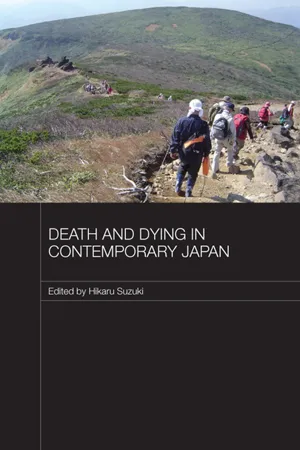
This book, based on extensive original research, explores the various ways in which Japanese people think about death and how they approach the process of dying and death. It shows how new forms of funeral ceremonies have been developed by the funeral industry, how traditional grave burial is being replaced in some cases by the scattering of ashes and forest mortuary ritual, and how Japanese thinking on relationships, the value of life, and the afterlife are changing. Throughout, it assesses how these changes reflect changing social structures and social values.
- 246 pages
- English
- ePUB (mobile friendly)
- Available on iOS & Android
eBook - ePub
Death and Dying in Contemporary Japan
About this book
Information
Part I
Meaning of life and dying in
contemporary Japan
1 Death and ‘the pursuit of a life worth
living’ in Japan
Ikigai is a Japanese word whose primary meaning is ‘that which makes one’s life worth living’. Ikigai is a commonly used term, appearing in numerous Japanese books and newspaper articles, and in countless daily conversations. The most common ikigai are family and work, with personal dreams, hobbies and religious beliefs also held, according to opinion polls as well as my own research (Mathews 1996). Ikigai shifts over the life course, with one conspicuous shift taking place after retirement from one’s company or one’s children leaving home, whereupon the earlier ikigai of work and family may no longer be sufficient to base one’s life upon. Many Japanese municipalities today offer ‘ikigai centres’, where elders can seek through hobby gatherings and classes a new ikigai to replace that which they have lost.
This matter-of-fact accounting of ikigai is, however, by no means uncontested. While some books and articles define ikigai practically, as a pursuit in a new phase of life, such as retirement, through which one may keep busy and contented, others define it in a much broader way, arguing that one cannot consider ikigai without considering death and the meaning of one’s life. While some define ikigai as a matter of fully playing one’s social role, others define it as the pursuit of one’s own individual meaning. Many of the other chapters in this book deal with forms of death ritual; this chapter explores not rituals, but attitudes towards aging and death in Japan today, through the conflicting meanings of ikigai. This chapter is based on my in-depth interviews on ikigai conducted with 50 diverse Japanese people in 1989–90, and the follow-up interviews I have had with many of these people in the 20 subsequent years; it is also based on my study of recent Japanese writings on ikigai, as well as a range of new interviews I have conducted on the topic of life after death. In this chapter I first discuss the different formulations of ikigai and how they have shifted over the past 20 years. I then explore what this shift may indicate about ikigai and death, in Japan in particular, and by implication, for us all.
Changing conceptions of ikigai in Japan
The term ikigai has a complicated etymological history, as discussed by Wada (2001: 28–32). The term was used as early as the Taiheiki, referring to the fulfillment of socially recognised values and roles. By the late nineteenth century, however, the term had effectively died out in Japanese usage, and vanished from dictionaries for several decades; it was revived by writers such as Natsume Sōseki, seeking to describe a new sense, brought about by modernism, of fulfilling one’s own individual purpose in life. Thus ikigai historically shifted in its meaning, from signifying one’s commitment to group and role up to the late nineteenth century to signifying the pursuit of self in the opening decades of the twentieth century.
Over the past half-century, both these concepts of ikigai have had their adherents. Some writers have advocated ikigai as ‘commitment to group and role’, using the term ittaikan [‘sense of oneness with’] (for example, Niwano 1969); others have advocated ikigai as ‘self-realisation’ [jiko jitsugen] (for example, Kamiya 1980 and especially Kobayashi 1989). Ikigai as ‘commitment to group’ connotes that one’s dominant loyalty should be to the social group and role to which one belongs: one should play one’s role to the hilt, as, for example, worker or mother, devoting oneself wholly to one’s company or family because this role was the essence of one’s being. Ikigai as ‘self-realisation’ connotes that one’s dominant orientation should be towards the growth of the self. One might still be devoted to company or to family, but for different reasons – one may feel that devoting oneself to one’s company or family might provide maximum fulfillment for oneself as a human being. In outward appearance, these might appear similar, but in underlying orientation they are distinct: for example, should one devote oneself to one’s children because this is what one should do as a mother, or because this is the deepest self-fulfillment that one can attain? If the former is the answer, then one will be committed to one’s children by definition. If the latter is the answer, then one may, for example, feel justified in leaving one’s children if they don’t provide self-fulfillment (even if social pressure may prevent one from acting on this feeling).
Based on an analysis of Japanese books and articles (Mathews 1996: 12–26), I explored how these two concepts of ikigai were in contestation in the early 1990s, with ‘self-realisation’ somewhat more advocated as to how one should live. I initially found this remarkable, given the fact that Japanese institutions tended to leave so little room for the pursuit of ‘self-realisation’, emphasising so strongly the individual’s immersion in role and group. I then realised that it was because many Japanese could not find ‘self-realisation’ in their institutionalised lives that they sought it instead in their ikigai dreams of individual fulfillment. I argued in my 1996 book that self-realisation was winning out over commitment to group as a dominant conception of ikigai in Japan, but that what this actually meant was unclear – was self-realisation really becoming a dominant mode of life in Japan, or was it merely a cultural dream, overshadowed by the dominant institutionally enforced reality of commitment to group? The latter was closer to reality, I conjectured.
This remains true at present as well: but there has been a significant change in how ikigai is discussed. Today, we still see books advocating ‘self-realisation’, just as we see books advocating ‘commitment to group’, but their focus has shifted, as Japan’s population ages. Whereas 20 years ago, the books dealing with ikigai that I came across generally discussed sarariiman and sengyō shufu, company workers and wives/mothers in their prime of life, today the focus is much more on those who are retiring or retired. This is because of the retirement of the dankai no sedai, the post-war baby-boom generation in Japan born between 1947 and 1949; in a larger sense this is due to Japan’s rapidly aging population, with over 20 per cent of the population now over the age of 65. Twenty years ago the section of Japanese bookstores in which books on ikigai were most readily found was ‘psychology’; today, this section of Japanese bookstores is ‘social welfare’ [shakai fukushi]: care for those who need help in society, and particularly the elderly. If one googles ikigai in Japanese, one finds webpages of numerous ikigai centres, as earlier mentioned, providing activities for the elderly.
Most members of the post-war baby-boom generation probably feel too young to attend ikigai centers; they are middle-aged, or members of ‘the young old’ rather than ‘the old old’ (Pipher 1999). This generation is still decades from death; but because they are now retiring, the consideration of ikigai and death should perhaps begin with them. This is the generation that was tinged with the Japanese counterculture of the 1960s, and that (for at least a few of its members) stormed the ramparts of their universities in student protest; but this is also the generation that, in its male incarnation, became kigyō senshi, the corporate warriors spearheading Japanese economic advances in the 1970s and 1980s. It is members of this generation that are now being asked to live for themselves and find their own purpose in life once they retire, but this may be difficult after decades of having more or less left behind one’s individual self to fulfill a social role. One salaryman friend in his fifties complained bitterly to me that when he attended a long-delayed reunion of his university friends a few years ago, friends with whom he had once protested against all that was wrong with Japan, they exchanged business cards: they had lost their own identities and become corporate cogs, he indicated. But soon they, and he himself, will be cast aside by their corporations, to be on their own: what, then, will they do with themselves? Will they still have selves left to which to return?
For the sengyō shufu – ‘professional housewives’ – of this generation, the transition beyond role may be less abrupt, but still jarring. A woman of this generation I first interviewed in 1990 was in 2008 adrift: her children have grown up and are doing well, and she has a reasonably good relation with her husband. But nonetheless, she says, ‘life isn’t interesting anymore’ – she feels she has nothing to do. Once one’s role as corporate employee or as wife and mother is attenuated, who, then, are you? Given the immense importance of social roles in defining identities in Japan, this is a very real question, more than in most other societies. But the problem of rolelessness seems more apparent among the men I interviewed than among the women: some are able to flourish in their new-found time, but others sleep and mope. One authority writes that men of this generation may become alcoholic in their retirement: they may have no friends or activities, but only drink and watch TV (Takenaka 2000: 44, 47). Another authority remarks how these newly retired men ‘have wholly devoted themselves to work, and now they have no idea what to do with their lives … This is especially true for salarymen during the high growth era, for whom work was their ikigai—losing their purpose in life, they may quickly grow old’ (Kanemaru 1999: 10).
There are, in the recent popular literature on ikigai, two different responses to this new situation of rolelessness, corresponding to the ikigai conceptions of ‘self-realisation’ and ‘commitment to group’. One argument is that ‘after age fifty, you’ve arrived at a time when you can honestly live for yourself … You can stop worrying about what other people think’ (Shimizu 2005: 59, 60). An opposing argument is that ikigai is not simply self-fulfilment but rather ‘something that you do for others’: ‘Old people too can feel that they have ikigai by playing a proper role as a member of society’, even if it is no more than watching over children playing in the park (Saitoh 2004: 90–91). Traphagan has found that his elderly rural Japanese informants define ikigai in a similar way, as a matter of doing all they possibly can to remain socially involved and productive (2004: 57–77). One Japanese book exploring ikigai gives this formulation of the term a cultural–nationalist tinge, discussing Japanese-style ikigai as involving the playing of a social role, and contributing to society through activities such as volunteering, unlike ikigai’s Western equivalents, which are more self-centred and selfish in orientation (Shibata 2002: 33–38).
Empirically dubious though this last argument may be,1 these appeals to the newly retired to volunteer have significant resonance in Japan today. I have, over the past two years, spoken with most of the post-war baby-boom generation of men and women I interviewed in 1989–90, and with many other members of this generation as well, and found that many of them echoed the call for Japanese retirees to serve as volunteers aiding society. Indeed, so many of my informants spoke of working in the future as volunteers serving the disabled that I found myself archly wondering if there were enough disabled people to fully occupy the yearnings and energies of what might be a horde of baby-boom generation volunteers. The fact that so few members of this generation spoke of pursuing their own personal interests, while virtually everyone spoke of wanting to help others, is indicative of the power of this new discourse of volunteerism. The dream of finding oneself yearningly set forth by many of my informants in their forties in 1989–90 seems to have been largely laid aside in the intervening years, except to the extent that self may be found by helping others.
It is no doubt a positive development that many of Japan’s young old are eager to devote their energies to bettering their society. But there is a larger question lurking below their proclaimed desires to contribute: given the fact that one will inevitably die, how should one live? This question may have particular resonance for the dankai no sedai generation, since they are now losing their social roles, roles that have more or less defined their existences as Japanese and as human beings. However, this is a question that all of us, of all generations and all nationalities face, as I will explore later in this chapter.
Ikigai, old age, and death
The post-war baby-boom generation is still relatively young, in its early sixties; how this generation ages remains to be seen. My sense is that they will age in a more divergent and vibrant way than their elders of the Shōwa hitoketa generation, born between 1925 and 1934, or those born during the Japan–China War or the Pacific War. It is mostly elders of these latter groups who today are clients of the ikigai centres, and for whom the relation between ikigai and death is particularly poignant at present.
There is a tension apparent in the ikigai literature as to what ikigai in old age should be. Should ikigai consist of one’s own personal discovery and cultivation of the meaning of one’s life as one ages and approaches death, or is it instead something that society should provide for individuals who have lived beyond their societal usefulness? Kamiya Mieko, probably the most widely cited authority on ikigai over the past 30 years, maintains that in facing one’s death, one may have the capacity to truly find one’s ikigai, a pursuit that may have been obscured earlier in life: ‘When one is confronted with death … one can no longer be attached to social status, money, and glory … and one may to a surprising extent purely experience the happiness of being alive’ (1980: 157–58). The ikigai centres mentioned above, on the other hand, provide a way of keeping old people engaged and occupied: their implication is that because as one grows older, one loses one’s social roles and one’s ikigai, one must be provided by society with a new ikigai.
One way to read this apparent contradiction is to see Kamiya’s self-realisation as an ideal that only a few people can actually attain in their lives; for the rest, there are the ikigai centres (and of course a given individual could conceivably do both). A number of recent books speak, as does Kamiya, about the possibility of attaining wisdom as one approaches death. One writer states: ‘As you get closer to death and confront death, you can question yourself as to what your ikigai really has been’ (Asahi 2006: 84); another writer, quoting Heidegger, argues that ‘death is the final chance you have to show that you are really alive. … Death is the last chance you have for self-realisation’ (Hinohara 2003: 201, 221). Another writer argues that ‘only you die’ – so ‘it’s only natural that how you die should be original’ (Shimizu 2005: 17...
Table of contents
- Cover Page
- Half Title page
- Series Page
- Title Page
- Copyright Page
- Dedication
- Contents
- List of illustrations
- Notes on contributors
- Acknowledgements
- Preface
- Introduction Making one’s death, dying, and disposal in contemporary Japan
- Part I Meaning of life and dying in contemporary Japan
- Part II Professionalization of funerals
- Part III New burial practices in Japan
- Index
Trusted by 375,005 students
Access to over 1.5 million titles for a fair monthly price.
Study more efficiently using our study tools.
Frequently asked questions
Yes, you can cancel anytime from the Subscription tab in your account settings on the Perlego website. Your subscription will stay active until the end of your current billing period. Learn how to cancel your subscription
No, books cannot be downloaded as external files, such as PDFs, for use outside of Perlego. However, you can download books within the Perlego app for offline reading on mobile or tablet. Learn how to download books offline
Perlego offers two plans: Essential and Complete
- Essential is ideal for learners and professionals who enjoy exploring a wide range of subjects. Access the Essential Library with 800,000+ trusted titles and best-sellers across business, personal growth, and the humanities. Includes unlimited reading time and Standard Read Aloud voice.
- Complete: Perfect for advanced learners and researchers needing full, unrestricted access. Unlock 1.5M+ books across hundreds of subjects, including academic and specialized titles. The Complete Plan also includes advanced features like Premium Read Aloud and Research Assistant.
We are an online textbook subscription service, where you can get access to an entire online library for less than the price of a single book per month. With over 1.5 million books across 990+ topics, we’ve got you covered! Learn about our mission
Look out for the read-aloud symbol on your next book to see if you can listen to it. The read-aloud tool reads text aloud for you, highlighting the text as it is being read. You can pause it, speed it up and slow it down. Learn more about Read Aloud
Yes! You can use the Perlego app on both iOS and Android devices to read anytime, anywhere — even offline. Perfect for commutes or when you’re on the go.
Please note we cannot support devices running on iOS 13 and Android 7 or earlier. Learn more about using the app
Please note we cannot support devices running on iOS 13 and Android 7 or earlier. Learn more about using the app
Yes, you can access Death and Dying in Contemporary Japan by Hikaru Suzuki in PDF and/or ePUB format, as well as other popular books in Social Sciences & Ethnic Studies. We have over 1.5 million books available in our catalogue for you to explore.