![]()
Part I
History of Action Learning
This part will provide an overview of the history of action learning in South Korea over the past 20 years. Chapter 1 summarizes the history of action learning in South Korea through three important milestone phases: Introduction (before 2000), Implementation (2000–2004), and Growth (2005–Current). The Korea Action Learning Association (KALA) was formed in 2005 and has developed 1,000 learning coaches. Chapter 2 discusses the roles of the Korea Action Learning Association in terms of developing learning coaches and providing channels to share best practices of action learning. KALA’s organization structure and primary services could be duplicated in other countries. Based on its track records of success in the expansion of action learning in the past 20 years, we propose an international organization (e.g., International Coach Federation) that will oversee each country’s association for action learning to share best practices and to expedite the process of the expansion of action learning throughout the world.
![]()
1
Twenty Years of Action Learning
The number of organizations employing action learning programs is rapidly increasing in South Korea. LG Electronics implemented an action learning program titled, “Talent Development Program for Executives,” which was created to develop 30 to 40 managers to become executives within the company. Two decades later, the action learning program is still in use. Action learning in South Korea has been used as a tool for talent development in corporate settings for the past decade. Since 2002, Hyundai Oilbank and Daelim Industrial have developed new ways to use action learning for organization development with the purpose of management innovation and the establishment of a learning organization.
Academic interest in action learning began in 2000. Bong and Kim (2000) published a translated copy of Marquardt’s Action Learning in Action (1999). The following year, the Korean Society for Training and Development held its first conference on action learning. There have since been several conferences featuring topics related to action learning research and practice.
The KALA was formed in 2005 to share best practices and develop learning coaches. As of 2012, KALA has more than 1,000 individual members and 35 organization members. With the assistance of KALA, action learning has been introduced to the public and business sectors as well as schools and has brought a new wave of talent development and management innovation. Learning coaches developed through KALA play the role of change agent through action learning in business, public, and education sectors.
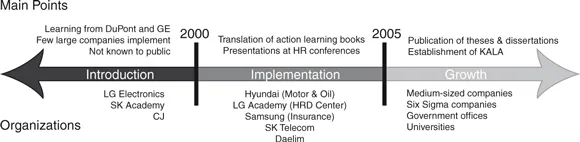
In this chapter, we will summarize the history of action learning in South Korea through three important milestones (see Figure 1.1).
Figure 1.1 History of Action Learning in South Korea. Note: “Six Sigma companies” refer to the companies that have Six Sigma as their primary management tool.
In the “Introduction” section, we will examine a few large companies’ first attempt at action learning, specifically LG Electronics, SK Academy, and CJ . In the “Implementation” section, we will discuss the first academic interest in and the expanded use of action learning in large companies. In the “Growth” section, we will focus on the establishment of KALA and its expansion.
Introduction (Before 2000)
With the strong leadership of Hyunjo Lee, the then CEO, LG Electronics used action learning to develop future executives. The purpose of this action learning program was to enhance the future leaders’ strategic thinking and leadership skills through problem-solving of corporate strategic issues. Learning teams of four to five high-potential leaders from diverse functions in the company were formed to achieve this goal. Participating managers solved strategic issues with the help of either an external or internal learning coach over the course of two to three months. Learning teams selected projects related to overseas expansion and implemented solutions selected by sponsors, typically company executives, following a presentation by the learning team. LG Electronics’s action learning for manager talent development has been used for nearly two decades and is considered the oldest action learning program in South Korea.
SK Academy implemented action learning for new executives in 1996. Fifteen executives were divided into two teams, and four facilitators (a project expert, a corporate planning staff, a professor, and a regional expert) were added to assist participants with the problem-solving process and content knowledge. Learning teams developed strategies for entering into global markets and presented their ideas to the CEO. Participants documented their extended understanding of business and newly developed competencies through reflection on the action learning process.
The food company CJ Corp.’s use of action learning attracted more attention than LG Electronics and SK Telecom’s programs. With the CEO’s sponsorship, CJ implemented action learning for all levels of new managers in 1998. CJ executives realized that the company leaders could not respond to the changing management environments with their existing knowledge and skills. Action learning was selected as a new learning initiative to solve this problem. The company developed the Four Leaders Model: sharing vision, being a change agent, building competencies, and creating value. New managers at all levels participated in action learning that consisted of field work, workshops, and receiving feedback for nine months. It was found that this initiative led to better skills in initiation (for value creating leaders), coaching (for competency building leaders), communication (for vision sharing leaders), and responsibility and challenging tasks (for change agents). As a result of using action learning, it is believed that CJ’s market share has increased by 29 percent, loss has decreased by $175 million, and profits have risen by $131 million (Kim, 2001).
Implementation (2000–2004)
Bong and Kim (2000) published the first translated action learning book of Marquardt’s (1999) Action Learning in Action with the help of Hyundai Motor Company’s HRD team. Bong and Hyundai Motor Company’s HRD team developed an action learning program titled “The Overseas Program for Hyundai-Kia’s Change Agents.” The program consisted of 250 hi-potential managers who delivered ideas for improving manufacturing processes, marketing, and production support. This action learning program has enabled the company to implement innovative ideas and contribute to its performance improvement (Kim & Bong, 2004).
In 2002, Hyundai Oilbank and Daelim Industrial Co. mandated all employees participate in action learning. In an attempt to save the company which had financially hit rock bottom, Hyundai Oilbank’s CEO Youngtae Seo initiated an implementation of action learning to encourage all employees to solve problems and bring about management innovation. Hyundai Oilbank continued using action learning for the next nine years and increased the company’s financial performance by $18 million to $54 million per year by 2010.
Daelim Industrial, a construction company, began using action learning in 2002 and has used it for employees in all business units since 2005 with the goal of establishing a learning organization within the company. In action learning teams, participating employees choose either strategic issues within the company or their team’s own issues at work. Learning teams’ deliverables are managed through a knowledge management system including new apartment designs, new construction methods, cost-saving, innovative processes, and improved productivity. More importantly, the company has improved its organizational culture into being participative, fact-based, action-oriented, and learning-focused. Daelim Industrial’s action learning is still in use.
In 2001, the Korean Society for Training and Development held a special themed conference for action learning. There were sessions on the essential elements of action learning (Bong & Yoo, 2001) and the effectiveness of action learning, (Kim, 2001). Many practitioners and consultants participated in the conference to better understand how to use action learning. Action learning research and practice has expanded to include diverse disciplines and conferences such as the Korean Academy of Organization and Management and Korean Society for Learning and Performance. Particularly, the use of action learning in higher education and nursing units is among the emerging topics.
Korean companies’ interest in action learning was generated by the financial crisis (called “IMF” in the country because the Korean government went bankrupt and had to borrow money from the International Monetary Fund) in the late 1990s that hugely impacted the country’s economic situation. Companies realized that the previous paradigm that dominated the economy before IMF was not effective for global competition. The management paradigm meant life-long employment, internal succession, seniority-based promotion, hierarchical collectivism, nepotism, and externally driven growth as well as HR having no direct relation to performance. Career development under the system of the vertical, seniority-based structure has been based on life-long employment but has not led to performance improvement. As a result, HR has certain limitations in developing innovative human resources for the twenty-first century. As growth of organizations and promotions has slowed, employees were losing vision for the future. Training and development as a tool for career development had been separated from employees’ career goals and the organization’s performance improvement.
After the financial crisis, the traditional personnel practices collapsed as companies implemented performance as a new HR paradigm. Companies changed their HR system from the traditional model to a performance-oriented one, including an annual salary system based on individual achievements, a discriminating incentive system, and restructuring of underperforming employees. This change had a fundamental impact on corporate social-psychological foundations (Shin, Ku, & Chung, 2011). Because of this shift, many companies became interested in action learning as a realistic, practical tool for the changing corporate performance-oriented standard.
Hospitals were the first non-profit organizations to implement what companies have done since the financial crisis. The Chonnam National University Hospital used action learning in 2004 to enhance chief nurses’ leadership skills (Cho, Bong, & Jang, 2012). Forty managing nurses were divided into six learning teams and participated in action learning for six weeks with six facilitators, who consisted of a nursing professor, who initiated the action learning program, and her doctoral students. The purpose of action learning for managing nurses was to develop leadership skills in correspondence with the hospital’s strategic direction and promote their innovative management and planning skills. The nursing unit aimed to produce performance-driven talent development through action learning. A significant goal was to solve issues in the workplace and plan for the future. The next goal was organizational culture change. After the implementation of action learning, it became common to have two-way communication and get support from other units to better care for patients. Since the Chonnam National University Hospital’s implementation, action learning has been used in hospitals in the two largest cities, Seoul and Busan, to enhance nurses’ competencies and hospitals’ competitive advantage.
In 2004, the Prime Minister’s Office requested an action learning workshop to solve a poverty issue dealing with the poorest people who were beyond the government’s reach. The workshop has been successful with ten action learning leaders. Following this experience, action learning leaders realized that there would be higher demand for action learning workshops and programs from government offices and other organizations, leading to the formation of the Korea Action Learning Association (KALA) in 2005. The establishment of KALA was essential for Korean action learning to move from the implementation to growth era. KALA is further detailed in Chapter 2.
Growth (2005–Current)
KALA has played a significant role in the expansion of action learning since its creation in 2005. The association has produced approximately 1,000 learning coaches through 60 rounds of 40-hour training programs. Learning coaches work either as internal action learning coaches within their organizations or external consultants for their clients.
University faculty members stand out among learning coaches developed by KALA. Higher education institutions in Korea have reported a low level of satisfaction from students because professors provide one-way lectures only. The Korean government has supported higher education institutions’ competitive advantage, one of which concerned building professors’ competency in teaching. Professors were trained through KALA with the financial help of the Korean government. For example, regional universities such as Chonbuk National University, Chonnam Science University, and Jeju National University have worked with KALA since 2009 to develop customized action learning programs. As a result of increased demand from universities, KALA has been offering exclusive training programs for professors si...