- 328 pages
- English
- ePUB (mobile friendly)
- Available on iOS & Android
eBook - ePub
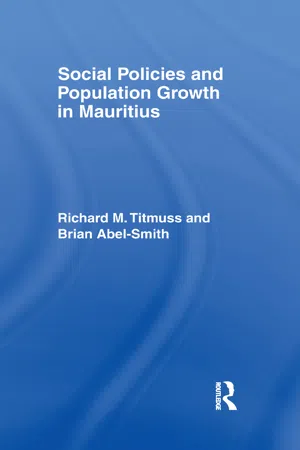
Social Policies and Population Growth in Mauritius
About this book
First Published in 1968. This a report of the Ministerial Committee, to advise the Government of Mauritius as to the provisions to be made for social security, bearing in mind the resources of the territory and the needs of its people.
Trusted by 375,005 students
Access to over 1.5 million titles for a fair monthly price.
Study more efficiently using our study tools.
Information
Topic
HistoriaSubtopic
Historia asiáticaCHAPTER 1
Introduction to the Social Problems of Mauritius
NEEDS AND RESOURCES
In making our recommendations, we are asked to bear in mind both the resources of Mauritius and the needs of its people. We have interpreted these in broad terms. The social services which a country requires depend on a variety of factors. They depend on the history of the country insofar as these affect social, economic and cultural determinants. They depend upon the ethnic composition of the country and its social structure. They depend on religious and political factors, the quality of the administration, and on the viability of the economy. We have had not only to take account of the past and present of Mauritius, but to form some view of the future to which the population aspires. Mauritius is in a state of rapid change from a low-income cash economy with a strong and extensive kinship system to a society which aspires to a higher national income per head and to a more westernised way of life.
We have assembled in this Report many facts about the past and present of Mauritius. We wish to set out the main heads in this chapter partly to make clear the assumptions on which we have formulated our proposals, and partly to enable those who are less familiar with the island to appreciate its problems in a broad perspective. If our views are of value to the people of Mauritius, they may also be of value to other countries at a similar stage of development. It is for these reasons that we include information which will be broadly familiar to many of our readers.
In the first part of this chapter we outline some of the essential facts about the people of Mauritius—their origins, their history, their religions, their homes and schools and occupations. In the second part we summarise the social and economic problems which have been emerging since the Second World War and show how these problems were strikingly magnified by the cyclones of 1960. This introduction does no more than exhibit the essential interrelationships of the themes developed in much greater detail in later chapters.
We are by no means the first to consider these questions though our perspective is no doubt broader than that adopted by other students of Mauritius. In Appendix E, we give a chronological list of the commissions, committees and official investigations into social conditions and social policy since the Royal Commission of 1909. There has been no lack of pertinent enquiries. We trust that our Report will not suffer the fate of many of its predecessors.
THE WIDER BACKGROUND
The island of Mauritius is situated in the Indian Ocean, some 500 miles east of Madagascar. It is about 720 square miles in area and supports a population of over 600,000 people. Although just inside the tropics, Mauritius has a temperate climate which favours the production of sugar. This is by far the most important crop grown on the island. The Government is encouraging the development of other crops such as tea and tobacco, but these at present are largely for the local market. Sugar constitutes almost the total of the island's exports. There is as yet little industrial development.
Mauritius was first colonised by the Dutch in the seventeenth century. They found the island uninhabited and imported slaves from Madagascar. The settlement was not a success and the Dutch abandoned it in 1710. Five years later, France laid claim to the island and gave it the name of Ile de France. It remained in French hands until 1810, when it was occupied by the British during the Napoleonic War. By the Treaty of Paris in 1814, the island was finally ceded to Great Britain, and its name changed again to Mauritius. The French settlers were permitted to retain their language and religion. As a result, French and English are both still spoken on the island. English is used for official purposes. The most commonly heard language, however, is Creole, a colourful language mainly derived from French.
The population of the island rose to nearly 60,000 by 1797, including 50,000 slaves from Madagascar and Africa. Under British rule it continued to expand rapidly, and by 1833 it had reached 100,000—three-quarters of whom were slaves. In 1835, the slaves were freed, and a sum of £2 million was paid to their owners as compensation. This raised problems on the sugar plantations as the newly-freed slaves were not anxious to continue to work on them. The planters responded by importing indentured labourers from India. This immigration gave a new impetus to the growth of the population, which increased from 183,000 to 313,000 between 1851 and 1861. After this the rate of increase slowed down; at the turn of the century the population totalled about 370,000 and in 1944 it was still only about 420,000. Since then, however, there has again been a very rapid increase, caused not by immigration but by the combination of a high birth-rate with a sudden fall in mortality following the eradication of malaria.
As a result of the heavy immigration of the nineteenth century the ethnic composition of the population changed dramatically. From an exploited minority of immigrant labourers, the population of Indian descent has grown until it now accounts for about 67 % of the people of Mauritius. Some 29 % are classified as “general population”, including “Europeans and descendants of Europeans, and people of African and mixed origin”. Very few of these would claim to be of “pure” European descent. The remaining 4% of the population are Chinese.
This classification of the population can only be regarded as very approximate. It is becoming less meaningful as the result of intermarriage. It nevertheless broadly reflects the occupational distribution. Ownership of most of the larger sugar estates still remains in the hands of the descendants of the original French owners, from whose number come most of the senior staff on the estates. The labourers on the sugar estates are mainly of Indian origin; as are the 18,000 small planters who own about 16% of the sugar land. The “creoles”, people of mixed origin, are more generally to be found in the towns and until recently provided most of the recruits to the higher ranks of commerce and the civil service. They have inherited from the days of slavery a prejudice against agricultural labouring work, though this section of the population does provide a proportion of the more skilled workers on the estates. The Chinese section provides most of the island's shopkeepers. There is a “Chinese” shop in every village, providing nearly all the goods required by the local community. Both Indian and Chinese sections are now making an increasing contribution to the professions and administration.
Religious divisions also follow broadly the lines of the ethnic classification. The “general population” is mainly Catholic, while the Indian section is either Hindu or Muslim. Many of the Chinese are Catholics, while others are Buddhists. The Church of England has some adherents in all sections of the population.
The sugar industry is the largest source of employment. Mr. R. W. Luce estimated that in March 1958 it accounted for 51,000 of the 174,000 employed persons in the island. Other agricultural and similar activities, including fishing, accounted for 23,000. There were 30,000 in service occupations (ranging from professional to domestic service), 23,000 in manufacturing industries, 17,000 in commerce, 12,000 in the building industry, and 9,000 in the transport and communication industries. It is not uncommon for women, including married women, and particularly among the poorer classes, to work; in 1958 they accounted for 26% of all employed persons. Between 1952 and 1958, the proportion of females aged 14 and over who were economically active, including the unemployed, rose from 21 % to 33%. There was only a small increase in the proportion of economically active males during the same period despite a large rise in the number of boys leaving school.*
The present system of social services in Mauritius is a product of the history of the island. A variety of provisions were made in the nineteenth century for the protection of the immigrant Indian labourers. Thus, provisions were made under the Poor Law for outdoor and indoor relief. In addition, a system of medical care was evolved, consisting both of hospitals and of dispensaries. We describe these developments in some detail in the chapters dealing with the particular services. In addition to these public services, planters were required by law to provide medical care for some of their employees.† From this legislation there has grown up a system of dispensaries and hospitals on the sugar estates. The terms and conditions of service laid down under the Labour Ordinance for the sugar and other industries have been improved and certain social security provisions have been introduced. Social security has thus developed in two separate streams—on the one hand, provision under the Poor Law, subject to inquiry into means and with requirements that relatives should support the impoverished members of the family; and on the other, legislation which has guaranteed minimum wages and provided to a limited extent housing, sickness, maternity and other benefits for employees of particular industries.
There have been two breaches in the principles of the Poor Law. First, in 1931, provision was made for workmen's compensation. We describe this legislation in Chapter 6. Secondly, in 1950, provision was made for old age pensions. They were first subject to a means test, but this was abandoned in 1957.
Primary education is available to all, free of charge, and although it is not compulsory nearly all children of primary school age attend school. Of the 107,000 primary pupils in January 1960, over 60,000 were enrolled at the 113 Government primary schools. Most of the remainder were at Government-aided denominational schools, of which there are 72 in all, including 49 Catholic and 17 Church of England schools. Secondary education is more limited—there are 107,000 primary school places but only some 18,500 secondary school places. There are three Government secondary schools and eight “ approved” secondary schools which receive a Government subsidy. In these, higher standards, both academic and physical, are maintained. However, nearly 80 % of secondary pupils attend unaided schools, most of which leave much to be desired. Often they are housed in totally unsuitable premises, where unqualified teachers, themselves products of these schools, impart what little academic knowledge they possess to large and overcrowded classes of children.*
The education provided in both primary and secondary schools is geared to a system of Government scholarships. These heavily determine the values and content of the educational system. There are 128 scholarships giving free tuition in Government or aided secondary schools, free travelling and a grant of Rs. 300 a year. In addition, there are six “English scholarships” each year. The winners of these scholarships are offered a university course in a subject of their choice, either in England or elsewhere. Their passage is paid and they receive a living allowance. Of the 36 laureates who won English scholarships in the six years 1953–58, 21 chose to study medicine. The estimated cost of the English scholarships for the year 1959/60 is Rs. 280,000. We refer to this system again in Chapter 9. Other scholarships (normally five each year) are awarded to Mauritian students by the Government of India.
The educational system as a whole has a pronounced academic rather than a practical slant. Its implied aim is to prepare large numbers of young people for clerical and administrative posts. As long ago as 1909, a Royal Commission commented forcibly on the system:—
“Although the community is almost entirely an agricultural one, hardly anything is done to give either theoretical or practical instruction in agriculture … At present the child of an Indian agricultural labourer or small holder learns, out of school, to speak his Indian mother tongue and the local dialect, founded on French and known as Creole.“In school, he is taught a certain amount of English and French, which, if he follows his father's calling, he will seldom or never use again. He thus obtains a smattering of four languages and an adequate knowledge of none. The nature of his schooling naturally leads him to aspire to become a clerk or adopt some other calling not entailing manual labour. The field of employment open to such youths is small in a Colony like Mauritius, and the result is that a considerable proportion of them become unemployed loungers, living on the scanty earnings of their parents. It is for these reasons amongst others, that we strongly recommend the introduction of technical and agricultural training.”*
The passing of half a century has left the problem virtually unchanged. The competition for non-manual employment, and especially for the security of Government employment, is greater than ever, and there is a large and increasing number of young people whose education has fitted them (in their own eyes at least) for employment of a higher status than is available to them. Apart from the Agricultural College, the only real centre of technical education is the Central Prison. Here excellent training is provided in furniture making, shoe making, tailoring and other trades. Selection for technical education is at present based not on aptitude but delinquency.
The educational system and its implications ...
Table of contents
- Cover
- Half Title
- Full Title
- Copyright
- Contents
- Letter to His Excellency The Governor of Mauritius
- CHAPTER 1 Introduction to the Social Problems of Mauritius.
- CHAPTER 2 The Present Social Services
- CHAPTER 3 The Problem of Population
- CHAPTER 4 The Dilemma of Public Assistance
- CHAPTER 5 Social Insurance and Pensions
- CHAPTER 6 Industrial Injuries and Diseases
- CHAPTER 7 Family Needs
- CHAPTER 8 A National Assistance Board
- CHAPTER 9 The Fundamental Problems of Medical Care
- CHAPTER 10 A National Health Service
- CHAPTER 11 Institutional Care
- CHAPTER 12 Social Policies and Population Growth
- APPENDIX A List of Organisations and Individuals who submitted Evidence, etc.
- APPENDIX B Population Estimates and Projections
- APPENDIX C Income Tax Statistics
- APPENDIX D Diet Sheet submitted in Evidence
- APPENDIX E Official Enquiries into Social Conditions and Problems in Mauritius, 1910–1960
- APPENDIX F Estimated Cost of Social Insurance, Non-contributory and Welfare Benefits
- Index
Frequently asked questions
Yes, you can cancel anytime from the Subscription tab in your account settings on the Perlego website. Your subscription will stay active until the end of your current billing period. Learn how to cancel your subscription
No, books cannot be downloaded as external files, such as PDFs, for use outside of Perlego. However, you can download books within the Perlego app for offline reading on mobile or tablet. Learn how to download books offline
Perlego offers two plans: Essential and Complete
- Essential is ideal for learners and professionals who enjoy exploring a wide range of subjects. Access the Essential Library with 800,000+ trusted titles and best-sellers across business, personal growth, and the humanities. Includes unlimited reading time and Standard Read Aloud voice.
- Complete: Perfect for advanced learners and researchers needing full, unrestricted access. Unlock 1.5M+ books across hundreds of subjects, including academic and specialized titles. The Complete Plan also includes advanced features like Premium Read Aloud and Research Assistant.
We are an online textbook subscription service, where you can get access to an entire online library for less than the price of a single book per month. With over 1.5 million books across 990+ topics, we’ve got you covered! Learn about our mission
Look out for the read-aloud symbol on your next book to see if you can listen to it. The read-aloud tool reads text aloud for you, highlighting the text as it is being read. You can pause it, speed it up and slow it down. Learn more about Read Aloud
Yes! You can use the Perlego app on both iOS and Android devices to read anytime, anywhere — even offline. Perfect for commutes or when you’re on the go.
Please note we cannot support devices running on iOS 13 and Android 7 or earlier. Learn more about using the app
Please note we cannot support devices running on iOS 13 and Android 7 or earlier. Learn more about using the app
Yes, you can access Social Policies and Population Growth in Mauritius by Brian Abel-Smith,Richard M. Titmuss in PDF and/or ePUB format, as well as other popular books in Historia & Historia asiática. We have over 1.5 million books available in our catalogue for you to explore.