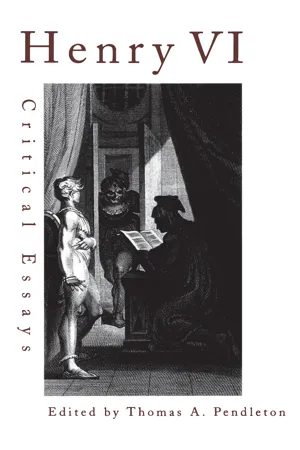
This collection of original essays provides a selection of current criticism on the Henry VI plays. Topics addressed will include feminist commentaries on the play, the principal of unity in the trilogy, the tradition of illumination of the play, textual variations, and finally, anachronism and allegory.
- 316 pages
- English
- ePUB (mobile friendly)
- Available on iOS & Android
eBook - ePub
About this book
Information
FOLK MAGIC IN HENRY VI, PARTS 1 AND 2:
TWO SCENES OF EMBEDDING
While problems of authorship, the use of sources, the authority of texts and, more recently, gender and politics, have been central in discussions of the three parts of Henry VI, the drama itself has received limited critical attention as an imaginative construct about war and disorder. Critics have recognized its disjointed, episodic qualities that play havoc with history and causation, and they have duly noted the shabby treatment of Joan of Arc, Lady Eleanor, and Queen Margaret.1 Concern with these matters, however, has obscured the canonical importance of Shakespeare’s first or very early group of plays and has overlooked the imaginative strategies Shakespeare developed for the encoding and production of meaning. Although the introduction of the demonic or magical scenes in Parts 1 and 2 is often ignored or dismissed as extraneous, renewed interest in Renaissance magic, witchcraft, and women has urged a reexamination of these scenes and leads me to a very different assessment.
The texts of Henry VI, Parts 1 and 2,2 interrupt their diachronic schemes to introduce several embedded scenes, all highly reflective of the thematics of the outer play, which are mises en abyme of sorts. Two of the scenes are demonic interludes with misogynist subtexts, which engage the audience in vivid spectacle and produce synchronic “readings” or interpretations of the principal text. The contained scene of Part 1 allows the appearance of fiends as familiars of Joan of Arc, thus presenting dramatic and “ocular proof” of English assertions that she employed witchcraft to defeat England’s heroes; in Part 2, another contained scene introduces the conjurers who perform magic for Lady Eleanor, linking her to witchcraft, charges of treason, disgrace, and the ultimate downfall of the Lancasters. At the heart of the two scenes are subtextual signifiers of evil causation derived from popular beliefs about dangerous women, particularly those of “manly” disposition, which conformed with common folklore about women, witches, and conjurers.3 These beliefs, reinforced in actuality by Church and State, fed into the political unrest and concern over Queen Elizabeth’s rule in the troubled years near the century’s end. While seemingly extraneous, Shakespeare’s demonic scenes are, in fact, integral to the principal texts. They call up referential meanings validated by the historical fiction of the plays and, although dependent on the complicity of a superstitious and misognynist audience for their full impact, may be appreciated as strategic devices which strengthen the structure of the whole.
Structurally, these scenes—that is, the mises en abyme—constitute a microtext or microcosm of the principal texts, which may double or oppose or ambiguate the thematic concerns of the play. The mise en abyme, it will be recalled, is a structural device named by Andre Gidé from heraldic imagery, in which a figure en abyme appears at the center of the shield and is a miniature replica of the shield itself. In The Mirror in the Text, Lucien Dallenbach describes the duplication en abyme as a kind of “reflexion” by “which a work turns back on itself” to give “meaning and form to the work” (1-2, 9). In drama, it is an “interior duplication,” like the internal play in Hamlet, which holds a mirror up to Claudius’s guilt (12). But the concept is not simply that of a reflecting mirror. Like the mirror or window of Renaissance art, which is “embedded” in the composition, the mise en abyme can deepen meaning by reflecting the world within the frame or by extending meaning beyond the canvas. It can also have a circular structure—implicit at the beginning, explicit at a later point, as in Hamlet, where the Ghost’s story is later amplified and verified in “The Mousetrap.” The device can also be a tale within the tale, a puppet show, festivities, or a song introduced to the larger structure, having symbolic, allegorical, or metatheatrical import. And its purpose can be ambivalent as well as definitive. In Part 2 of Henry VI, the comic interlude of Simpcox’s “miracle” in 2.1 exposes the beggar’s fakery unequivocally, reflecting a common crime among charlatans of the time who exploited the superstitious with magical tricks for personal gain. It is followed in the same scene by grim certainties in the sentencing of “the witch” Margery, her cohorts, and Lady Eleanor. Next in the same scene is the trial by combat between the apprentice Peter and his master Horner. Although using different terms, Phyllis Rackin describes the mise en abyme and the ambivalent function of this trial:
A trial by combat constitutes a miniature plot that stages conflicting propositions about historical truth in the form of physical action, its outcome designed to ratify one proposition and discredit the other. As such, it exhibits in simplified microcosm the dynamics of the larger and more complicated plots of the plays. (54)
When Peter defeats Horner, disrupting the servant-master order of society, Shakespeare offers two views of the trial’s surprising outcome to reflect major dichotomies in the play. On the one hand, King Henry believes providential justice has been accomplished by Horner’s defeat and confession; on the other, York offers Peter an opposing interpretation: “Fellow, thank God, and the good wine in thy master’s way” (2.3.92-93). Horner’s drinking and not providence has brought the traitor to justice.
The mise en abyme often calls attention to itself by an announcement or a striking interruption in the main play and by startling closure. The cry “A miracle!” (2.1.SD 56) introduces the Simpcox interval, which ends when Simpcox is whipped and runs away (SD 150). Trumpets sound for Hamlet’s play to begin (3.2.SD 135); it ends when Claudius interrupts with the cry, “Give me some light. Away” (269). At other times, the device may be introduced more ominously with the sound of thunder or show of lightning. Often the abyme creates “the illusion of mystery and depth,” as C. E. Magny has written, a concept which aptly applies to the hellish shapes rising from the stage trap which signifies the abyme, literally the “abyss” with connotations of depth, infinity, vertigo, and falling. In Henry VI, two of the mises en abyme provide horrific associations with women and evoke demonic reflections on the historical or referential disorders of the so-called Hundred Years War, the contentions of cousins in the War of the Roses, and the witch-hunt hysteria of the fifteenth and sixteenth centuries. Together these embedded scenes emit strong signals for the reception of meanings: “low” magic tells truth; Elizabethan policy thrives in the knowledge that the Tudor regime has fulfilled God’s providential plan for national harmony in the legitimate and virtuous body of the reigning queen. Yet opposing anxieties, encoded within both sub- and main texts and produced by disorders in the past, figured in terms of history’s dangerous women, remain underlying threats in the uncertain Elizabethan present.
Shakespeare determined the reception of these embedded scenes by responding to popular interest in plays with Faustian themes which expressed a common belief in spirits and echoed the painful conflict within Renaissance society between traditional folk knowledge of witchcraft or “low magic” and humanist challenges to these inherited beliefs, advanced in learned theses on occult philosophy or “Neoplatonic magic.” Church authorities believed in witch lore and persecuted its practitioners, while the learned “magi” claimed virtue in taming spirits and argued that occult practice gave mankind the creative power to conquer the unknown (Mebane 98ff.; Levack x). To the extent that the Renaissance stage bears witness to popular interest in magic, sorcery, and witchcraft, the period of attraction was relatively short, beginning in the 1570s, peaking in the 1590s, waning by 1614, and little more than an extended metaphor in the 1620s (Traister 33, 157, 179). The Henry VI plays were performed at the peak of theatrical interest, giving rise to modern assessments that the witches’ scenes were mere crowd-pleasers, unnecessary to the plots. For many Elizabethans, however, the demonic shows reinforced belief and established providential causation, even as they may have provoked debate among the skeptical.
Witchcraft lore was based on a continuum of ancient magical practice of the people and Christian ideology; it was crystallized in the twelfth-century Church and culminated in the inquisitorial procedures of the fourteenth century. The advent of print made it possible to perpetuate these ancient superstitions in demonological literature, notably represented by Jakob Sprenger and Heinrich Kramer in Malleus maleficarum (1486ff.), which became “the standard manual for the persecution of witches for two centuries” (Mora lv, xlv). At least thirty-four editions of Malleus maleficarum appeared between 1486 and 1669, mainly during 1486-1520 and 1574-1621 when persecutions were at their height, the latter period coinciding with Shakespeare’s career. In 1582 alone, 300 women were condemned on the Continent for causing calamities in the guise of werewolves (Mora xlv). Although aristocratic women such as the queen widow of Henry IV, Lady Eleanor, and Ann Boleyn were accused of witchcraft for political reasons, it was commonly held that wicked women and wizards were of the lower class, that they met with fiends at night, had sexual relations with demons, practiced pagan blood rituals, could bewitch neighbors, cause storms, change form, and injure livestock.
More skeptical views of witchcraft were also current. Besides stage satires of fake magicians which circulated widely in the last quarter of the century, there were serious discussions challenging witch belief. In De praestigiis daemonum (1563), which appeared in numerous editions before the end of the sixteenth century, the physician Johann Weyer declared outright that alleged witches were disturbed but innocent victims of superstition, that accusers were usually frightened or jealous neighbors, that pacts with the devil were impossible, and that the magistrates who tried and condemned witches were deluded. Weyer was supported in English publications by Reginald Scot [The Discoverie of Witchcraft, 1584) and Samuel Harsnett (A Discovery of the Fradulent Practices of John Darrell, 1599), but his work had been placed on the Index Librorum Prohibitatorum 1570 and was regularly discredited by both religious and political figures, such as Jean Bodin in De la demonomanie des sorciers (1580) and King James I in Daemonologie (1597, 1603). In short, witchcraft lore, reinforced by church and political authorities, continued to inform popular culture, even in distant Salem, until the end of the seventeenth century (Mora lxix-lxxi, lxxxiv; Mebane 98ff).
Today’s scholars seek causation of the Renaissance witch-hunt from modern perspectives, some finding it in the overwhelming psychological stresses of simple people beset by religious wars, devastating storms, mysterious deaths of humans and animals, and ancient superstitions expressed in a “universal contempt toward women [which] must serve as a background for any understanding of the Renaissance witch-hunt” (Mora li). Other scholars add a political perspective, recognizing that for doctrinal and political reasons both Church and State defended witch-hunting, asserting power by exploiting common fears of eccentric women. Whether shepherd’s daughter, duchess, or queen, a woman might be accused of witchcraft if a political scapegoat were needed, and for other political and doctrinal reasons opposing forces might defend her. As Constance Jordan points out, Joan’s reputation in the sixteenth century often controverted English opinion “as the result of shifts in political power”: Italian and French writers praise Joan’s “successful liberation of France,” note “that her fellow countrymen regarded her as divine,” saw her deeds as the expression of God’s will, and commended her virtuous constancy (75n, 204, 210). In contrast, the Tudor position on Joan and Eleanor was defensive. Edward Hall’s account (1543) justifies Joan’s prosecution for her great crimes against the English, and Raphael Holinshed (1587) “details contradictory accounts” of her death to mock her defenders (Levine 43-44). Eleanor’s histories also became somewhat controversial. The certainty of her treasonous necromancy, advanced in the early Yorkist chronicles, is challenged on doctrinal grounds in Foxe’s Acts and Monuments (1570). But, although hints of political animosity behind Eleanor’s case entered Tudor accounts of her life, these later histories did not clear her of the charges brought against her (Levine 50-58; Howard 136).
In Henry VI, Shakespeare evoked traditional beliefs in witchcraft and, through contradictory or circular structures of the mises en abyme, reaffirmed the misogynist histories condemning Joan and Eleanor, even as opposing histories attempted to defend them. Shakespeare’s strategy for producing meaning in Part 1 is signaled by the mise en abyme located near the end of the text (5.3), after the French flee in defeat. To the noises of “Alarum” and “Excursions,” Joan enters alone to work her witchcraft. The mise en abyme which ensues calls attention to itself by Joan’s magical chant and the sounding of thunder: “Now help, ye charming spells and periapts [amulets],/ And you choice spirits that admonish me” (5.3.2-3). Thus, with blasphemous invocation, Joan leaves the historical frame of the play and enters the mise en abyme to perform as a witch, inducing thunder and uttering conjurations to summon the “speedy helpers” that serve “the lordly Monarch of the North” (that is, the Devil) to her aid. The Fiends (perhaps with monstrous heads and hairy suits) appear promptly from “under earth,” for the the stage trap has opened Hell’s abyme, introducing “internal space... into the very heart of the work” and suggesting an infinite series of parallels with the surrounding text (Magny 271). To the spirits Joan declares:
This speedy and quick appearance argues proof
Of your accustom’d diligence to me.
Now, ye familiar spirits, that are cull’d
Out of the powerful regions under earth,
Help me this once, that France may get the field. (5.3.9-12.)
Joan’s voice has been altered in this speech, for the voice heard here is inappropriate to this speaker. It is not Joan who needs to “argue proof,” but the author who, probably in a forgetful moment, usurps Joan’s voice to have her accuse herself of “accustom’d” demonic practice. The English have so charged her throughout the play. At the same time she pleads for “help... this once,” apparently a fracture in the text which refers to the Fiends’ first appearance on stage, although it also seems to argue that Joan has had no prior assistance from the lower world.
The position of the mise en abyme near the end of Part 1 has an important bearing on its reception, for it “argues proof” for the first time and forces the reader/viewer to readjust earlier receptions of Joan’s character. Whereas some of Shakespeare’s audience would accept English assessments of her victories as witchcraft from the start, skeptics must now replace doubt for certainty. In Dällenbach’s theoretical system of analysis, the mise en abyme may be placed at the center or end of a text and made suddenly to “appear as the opposite of the dominant reception and as such is unsurpassed as a means for bringing contradiction into the heart of reading [or viewing] activity” (1979-1980:445). By usurping Joan’s voice in the self-condemnation of Act 5, the author brings into play a competing “reading” or interpretation which challenges the foregrounded text and calls for a second or recursive “reading” of the entire play that resolves earlier ambiguities.
Initially, the reception of Joan is ambivalent, balanced between Pucelle and Puzel (virgin and whore). However, the mise en abyme with its inverted point of view dramatizes and subverts this initial balanced reception. Joan la Pucelle arrives on the scene as a “holy maid... / Which by a vision sent to her from heaven” will drive out the English (1.2.51-54). Although she is a “shepherd’s daughter” (1.2.72), the French ac...
Table of contents
- Cover
- Half Title
- Title Page
- Copyright
- Dedication
- Table of Contents
- Acknowledgments
- General Editor’s Introduction
- Introduction
- Texts With Two Faces: Noticing Theatrical Revisions in Henry VI, Parts 2 and 3
- A Touch of Greene, Much Nashe, and All Shakespeare
- Henry VI in Japan
- The Progress of Revenge in the First Henriad
- Shakespeare’s Queen Margaret: Unruly or Unruled?
- The Paper Trail to the Throne
- Folk Magic in Henry VI, Parts 1 and 2: Two Scenes of Embedding
- Shakespeare’s Medieval Devils and Joan la Pucelle in 1 Henry VI: Semiotics, Iconography, and Feminist Criticism
- Climbing for Place in Shakespeare’s 2 Henry VI
- Henry VI, Part 2: Commodifying and Recommodifying the Past in Late-Medieval and Early-Modern England
- Theme and Design in Recent Productions of Henry VI
- Talking with York: A Conversation with Steven Skybell
- Henry VI: A Television History in Four Parts
- Henry VI and the Art of Illustration
- Bibliography
- Index
Trusted by 375,005 students
Access to over 1.5 million titles for a fair monthly price.
Study more efficiently using our study tools.
Frequently asked questions
Yes, you can cancel anytime from the Subscription tab in your account settings on the Perlego website. Your subscription will stay active until the end of your current billing period. Learn how to cancel your subscription
No, books cannot be downloaded as external files, such as PDFs, for use outside of Perlego. However, you can download books within the Perlego app for offline reading on mobile or tablet. Learn how to download books offline
Perlego offers two plans: Essential and Complete
- Essential is ideal for learners and professionals who enjoy exploring a wide range of subjects. Access the Essential Library with 800,000+ trusted titles and best-sellers across business, personal growth, and the humanities. Includes unlimited reading time and Standard Read Aloud voice.
- Complete: Perfect for advanced learners and researchers needing full, unrestricted access. Unlock 1.5M+ books across hundreds of subjects, including academic and specialized titles. The Complete Plan also includes advanced features like Premium Read Aloud and Research Assistant.
We are an online textbook subscription service, where you can get access to an entire online library for less than the price of a single book per month. With over 1.5 million books across 990+ topics, we’ve got you covered! Learn about our mission
Look out for the read-aloud symbol on your next book to see if you can listen to it. The read-aloud tool reads text aloud for you, highlighting the text as it is being read. You can pause it, speed it up and slow it down. Learn more about Read Aloud
Yes! You can use the Perlego app on both iOS and Android devices to read anytime, anywhere — even offline. Perfect for commutes or when you’re on the go.
Please note we cannot support devices running on iOS 13 and Android 7 or earlier. Learn more about using the app
Please note we cannot support devices running on iOS 13 and Android 7 or earlier. Learn more about using the app
Yes, you can access Henry VI by Thomas A. Pendleton in PDF and/or ePUB format, as well as other popular books in Literature & Literary Criticism. We have over 1.5 million books available in our catalogue for you to explore.