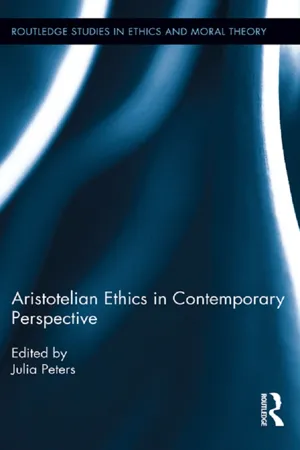
By bringing together influential critics of neo-Aristotelian virtue ethics and some of the strongest defenders of an Aristotelian approach, this collection provides a fresh assessment of the strengths and weaknesses of Aristotelian virtue ethics and its contemporary interpretations. Contributors critically discuss and re-assess the neo-Aristotelian paradigm which has been predominant in the philosophical discourse on virtue for the past 30 years.
- 238 pages
- English
- ePUB (mobile friendly)
- Available on iOS & Android
eBook - ePub
Aristotelian Ethics in Contemporary Perspective
About this book
Information
Part I
Themes in (Neo-)Aristotelian Virtue Ethics
1 Aristotle on Virtue
Wrong, Wrong, and Wrong
Recent decades have seen a revival of philosophical interest in moral virtue. Prompted initially by an article of Elizabeth Anscombe’s,1 it has generated a school of thought called ‘virtue ethics’ that’s now often seen as a third main ‘method of ethics’ alongside consequentialism and deontology. While Mill and Kant are the classical exponents of these views, the classical exponent of virtue-based ethics is commonly taken to be Aristotle; the rise of virtue ethics has therefore been the rise of an Aristotelian approach to the subject.
I agree that moral virtue is an important moral concept, but I think Aristotle is the wrong figure to look to for insight into it. Many of his central claims about virtue are mistaken, and present-day virtue-ethical theories that embrace them are therefore misguided. This chapter develops a critique of Aristotle’s account of virtue, but it first sketches a better account by contrast with which the flaws in his become evident.
VIRTUE AS A HIGHER-LEVEL GOOD
This account was widely accepted in the late nineteenth and early twentieth centuries—in Britain by Hastings Rashdall, G. E. Moore, W. D. Ross, and others, in Europe by Franz Brentano and his followers.2 It treats virtue as a higher-level moral concept, involving a relation to items falling under other, independently applied moral concepts. More specifically, it sees the virtues as intrinsic goods that involve morally fitting attitudes to items with other moral properties, and the vices as evils involving unfitting attitudes.
The account’s first proponents were consequentialists and therefore took all the virtues and vices to involve attitudes to items falling under the consequentialist concepts of good and evil. One of their claims was that if something is intrinsically good, then having a positive attitude toward it, that is, desiring, pursuing, or taking pleasure in it—in short, loving it—for itself is another intrinsic good and a form of virtue. Thus, if your pleasure is intrinsically good, my desiring, pursuing, or taking pleasure in it is also good and an instance of virtue, more specifically of benevolence. By contrast, if something is intrinsically evil, loving it for itself is another evil and vicious; thus, my desiring, pursuing, or taking pleasure in your pain for itself is evil and, more specifically, malicious. The fitting and therefore virtuous attitude to an evil such as your pain is negative, involving desire for or pursuit of its absence, or pain at its presence; this hating your pain for itself is good and involves the virtue of compassion. But hating something good, as when I enviously want your pleasure to end, is vicious and evil. Attitudes whose orientation matches the value of their object—positive to positive or negative to negative—are virtuous and good, while ones that oppose it are vicious. There can also be deontological virtues. If an act is right, my wanting to perform it because it’s right is fitting and therefore virtuous—it involves conscientiousness, or a Kantian good will. And it’s likewise virtuous to hate doing what’s wrong. But whether its object is good or right, a virtuous attitude need not care about it as good or right. If your pleasure is good, my wanting it because it’s good is virtuous, but so is my wanting it just because it’s a pleasure and independently of any thoughts about goodness. Likewise, my hating lying is virtuous not only when I think of lying as wrong but also when I just don’t like lying. An attitude to something good or right for the properties that make it so is virtuous even when it doesn’t think of them as good- or right-making.
A complete higher-level account must also say how virtuous or vicious different attitudes are. Here it’s guided by an ideal of proportionality, which says it’s best to love objects in proportion to their degrees of goodness or evil. Thus, a fully virtuous person will be more pleased by another’s intense pleasure than by her mild pleasure, and by as much as the first pleasure is more intense; he’ll likewise be more anxious to relieve a worse pain. Something similar holds for deontological virtues. If some act’s being an instance of lying does more to make it wrong than its promoting pleasure does to make it right, he’ll be more averse to it as an instance of lying than drawn to it as a promoting of pleasure.
However exactly it’s developed, the higher-level account treats the moral virtues as intrinsically good, so they have value not just instrumentally, or for the other goods they promote, but also in themselves. Being benevolent by itself makes your life better and being malicious makes it worse. But the account also makes virtue in several ways a secondary moral concept. First, as a response to items falling under other moral concepts, it can’t be the only or main such concept; unless other things are independently good or right, there’s nothing for it to care fittingly about. Second, as so understood virtue plays only a minor role in the evaluation of actions. Imagine that you can give either a large pleasure to one person or a small pleasure to another. Given the ideal of proportionality, it’s most virtuous to desire the larger pleasure more than the smaller and therefore to produce the larger pleasure. But the claim about virtue isn’t needed to establish that you ought to produce the larger pleasure. That already follows from the fact that it’s the greater good, or from that plus the claim that you ought to produce the most good you can. That in doing so you’ll also act from the most virtuous motive may be an additional reason to do the independently right act, but it can’t change what this act is; that already follows from the facts that make your motive best. Finally, and departing from many of the account’s proponents, I think virtue is a lesser intrinsic good in the sense that it always has less value than its intentional object. Compassion for another’s pain is good, but it isn’t more good than the pain is evil; it can’t be better for there to be pain and compassion for it than no pain and no compassion. Likewise for vice: a torturer’s malicious pleasure in his victim’s pain isn’t as evil as the victim’s pain. If you can eliminate only one of the two, you ought to eliminate the pain.
This is a brief sketch of a ‘higher-level’ account of virtue, and when we turn to Aristotle’s account, we find several points of similarity. He too thinks moral virtue is good in itself, contributing to a desirable life not just instrumentally but in its own right. He also thinks virtue is a matter of your attitudes broadly conceived, of your desires, motives in acting, and pleasures and pains. An act’s virtuousness depends not on its effects or conformity to external moral rules but on inner states such as its motive and accompanying feelings. But on other central issues he’s mistaken.
PRAISE AND BLAME
First a smaller point. In the Nicomachean Ethics Aristotle says the virtues and vices are traits for which we’re praised and blamed (1105b31–1106a1, 1106a7).3 Since he recognizes that praise and blame are appropriate only for things under our voluntary control (1109b30–33), he must hold that virtue and vice are voluntary, and he defends that view in NE III.5. But his arguments for it are unpersuasive.
In one passage he seems to argue that it’s always in our power to act virtuously (1113b3–6), but a virtuous action must be done from a virtuous motive, and someone who’s vicious can’t now produce a virtuous motive in himself.4 He also argues that even if a vicious person can’t now act virtuously, he’s responsible for his vicious action because he could have avoided developing his bad character in the past: vicious people ‘are themselves by their slack lives responsible for becoming men of that kind’ (1114a3–5). But this claim is hard to square with his insistence on the importance for moral virtue of the right childhood training and education (1095b4–12, 1103a15–18, 1103b3–6, 24–25, 1104b11–13, 1105a1–2, 1179b24–27). If you were raised badly by vicious parents, how could you start to develop virtuous desires, and if you couldn’t start, how can you be blamed for not having them now?
The concepts of praise and blame, like those of right and wrong, presuppose voluntariness: you can’t have acted wrongly or be to blame unless you could have done otherwise. But no such requirement governs the concepts of good and evil. A serendipitous pleasure is good even if no one voluntarily produced it, and pain evil even when it’s no one’s fault. The higher-level account makes use of only these last two concepts. It says virtue is intrinsically good and vice evil, and they can be so regardless of how they came about. If Hume and Mill were right that we have innate tendencies to be pleased by others’ pleasure and pained by their pain, the account says we’re naturally virtuous and good, though we deserve no credit for this. If we innately delight in others’ pain, as a bleaker view has it, we’re naturally vicious but not blameably so. Aristotle’s claim that virtue is praised and vice blamed applies the wrong concepts to them, forcing him into implausible arguments about voluntary control. Those arguments aren’t needed if virtue and vice are instead said to be just good or evil.
DISPOSITIONS VS. OCCURRENT STATES
Another issue concerns the primary locus of virtue. We make virtue ascriptions at two levels, one more global and one more local. Speaking globally, we may say someone has the character trait of generosity or is a generous person. More locally, we may say a particular act was generous or a particular feeling malicious. Is one of these two types of ascription primary? Do we first understand the virtues as traits of character and count individual acts or feelings as virtuous only when they issue from such traits? Or do we first identify individual motives and feelings as virtuous and understand a virtuous character as one that tends to produce them?
The higher-level account takes the second view, ascribing virtue properties first to occurrent states such as individual desires, acts, and feelings and only then to dispositions. However, Aristotle takes the first view. He defines virtue as a state of character (hexis) (1105b20–1106a13) and says that to be done virtuously an act must issue from a ‘firm and unchangeable character’ (1105a33–34), otherwise it may be ‘in accordance with the virtues’ (1105a29) but it can’t be fully virtuous. Aristotle doesn’t think the mere possession of virtue is the highest good; that comes only in the active exercise of virtue, as in particular virtuous acts (1095b32–34, 1098b33–1099a6). But they’re only done virtuously if they issue from a stable character.
I think this view is both false to our everyday understanding of virtue and morally mistaken. If you see someone kick a dog just for pleasure, do you say ‘That was a vicious act, on condition that it issued from a stable disposition to perform similar acts on similar occasions’, or just ‘That was a vicious act’. Surely you say the latter. Your remark doesn’t concern only the kick’s physical properties; it turns essentially on the motive from which it was done. But it concerns only its motive at the time, independently of any longer-lasting trait. Or imagine that a friend who normally doesn’t do this gives $20 to a homeless person from concern at the time for his welfare. If you say ‘That was uncharacteristically generous of you’, you don’t contradict yourself. Or imagine that we’re a military committee deciding whether to give a medal for bravery to a soldier who threw himself on a hand grenade, knowing it would kill him and in order to save his comrades. If an Aristotelian says ‘This is a medal for bravery, and we can’t know whether his act was brave unless we know whether he would have acted similarly a week before or a week after’, we’ll throw him out of the room.5
Nor is the issue here just one of terminology. ‘Virtue’ is an evaluative term, in that to call something virtuous is to call it somehow good, and Aristotle’s claim that acts not expressing a virtuous character aren’t done virtuously implies that they aren’t fully good: since they don’t involve the ‘exercise of virtue’, they can’t make the same contribution to your good as ones that do. (Perhaps they make no contribution.) And that seems wrong. Considered just in itself and apart from the other things co-present with it in a life, an out-of-character act of generosity or courage seems every bit as good as one based in a stable disposition. The second act may be accompanied by more acts of similar value in the same life, and that life may be better as a whole, perhaps even in part because it contains enduring virtuous dispositions.6 But Aristotle’s claim that the in-character act is by itself better is unpersuasive. Both analytically and evaluatively, the primary locus of virtue is occurrent desires, actions, and feelings apart from any connection to more stable traits.
THE DOCTRINE OF THE MEAN
A further issue concerns Aristotle’s differentia for the virtues among traits of character, his doctrine of the mean. It says that every virtue is a mean between two vices, and every vice an excess or deficiency with respect to the same feeling as concerns some virtue. Thus the virtue of temperance is a mean with respect to the desire for physical pleasure, a desire the excess of which is self-indulgence and the deficiency of which is insensibility. Courage is a mean with respect to fear, of which the excess is cowardice and the deficiency rashness. Many present-day Aristotelians distance themselves from the doctrine of the mean, but I think something like it can be part of an adequate account of virtue. It can’t be the whole, however, most clearly because of what it says about vice.
By taking all the vices to involve...
Table of contents
- Cover
- Halftitle
- Title
- Copyright
- Contents
- Introduction: Aristotelian Ethics in Contemporary Perspective
- Part I: Themes in (Neo-)Aristotelian Virtue Ethics
- Part II: Beyond (Neo-)Aristotelian Virtue Ethics
- List of Contributors
- Index
Trusted by 375,005 students
Access to over 1.5 million titles for a fair monthly price.
Study more efficiently using our study tools.
Frequently asked questions
Yes, you can cancel anytime from the Subscription tab in your account settings on the Perlego website. Your subscription will stay active until the end of your current billing period. Learn how to cancel your subscription
No, books cannot be downloaded as external files, such as PDFs, for use outside of Perlego. However, you can download books within the Perlego app for offline reading on mobile or tablet. Learn how to download books offline
Perlego offers two plans: Essential and Complete
- Essential is ideal for learners and professionals who enjoy exploring a wide range of subjects. Access the Essential Library with 800,000+ trusted titles and best-sellers across business, personal growth, and the humanities. Includes unlimited reading time and Standard Read Aloud voice.
- Complete: Perfect for advanced learners and researchers needing full, unrestricted access. Unlock 1.5M+ books across hundreds of subjects, including academic and specialized titles. The Complete Plan also includes advanced features like Premium Read Aloud and Research Assistant.
We are an online textbook subscription service, where you can get access to an entire online library for less than the price of a single book per month. With over 1.5 million books across 990+ topics, we’ve got you covered! Learn about our mission
Look out for the read-aloud symbol on your next book to see if you can listen to it. The read-aloud tool reads text aloud for you, highlighting the text as it is being read. You can pause it, speed it up and slow it down. Learn more about Read Aloud
Yes! You can use the Perlego app on both iOS and Android devices to read anytime, anywhere — even offline. Perfect for commutes or when you’re on the go.
Please note we cannot support devices running on iOS 13 and Android 7 or earlier. Learn more about using the app
Please note we cannot support devices running on iOS 13 and Android 7 or earlier. Learn more about using the app
Yes, you can access Aristotelian Ethics in Contemporary Perspective by Julia Peters in PDF and/or ePUB format, as well as other popular books in Philosophy & Ancient & Classical Philosophy. We have over 1.5 million books available in our catalogue for you to explore.