eBook - ePub
Collective Rights of Indigenous Peoples
Identity-Based Movement of Plain Indigenous in Taiwan
- 156 pages
- English
- ePUB (mobile friendly)
- Available on iOS & Android
eBook - ePub
Collective Rights of Indigenous Peoples
Identity-Based Movement of Plain Indigenous in Taiwan
About this book
The focus of this book is on the PingPu peoples in Taiwan and their right to official recognition as "indigenous peoples" by the Taiwanese government. The result of centuries of colonization, indigenous tribes in Taiwan have faced severe cultural repression because of the government's refusal to accept ethnic, racial, and cultural diversity. The PingPu Status Recognition Movement is the result of a decade of activism by impassioned people seeking the right to self-determination, autonomy, and tribal legitimacy from the Han-Chinese-controlled Taiwanese government.
This book examines, through in-depth interviews, questionnaires, field observations, and analysis of governmental and United Nations documents, the perspectives of those directly involved in the movement, as well as those affected by "indigenous" status recognition. Study of the PingPu Indigenous movement is vitally important as it publicly declares Taiwanese Indigenous population's humanity and collective rights and provides a more comprehensive analysis of identity-based movements as a fundamental form of collective human rights claims.
Information
Chapter One
Introduction
Taiwanese indigenous populations have seen their territory colonized by several countries and dynasties since the seventeenth century. These include the Netherlands, Spain, Chinese Ching Dynasty, Japan and finally the Chinese Nationalist government of Chiang Kai-Shek. Rapid economic development in Taiwan has brought political and societal changes since the 1980s. Among the reform efforts, the lifting of the 38-year-old martial law decree on July 15, 1987, was the pivotal historic event. The lifting of martial law has provided a foundation for a wide array of reforms, including a liberalized policy toward the formation of political parties voluntary associations and the liberalization of the press. These reforms have created a liberal, more democratic, pluralistic society on the island. By amending and protecting fundamental rights and needs through the process of constitutional and regulatory reform, increasing citizen involvement in challenging social power structures has become a core theme in the reform movement.
One major manifestation of social reform movements within Taiwan is the indigenous peoples’ movement. Distinguished from the majority Han-Chinese peoples, indigenous tribal groups are part of the Malayo-Polynesians. One of the known tribes is the PingPu. Linguistically, each tribe is a subgroup of the Austronesian-speaking family. Hence, they are also called Austronesians. Although their languages derive generically from Austronesian, the languages they currently speak are not mutually intelligible among the groups. Over the past century, like other indigenous populations around the globe, Taiwanese indigenous peoples have faced the collapse of their population, territory, culture, and traditional society, and personal values. Before discussing the specifics of the research project, I will provide a brief background of the indigenous peoples’ movement in Taiwan and the PingPu Peoples.
INDIGENOUS MOVEMENT IN TAIWAN
Indigenous peoples1 were perceived as “savages” in nineteenth-century Europe and “Fan” to the Chinese, so policies of both segregation and assimilation were enforced in Taiwan against indigenous peoples. Yet, as the result of their awareness of cultural destruction and discrimination, Taiwanese indigenous peoples not only made consciousness raising an important aspect of their collective rights and needs, but they also created their own movement. In such social reform movements, indigenous peoples are often motivated by the desire to overthrow politically corrupt regimes in order to fight against racial/ethnic discrimination and structural violence, seeking greater social justice to fit their special needs.
Goodwin and Jasper (2003) define the need for social movements in this way; “A social movement is a collective, organized, sustained, and noninstitutional challenge to authorities, powerholders, or cultural beliefs and practices,” and that “Social Movements are conscious, concerted, and sustained efforts by ordinary people to change some aspect of their society by using extra-institutional means” (3). Goodwin and Jasper pose a necessary question,
Why study social movement? … They are often the first to articulate new political issues and ideas. As people become attuned to some social problem they want solved, they typically form some kind of movement to push for a solution. Political parties and their leaders are rarely asking the most interesting questions, or raising new issues; bureaucracy sets in, and politicians send insiders to recognize new fears and desires.… Social movements raise the famous Hobbesian problem of social order: why do people cooperate with each other when they might get as many or more benefits by acting selfishly or alone? … Social movements are one central source of social change (2003, 5).2
Thus, social activism and the indigenous people’s movement have become major strategies for the Taiwanese indigenous population to prevail in gaining their collective rights and cultural survival.
Historically, from a power-conflict perspective, the past few hundred years in Taiwan have been about Austronesian indigenous peoples and Han-Chinese immigrants’ relations, interaction among different tribes, and conflicts among different Han ethnic immigrant populations and the Austronesians. Currently, only twelve tribes are recognized officially as indigenous peoples, and the remaining have been assimilated into the Han-Chinese people through a policy of “modernized” and “civilized” indigenous populations. From a critical indigenous peoples’ perspective, modernization and civilization are primarily ideologies that rationalize their destruction. In other words, a modernizing society presumes the superiority of their way of life and the inferiority of indigenous cultures and peoples. In the name of modernization and civilization, their indigenous status has “disappeared,” their culture has suffered genocide, and their land and resources have been stolen.
“The only good Indian is a dead Indian” is a well-known saying that was coined by General Philip H. Sheridan during the Indian Wars period of United States (U.S.) history.3 This was not only a sad part of U.S. history with the genocide of its indigenous peoples, but it is still a significant concern of a continuing and global process to annihilate indigenous cultures and peoples. It is estimated that the current Austronesian population in Taiwan is a little more than 400,000, the highest it has been in formal historical record. However, the percentage of indigenous peoples versus other Han-Chinese peoples is decreasing. Not only is the Austronesian population the “minority,” they are powerless in every social, legal, economical, political, and cultural arena. Their unique tradition and customs have been severely weakened by the dominant culture. The gradual annihilation of Austronesian culture is a result of the assimilation policies.
Looking back at the history of the indigenous movement in Taiwan during the past twenty years, there are many successful achievements. For example, they were called “mountain peoples,” but now they are called indigenous peoples. This is significant because it allows for international support and the legal authority to challenge their colonizers. Another important victory was a few years ago when Taiwan’s indigenous peoples obtained the legal right to reclaim their traditional names instead of using the Chinese method of naming. For example, an indigenous Taiwanese person would receive their name from either their father’s or mother’s tribe depending on the tribe’s traditional naming system, but the Chinese traditional patriarchal method would be to give their children the father’s last name regardless of origin.
THE PINGPU PEOPLES
In brief, the 1990s was an active era of indigenous movements in Taiwan. One highly noticeable situation is the PingPu’s participation in various indigenous movements, including PingPu’s claims on applying for the United Nations’ (UN) “self-identification” principle and seeking indigenous status recognition by both the Han-Chinese and government-recognized indigenous tribes. Revitalized traditional ceremonies and customs have also been a part of PingPu efforts to claim their identity.
The PingPu (meaning “plain indigenous people”) are indigenous peoples who live in a prairie area of Taiwan. Since their first encounters with their colonizer as early as the 16th century, the PingPu have shown resilience and determination to affirm their identity in the face of opposition. The PingPu’s indigenous status was dissolved in 1954 by the Chinese Nationalist Party (Kuo-Ming-Tang, KMT) because they were “civilized” and their “moral standard” was similar to Han-Chinese, thus stripping them of their tribal status and their rights of being indigenous. The termination of PingPu tribal status left many PingPu descendants without the funding necessary to establish formal community support and, consequently, no sense of identity. Disagreements among the PingPu peoples about their rights to indigenous status continue today.
The PingPu Status Recognition Movement is a wave of political activists who have, with marked passion, asserted their rights to be recognized as indigenous peoples over the last decade in Taiwan. It is inspired by a global-wide indigenous movement, as well as the Panindigenous movement in Taiwan during the 1980s. Throughout the 1990s, the PingPu Status Recognition Movement spread throughout the whole island. In October 1998, the Taiwan PingPu Studies Association was established. In February 2001, nearly 500 PingPu peoples attended a legislative public hearing on the PingPu peoples’ demand for the government of Taiwan to recognize them as indigenous peoples. Later that year, several well-organized tribal workshops regarding PingPu’s future and solidarity were held throughout the island due to the collective efforts of many PingPu communities and groups, such as the Kavalan (as of 2002, Kavalan has been recognized as an indigenous tribe by the government of Taiwan) and Siraya.
The rise of the movement tells us PingPu peoples still exist in every corner of the island, yet they have been forced to “hide” their real identity as indigenous peoples. The activists believe the only way to reclaim their PingPu traditional culture and real identity is by demanding official recognition of their indigenous status.
This book focuses on PingPu peoples’ right of self-identification as “indigenous peoples” and their efforts to seek official recognition by the Taiwanese government and other governments around the world. It examines those PingPu who are hoping to establish or reestablish ties to their indigenous identity. Moreover, this book is specifically concerned about the strategies of rights claims by those whose biological and cultural heritage is mixed and forced to be forgotten, but who are choosing to identify with their indigenous heritage and demand official status recognition. Identity, as I use the term in this book, refers both to who you are as an individual and recognition by the community to which you belong. I analyze the fundamental concepts of rights and identity and detail practical implications of identity-based movements and the claims of collective human rights. Since Taiwan is in a unique situation in terms of being a political entity rather than being recognized as a “nation–state” by most of the countries among the world, this book also deals with the relations between indigenous peoples’ sovereignty and national identity building.
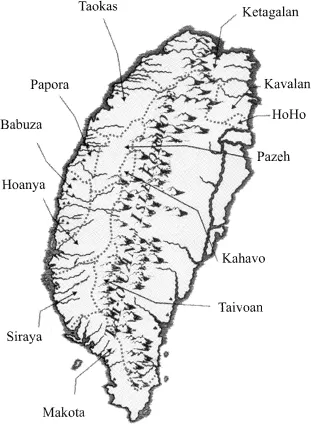
Figure 1. Traditional Territory of PingPu Peoples of Taiwan
Despite the many studies of PingPu peoples that have been done in recent years, little attention has been given to PingPu rights claim and identity, especially from sociolegal perspectives.4 A study on PingPu’s indigenous status recognition is important not only because it claims the Taiwanese indigenous population’s humanity, collective rights, and the right of self-identification, but also because it provides for a more comprehensive understanding, exploration, and analysis of identity-based movements as a fundamental form for collective human-rights claims.
Chapter Two
Theoretical Perspectives: The Contextualization of Human Rights and Identity-Based Movements
The discussion of indigenous rights, within the UN and worldwide, rests on a framework of debate that has taken place over the last few hundred years, and many of the aspects of the discussion are still relevant today. Rights are entitlements to a moral space in which human beings can live in dignity (Brugger 1996; Donnelly 1985, 1989; Forsythe 1995; Schwartz 1990) that can take negative and positive forms. Negative rights protect people against coercive interference in their affairs by others, with the objective of establishing and sustaining liberty and social freedom; while positive rights are claims on others to provide basic necessities with a goal to ensure human life and social welfare (Kothari and Sethi 1989; Preis 1996; Skogly 1993; Wellman 1985). Rights also have political and moral implications, both of which relate to indigenous peoples. Donnelly (1989) views legal entitlements as being protected and strengthened on two levels. First, legal claims are grounded as legal rights upon a particular political system that protects previously established legal entitlements. Secondly, moral claims are grounded by human rights upon a political system in order to reinforce or include current legal entitlements. This chapter raises several crucial issues concerning indigenous peoples’ rights, not only from a legal framework, but from a sociocultural philosophical view as well. Such perspectives focus on a particular moral vision of human dignity. The purpose of approaching rights in this way is to investigate and analyze the political rhetoric of indigenous peoples and governments.
THE LANGUAGE OF HUMAN RIGHTS
Jack Donnelly (1985) and many others claim that “rights terms,” such as human rights, social rights, and economic rights, are not clearly defined. Although the concept of rights is used very loosely, in their most fundamental sense, human rights are a special type of rights that are dominated by Western moral values. Therefore, the idea of human rights is often connected to Western philosophical traditions, especially natural law and rights principles. Natural law was considered the standard against which all other law was to be judged. To contest the injustice of a man-made law, one could appeal to the higher authority of the Divine or natural law. Natural law came to be dominated by the analysis of natural rights. The former provided a basis for curbing excessive state power, while the latter offered a means by which an individual could press claims against the government (e.g., liberal tradition theorists such as Hobbes, Locke, Rousseau, and Mill). The philosophic and ideological claims were accompanied by radical socioeconomic transformations and changing societal values during the 17th and 18th centuries. For example, Western Europe’s communal bonds of feudalism had collapsed, and extended family ties were corrupted by the Industrial Revolution (e.g., urbanization and mechanization). A capitalist system came into existence and a new industrial class rebelled against the constraints of governments, demanding political participation and freedoms, and arguing for the ethic of social contract (An-Na’im 1992; Barnet and Cavanagh, 1994; Bay 1990; Carothers 1996; Cohen 1996; Forsythe 1995).
In the U.S. new land was being settled and the philosophic doctrines of the autonomous individual and inherent rights were assimilated, both as an explanation of and a justification for the new social order. The conceptualization of natural rights took firm root in the 17th and 18th centuries, beginning with the English Petition of Rights of 1627, the American Declaration of Independence of 1776, the United States Constitution of 1787, the French Declaration of the Rights of Man and Citizen of 1789, and the American Bill of Rights of 1791. Among these, the American Declaration of Independence is frequently referenced as the first modern declaration of the human rights of men (white men), and declared the rights of each person to:
“[d]issolve political bonds which have connected them with another, and to assume, among the powers of the earth, to separate and equal station to which the laws and nature’s God entitle them.”
Very clearly, such thoughts constitutionalized and institutionalized a Western standard of human rights and liberties that still exists today.
The Universal Declaration of Human Rights (UDHR), adopted by the UN General Assembly i...
Table of contents
- Cover
- Title Page
- Copyright Page
- Dedication
- Contents
- List of Figures
- List of Tables
- List of Abbreviations
- Declaration of the PingPu Peoples of Taiwan
- Acknowledgments
- Chapter One Introduction
- Chapter Two Theoretical Perspectives: The Contextualization of Human Rights and Identity-Based Movements
- Chapter Three Research Approaches
- Chapter Four Rights Analysis
- Chapter Five Historical Analysis
- Chapter Six Ethnographic Exploration of PingPu Peoples
- Chapter Seven Further Explorations of PingPu Identity, Rights, and Movement: Survey Results and Policy Discussion
- Chapter Eight Research Contributions, Implications, Recommendations, and Shortcomings
- Chapter Nine Conclusion and Reflections
- Appendix A In-Depth Interview Questions/Guidelines
- Appendix B Survey Questionnaire
- Appendix C Taipei Declaration on the Rights of Indigenous Peoples
- Notes
- References
- Index
Trusted by 375,005 students
Access to over 1.5 million titles for a fair monthly price.
Study more efficiently using our study tools.
Frequently asked questions
Yes, you can cancel anytime from the Subscription tab in your account settings on the Perlego website. Your subscription will stay active until the end of your current billing period. Learn how to cancel your subscription
No, books cannot be downloaded as external files, such as PDFs, for use outside of Perlego. However, you can download books within the Perlego app for offline reading on mobile or tablet. Learn how to download books offline
Perlego offers two plans: Essential and Complete
- Essential is ideal for learners and professionals who enjoy exploring a wide range of subjects. Access the Essential Library with 800,000+ trusted titles and best-sellers across business, personal growth, and the humanities. Includes unlimited reading time and Standard Read Aloud voice.
- Complete: Perfect for advanced learners and researchers needing full, unrestricted access. Unlock 1.5M+ books across hundreds of subjects, including academic and specialized titles. The Complete Plan also includes advanced features like Premium Read Aloud and Research Assistant.
We are an online textbook subscription service, where you can get access to an entire online library for less than the price of a single book per month. With over 1.5 million books across 990+ topics, we’ve got you covered! Learn about our mission
Look out for the read-aloud symbol on your next book to see if you can listen to it. The read-aloud tool reads text aloud for you, highlighting the text as it is being read. You can pause it, speed it up and slow it down. Learn more about Read Aloud
Yes! You can use the Perlego app on both iOS and Android devices to read anytime, anywhere — even offline. Perfect for commutes or when you’re on the go.
Please note we cannot support devices running on iOS 13 and Android 7 or earlier. Learn more about using the app
Please note we cannot support devices running on iOS 13 and Android 7 or earlier. Learn more about using the app
Yes, you can access Collective Rights of Indigenous Peoples by Jolan Hsieh in PDF and/or ePUB format, as well as other popular books in Social Sciences & Politics. We have over 1.5 million books available in our catalogue for you to explore.